01Facts
On 28.09.1982, the dead body of eight-year-old Kunta, niece of the first informant Ganga Saran, was found in Jagvir Singh's sugarcane field. Her undergarment was torn, and she showed signs of rape.
¶ 2–3The FIR alleged that the appellant, Brij Pal, had followed the victim after she delivered food to her father, Jai Deva, in the Mohan wali garden on 27.09.1982.
¶ 2Recoveries included the victim's undergarment, the appellant's pyjama and underwear bearing blood and semen stains, blood-stained soil, and Makka plant remains.
¶ 5The postmortem was conducted on 29.09.1982, and a medical examination of the appellant found no visible injury on his penis.
¶ 6PW-2 (Jai Deva) stated he saw the appellant following the victim.
¶ 9PW-3 (Sheesh Pal) stated he saw the appellant coming out of the sugarcane field, but this was disclosed only after the body was found.
¶ 10, 33PW-6 (Jagvir Singh) deposed that the appellant made an extra-judicial confession to him at around 2:00–2:30 a.m. on the night before the body was recovered.
¶ 13The chemical report on semen was inconclusive as to a match with the accused.
¶ 23Court witness Dr. J.D.S. Sharma assessed the appellant's age at 15–16 years.
¶ 19The Juvenile Justice Board found the appellant to be a juvenile at the time of the offence.
¶ 30The appellant denied the charges under Section 313 CrPC.
¶ 20The trial court (VIIth Additional Sessions Judge, Ghaziabad) convicted the appellant under Section 302 IPC (life imprisonment) and Section 376 IPC (10 years' RI), concurrently, on 18.05.1984.
¶ 102Issues
i.1. Whether the prosecution evidence, in the absence of any eyewitness or last-seen evidence linking the appellant with the victim, was sufficient to sustain convictions under Sections 302 and 376 IPC.
¶ 33ii.2. Whether an adverse inference could be drawn against the appellant for refusing to furnish a semen sample for comparison.
¶ 23–24, 35iii.3. Whether the blood and semen stains on the appellant's pyjama, and the extra-judicial confession, could connect the appellant to the offence.
¶ 34 · ¶ 13, 22, 32iv.4. Whether the appellant's juvenile status (age 15) rendered the alleged brutality implausible as his act.
¶ 30, 3503Law Applied
The court relied on Article 20(3) of the Constitution, which bars compelling an accused to be a witness against himself, holding that no adverse inference may be drawn from refusal to provide a bodily sample at the relevant time.
¶ 26, 35It referred to Section 53 CrPC, as amended by Act 25 of 2005 (effective 23.06.2006), which expanded "examination" to include semen and blood samples, and to Section 53A CrPC, which governs examination of persons accused of rape; the court treated these amendments as post-dating the offence.
¶ 28–29It noted the principles in Smt. Nandini Satpathy v. P.L. Dani, (1978) 2 SCC 424, on the privilege against self-incrimination and the protection of the accused's "private enclave".
¶ 25The court applied the general principle that a conviction must rest on proved evidence linking the accused to the crime, with the benefit of doubt going to the accused.
¶ 33–34The court also treated the juvenile status of the accused and the nature of the alleged brutality as relevant to plausibility.
¶ 35Provisions in the judgment · 11 · Linked ones open on LawLens
Indian Penal Code, 1860 Section 302Section 376Section 436Section 323
Code of Criminal Procedure, 1973 Section 107Section 117Section 313Section 160Section 53Section 54Section 173
04Reasoning
The court held that no eyewitness saw the incident and that no witness saw the appellant and victim together at the time of the offence.
¶ 33PW-2's testimony that the appellant "followed" the victim was discounted because both had gone to the same field to deliver food to their fathers, making such movement normal.
¶ 33PW-3's sighting of the appellant leaving the field was regarded as unreliable because it was first disclosed only after the body was found.
¶ 33On the forensic evidence, the court found that neither the blood on the pyjama nor the semen was linked to the victim's blood or to the semen on her body.
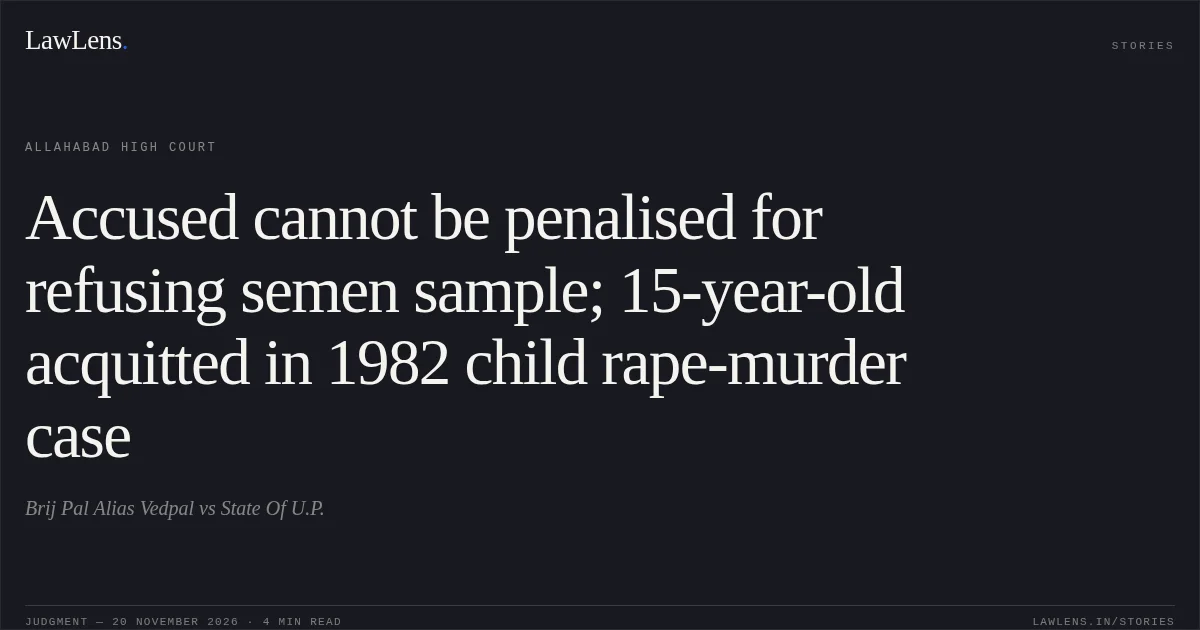
¶ 34The trial court's adverse inference from the refusal to give a semen sample was rejected because Article 20(3) prevented compelled self-incrimination.
¶ 35The court further relied on the appellant's age of about 15 years to conclude that the brutality shown on the body "could not be believably" committed by him.
¶ 35The judgment does not expressly analyse the extra-judicial confession before PW-6 despite it being argued by both sides.
¶ 13, 22, 3205Holding
The court held that the prosecution failed to establish the appellant's guilt beyond reasonable doubt. Since there was no direct, last-seen, or forensic link, and an adverse inference could not be drawn from refusal to give a semen sample under Article 20(3), the appellant was acquitted of the charges under Sections 302 and 376 IPC.
¶ 33–36The judgment and order dated 18.05.1984 of the VIIth Additional Sessions Judge, Ghaziabad, were set aside, the appeal was allowed, and the bail bonds were discharged.
¶ 36Original Court PDF
Brij Pal Alias VedpalvsState Of U.P.
Click to open original judgment
Original judgment, available to read, download and summarize on LawLens.in