01Facts
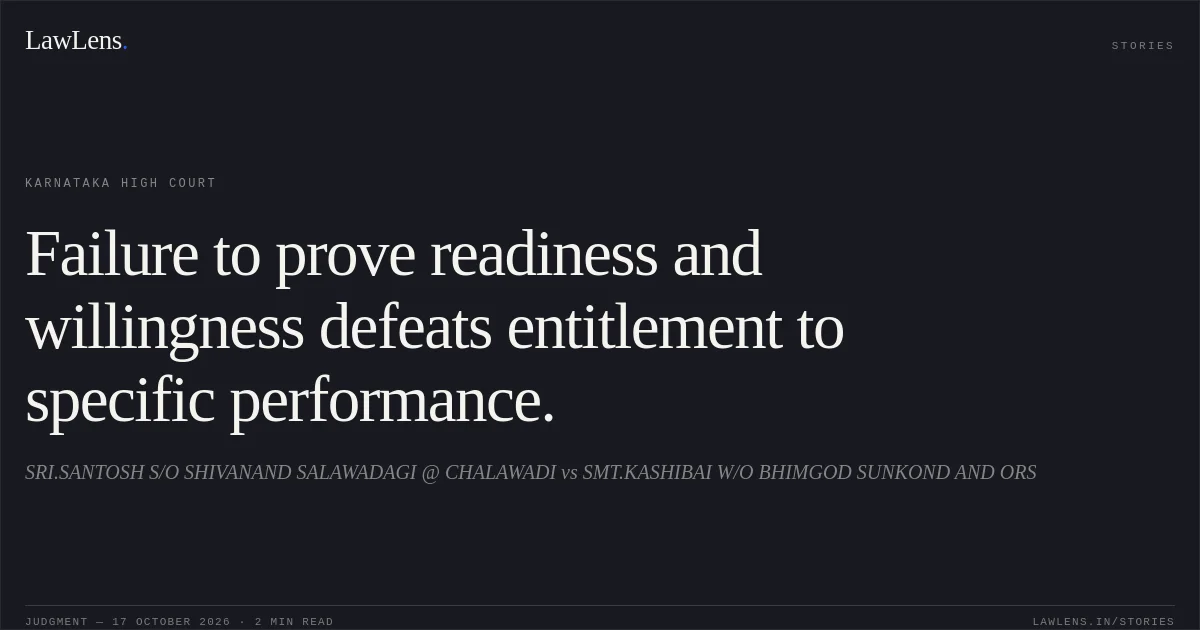
The plaintiff sued for specific performance of an agreement to sell agricultural land, alleging that he had paid ₹2,00,000 of the ₹2,27,500 consideration and that the defendants were required to rectify the revenue and survey records before completing the sale.
pp. 5–6, 23–24The Trial Court decreed specific performance, directing payment of the ₹27,500 balance and requiring the defendants to obtain the survey sketch and rectify the records.
pp. 5–6, 23–24The First Appellate Court upheld the findings that time was not of the essence and the suit was not time-barred, but set aside specific performance and directed refund of the advance with 10% interest, reasoning that delay and price escalation would cause hardship to the defendants.
pp. 25–27The plaintiff appealed under Section 100 CPC; the defendants did not appear in the High Court.
p. 2, 502Issues
i.1. Whether the First Appellate Court was justified in exercising its discretion against the plaintiff under Section 20 of the Specific Relief Act, 1963
p. 4ii.2. Whether the First Appellate Court could refuse specific performance and direct refund without recording a finding on comparative hardship, particularly in the absence of the defendants’ pleadings and evidence on hardship
p. 403Law Applied
Under the applicable version of Section 20 of the Specific Relief Act, 1963, specific performance was discretionary, but the discretion had to be exercised judicially and on established principles; the statutory grounds for refusing relief included unfair advantage, unforeseen hardship to the defendant, or inequitable circumstances.
pp. 28–29A defendant seeking to resist specific performance on hardship grounds must plead that hardship; the court should not entertain such a plea in the absence of the necessary pleading [Beemaneni Maha Lakshmi v. Gangumalla Appa Rao, (2019) 6 SCC 233].
pp. 29–31The High Court also relied on J.R. Shanmukhappa v. Jyotiba, RSA No. 100012/2017 (11 July 2023), for the proposition that price escalation alone does not justify refusing specific performance where hardship has neither been pleaded nor proved.
pp. 31–32Provisions in the judgment · 2 · Linked ones open on LawLens
Code of Civil Procedure, 1908 Section 100
Specific Relief Act, 1963 Section 20
04Reasoning
The defendants’ written statement contained no plea that specific performance would cause hardship, confer an unfair advantage on the plaintiff, or otherwise be inequitable; nor was hardship supported by evidence.
pp. 27–28, 32The First Appellate Court nevertheless relied on delay and escalation in prices to refuse relief, without a proper basis in the pleadings or evidence.
pp. 26–27, 32–33Further, the agreement placed on the defendants the obligation to obtain the survey sketch and rectify the revenue records before executing the sale deed. Their failure to perform that obligation could not be used to deny the plaintiff specific performance.
p. 33The High Court therefore held that the First Appellate Court’s exercise of discretion was legally unsustainable.
pp. 33–3405Holding
The High Court answered both substantial questions of law in the plaintiff’s favour, allowed the appeal, and set aside the First Appellate Court’s judgment and decree in R.A. No. 102/2009.
pp. 34–35It restored the Trial Court’s decree for specific performance in O.S. No. 138/2007, including the direction to pay the balance consideration and the defendants’ obligation to complete the required survey and revenue-record corrections before executing the sale deed.
pp. 23–24, 35Original Court PDF
SRI KEMPAIAHvsSMT G GANGABAI
Click to open original judgment
Original judgment, available to read, download and summarize on LawLens.in