01Facts
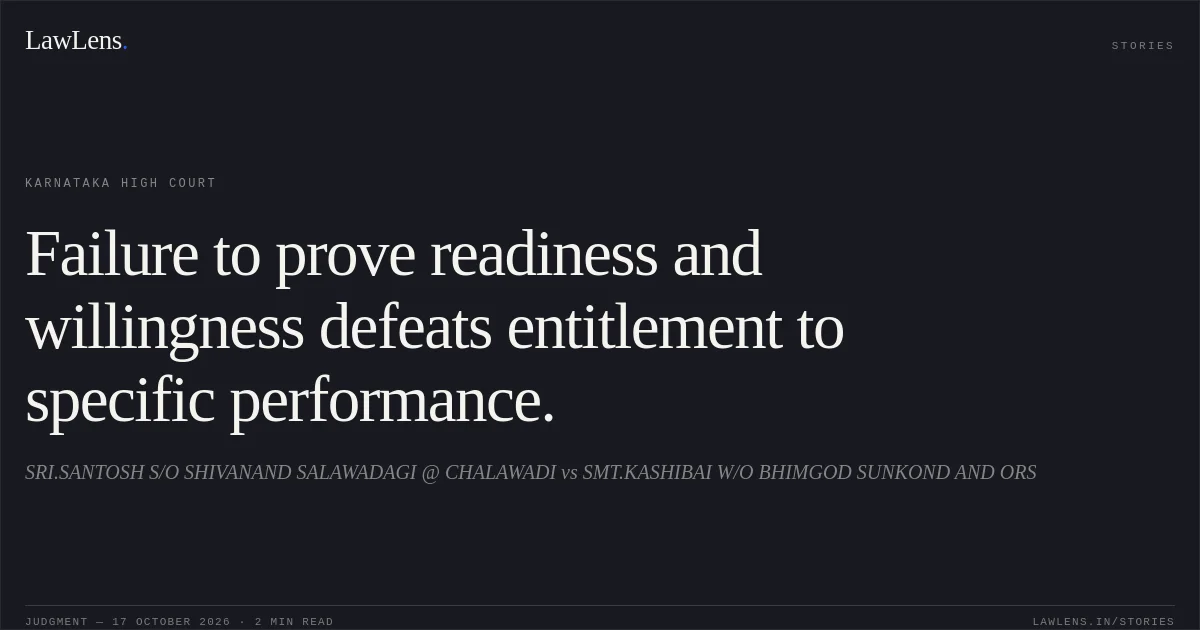
The plaintiff sued for specific performance, relying on a registered agreement dated 4 October 2007 that recorded payment of ₹5,80,000 towards a sale price of ₹6,00,000, with the balance payable within one month.
pp. 4–12The defendants maintained that the document secured a loan of ₹1,00,000.
pp. 4–12The trial court decreed specific performance, but the First Appellate Court reversed that decree, finding the plaintiff had not established readiness and willingness; it instead ordered repayment of ₹1,00,000 with interest.
pp. 4–12The plaintiff appealed under Section 100 CPC.
¶ 4–8, 12–16 · pp. 4–1202Issues
i.1. Whether the First Appellate Court erred in appreciating the plaintiff’s evidence, particularly Exhibit P1, the registered sale agreement
¶ 23 · p. 17ii.2. Whether the First Appellate Court’s findings were perverse in its assessment of the evidence in the specific-performance suit
¶ 23 · p. 1703Law Applied
Section 16(c) of the Specific Relief Act, 1963 requires a plaintiff seeking specific performance to aver and prove performance, or continuous readiness and willingness to perform, the essential contractual obligations; where payment is required, actual tender or deposit is not necessary unless directed by the court, but readiness and willingness must be shown according to the contract’s true construction.
¶ 18 and footnote · pp. 13–14The Court relied on Pydi Ramana @ Ramulu v. Devarasety Manmadhar Rao for the distinction between “readiness” (capacity, including financial ability, to perform) and “willingness” (conduct), and for the need to establish conduct consistent with performance.
¶ 33 · pp. 21–24It also referred to Kalawati (dead) through LRs v. Rakesh Kumar on the denial of specific performance where the claimant is unable to perform the payment obligation.
¶ 36 · p. 25Provisions in the judgment · 4 · Linked ones open on LawLens
Code of Civil Procedure, 1908 Section 100Section 47Section 48
Specific Relief Act, 1963 Section 16
04Reasoning
The agreement required completion within one month, but the plaintiff produced no evidence of efforts to tender the balance or otherwise pursue completion between the contractual deadline and the legal notice issued on 23 September 2010.
¶ 32–37 · pp. 21–26The Court therefore upheld the finding that the plaintiff had not proved continuous readiness and willingness, making specific performance unavailable.
¶ 32–37 · pp. 21–26However, the registered agreement recorded receipt of ₹5,80,000, whereas the First Appellate Court had ordered repayment of only ₹1,00,000.
¶ 41–42 · p. 27The Court held that the refund award was contrary to Exhibit P1’s recital and modified it accordingly.
¶ 41–42 · p. 2705Holding
The Court answered the first substantial question of law in the negative and the second partly in the affirmative.
¶ 43 · p. 28It partly allowed the appeal, modified the First Appellate Court’s decree, and awarded the plaintiff a refund of ₹5,80,000 with interest at 6% per annum from 4 October 2007 until realization, payable within two months; failing payment, the plaintiff may recover the amount in accordance with law.
¶ 44 · pp. 28–29No order was made as to costs.
¶ 44 · pp. 28–29Original Court PDF
SRI.SANTOSH S/O SHIVANAND SALAWADAGI @ CHALAWADIvsSMT.KASHIBAI W/O BHIMGOD SUNKOND AND ORS
Click to open original judgment
Original judgment, available to read, download and summarize on LawLens.in