01Facts
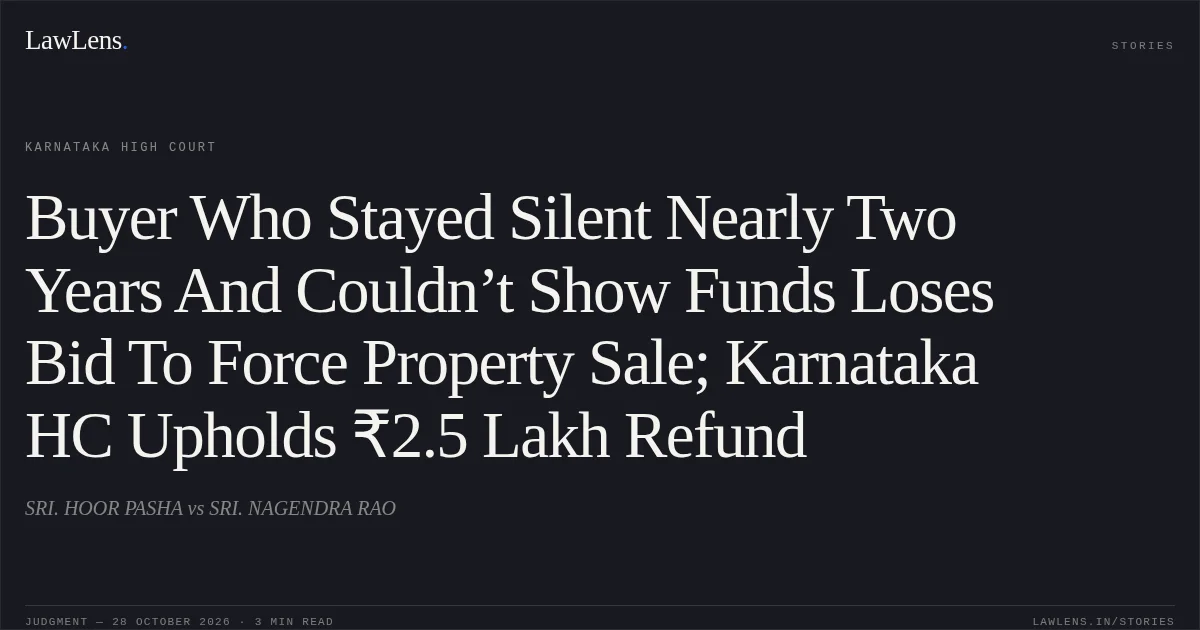
The plaintiff sued for specific performance of a registered sale agreement dated 8 June 2011, under which the defendants agreed to sell the suit property for ₹7,50,000 and acknowledged receipt of ₹2,50,000 as advance.
pp. 6, 32–33The agreement did not fix a completion date and required the defendants to obtain a survey sketch and other records.
pp. 6, 32–33The trial court found execution of the agreement and payment proved, but rejected specific performance for want of proof of readiness and willingness and on comparative-hardship grounds; it instead ordered refund of ₹2,50,000 with interest at 6% per annum from the date of suit.
pp. 9, 28–30The plaintiff’s appeal challenging refusal of specific performance was dismissed, and the refund decree was not challenged.
pp. 9, 28–30In the second appeal, the High Court noted that the plaintiff had not shown steps to perform the contract between the agreement and his first notice of 26 July 2013, or produced evidence of funds or capacity to raise the balance consideration.
pp. 42, 50–5102Issues
i.1. Whether the courts below erred in finding that the plaintiff had not continuously proved readiness and willingness to perform his part of the agreement, as required for specific performance
pp. 42–43, 50–52ii.2. Whether the concurrent refusal of specific performance raised a substantial question of law warranting interference under Section 100 CPC
pp. 52–5403Law Applied
Section 16(c) of the Specific Relief Act, 1963, as applicable to the transaction, requires a plaintiff seeking specific performance to plead and prove continuous readiness and willingness to perform the essential terms of the contract.
pp. 43–50Readiness concerns financial capacity; willingness is assessed from the plaintiff’s conduct and intention.
pp. 43–50The requirement continues from the agreement through the relevant proceedings, and the plaintiff must establish the availability of the balance consideration or the capacity to arrange it.
pp. 43–50Specific performance is an equitable and discretionary remedy; under Section 20, as referred to in the judgment, it is not granted merely because a valid agreement is proved.
pp. 43–50The Court relied on the Supreme Court’s discussion in Mohd Khaleel (D) through LRs. & Ors. v. Jayamma, 2026 INSC 651, and the principles in N.P. Thirugnanam v. Dr. R. Jagan Mohan Rao concerning continuous readiness and willingness and proof of financial capacity.
pp. 43–50Under Section 100 CPC, a second appeal does not warrant interference with concurrent factual findings absent a substantial question of law.
pp. 52–54Provisions in the judgment · 10 · Linked ones open on LawLens
Code of Civil Procedure, 1908 Section 100
Specific Relief Act, 1963 Section 10Section 12Section 16Section 17Section 18Section 19Section 20
Limitation Act, 1963 Section 54
KARNATAKA LAND REFORMS ACT, 1961 Section 79
04Reasoning
The agreement’s lack of a fixed completion date and its provision that the defendants obtain the survey sketch did not relieve the plaintiff of his independent obligation to prove readiness and willingness.
pp. 13–14, 33–34The plaintiff remained inactive for about two years before issuing the first notice, and, after receiving the defendants’ denial, did not promptly take further action; his assertion that he had made personal requests was unsupported by evidence.
pp. 13–14, 33–34He also produced no reliable evidence that he had the ₹5,00,000 balance consideration or could arrange it.
pp. 42, 50–52The defendants’ reciprocal obligation to obtain documents could not, without such proof, establish the plaintiff’s readiness.
pp. 42, 50–52The High Court further found that the trial and first appellate courts had assessed the evidence and comparative hardship, and that the plaintiff’s challenge disclosed no substantial question of law.
pp. 52–5405Holding
The High Court held that the plaintiff failed to prove continuous readiness and willingness and was not entitled to specific performance.
pp. 53–54Finding no substantial question of law, it dismissed the second appeal and confirmed the concurrent judgments.
pp. 53–54The unchallenged decree for refund of ₹2,50,000 with 6% annual interest remained in force; the trial-court registry was directed to release the deposited sum of ₹3,83,750 to the plaintiff.
pp. 53–54Original Court PDF
SRI. HOOR PASHAvsSRI. NAGENDRA RAO
Click to open original judgment
Original judgment, available to read, download and summarize on LawLens.in