01Facts
Respondent No. 1 was a subscriber to two chits conducted by the appellant and also stood as surety for two other chit subscribers who defaulted.
¶ 2The appellant sought to apply funds standing to respondent No. 1’s credit towards the defaulters’ dues.
¶ 2Respondent No. 1 disputed recovery beyond one-sixth of the dues, contending that there were five other co-sureties.
¶ 2–7The Deputy Registrar directed the appellant to pay respondent No. 1 ₹8,18,763 with interest; the Joint Registrar dismissed the appellant’s appeal, and the learned Single Judge dismissed its writ petition.
¶ 2–7The appellant appealed, asserting a right to recover the defaulters’ dues from the attached funds.
¶ 2–702Issues
i.1. Whether a surety’s liability to the creditor is limited to an equal share under Section 146 of the Indian Contract Act, 1872, where there are co-sureties.
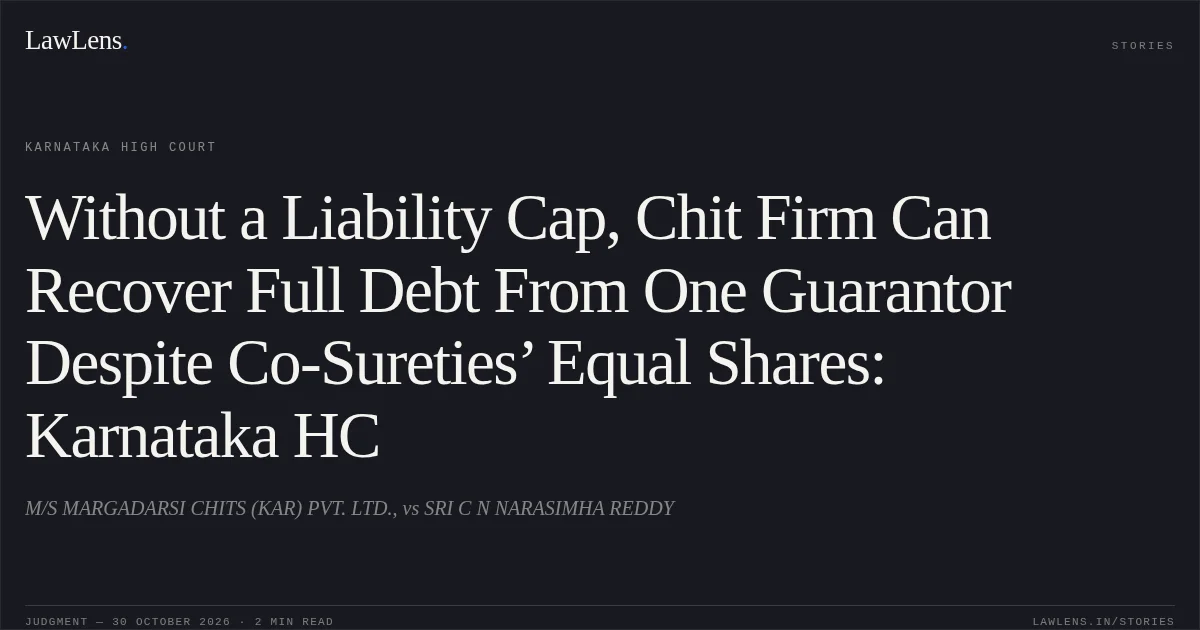
¶ 8, 18–19ii.2. Whether the creditor may recover the entire debt from any one surety, without first proceeding against the principal debtor or other co-sureties.
¶ 10–1703Law Applied
Section 128 of the Indian Contract Act, 1872 provides that a surety’s liability is co-extensive with that of the principal debtor, unless the contract provides otherwise.
¶ 12Under Bank of Bihar Ltd. v. Damodar Prasad, a surety’s liability is immediate, and the creditor need not first exhaust remedies against the principal debtor.
¶ 13–14The Court relied on State Bank of India v. Indexport Registered for the principle that the creditor may proceed against the principal debtor, a surety, or both, without first exhausting remedies against the principal debtor.
¶ 15–16Section 146 provides for equal contribution among co-sureties “as between themselves”; it does not limit a surety’s liability to the creditor.
¶ 19A surety who pays more than their share may seek contribution from co-sureties.
¶ 19Provisions in the judgment · 4 · Linked ones open on LawLens
KARNATAKA HIGH COURT ACT, 1961 Section 4
Chit Funds Act, 1982 Section 64
Indian Contract Act, 1872 Section 128Section 146
04Reasoning
The guarantee agreements contained no term limiting respondent No. 1’s liability to one-sixth of the debt.
¶ 10–17Applying Section 128, the Court held that each surety’s liability to the creditor was co-extensive with the principal debtors’ liability, and the appellant could proceed against any or all of the sureties without first pursuing the principal debtors or other sureties.
¶ 10–17Section 146 did not support respondent No. 1’s defence because its equal-sharing rule governs contribution among co-sureties, not the creditor’s right of recovery.
¶ 18–19Any surety who paid more than their proportionate share could pursue contribution from the others.
¶ 18–1905Holding
The Court held that Section 146 did not restrict the appellant’s right to recover the debt from respondent No. 1, whose liability was not contractually limited.
¶ 20It allowed the appeal, set aside the learned Single Judge’s order, and disposed of the pending interlocutory application.
¶ 20Original Court PDF
M/S MARGADARSI CHITS (KAR) PVT. LTD.,vsSRI C N NARASIMHA REDDY
Click to open original judgment
Original judgment, available to read, download and summarize on LawLens.in