01Facts
The plaintiffs (five daughters of Rangappa through his second wife, Nanjamma) sued for partition and separate possession of seven items of property, claiming 5/7 share as coparceners.
p. 3Defendant No.1 (Omkarappa), son of Rangappa's first wife, claimed Item No.2 (Sy. No. 90/4), Items 5 and 6 as self-acquired property (by sale deed dated 18.01.1979 and gift deed dated 20.02.1957), and pleaded an oral family partition.
pp. 3-4Defendant No.2 (Basavarajappa) did not file a written statement.
p. 6The Trial Court held that Items 1, 3, 4, 7 and Sy. No. 90/5 (Item 2) were joint family properties, that Sy. No. 90/4 and Items 5 and 6 were Defendant No.1's separate property, that oral partition was unproved and legally unrecognised, and decreed a 1/7 share to each plaintiff in the joint properties.
pp. 5, 9-21The plaintiffs accepted the dismissal of their claim to Sy. No. 90/4 and Items 5 and 6 and did not appeal.
pp. 4-5Defendant No.1 appealed (R.A. No. 13/2014), and the First Appellate Court reduced the plaintiffs' share to 1/21, relying on Prakash v. Phulavati.
pp. 21-22Only the plaintiffs appealed to the High Court.
p. 2202Issues
i.1. Whether the First Appellate Court was justified in reversing the Trial Court's decree, following Prakash v. Phulavati, when that judgment was partly overruled by Vineeta Sharma v. Rakesh Sharma.
p. 23ii.2. Whether the plaintiffs, as daughters, are entitled to an equal (1/7) coparcenary share in Items 1, 3, 4, 7 and Sy. No. 90/5 under amended Section 6 of the Hindu Succession Act, 1956, notwithstanding Defendant No.1's plea of oral partition.
pp. 11-12, 18-19, 23-2403Law Applied
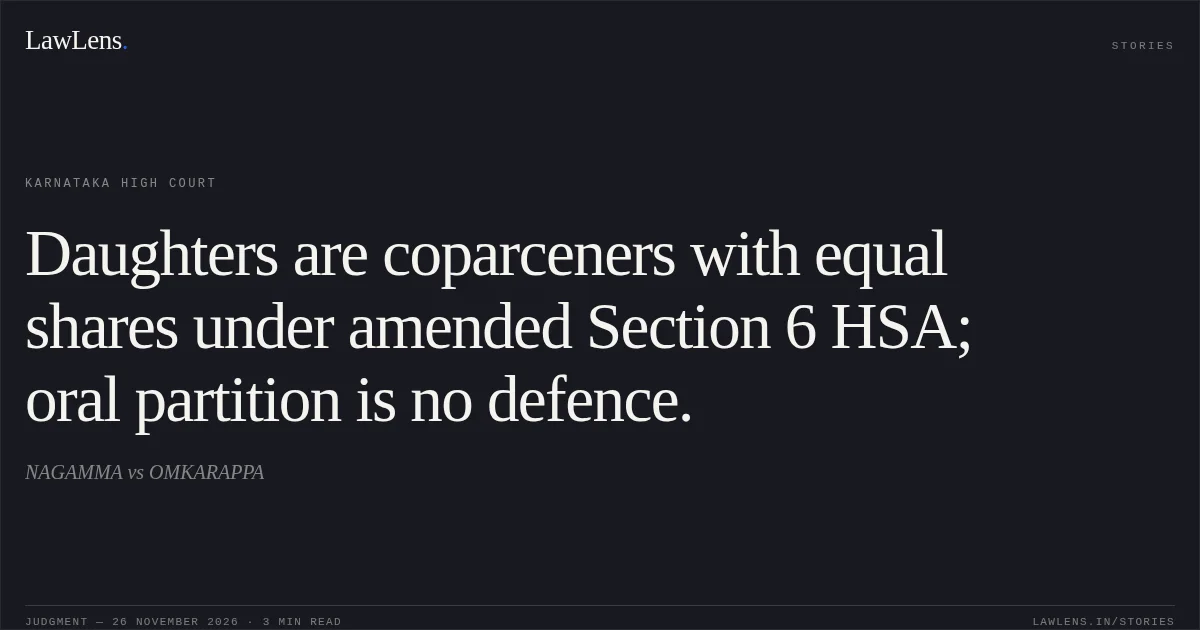
The Court applied Section 6 of the Hindu Succession Act, 1956, as substituted by the 2005 Amendment, which confers coparcenary status on daughters with the same rights and liabilities as sons.
pp. 24-25Vineeta Sharma v. Rakesh Sharma (2020) 9 SCC 1 holds that the daughter's right applies to daughters born before or after the amendment, that the statutory partition fiction under the proviso to Section 6 does not effect actual partition, and that oral partition is not a recognised mode of partition under the Explanation to Section 6(5) save in exceptional cases supported by public documents; Prakash v. Phulavati (2016) 2 SCC 36 was overruled to that extent.
pp. 24-26The Explanation to Section 6(5) regarding the mode of partition (registered deed or decree) was referred to.
pp. 11-12Property received by gift from a coparcener's own father in a prior family partition is separate property.
pp. 13-15Provisions in the judgment · 3 · Linked ones open on LawLens
Code of Civil Procedure, 1908 Section 100Section 54
Hindu Succession Act, 1956 Section 6
04Reasoning
The First Appellate Court's reduction of the plaintiffs' share to 1/21 rested on Prakash, which the larger bench in Vineeta Sharma has since overruled.
pp. 22-23The plaintiffs' claims to Sy. No. 90/4 and Items 5 and 6 had been finally rejected and were not before the Court, so the only question was the share in the joint family properties.
pp. 23-24Applying Vineeta Sharma, the plaintiffs, as daughters of Rangappa, are coparceners with equal rights to Defendant Nos. 1 and 2.
p. 26Since Rangappa had five daughters and two sons, each of the seven heirs takes 1/7.
p. 26The defendants' oral partition plea was not a recognised mode of partition under Section 6(5), and the Trial Court had already found it unproved.
pp. 18-19The First Appellate Court's 1/21 apportionment was therefore unsustainable.
p. 2605Holding
The Court answered the substantial question of law in favour of the plaintiffs, holding that the First Appellate Court was not justified in reversing the Trial Court following Prakash, which had been overruled by Vineeta Sharma.
p. 26The appeal was allowed. The First Appellate Court's declaration of a 1/21 share was set aside, and the Trial Court's judgment and decree dated 03.01.2014 in O.S. No. 52/2010 was restored for Items 1, 3, 4, 7 and Sy. No. 90/5. The plaintiffs and Defendant Nos. 1 and 2 were each declared entitled to a 1/7 share in those properties, the suit regarding Sy. No. 90/4 and Items 5 and 6 remained dismissed, and a decree was ordered to be drawn up.
p. 27Original Court PDF
NAGAMMAvsOMKARAPPA
Click to open original judgment
Original judgment, available to read, download and summarize on LawLens.in