01Facts
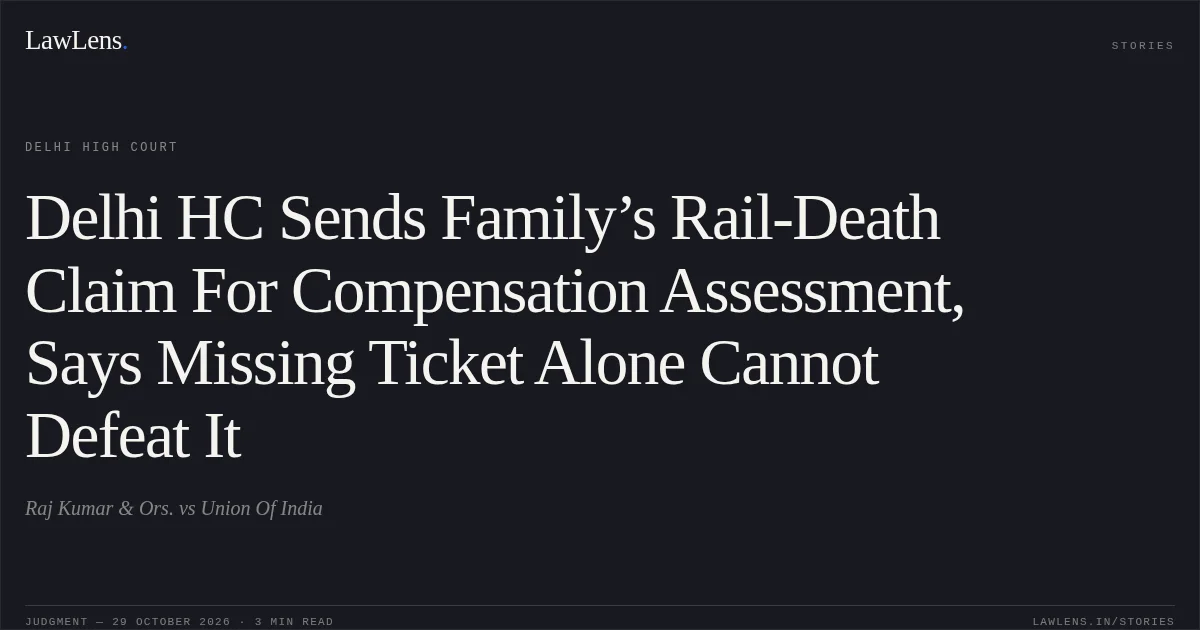
The appellants, the deceased Rajendra Singh’s children, claimed compensation under the Railways Act, 1989, alleging that on 21 September 2018 he was travelling with a valid ticket from Ghaziabad to Maripat and accidentally fell from a passenger train.
pp. 2, paras 2–3The Railway Claims Tribunal dismissed the claim, relying on the non-recovery of a ticket and a DRM inquiry report concluding that the deceased had been run over while crossing the track. The appellants challenged that decision under Section 23 of the Railway Claims Tribunal Act, 1987.
p. 2, para 3 · p. 1, para 102Issues
i.Whether the deceased was a bona fide passenger at the time of the occurrence
pp. 3, paras 7–9ii.Whether his death resulted from an “untoward incident” within the meaning of the Railways Act, 1989
p. 3, para 7 · p. 4, para 1003Law Applied
Section 123(c)(2) of the Railways Act, 1989 includes the accidental falling of a passenger from a train carrying passengers within the definition of an “untoward incident”; Section 124-A provides for compensation on a no-fault basis, subject to statutory exceptions.
p. 4, para 10Under Union of India v. Rina Devi, the claimant’s initial burden to establish bona fide passenger status is not onerous and, once relevant facts and circumstances are shown, the burden shifts to the Railways to rebut the claim with cogent evidence; the judgment also cites Lata v. Union of India and Sukhabhai Nanjibhai Makwana & Anr. v. Union of India in support.
p. 3, para 8A body’s location or injuries alone do not conclusively establish that the deceased was crossing the track, and the evidentiary weight of a delayed DRM inquiry must be assessed in light of its basis and circumstances.
pp. 5–7, paras 12–14Provisions in the judgment · 2 · Linked ones open on LawLens
Railway Claims Tribunal Act, 1987 Section 23
Railways Act, 1989 Section 123
04Reasoning
The deceased’s son testified that his father was travelling for work and had purchased a valid ticket; the ticket’s non-recovery, without more, did not disprove bona fide passenger status.
p. 4, para 9The gateman’s memo, panchnama and post-mortem report established recovery of the body and fatal injuries, but did not establish that the deceased was crossing the track rather than having fallen from a train.
pp. 5–6, paras 11–13The DRM inquiry began more than five years after the incident and after the claim was filed, diminishing the basis for treating its conclusion as decisive.
pp. 6–7, para 14On the evidence as a whole, the Tribunal had given undue weight to the missing ticket and the inference of a run-over, neither of which independently established that the deceased was crossing the track.
p. 7, para 1505Holding
The Court set aside the Tribunal’s judgment and allowed the appeal.
p. 7, para 16It remanded the matter to the Tribunal to assess the compensation payable in accordance with law and directed the authorities concerned to disburse it within two months of receiving the order; the matter was listed before the Tribunal on 18 March 2027.
p. 8, para 17Original Court PDF
Devdutt & Ors.vsUnion Of India
Click to open original judgment
Original judgment, available to read, download and summarize on LawLens.in