01Facts
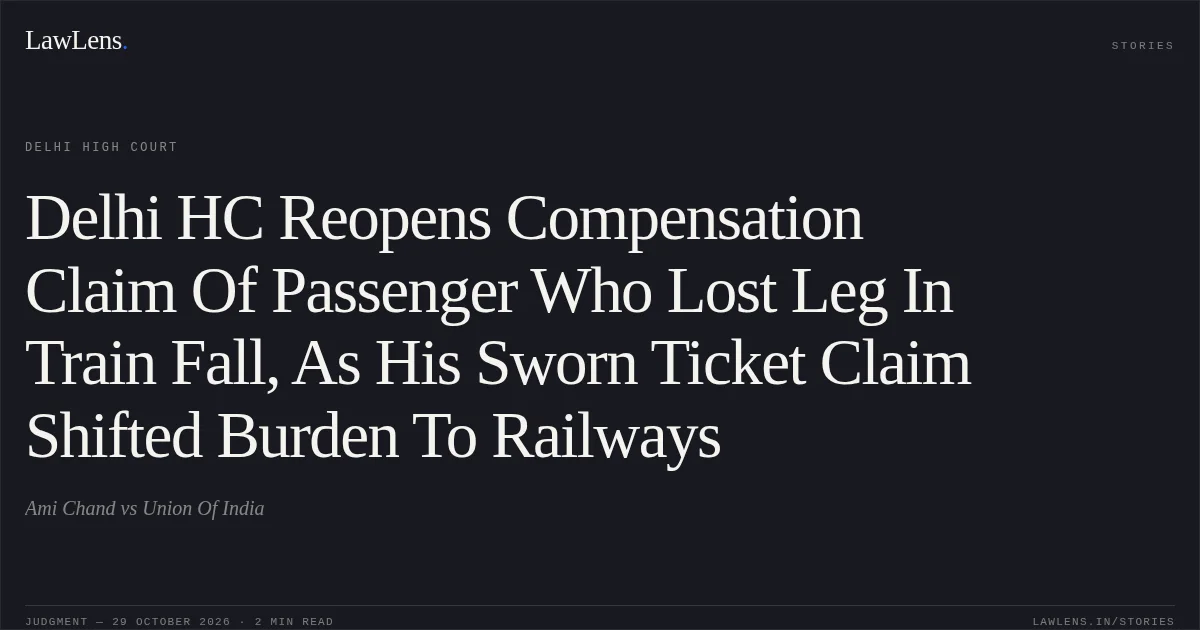
The appellant claimed that she had purchased a second-class ticket from Aligarh to Etawah but inadvertently boarded the Mahabodhi Express.
p. 2She alleged that ticket-checking staff took her ticket and that she was pushed from the moving train at Shikohabad, sustaining serious injuries, including the eventual amputation of her left leg.
p. 2 · p. 5The Railway Claims Tribunal dismissed her compensation claim, finding that she had not established bona fide passenger status and had probably jumped from the train.
p. 2She appealed under Section 23 of the Railway Claims Tribunal Act, 1987.
p. 102Issues
i.1. Whether the Tribunal was justified in finding that the appellant had failed to establish that she was a bona fide passenger, notwithstanding the non-recovery of her ticket.
p. 3 · p. 4 · ¶ 6ii.2. Whether the appellant’s injuries resulted from an “untoward incident” under the Railways Act, 1989, or from conduct attracting the statutory exception for self-inflicted injury.
p. 4 · p. 6 · ¶ 6 · ¶ 10–1403Law Applied
Section 2(29) of the Railways Act, 1989 defines a passenger as a person travelling with a valid pass or ticket.
p. 3 · ¶ 7Under Union of India v. Rina Devi, (2019) 3 SCC 572, absence of a ticket does not, by itself, disprove bona fide passenger status: the claimant must first establish the relevant facts and circumstances, after which the burden shifts to the Railways to rebut the claim.
p. 4 · ¶ 8The judgment also relied on Lata v. Union of India, 2026 SCC OnLine SC 1350, and Sukhabhai Nanjibhai Makwana & Anr. v. Union of India, 2026 INSC 1056, as reiterating that principle.
p. 4 · ¶ 8Section 123(c)(2) includes the accidental falling of a passenger from a train as an “untoward incident,” while Section 124-A provides for no-fault compensation, subject to its statutory exceptions.
p. 5 · ¶ 10Negligent or imprudent conduct alone does not establish self-inflicted injury; the circumstances necessary to invoke the exception must be shown.
p. 6 · ¶ 14Provisions in the judgment · 3 · Linked ones open on LawLens
Railway Claims Tribunal Act, 1987 Section 23
Railways Act, 1989 Section 2Section 123
04Reasoning
The appellant’s account that she had bought a ticket and that it was taken by railway staff could not be rejected solely because no ticket was recovered.
p. 4 · p. 5 · ¶ 9The Tribunal therefore erred in treating the ticket’s absence as conclusive against bona fide passenger status.
p. 4 · p. 5 · ¶ 9Railway records contemporaneously recorded that a woman had fallen from the train, and the Train Manager’s statement and medical evidence corroborated the fall and the severity of her injuries.
p. 5 · ¶ 11 · p. 6 · ¶ 12Those records did not establish that she had deliberately jumped.
p. 5 · ¶ 11 · p. 6 · ¶ 12The Tribunal’s inference of a deliberate jump, based principally on the missing ticket and the circumstances of boarding, was insufficient to establish self-inflicted injury; the fact of a fall had to be distinguished from the disputed inference about how it occurred.
p. 6 · ¶ 13–1405Holding
The High Court set aside the Tribunal’s judgment and allowed the appeal.
p. 6 · ¶ 15It remanded the matter to the Tribunal to assess compensation in accordance with law and directed that the amount be disbursed within two months of receipt of the order.
p. 6 · ¶ 15 · p. 7 · ¶ 16The matter was listed before the Tribunal on 18 March 2027.
p. 7 · ¶ 16Original Court PDF
Rani DevivsUnion Of India
Click to open original judgment
Original judgment, available to read, download and summarize on LawLens.in