01Facts
The appellant-claimant, a pillion rider on motorcycle KA-29-Y-9208, was injured on 16.01.2017 when a motorcycle (KA-03-HN/4998) coming from the opposite direction, allegedly ridden rashly, went onto the wrong side of the road.
¶ 4(ii)He claimed Rs.50,90,000 as compensation, alleging a monthly income of Rs.15,000 from skilled private work, Rs.4,00,000 per year from agriculture, and permanent physical impairment.
¶ 4(i), 4(iii)The Tribunal (MACT-III, Vijayapura, MVC No. 934/2017) awarded Rs.2,30,000 with 7.5% interest, fastening liability on National Insurance Co. Ltd.
¶ 9The Tribunal assessed whole-body disability at 4% and notional income at Rs.10,250 per month.
¶ 17, 60The treating-level doctor (PW3) assessed the left lower limb disability at 22–24%.
¶ 17, 19–20Five fractures were sustained.
¶ 17X-rays Ex. P13 and P17 showed a femur fracture treated with implants still in situ.
¶ 54The insurer filed no cross-objections.
¶ 19The appellant was treated as an inpatient for eight days.
¶ 6602Issues
i.1. Whether the Tribunal's assessment of 4% whole-body disability, which was unreasoned and contrary to the medical evidence, warrants interference.
¶ 15, 17–18, 55ii.2. Whether the appellant is entitled to a higher assessment of permanent disability, and, if so, at what percentage.
¶ 55–56iii.3. Whether the appellant is entitled to an addition for future prospects, notwithstanding that the disability is below 30%.
¶ 57–59iv.4. Whether the Tribunal's notional income of Rs.10,250 per month is sustainable in the absence of proof of income.
¶ 60v.5. Whether the remaining heads of compensation (laid-up period, attendant charges, loss of amenities, medical expenses) require enhancement.
¶ 64–6703Law Applied
The appeal is maintained under Section 173(1) of the Motor Vehicles Act, 1988.
p. 2Disability is assessed under the Ministry of Social Justice and Empowerment Gazette Notification (2001), framed on the DGHS Committee's recommendations, which requires evaluation of nine coordinated lower-limb activities and ten upper-limb activities, graded muscle strength (Grade 5 normal, Grade 4 equals 20% joint disability, multiplied by 0.30 for three principal joints), and comparison with the healthy limb as benchmark.
¶ 24–30A claimant's unchallenged sworn testimony on residual difficulties must be accepted absent contrary evidence.
¶ 52Future prospects are governed by National Insurance Co. Ltd. v. Pranay Sethi, (2017) 16 SCC 680, which provides a 40% addition for self-employed or fixed-income claimants below 40 years.
¶ 61No Supreme Court or High Court authority prescribes a 30% whole-body disability threshold for future prospects.
¶ 59Two Division Bench decisions of the High Court hold that no interest is payable on the future-prospects component.
¶ 59A multiplier of 18 is applied for the claimant's age.
¶ 61Provisions in the judgment · 1 · Linked ones open on LawLens
Motor Vehicles Act, 1988 Section 173
04Reasoning
The court held that PW3's evidence was credible. The insurer's cross-examination put only general suggestions and did not dispute the claimant's reported difficulties, so the testimony remained unchallenged.
¶ 52PW3's admission that he had not treated the claimant did not undermine his assessment, because the X-ray evidence corroborated the implants and fracture.
¶ 53–54The court applied the Gazette methodology, which accounted for restricted hip and knee movements, the five functional limitations (15%), and the muscle-power deficit (6%), and found the 22–24% assessment consistent with it.
¶ 22–23, 29–51Because the Tribunal gave no reasoning for its 4% finding, the court reassessed whole-body disability at 10%.
¶ 55, 56On future prospects, the court rejected the insurer's 30% threshold argument because no authority supports it. It applied the 40% addition under Pranay Sethi and excluded interest on that portion, following the Division Bench authority.
¶ 59, 61, 63The court accepted the Tribunal's notional income because the claimant produced no proof of Rs.15,000 salary or agricultural income.
¶ 60Income for the laid-up period was enhanced to two months' income, and attendant, conveyance, nourishment and amenities compensation was enhanced for the eight-day inpatient stay.
¶ 66–67Medical expenses were maintained because no further bills were produced. The pain and suffering award was maintained.
¶ 64, 65Applying the Gazette-based 10% disability to Rs.14,350 × 12 × 18 × 10% gives Rs.3,09,960 for loss of future earning capacity, of which Rs.88,560 is the future-prospects component.
¶ 61–6305Holding
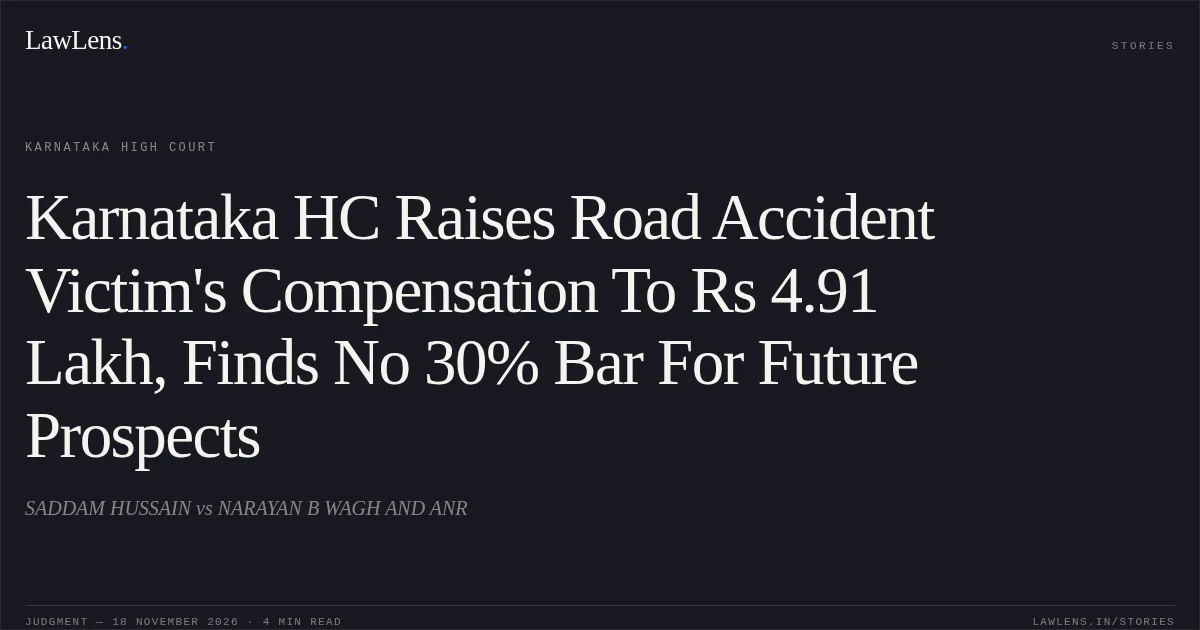
The Tribunal's 4% whole-body disability finding is unsustainable. Whole-body disability is assessed at 10%, the 40% future-prospects addition applies, and compensation is enhanced from Rs.2,30,000 to Rs.4,91,500.
¶ 56, 61–68The appeal is allowed in part. The insurer (Respondent No. 2) must deposit the enhanced amount within six weeks of receiving the certified copy, with release as per the Tribunal's order.
¶ 69, Order vi–viiInterest at 6% per annum runs from the claim petition date until realization.
¶ 69, Order iiiNo interest is payable on the Rs.88,560 future-prospects component or on the enhancement for the 204-day delay in filing the appeal.
¶ 69, Order iv–vOriginal Court PDF
SADDAM HUSSAINvsNARAYAN B WAGH AND ANR
Click to open original judgment
Original judgment, available to read, download and summarize on LawLens.in