01Facts
The respondent-plaintiff sued for declaration of title and permanent injunction in relation to the suit schedule property in O.S. No. 53/2012. After contest, the trial court decreed the suit in his favour.
p. 3The judgment states the decree date as 27.08.2018, while the cover page records it as 27.02.2018.
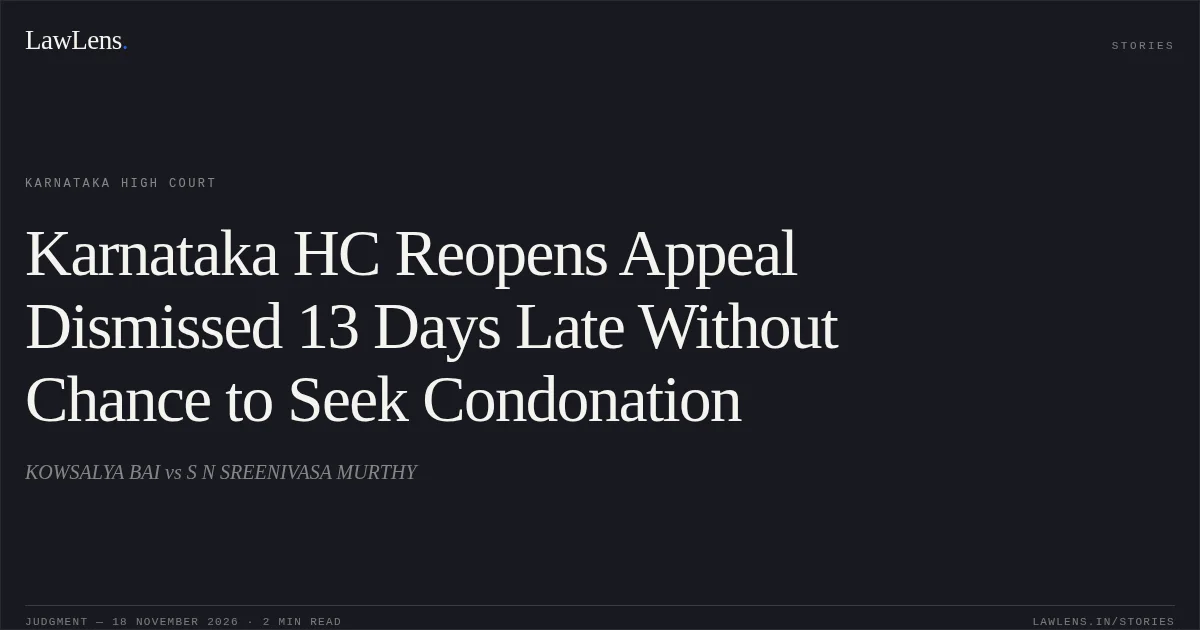
p. 3 · p. 2The appellants (defendants) appealed in R.A. No. 9/2018 with a delay of 13 days.
p. 3The First Appellate Court dismissed the appeal as barred by limitation, by judgment dated 16.01.2019.
p. 2No application under Section 5 of the Limitation Act was filed to condone the delay, which the parties accept as undisputed.
p. 5, para 4The appellants contend the delay arose from bona fide reasons, unavoidable circumstances and sufficient cause.
p. 5, para 2 · p. 6, para 4The respondent does not object to remand, but seeks the right to oppose any condonation application.
p. 5, para 3The matter came before the High Court under Section 100 CPC.
p. 202Issues
i.1. Whether the First Appellate Court was justified in dismissing the appeal as barred by limitation without first affording the appellants an opportunity to file an application under Section 5 of the Limitation Act to condone the 13-day delay.
pp. 3–4, substantial question of law as framed · p. 6, para 403Law Applied
Section 100 CPC, under which a second appeal lies only on a substantial question of law.
p. 2 · p. 3Section 5 of the Limitation Act, under which an appellant may seek condonation of delay by showing sufficient cause.
p. 5, para 2 · p. 6, para 4Where an appellant asserts bona fide reasons and sufficient cause for the delay, the appellant should be given an opportunity to file a Section 5 application, and the respondent should be heard on it before the appellate court decides it on merits.
p. 6, para 4 · pp. 7–8, order, directions 2–3Provisions in the judgment · 2 · Linked ones open on LawLens
Code of Civil Procedure, 1908 Section 100
Limitation Act, 1963 Section 5
04Reasoning
The court noted that the appellants had not filed a Section 5 application, which led to dismissal of the appeal as time-barred.
p. 5, para 4It relied on the appellants' specific assertion that their failure was due to bona fide reasons and sufficient cause.
p. 6, para 4Since the respondent did not oppose remand and only sought an opportunity to contest any condonation application, the court found it appropriate to give "one more opportunity" to the appellants.
p. 5, para 3 · p. 6, para 4This approach avoids deciding the sufficiency of cause at the second-appeal stage. The court expressly withheld any opinion on the merits of the rival contentions.
p. 6, para 4 · p. 8The reasoning therefore treats the dismissal without a Section 5 application as a procedural defect that must be corrected by remand.
p. 6, para 405Holding
The court did not frame a direct answer to the issue, but its reasoning implies that the First Appellate Court should have allowed the appellants an opportunity to seek condonation before dismissing the appeal as time-barred.
p. 6, para 4The appeal is allowed. The judgment and decree in R.A. No. 9/2018 are set aside, and the matter is remitted for fresh consideration. The appellants may file a Section 5 application on the date of appearance. On such filing, the First Appellate Court must permit the respondent to file objections, decide the application in accordance with law, and dispose of the appeal expeditiously. Both parties are directed to appear before the First Appellate Court on 07.12.2026. All rival contentions on merits are kept open.
p. 7 · p. 8Original Court PDF
KOWSALYA BAIvsS N SREENIVASA MURTHY
Click to open original judgment
Original judgment, available to read, download and summarize on LawLens.in