01Facts
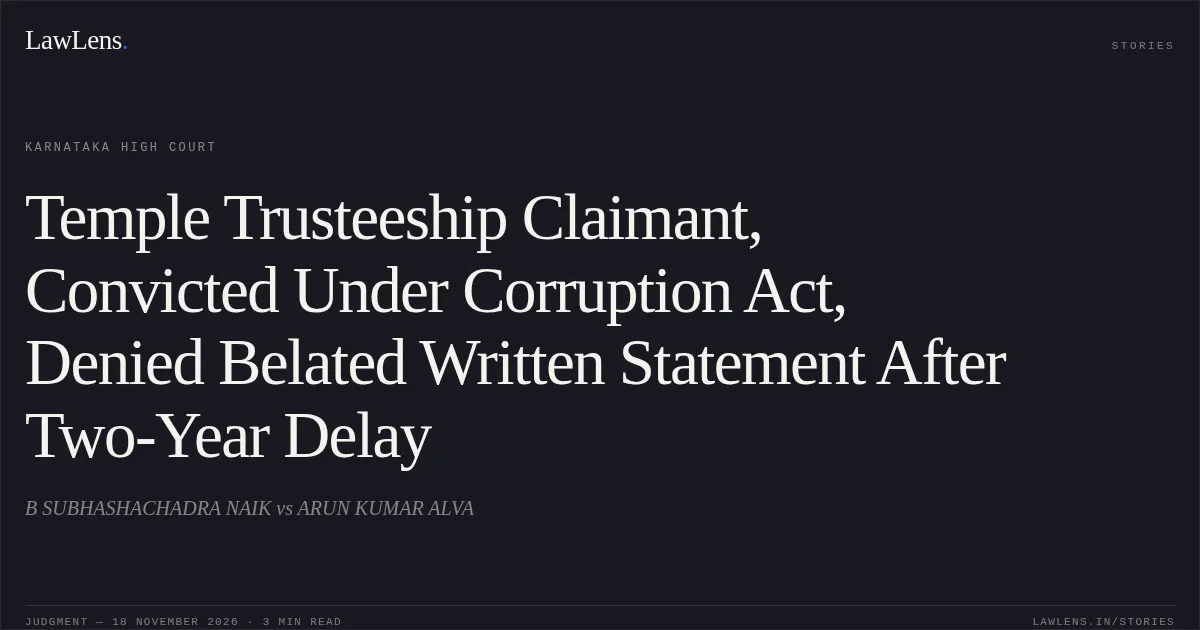
The petitioner, originally plaintiff No. 1 in O.S. No. 6/2014 before the III Additional District Judge, Mangaluru, sought a declaration of his entitlement to the hereditary trusteeship of Sri Rajarajeshwari Temple, Polali, as senior male member of Akkamma's branch.
¶ 2 · ¶ 5He was later transposed as defendant No. 9 and supported the reliefs in the original plaint, so no written statement was filed.
¶ 2.1The plaint was amended, deleting the reference to plaintiff No. 1; the amended plaint was filed on 30.08.2022.
¶ 5On 08.07.2022, the petitioner's counsel submitted that no written statement would be filed.
¶ 6 · ¶ 8No appearance was entered for the petitioner until 11.09.2023.
¶ 8Meanwhile, the plaintiff's witnesses were examined, the suit was posted for final arguments on 20.03.2023, and the death of defendant No. 3 was reported.
¶ 7The petitioner filed no written statement until 16.12.2024, the same date he filed I.A. Nos. 8 and 9 under Order VIII Rule 1 and Order XVIII Rule 17 CPC seeking extension of time to file a written statement and permission to cross-examine P.W.2.
¶ 6 · ¶ 8 · ¶ 1The petitioner relied on his conviction under the Prevention of Corruption Act, 1988, as a disqualification and as a subsequent development, and contended that the amended plaint was not served on him.
¶ 2.2 · ¶ 2.3The respondent contended that the amendment application and amended plaint were served on counsel and that the conviction predated the amendment.
¶ 3 · ¶ 3.1The trial court's order dated 08.01.2026 was impugned.
¶ 102Issues
i.1. Whether the petitioner is entitled to file a belated written statement beyond the prescribed timeline, given the inordinate delay and the stage of the proceedings.
¶ 9 · ¶ 10 · ¶ 12ii.2. Whether the alleged conviction under the Prevention of Corruption Act, 1988, constitutes a subsequent development justifying belated pleadings.
¶ 11iii.3. Whether the petitioner is entitled to cross-examine P.W.2 at the stage of final arguments.
¶ 12iv.4. Whether the impugned order warrants interference under Article 227 of the Constitution.
¶ 1303Law Applied
The petition was filed under Article 227 of the Constitution and concerned Order VIII Rule 1 CPC (filing of written statement) and Order XVIII Rule 17 CPC (examination of witnesses).
¶ 1The Court relied on the coordinate Bench decision in Basavaraj S. v. State of Karnataka, W.P. No. 8032/2026, holding that the timeline for filing a written statement is not mandatory in every case and that extension may be granted depending on the facts.
¶ 9That discretion is not unrestricted; it must be exercised judiciously, having regard to the stage of the proceedings and the reasons for delay.
¶ 10A conviction already in force when the amended plaint was filed is not a "subsequent development" that justifies belated pleadings.
¶ 11A disqualification based on conviction under the Prevention of Corruption Act, 1988, was the petitioner's contention, which the Court did not decide.
¶ 2.2 · ¶ 11A trial court's order supported by cogent reasons does not warrant interference in writ jurisdiction.
¶ 1304Reasoning
The Court accepted that the timeline for a written statement is directory and may be relaxed, but held that the petitioner had an opportunity to plead after the amended plaint was filed on 30.08.2022 and did not use it.
¶ 9 · ¶ 6 · ¶ 7His counsel's 08.07.2022 statement that no written statement would be filed, followed by a more than one-year absence from the record, weighed against him.
¶ 8The Court held that the conviction was already in force at the time of amendment and therefore could not be treated as a subsequent development. The petitioner's applications, filed after an inordinate delay of over two years and after the suit had reached final arguments, were therefore not justified.
¶ 11The same reasoning applied to the cross-examination of P.W.2, which was sought at the final stage.
¶ 12The Court did not accept the service argument, since the petitioner was represented by counsel and was aware of the amendment.
¶ 3 · ¶ 6Because the trial court's reasoning was cogent and no jurisdictional error was shown, the Court declined to interfere under Article 227.
¶ 1305Holding
The High Court held that no sufficient justification existed for permitting a belated written statement or cross-examination of P.W.2.
¶ 12The conviction under the Prevention of Corruption Act, 1988, was not a subsequent development, and the trial court's order dated 08.01.2026 on I.A. Nos. 8 and 9 was supported by cogent reasons and warranted no interference.
¶ 11 · ¶ 13The writ petition was dismissed, and the impugned order stands.
¶ 14Original Court PDF
B SUBHASHACHADRA NAIKvsARUN KUMAR ALVA
Click to open original judgment
Original judgment, available to read, download and summarize on LawLens.in