01Facts
The parties married on 18 May 2013 and lived together for a few months at the husband’s home.
¶ 2–6The husband alleged that the wife was quarrelsome, left the matrimonial home, and subjected him to cruelty; he sought divorce.
¶ 2–6The wife alleged that the husband and his family mistreated and assaulted her, demanded further dowry, and forced her to leave.
¶ 2–6The Principal Senior Civil Judge and JMFC, Hosapete, dismissed the husband’s petition for divorce on grounds of cruelty and desertion.
¶ 2–6The husband appealed under Section 28 of the Hindu Marriage Act, 1955.
¶ 2–602Issues
i.Whether the wife had subjected the husband to cruelty warranting divorce under Section 13(1)(ia) of the Hindu Marriage Act
¶ 5, 11, 16ii.Whether the wife had deserted the husband for the statutory period, without justifiable cause, so as to warrant divorce under Section 13(1)(ib)
¶ 5, 16–17iii.Whether the Trial Court erred in its appreciation of the evidence
¶ 1103Law Applied
Section 13(1)(ia) of the Hindu Marriage Act, 1955 permits divorce on the ground of cruelty; whether conduct amounts to cruelty depends on the circumstances and the parties’ backgrounds, and is not determined by a single universal definition.
¶ 12Under Section 13(1)(ib), desertion must continue for at least two years immediately preceding the presentation of the petition.
¶ 17The mere filing of a criminal case does not, by itself, establish cruelty by the complainant spouse.
¶ 15The appeal was brought under Section 28 of the Act.
p. 1No judicial precedent is cited in the judgment.
Provisions in the judgment · 2 · Linked ones open on LawLens
Hindu Marriage Act, 1955 Section 28Section 13
04Reasoning
The Court found that the parties’ evidence consisted of competing allegations and that the husband’s supporting witnesses were either related to him, his friend, or not on cordial terms with the wife’s family; the Trial Court was therefore justified in not relying on their testimony to establish cruelty or desertion.
¶ 13The wife’s allegations of dowry demand and cruelty remained consistent across the criminal case, maintenance proceedings, and appeal, while the criminal case’s mere existence did not prove that she had committed cruelty.
¶ 14–15As to desertion, the parties’ marriage took place on 18 May 2013, and the husband presented his petition on 26 July 2014—less than two years later.
¶ 17The Court also accepted that the wife left after alleged pressure to divorce and physical assault, and therefore held that the statutory period and basis for desertion were not established.
¶ 1705Holding
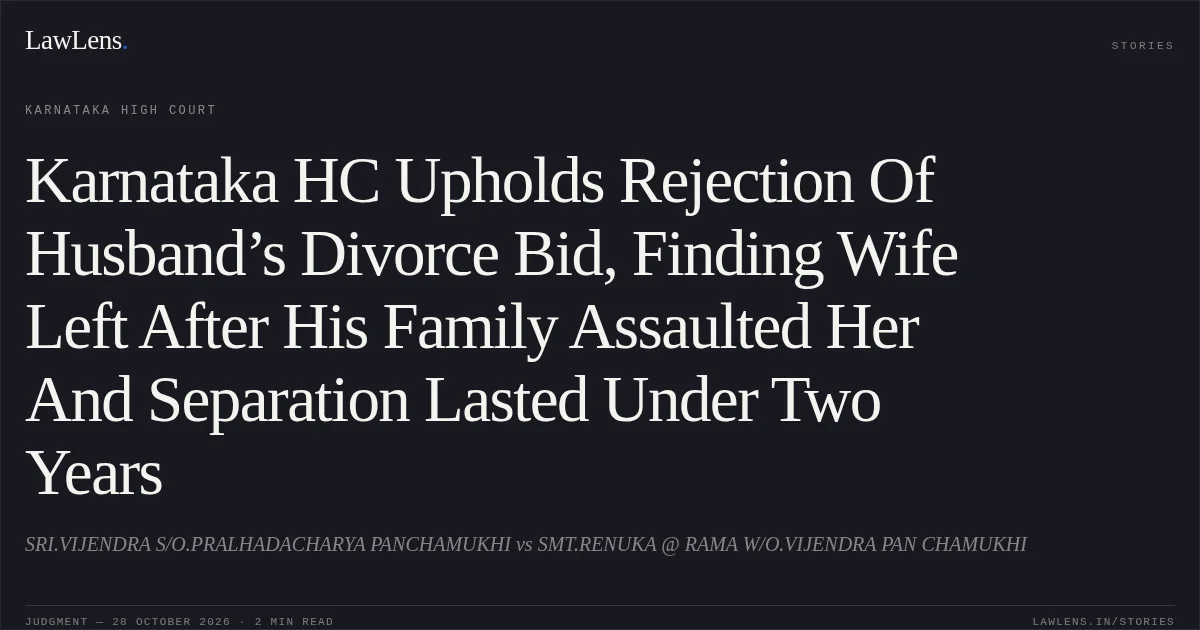
The High Court held that the husband had not proved cruelty or desertion and found no error in the Trial Court’s appreciation of the evidence.
¶ 18–19It dismissed the appeal, made no order as to costs, and directed the Registry to return the Trial Court record.
¶ 19Original Court PDF
SRI.VIJENDRA S/O.PRALHADACHARYA PANCHAMUKHIvsSMT.RENUKA @ RAMA W/O.VIJENDRA PAN CHAMUKHI
Click to open original judgment
Original judgment, available to read, download and summarize on LawLens.in