01Facts
Ten appellants were appointed by the Punjabi Academy, GNCTD, as part-time Punjabi language teachers between 1986 and 1994 for deployment in Directorate of Education (DOE) schools.
¶ 4–5, 7Their appointments were styled as temporary and ad hoc, were renewed annually on identical terms, and disclaimed any right to regularisation.
¶ 4–5, 7The Punjabi Academy was held to be a State instrumentality under Article 12; that finding was not challenged.
¶ 6The appellants had the prescribed qualifications and were recruited through a written test and interview, facts not disputed in the counter-affidavits.
¶ 10–11A 1991 direction to create regular posts and absorb qualified part-time teachers was not implemented, and a 1993 age-relaxation communication was never conveyed to them.
¶ 13–16By Cabinet decision dated 17.04.2008, the GNCTD held that part-time teachers could at best be treated at par with contract teachers, with only age relaxation for DSSSB examinations.
¶ 8In 2008, 2010 and 2011, after 20 or more years of service, the appellants were appointed as full-time Punjabi TGTs, with enhanced salaries, on the same ad hoc terms.
¶ 9Representations to the DOE and PIO responses under the RTI Act left the appellants in a position where the Academy and DOE each disclaimed them as employees.
¶ 17–18WP(C) 2571/2011 sought regularisation and parity with regular TGTs.
¶ 19The Single Judge dismissed the regularisation prayer relying on Uma Devi, and granted liberty to pursue equal pay for equal work.
¶ 20–23LPA 937/2013 arises from WP(C) 4896/2012, which followed the same reasoning.
¶ 202Issues
i.1. Whether long, unblemished service of appellants, appointed through a written test and interview against sanctioned vacancies on ad hoc or part-time terms, entitles them to regularisation despite the contractual nomenclature and Uma Devi.
¶ 1, 31–33, 43ii.2. Whether the appellants are employees of the DOE/GNCTD, notwithstanding the Punjabi Academy's role as the appointing and disbursing agency.
¶ 28, 43.2iii.3. Whether, upon regularisation, the appellants are entitled to pay parity with regular TGTs, and from what date.
¶ 29, 44 · Conclusion · ¶ 45(v)03Law Applied
The Court applied Secretary, State of Karnataka v. Uma Devi (2006) 4 SCC 1, as clarified in later decisions, and treated the bar against regularisation as inapplicable to irregular, non-illegal appointments made through a regular selection process.
¶ 32The Court relied on Vinod Kumar v. Union of India (2024) 9 SCC 327 for the proposition that the "essence of employment," not initial terms, governs, and that substantive rights accrue through continuous service where recruitment mirrors regular selection.
¶ 33, 3.3The Court followed Jaggo v. Union of India (2024 SCC OnLine SC 3826) that long, uninterrupted, unblemished service on essential, perennial functions transforms ad hoc employment into one demanding regularisation, and that outsourcing and educational-qualification objections cannot defeat such claims.
¶ 4.3The Court applied Shripal v. Nagar Nigam, Ghaziabad (2025 SCC OnLine SC 221) and Dharam Singh v. State of U.P. (2025 SCC OnLine SC 1735), under which courts may direct regularisation, and the State's "no sanctioned post" plea may be rejected where work is perennial.
¶ 5.9, 6.13The Court relied on the Supreme Court's affirmance in Pawan Sharma v. GNCTD (2026) 327 DLT 9789 (aff'd 14.05.2026), with a seniority clarification.
¶ 33–35Further authority included Bhola Nath v. State of Jharkhand (2026 SCC OnLine SC 129) (contractual terms cannot override Article 14; the "lion and lamb" principle; legitimate expectation); Pawan Kumar v. Union of India (2026 SCC OnLine SC 200); Sukhendu Bhattacharjee v. State of Assam (2026 SCC OnLine SC 909) (State cannot rely on form of engagement; Uma Devi is no shield); Rupesh R. Gaonkar v. State of Goa (2026 SCC OnLine SC 1495) (temporary status as indicator of State's intent to absorb); and Om Prakash Gaur v. Delhi Technological University (2026 SCC OnLine Del 6224).
¶ 37–41The Court's consolidated principles are set out, including the equal-pay principle under which pay parity follows regularisation.
¶ 42, 44Provisions in the judgment · 2
Right to Information Act, 2005 Section 6NSection 6E
04Reasoning
The Court held that the Single Judge's reliance on Uma Devi and the appointment letters was no longer sustainable after Vinod Kumar, Jaggo, Shripal, Dharam Singh, and the Supreme Court's decisions in Bhola Nath, Pawan Kumar, Sukhendu Bhattacharjee, and Rupesh Gaonkar.
¶ 43.3Applying the Pawan Sharma principles, the Court found each element satisfied: the appellants were selected through a written test and interview, not through a "back door"; they served for close to two decades without blemish; and teaching Punjabi is a core, essential function of DOE schools, with the appellants adjusted against available vacancies.
¶ 33, 43.1The Court rejected the contractual-terms argument on the lion-and-lamb reasoning drawn from Bhola Nath and the consolidated takeaway.
¶ 42(i)The Single Judge's observation that the appellants were not DOE employees was rejected: the GNCTD determined their salary and terms (including through the 20.06.2008 order), and the funds came from the DOE and GNCTD, with the Academy acting as a conduit.
¶ 43.2, 28Because regularisation was granted, the Court held it "unconstitutional to distinguish between them and regular TGTs" in pay, but limited the pay benefit to prospective effect from the date of judgment and declined arrears, while preserving liberty to seek arrears separately.
¶ 44, 45(v)Seniority was made subject to regularly recruited TGTs, following the Supreme Court's clarification in Pawan Sharma.
¶ 34–35, 45(vi)05Holding
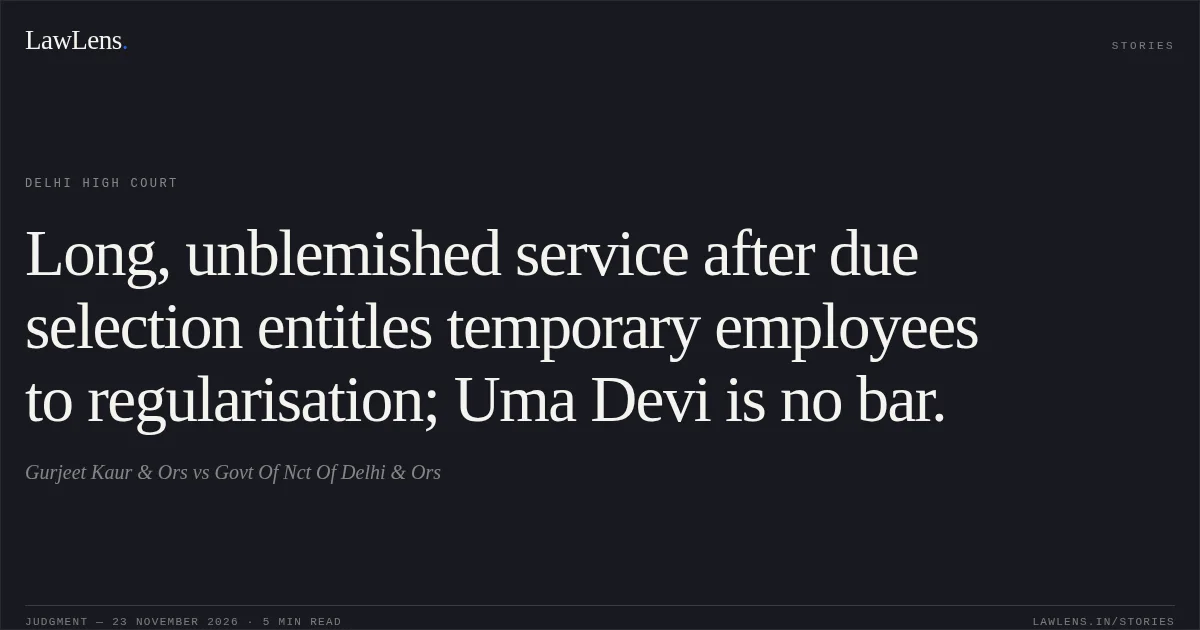
On Issue 1, the Court answered in the affirmative: the appellants' regularisation claim is upheld, and the Single Judge's rejection of it is quashed.
¶ 43.4, 45(i)–(ii)On Issue 2, the appellants are held to be employees of the DOE/GNCTD, irrespective of the original nature of their engagement.
¶ 43.2On Issue 3, the appellants are entitled to the salary of regular TGTs from the date of judgment, with consequential benefits.
¶ 44, 45(iii)–(iv)Orders: (a) if no longer in service, reinstatement on the same posts with back wages computed on their last wages and pay fixed as if continuously in service; (b) retirees to receive notional regular-service terminal and retiral benefits; (c) no arrears of pay differential before the judgment date, with liberty to pursue such claims separately; (d) no seniority over regularly recruited TGTs of the contractual period; (e) compliance by DOE/GNCTD within 12 weeks.
¶ 45(iii)–(vii)The same directions apply mutatis mutandis to LPA 937/2013, and both appeals are disposed of in these terms.
¶ 46–47Original Court PDF
Gurjeet Kaur & OrsvsGovt Of Nct Of Delhi & Ors
Click to open original judgment
Original judgment, available to read, download and summarize on LawLens.in