01Facts
The ten appellants were appointed by the Punjabi Academy, an instrumentality of the State (not challenged), as part-time Punjabi language teachers in schools under the Directorate of Education (DOE) between 1986 and 1994.
¶ 4 · ¶ 6Their appointments were temporary and ad hoc, terminable without notice, renewed annually, and stated to confer no right to regularisation.
¶ 5 · ¶ 7The appellants were graduates or post-graduates with B.Ed. degrees, and were recruited through written examination and interview. Neither fact was disputed in the counter-affidavits.
¶ 10 · ¶ 11The appellants were redeployed against vacant TGT (Punjabi) posts in DOE schools.
¶ 12In 2008, 2010 and 2011, after 20 or more years of part-time service, the appellants were made full-time Punjabi teachers with enhanced salaries, on the same ad hoc terms.
¶ 9 · ¶ 21A 1991 direction to create regular posts and absorb the appellants was not implemented.
¶ 13A 1993 DOE letter granted age relaxation for open competitive examinations, but the Punjabi Academy never informed the appellants of it.
¶ 15 · ¶ 16The Cabinet decision of 17 April 2008 limited relief to age relaxation and held that regularisation could be only through DSSSB recruitment.
¶ 8 · ¶ 21The appellants' representations were met with the stand that they were Punjabi Academy employees, and the DOE denied any employment relationship.
¶ 17 · ¶ 18The learned Single Judge dismissed the writ petitions insofar as they sought regularisation, relying on Uma Devi, but granted liberty to pursue equal pay for equal work.
¶ 20 · ¶ 21 · ¶ 22 · ¶ 2302Issues
i.1. Whether long-serving part-time/ad hoc teachers, appointed after written test and interview against vacant sanctioned posts and rendering unblemished service for two decades, are entitled to regularisation notwithstanding the temporary terms of their appointment and Uma Devi.
¶ 1 · ¶ 25 · ¶ 26 · ¶ 27 · ¶ 31 · ¶ 32 · ¶ 33 · ¶ 43ii.2. Whether the appellants, though appointed by the Punjabi Academy, are to be treated as employees of the DOE/GNCTD for the purposes of regularisation and pay.
¶ 28 · ¶ 43.2iii.3. Whether the appellants are entitled to pay parity with regular TGTs (Punjabi).
¶ 29 · ¶ 4403Law Applied
The line of Supreme Court decisions restricts Uma Devi (2006) 4 SCC 1 to illegal backdoor appointments and holds that irregular appointments made through due selection and continued for long periods may warrant regularisation.
¶ 32 · ¶ 37.3 (quoting para. 53 of Uma Devi)Vinod Kumar v. Union of India (2024) 9 SCC 327 holds that the substantive nature of employment is decisive and not the initial label, and that service after a regular-type selection is protected.
¶ 3.3 · ¶ 33Jaggo v. Union of India (2024 SCC OnLine SC 3826) holds that courts must look past labels to the realities of employment, and that long, unblemished service on essential functions justifies regularisation.
¶ 4.3 · ¶ 33Shripal v. Nagar Nigam, Ghaziabad (2025 SCC OnLine SC 221) holds that Uma Devi cannot shield exploitative, long-term temporary engagements.
¶ 5.9 · ¶ 33Dharam Singh v. State of U.P. (2025 SCC OnLine SC 1735) holds that the State, as a constitutional employer, may be directed to create posts and regularise, and that interim protection is not a ground to deny rights.
¶ 6.13 · ¶ 33Pawan Sharma v. GNCTD (2026) 327 DLT 9789, affirmed by the Supreme Court on 14 May 2026, states the governing principles, including that initial labels do not matter, that a selection process mirroring regular recruitment suffices, and that educational deficiency and bans on recruitment are no defence.
¶ 33 · ¶ 34 · ¶ 42Bhola Nath v. State of Jharkhand (2026 SCC OnLine SC 129) holds that contractual terms cannot override Article 14, that the State is a model employer, and that legitimate expectation arises from long service.
¶ 37.4 · ¶ 37.5Pawan Kumar v. Union of India (2026 SCC OnLine SC 200), Sukhendu Bhattacharjee v. State of Assam (2026 SCC OnLine SC 909) and Rupesh R. Gaonkar v. State of Goa (2026 SCC OnLine SC 1495) reaffirm these principles.
¶ 38.6 · ¶ 38.7 · ¶ 39.8 · ¶ 40.5Om Prakash Gaur v. Delhi Technological University (2026 SCC OnLine Del 6224) applies Pawan Sharma.
¶ 41Equal pay for equal work, drawn from Article 14, is applied in Bhola Nath and Shripal.
¶ 37.3 · ¶ 5.6Provisions in the judgment · 2
Right to Information Act, 2005 Section 6NSection 6E
04Reasoning
The Court held that the appellants' ad hoc labels and renewal terms carried no weight, because the Supreme Court has held that contractual stipulations do not bar regularisation where the employer holds a lion-and-lamb relationship with the employee.
¶ 37.4(iii) · ¶ 37.4(iv) · ¶ 42(i)The appellants satisfied the Pawan Sharma / Vinod Kumar criteria. They were selected through written tests and interviews, which mirror regular recruitment, served for close to two decades without blemish, and performed work, teaching Punjabi, that was core to DOE schools and was performed against available vacancies.
¶ 10 · ¶ 11 · ¶ 43.1The Court rejected the Single Judge's reliance on Uma Devi, holding that the case no longer bars regularisation of this kind, having been explained in the subsequent line of authority.
¶ 43.3The Court held that the appellants could not be denied employee status on the ground that the Punjabi Academy was their formal appointing body. The DOE/GNCTD had determined their salaries and full-time status, and the funds came from GNCTD, with the Academy acting as a conduit.
¶ 28 · ¶ 43.2The 1991 and 1993 communications showed that the State had recognised the appellants' claims and had failed to act on them.
¶ 13 · ¶ 14 · ¶ 15 · ¶ 16Once regularisation was directed, the Court held that it would be unconstitutional to pay the appellants less than regular TGTs for the same duties.
¶ 44The Court limited pay parity to prospective effect, because arrears required factual findings not adequately pleaded.
¶ 45(v)05Holding
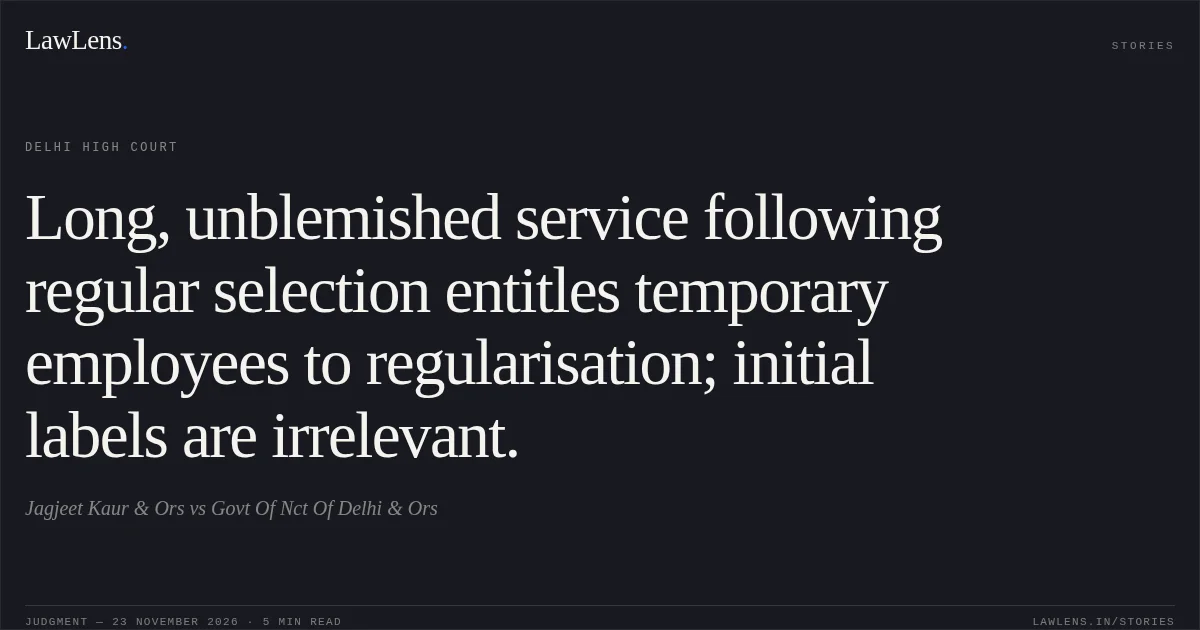
The Court held that the appellants are entitled to regularisation.
¶ 45(i) · ¶ 45(ii)The impugned judgment is quashed and set aside to the extent it rejected the claim for regularisation.
¶ 45(i) · ¶ 45(ii)Where appellants are no longer in service, reinstatement on the posts held and back wages on the basis of the wages then paid are granted, computed as if they had continued in service.
¶ 45(iii)Retirees' terminal and retiral benefits are to be computed as if they had superannuated as regular employees.
¶ 45(iv)From the date of the judgment, appellants are entitled to the salary of regular TGTs, with no arrears for the earlier period, and liberty is preserved to pursue arrears separately.
¶ 45(iii) · ¶ 45(v)The appellants are not entitled to seniority over regular TGTs recruited during their contractual engagement.
¶ 45(vi)The DOE/GNCTD must comply within 12 weeks.
¶ 45(vii)The same directions apply mutatis mutandis to LPA 937/2013. Both appeals are disposed of accordingly.
¶ 46 · ¶ 47Original Court PDF
Jagjeet Kaur & OrsvsGovt Of Nct Of Delhi & Ors
Click to open original judgment
Original judgment, available to read, download and summarize on LawLens.in