01Facts
The petitioner, a proprietary concern, availed a loan of Rs. 2.5 crore from the respondent Bank in 2009.
The Bank initiated proceedings under the SARFAESI Act, 2002, and issued a demand notice under Section 13(2).
¶ 2The Bank offered a One Time Settlement (OTS) of Rs. 85 lakh on 06.11.2020. The petitioner could not pay due to COVID-19 and made representations on 27.11.2020 and 30.12.2020.
¶ 2The Bank allegedly debited Rs. 1.31 crore from the petitioner's account without consent.
The petitioner does not dispute that the Bank took symbolic and then physical possession of the secured assets.
¶ 3By communication dated 09.12.2021 (Annexure-D), the Bank stated that the OTS had lapsed and no OTS scheme was in vogue, that the penal interest waiver (Rs. 20.82 lakh) had been recommended to the competent authority, and that the petitioner should pay the remaining dues of Rs. 17,42,524 by 14.12.2021 to avoid continued SARFAESI action. The petitioner paid this amount.
¶ 4, 10By communication dated 29.01.2022 (Annexure-G), the Bank demanded a further Rs. 38,14,024 with present and future interest and charges.
¶ 5The Bank relies on a letter of undertaking dated 30.11.2021, under which the petitioner and co-obligors undertook to pay Rs. 38,14,024 by 14.12.2021, and on a handwritten letter dated 29.11.2021.
¶ 6, 8, 11The Bank states that collateral release is conditioned on full discharge and withdrawal of proceedings.
¶ 7The petitioner contends that the undertaking was obtained under coercion and duress because it was in acute financial distress and needed release of the mortgaged property.
¶ 11The petitioner sought quashing of Annexure-G, release of collateral, refund of adjusted amounts, waiver of penal interest, and Rs. 100 lakh in damages.
p. 202Issues
i.1. Whether the letter of undertaking dated 30.11.2021 was forcibly obtained by the Bank, such that the demand of Rs. 38,14,024 under Annexure-G is liable to be quashed.
¶ 9ii.2. Whether the petitioner, having admittedly executed the undertaking, can disregard it in writ proceedings on the basis of bare allegations of coercion or duress without cogent material.
¶ 12, 14–1603Law Applied
A voluntarily executed written undertaking acknowledging a liability is binding and cannot be lightly disregarded in proceedings under Articles 226 and 227 of the Constitution.
¶ 15A party alleging coercion, duress, or undue influence must establish a factual foundation for that plea through cogent contemporaneous material, and the writ court is not the forum for detailed adjudication of disputed facts on the circumstances of execution.
¶ 15–16Financial distress alone does not render an undertaking unenforceable.
¶ 14A subsequent written commitment prevails over an earlier communication where the later correspondence shows the earlier position was superseded by deliberations.
¶ 12–13The Bank's demand is framed within the SARFAESI Act, 2002, particularly Section 13(2), though the court did not analyse the statute's provisions.
¶ 2Provisions in the judgment · 1 · Linked ones open on LawLens
Securitisation and Reconstruction of Financial Assets and Enforcement of Security Interest Act, 2002 Section 13
04Reasoning
The court did not accept the argument that the 09.12.2021 letter (Annexure-D) fixed the total liability at Rs. 17,42,524. It held that the contention could not be assessed in isolation from the later correspondence and the undertaking dated 30.11.2021.
¶ 11The petitioner admitted executing the undertaking and did not dispute its execution, so it could not rely on Annexure-D to disown the later written commitment.
¶ 12Even if the Rs. 17.42 lakh deposit was subject to approval of the penal interest waiver, the Bank's specific assertion that the waiver was not acceded to and the petitioner's subsequent agreement to pay Rs. 38,14,024 carried significant weight.
¶ 13On coercion, the court found that the petitioner produced no contemporaneous material beyond its financial distress, and that it had participated in deliberations before signing.
¶ 14Applying the rule that the party alleging coercion must prove it, the court held that the allegation raised disputed questions of fact unsuitable for writ adjudication.
¶ 15–16The court referred to Article 227 in paras. 15 and 17, although the petition was filed under Article 226.
p. 1 · ¶ 1705Holding
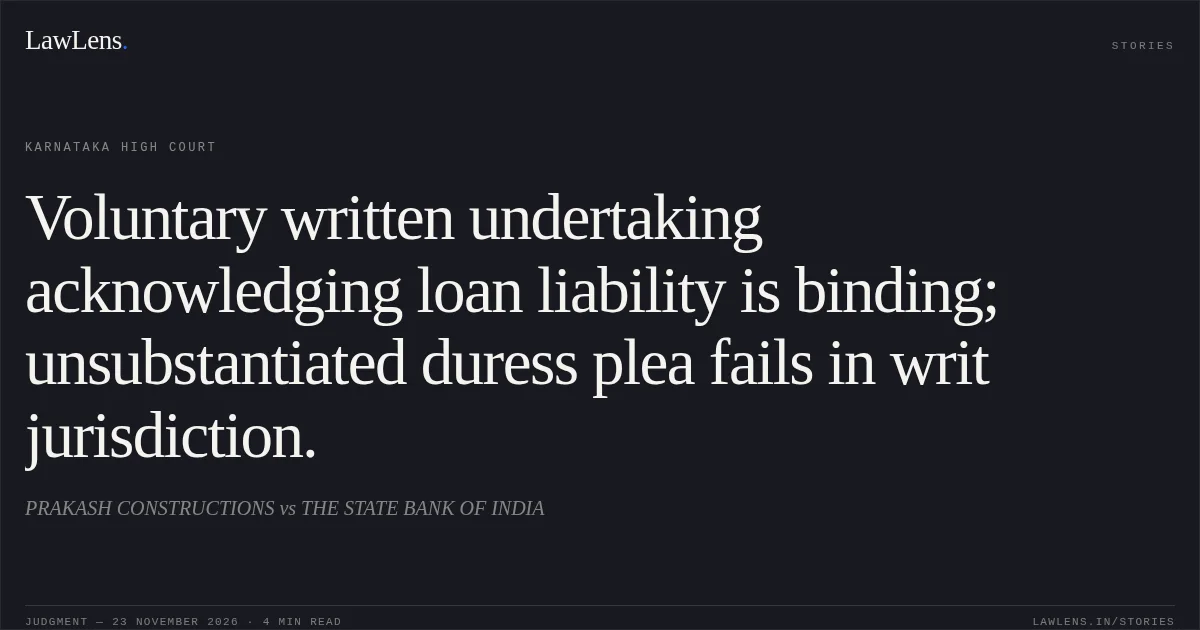
The court answered the sole point for consideration in the negative: the petitioner's contention that the undertaking was forcibly obtained, and that the Annexure-G demand of Rs. 38,14,024 is therefore liable to be quashed, was rejected. The court found no satisfactory material to show the undertaking was obtained by coercion, and held the commitment could not be disowned in these proceedings.
¶ 17The court held that no ground warranted interference with the communication at Annexure-G, and the writ petition was dismissed as devoid of merit.
¶ 18The consequential prayers for release of collateral, refund of adjusted amounts, waiver of penal interest, and Rs. 100 lakh damages were not separately allowed and fall with the petition. The Bank's position that collateral release depends on full discharge was left undisturbed.
p. 2 · ¶ 18 · ¶ 7Original Court PDF
PRAKASH CONSTRUCTIONSvsTHE STATE BANK OF INDIA
Click to open original judgment
Original judgment, available to read, download and summarize on LawLens.in