01Facts
The plaintiffs (sons and daughters of Chunilal) sued for specific performance of an agreement of sale dated 09.11.1982 (Ex.P1) for Sy.No.206/3, measuring 3 acres 10 guntas, at a consideration of Rs.31,041/-, with Rs.15,000/- allegedly paid as earnest money and possession allegedly delivered in part performance.
¶ 3.1 · ¶ 8Balance consideration was to be paid at registration, which was to follow disposal of writ proceedings by alleged tenants (Form No.7 before the Land Tribunal, Sedam).
¶ 3.1The writ petition was disposed of on 08.03.1983 and the matter remanded; the Land Tribunal rejected Form No.7 on 29.08.1987, and the Appellate Authority dismissed the appeal on 01.04.1989.
¶ 3.2 · ¶ 12Chunilal died on 06.12.1994.
¶ 12The plaintiffs issued a legal notice on 31.07.1997 (Ex.P2), served on the defendant, who did not reply.
¶ 3.1 · ¶ 8 · ¶ 9The defendant denied the agreement, the receipt of earnest money and delivery of possession, and pleaded limitation.
¶ 3.2 · ¶ 6 · ¶ 10The trial court (OS No.112/1997, judgment dated 19.02.2003) decreed the suit.
¶ 3.4The First Appellate Court (RA No.32/2003, judgment dated 25.06.2007) reversed, holding the agreement surrounded by suspicious circumstances and the suit time-barred and the plaintiffs not ready and willing, and dismissed the suit.
¶ 3.5 · ¶ 3.6PW-1 admitted that the stamp paper was purchased by Hanuman on 03.11.1982, although sale talks were completed only on 09.11.1982.
¶ 9PW-1 also admitted that a request to execute the sale deed was made during his father's lifetime.
¶ 1302Issues
i.1. Whether the First Appellate Court was justified in reversing the trial court's judgment by misleading the contents of Ex.P1 and the evidence placed by the plaintiffs.
¶ 3.8ii.2. Whether the plaintiffs proved the execution of the sale agreement dated 09.11.1982 and the payment of earnest money, given the suspicious circumstances surrounding it.
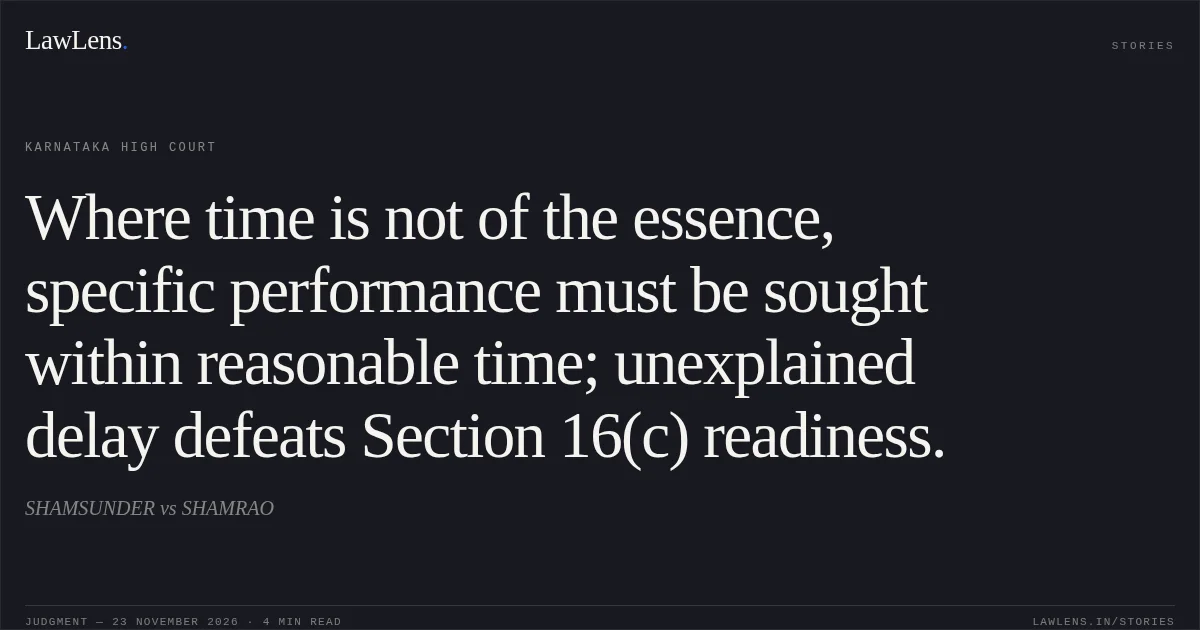
¶ 11 · ¶ 12iii.3. Whether the plaintiffs and their deceased father were ready and willing to perform their part of the contract, as required under Section 16(c) of the Specific Relief Act, 1963.
¶ 6 · ¶ 13iv.4. Whether the suit for specific performance is barred by limitation under Article 54 of the Limitation Act, 1963.
¶ 5 · ¶ 6 · ¶ 12 · ¶ 1303Law Applied
Section 16(c) of the Specific Relief Act, 1963, under which a plaintiff seeking specific performance must establish continuous readiness and willingness to perform the contract.
¶ 13Article 54 of the Limitation Act, 1963, which prescribes three years for specific performance, running from the date fixed for performance or, where no date is fixed, from the date the plaintiff has notice that performance is refused.
¶ 12Where time is not of the essence of the contract, the agreement must be enforced within a reasonable time.
¶ 12The judgment cites no precedents.
Provisions in the judgment · 3 · Linked ones open on LawLens
Code of Civil Procedure, 1908 Section 100
Limitation Act, 1963 Section 54
Specific Relief Act, 1963 Section 16
04Reasoning
The court found the First Appellate Court justified in holding the execution of the agreement surrounded by suspicious circumstances: the stamp paper was purchased on 03.11.1982, six days before the admitted completion of sale talks on 09.11.1982, and the plaintiffs offered no explanation.
¶ 9 · ¶ 11Since time was not of the essence under Ex.P1, the agreement had to be enforced within a reasonable time.
¶ 12The plaintiffs' father made no attempt to enforce the agreement after the Appellate Authority's order of 01.04.1989 and died in 1994, and the plaintiffs produced no evidence of financial capacity to pay the balance consideration.
¶ 12The legal notice of 1997 (Ex.P2) was the first demand on record.
¶ 12PW-1's admission of an earlier request during his father's lifetime meant that time ran from that refusal, and even on that date the suit filed in 1997 was outside three years under Article 54.
¶ 13The plaintiffs' contention that the 1997 notice itself gave a fresh cause of action was not accepted, because the limitation period had already run from the earlier refusal.
¶ 5 · ¶ 13Having re-appreciated the entire evidence, the court concluded that the plaintiffs were not ready and willing under Section 16(c) and that the suit was time-barred.
¶ 13The substantial question was framed in terms of misreading Ex.P1 and the evidence, and the court held that the First Appellate Court had rightly read Ex.P1 and reappreciated the evidence.
¶ 1305Holding
The substantial question of law is answered in the negative. The First Appellate Court was justified in reversing the trial court's decree, as the plaintiffs failed to prove the readiness and willingness required under Section 16(c) of the Specific Relief Act, and the suit was barred by limitation under Article 54 of the Limitation Act.
¶ 13 · ¶ 14The Regular Second Appeal is dismissed, and the judgment and decree dated 25.06.2007 in R.A. No.32/2003 are upheld.
¶ 13 · ¶ 14The decree of the trial court dated 19.02.2003 in O.S. No.112/1997 stands set aside, and the suit remains dismissed.
¶ 3.6 · ¶ 14Original Court PDF
SHAMSUNDERvsSHAMRAO
Click to open original judgment
Original judgment, available to read, download and summarize on LawLens.in