01Facts
The plaintiff (respondent) sued in O.S. No. 430/2012 (Principal Civil Judge and JMFC, Malur) for specific performance of an agreement of sale dated 25.08.2008. The total consideration was Rs. 3,50,000, of which Rs. 3,00,000 was allegedly paid. The agreement was registered.
The plaintiff alleged that the defendants postponed execution of the sale deed.
¶ 3Defendant No. 1 appeared through counsel but filed no written statement. Defendant Nos. 2–4 were placed ex parte.
¶ 3, 6The trial court decreed the suit on 07.11.2013 and directed execution of a sale deed within 30 days.
¶ 5The First Appellate Court dismissed R.A. No. 29/2014 on 28.08.2023. It held that notice had been served, that the defendants took no steps to contest, and that the plaintiff had paid 90% of the consideration.
¶ 6The agreement fixed one year for completion, expiring on 25.08.2009. The suit was filed on 24.08.2012, which is the last day under Article 54(1) of the Limitation Act, 1963.
¶ 11The defendants (LRs of Defendant No. 1 and Defendant Nos. 2–4) filed this second appeal under Section 100 CPC.
preamble · ¶ 102Issues
i.1. Whether the First Appellate Court, having framed the point "Whether the conclusion of the trial Court in decreeing the suit ... is proper?", erred by failing to answer it and by failing to examine the plaint averments and evidence to assess whether a decree of specific performance was warranted.
¶ 10ii.2. Whether the courts below failed to consider the plaintiff's delay in approaching the court, which was near three years beyond the agreed completion date, in exercising discretion in favour of specific performance.
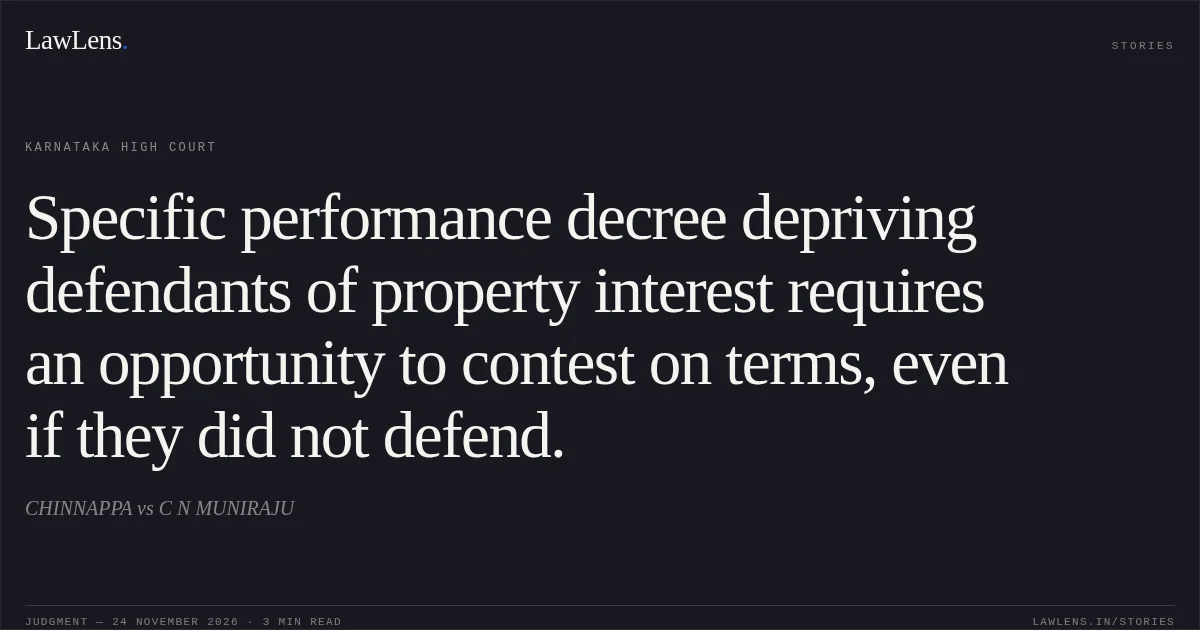
¶ 11iii.3. Whether, given the defendants' non-contest, the First Appellate Court ought to have granted them an opportunity to contest the suit on merits, on terms.
¶ 7, 1203Law Applied
Specific performance is a discretionary remedy and is not granted merely because it is lawful to do so.
¶ 10Article 54(1) of the Limitation Act, 1963 bars a suit for specific performance filed beyond the date fixed for performance, and the expiry of the one-year completion period on 25.08.2009 was treated as the reference point.
¶ 11Where a decree would deprive a defendant of proprietary interest in immovable property, a court should act with grace by granting time to contest the suit on merits, subject to terms.
¶ 12Jurisdiction under Section 100 CPC is invoked for a substantial question of law.
preamble · ¶ 10The judgment cites no specific statutory section of the Specific Relief Act, 1963 and no precedents.
Provisions in the judgment · 2 · Linked ones open on LawLens
Code of Civil Procedure, 1908 Section 100
Limitation Act, 1963 Section 54
04Reasoning
The First Appellate Court framed the correct question but did not answer it. Instead, it confined itself to whether Defendant No. 1 was justified in not contesting and relied on the 90% payment, without examining the plaint, the evidence, or the discretionary nature of the relief.
¶ 6, 10The suit was filed on the last day permissible under Article 54(1), roughly three years after the completion period expired. Neither court considered whether this delay justified exercising discretion in the plaintiff's favour.
¶ 11The decree would strip the defendants of their interest in immovable property, which warranted indulgence, even though they had not contested.
¶ 12The court expressly declined to decide the merits or limitation itself, leaving those questions to the trial court.
¶ 12–13, 14(vi)05Holding
The substantial question of law is answered in favour of the defendants and against the plaintiff.
¶ 10, 12, 13The appeal is allowed. The judgments and decrees of the trial court and First Appellate Court are set aside, and the case is remanded for fresh consideration according to law.
¶ 14(i)–(iii)The defendants must appear before the trial court on 10.12.2026 and file their written statement. The trial court must frame issues and try the suit on a day-to-day basis, disposing of it within six months of framing issues. This is conditional on the defendants paying Rs. 50,000 as costs to the plaintiff at the next hearing.
¶ 14(iv)–(v)Observations in the judgment are not to prejudice the trial court's merits determination.
¶ 14(vi)Original Court PDF
CHINNAPPAvsC N MUNIRAJU
Click to open original judgment
Original judgment, available to read, download and summarize on LawLens.in