01Facts
The petitioner began working as a Lower Division Assistant (LDA) in 1996 on the basis of a verbal instruction and a ministerial note, without selection.
pp. 3–5In an earlier writ petition, the High Court held his engagement invalid and refused regularisation, though it directed payment of salary for work performed.
pp. 3–5His service was terminated in 2005.
pp. 7–9A subsequent challenge to the termination order was dismissed; the dismissal was upheld in appeal and the Supreme Court later dismissed the special leave petition, directing payment of wages for the period actually worked, without recovery.
pp. 7–9The petitioner admitted receiving salary until May 2017.
p. 9A further writ petition challenging the termination order was dismissed in 2025.
pp. 9–10In this fourth writ petition, filed in 2025, he sought pension and other retirement benefits, relying principally on the Assam Government Office Memorandum dated 6 September 2003, which provides pensionary benefits in specified circumstances after twenty years’ service.
pp. 3, 5–7, 10, 1202Issues
i.1. Whether the petitioner, whose engagement had been finally held invalid and who had not been appointed as a Government servant, was entitled to pensionary benefits under the Office Memorandum dated 6 September 2003
pp. 11–12ii.2. Whether the present claim was barred by res judicata or constructive res judicata, or otherwise amounted to an abuse of process, in light of the earlier proceedings concerning the petitioner’s engagement and termination
pp. 10–12, 15–16iii.3. Whether the petitioner’s claim that the termination order was not served on him could be reopened in this proceeding
pp. 10–1103Law Applied
The Court applied the principle that res judicata and constructive res judicata are grounded in public policy and prevent parties from raising, in successive proceedings, matters that were or ought to have been litigated earlier; these principles apply to writ proceedings under Article 226.
pp. 11–15The Court relied on Devilal Modi v. Sales Tax Officer, Ratlam, AIR 1965 SC 1150, and M. Nagabhushana v. State of Karnataka, (2011) 3 SCC 408, including the rule that finality of litigation is essential to the rule of law and that relitigation may constitute abuse of process.
pp. 11–15The Office Memorandum dated 6 September 2003 provides pensionary benefits to qualifying Government servants who have rendered twenty years of service, including in specified circumstances where service was unconfirmed.
p. 12The Court also treated the prior final determination that the petitioner had never been appointed as controlling; on that basis, he could not claim the status of a Government servant for the purpose of the Office Memorandum.
pp. 7–8, 12Provisions in the judgment · 1 · Linked ones open on LawLens
Code of Civil Procedure, 1908 Section 11
04Reasoning
The Court held that the petitioner’s appointment or engagement had already been found invalid, and that the earlier proceedings had rejected both regularisation and his challenge to the termination order.
pp. 7–8, 10–11The petitioner’s non-service argument had also been raised and addressed in the second writ petition, where the Court found service of the termination order inconsequential because he had never been appointed.
pp. 7–8, 10–11The subsequent appeal, special leave petition and third writ petition did not alter that final determination.
pp. 8–10Although the petitioner had received salary until May 2017, that fact did not establish qualifying continuous service as a Government servant under the 2003 Office Memorandum, given the prior finding that he had never been appointed.
p. 12The Court further found that the pension claim remained connected to the same core issue—his purported appointment—and could not be pursued through successive writ petitions.
pp. 15–16It also rejected reliance on the Terminated Employees [Temporary Benefits] Bill, 2022, which had not become law.
pp. 12–1305Holding
The Court held that the petitioner was not entitled to pension or other retirement benefits under the 2003 Office Memorandum because he had not been appointed as a Government servant.
p. 12The present petition was also an impermissible fourth round of litigation on the same core issue and amounted to an abuse of process.
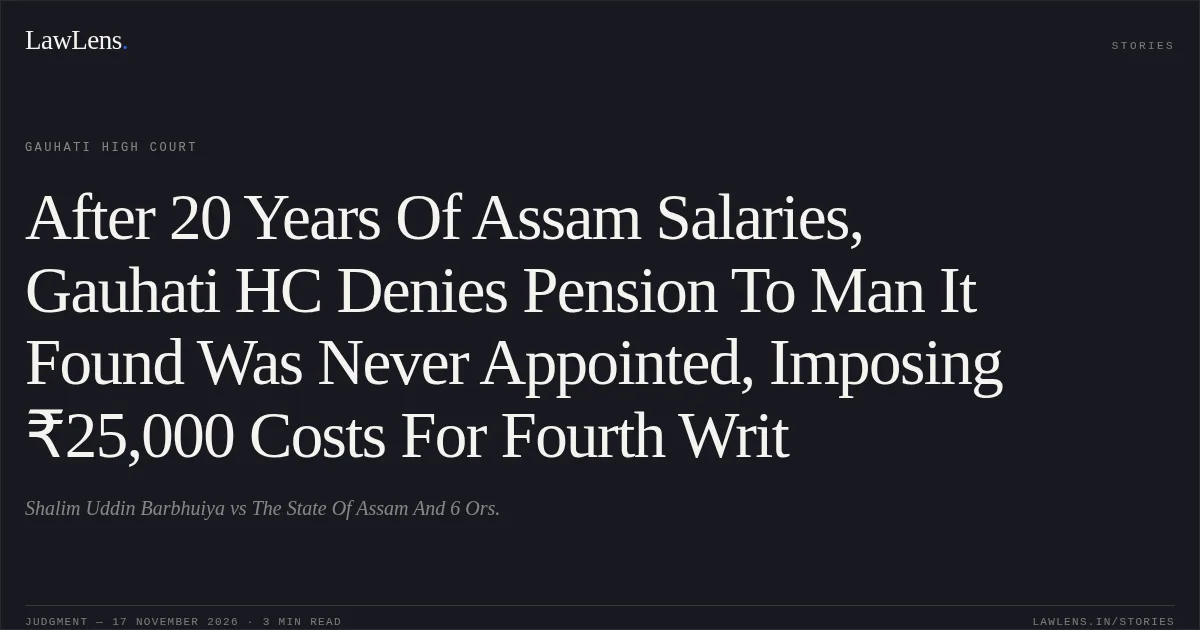
pp. 15–16The writ petition was dismissed with costs of Rs. 25,000, payable to the Registry within one month; upon deposit, the amount was to be transferred to the Gauhati High Court Bar Association.
p. 16Original Court PDF
Shalim Uddin BarbhuiyavsThe State Of Assam And 6 Ors.
Click to open original judgment
Original judgment, available to read, download and summarize on LawLens.in