01Facts
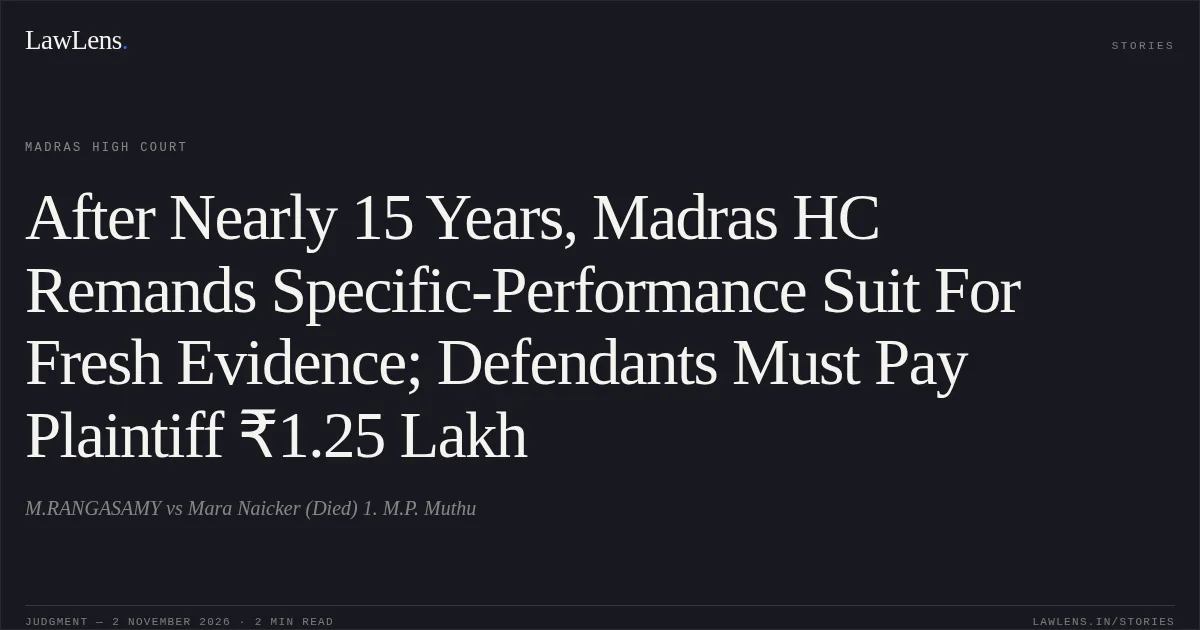
The plaintiff sought specific performance of a sale agreement dated 4 September 2009, under which the first defendant allegedly agreed to sell the suit property for ₹1,30,000, with ₹20,000 remaining payable and completion stipulated within two years.
¶ 4The plaintiff alleged that the first defendant later settled the property on his son, after which it was transferred to other defendants.
¶ 4The trial court dismissed the suit, finding the two-year period unexplained, the plaintiff’s non-deposit of the balance consideration indicative of lack of readiness and willingness, and a witness unreliable.
¶ 5The first appellate court reversed and granted specific performance, relying on the first defendant’s written statement as admitting execution of the agreement.
¶ 6The defendants appealed, contending that the agreement was not genuine and that they had not effectively presented their defence below.
¶ 7–902Issues
i.1. Whether the competing claims concerning the genuineness of the sale agreement and the parties’ respective cases required fresh consideration on evidence.
¶ 9–10ii.2. Whether the judgments of the courts below should be set aside and the suit remanded to afford the parties a further opportunity to adduce evidence.
¶ 9–1303Law Applied
The judgment does not identify or apply a specific statutory provision or precedent as the basis for its decision.
It applies the general principles that a party seeking specific performance must prove its case, and that where the genuineness of an agreement and material rival claims require evidentiary determination, the parties may be afforded an opportunity to adduce evidence and the matter remanded for fresh consideration.
¶ 10The Court also conditioned remand on payment of costs, having regard to the prolonged pendency of the litigation.
¶ 11–12Provisions in the judgment · 1 · Linked ones open on LawLens
Code of Civil Procedure, 1908 Section 100
04Reasoning
The Court considered that the defendants had disputed the agreement but neither the first nor the second defendant had entered the witness box, while the first appellate court had granted specific performance by relying on the first defendant’s written statement.
¶ 5–6, 9Given the prior settlement deed, the pleaded defence, and the possibility that the defendants had not effectively presented their case, the Court concluded that the agreement’s genuineness and the rival claims required assessment on oral and documentary evidence.
¶ 9It further observed that the plaintiff remained bound to prove his case for specific performance.
¶ 10In the interests of justice, it set aside both judgments and ordered a remand, subject to costs.
¶ 10–1205Holding
The Second Appeal was disposed of by setting aside the judgments and decrees of both courts and remanding the suit to the trial court for fresh consideration.
¶ 12–14The appellants were directed to pay the plaintiff ₹1,25,000 within four weeks.
¶ 12–14The trial court was directed to frame appropriate issues, permit both sides to adduce oral and documentary evidence, decide the suit independently of the earlier findings, and complete the proceedings within four months of receiving a copy of the order.
¶ 12–14The connected miscellaneous petition was closed.
¶ 14Original Court PDF
M.RANGASAMYvsMara Naicker (Died) 1. M.P. Muthu
Click to open original judgment
Original judgment, available to read, download and summarize on LawLens.in