01Facts
The plaintiff sought recovery of ₹1,40,75,000, alleging that he advanced ₹82,00,000 to the defendant and obtained nine promissory notes.
pp. 2–7 · ¶ 2–9The defendant admitted his signatures but contended that the notes were obtained under duress, without consideration, and arose from earlier borrowings by his father-in-law.
pp. 2–7 · ¶ 2–9He also disputed territorial jurisdiction and pleaded limitation.
pp. 2–7 · ¶ 2–9The plaintiff presented the plaint on 4 June 2018; two notes were dated 21 February 2015 and seven were dated 25 May 2015.
pp. 2–7 · ¶ 2–9The Court framed issues including entitlement, limitation, territorial jurisdiction, and consideration.
pp. 2–7 · ¶ 2–9The plaintiff examined himself and produced the notes and other documents; the defendant and his wife testified, but the defence produced no documents.
pp. 2–7 · ¶ 2–902Issues
i.Whether the Court had territorial jurisdiction to entertain the suit.
pp. 16–17 · ¶ 24–25ii.Whether the claims under the promissory notes were barred by limitation.
p. 17 · ¶ 26–29iii.Whether the seven promissory notes dated 25 May 2015 were supported by consideration, notwithstanding the defendant’s plea of duress.
pp. 18–21 · ¶ 30–36iv.Whether the plaintiff was entitled to recover the claimed amount, interest, and costs.
pp. 21–23 · ¶ 37–4303Law Applied
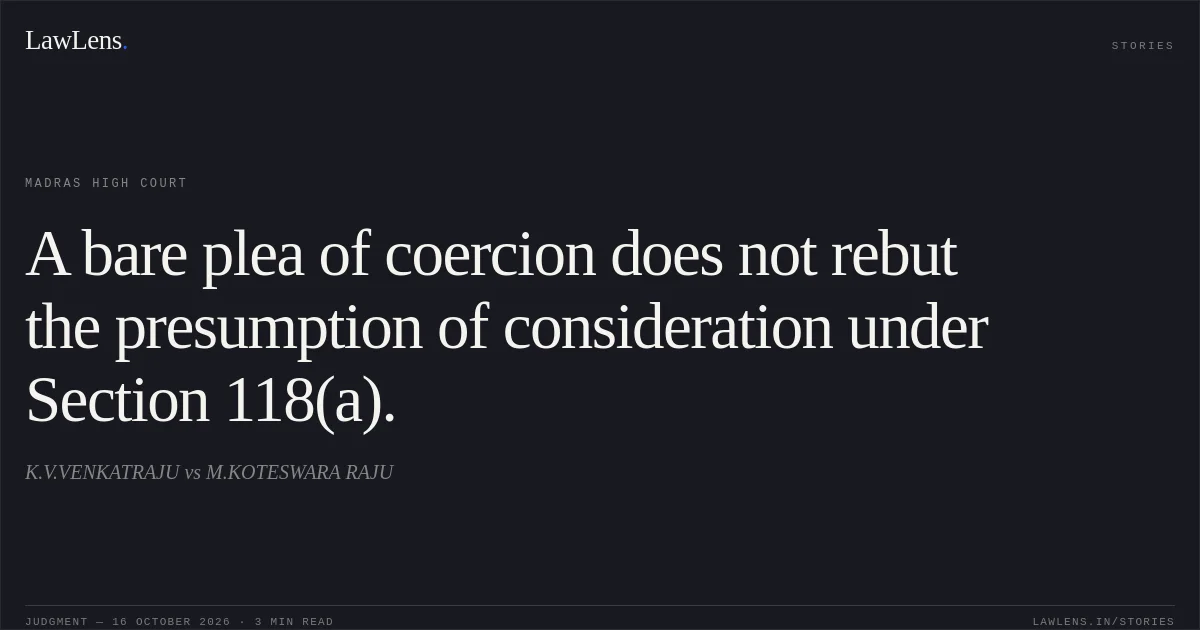
Section 118(a) of the Negotiable Instruments Act, 1881 raises a rebuttable presumption that a promissory note was made for consideration.
p. 19 · ¶ 32The defendant may rebut it on a preponderance of probabilities, including by relying on circumstances emerging from the plaintiff’s evidence; once a probable defence is raised, the burden shifts to the plaintiff to prove consideration, while a bare denial is insufficient.
p. 19 · ¶ 32Under Section 4 of the Limitation Act, 1963, where the limitation period expires while the Court is closed, a suit may be instituted on the day the Court reopens.
p. 17 · ¶ 28Clause 12 of the Letters Patent governed the Court’s original civil jurisdiction and leave to sue where only part of the cause of action arose within its limits.
p. 17 · ¶ 25Section 34 of the Code of Civil Procedure governed the discretionary award of interest; the Court considered the plaintiff’s delay in re-presenting the plaint when fixing the period for which interest would run.
pp. 22–23 · ¶ 39–42Provisions in the judgment · 3 · Linked ones open on LawLens
Negotiable Instruments Act, 1881 Section 118
Limitation Act, 1963 Section 4
Code of Civil Procedure, 1908 Section 34
04Reasoning
The Court found that the place where the promissory notes were executed had not been established, but held that the legal notice issued from Chennai constituted part of the cause of action within its jurisdiction; leave under Clause 12 had also been obtained and not revoked.
p. 17 · ¶ 24–25The claims on the two February 2015 notes were time-barred because their three-year limitation period expired before presentation of the plaint, whereas the limitation period for the seven May 2015 notes expired during the Court’s summer vacation, making presentation on the reopening day timely under Section 4.
p. 17 · ¶ 26–29On consideration, the defendant’s account of earlier family borrowings and coercion was unsupported by documents or independent evidence; the alleged earlier borrower was not examined, and no police complaint concerning the alleged duress had been made.
pp. 19–21 · ¶ 32–36The Court therefore held that the defence did not rebut the Section 118(a) presumption in respect of the seven notes.
pp. 19–21 · ¶ 32–36It excluded the claims under the two time-barred notes and reduced the contractual 24% interest to simple interest at 12% per annum on the ₹75,00,000 principal.
pp. 21–23 · ¶ 37–42It excluded interest for the period of delayed re-presentation, 20 June 2018 to 29 July 2019, as a matter of discretion under Section 34 CPC.
pp. 21–23 · ¶ 37–4205Holding
The suit was decreed in part.
pp. 21–23 · ¶ 37–43The defendant was directed to pay ₹1,29,00,000, comprising ₹75,00,000 principal and ₹54,00,000 pre-suit interest, together with simple interest at 12% per annum on ₹75,00,000 from 4 to 19 June 2018 and from 30 July 2019 to the date of decree, and thereafter until realisation.
pp. 21–23 · ¶ 37–43The plaintiff was awarded proportionate costs; recovery under the two notes dated 21 February 2015 was denied as time-barred.
pp. 21–23 · ¶ 37–43Original Court PDF
K.V.VENKATRAJUvsM.KOTESWARA RAJU
Click to open original judgment
Original judgment, available to read, download and summarize on LawLens.in