01Facts
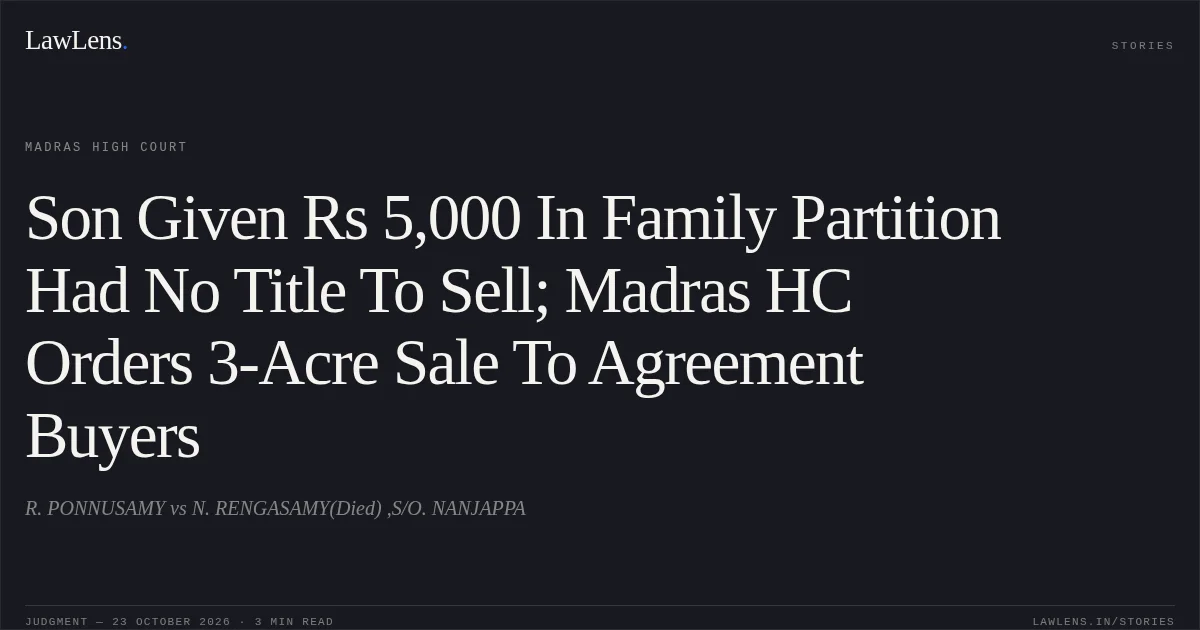
The appellants agreed on 7 November 2007 to purchase three acres of agricultural land from the first and second respondents for ₹9,08,000 per acre.
pp. 3–4They paid ₹3,00,000 on execution and a further ₹50,000 by endorsement.
pp. 3–4The vendors’ title arose from a settlement and a partition under which the first and second respondents received the land, while the fourth respondent received ₹5,000 and no land.
pp. 3–4 · pp. 15–16The appellants sought specific performance, asserting readiness and willingness; the vendors admitted the agreement but disputed that the appellants were ready and willing to complete the sale.
pp. 5–6 · p. 9The trial court dismissed the suit on that ground, including for want of proof of means.
pp. 5–6 · p. 9On appeal, the High Court framed an additional issue on readiness and willingness and directed the trial court to record evidence under Order XLI Rule 25 CPC.
pp. 10–12The fourth respondent had meanwhile conveyed the property, and the subsequent purchaser was impleaded as the sixth respondent.
p. 10 · p. 1202Issues
i.1. Whether the agreement dated 7 November 2007 was valid, binding and enforceable
p. 13ii.2. Whether the appellants were ready and willing to perform their part of the agreement
p. 11 · p. 13iii.3. Whether the fourth respondent had any right or title to convey the property, and whether the subsequent conveyance could be upheld
p. 1303Law Applied
The Court applied Section 96 CPC in hearing the first appeal and Order XLI Rules 25 and 30 CPC in obtaining additional evidence and determining the appellate points.
p. 2 · pp. 10–13It referred to Order XIV CPC, under which issues are to be framed on material propositions of fact or law affirmed by one party and denied by the other.
p. 16The Court applied the principles governing specific performance: a valid and binding sale agreement may be enforced where the parties are required to perform their respective obligations, including the purchaser’s obligation to pay the balance and the vendors’ obligation to execute the sale deed.
pp. 15–16It also applied the rule that a person without title cannot convey title to a subsequent purchaser.
p. 17Provisions in the judgment · 1 · Linked ones open on LawLens
Code of Civil Procedure, 1908 Section 96
04Reasoning
The agreement, the consideration, and both advance payments were undisputed; the Court therefore found the agreement valid and binding.
pp. 14–16It rejected the trial court’s inference that the appellants’ request for a cart track showed unwillingness, observing that access was reasonably necessary for agricultural land and that discussions about surveying and demarcating the land supported an intention to complete the transaction.
p. 15The trial court’s finding that the appellants lacked the means to pay was unsupported by evidence, and no readiness-and-willingness issue had initially been framed; the additional evidence also confirmed that the balance consideration had been deposited in court.
p. 16As the partition deed allotted no land to the fourth respondent and had not been set aside, he had no title to convey; the subsequent purchaser therefore acquired no title through him.
p. 12 · p. 1705Holding
The Court allowed the appeal, set aside the trial court’s judgment and decree, and decreed the suit for specific performance.
p. 18It held the agreement enforceable and the fourth respondent’s conveyance to the sixth respondent void and non-est.
pp. 16–18The second, fifth and sixth respondents were directed to execute the sale deed in favour of the appellants within three months; the second and fifth respondents may withdraw the deposited sale consideration with interest upon execution.
p. 18Original Court PDF
R. PONNUSAMYvsN. RENGASAMY(Died) ,S/O. NANJAPPA
Click to open original judgment
Original judgment, available to read, download and summarize on LawLens.in