01Facts
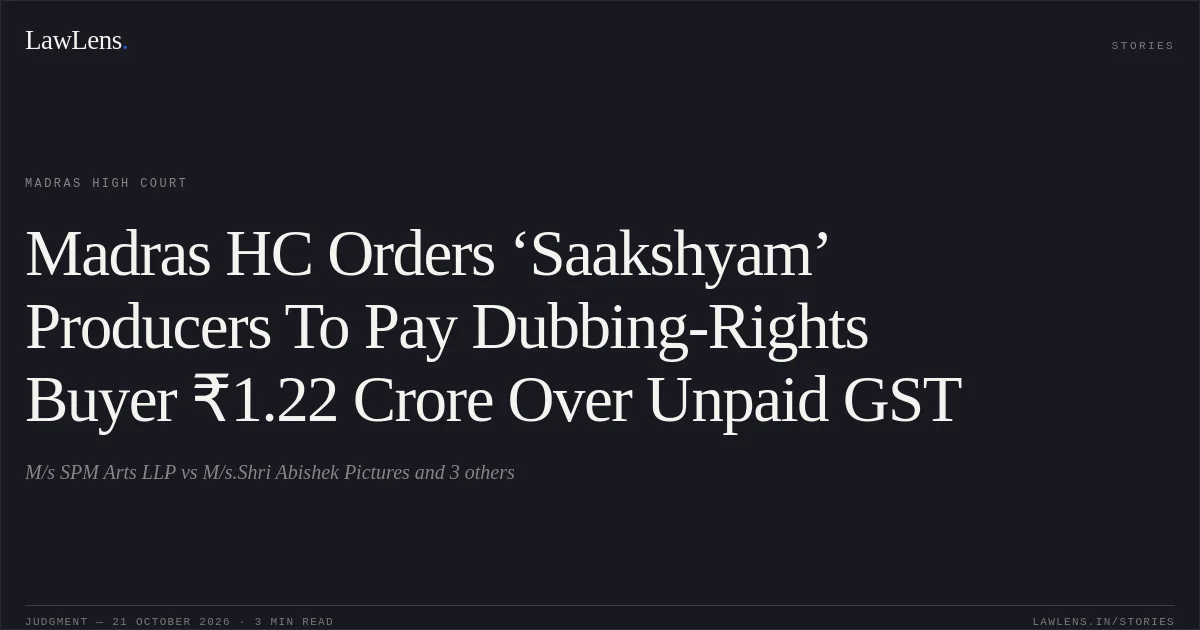
The plaintiff, an LLP engaged in film copyright transactions, entered into a deed of assignment dated 5 February 2018 with defendants 1 and 2 for dubbing rights to the film Saakshyam, for consideration of ₹7.5 crore inclusive of GST.
p. 3 · p. 7The plaintiff alleged it paid the full consideration, while defendants 1 and 2 failed to remit a GST component of ₹42,85,714; the plaintiff relied on the deed, invoices, payment records and a letter stating that the defendants would pay GST.
pp. 4–5, 8After the GST authorities issued proceedings against the plaintiff, it challenged the demand and paid 10% of it pending appeal.
p. 6, 9Defendants 1 and 2 were set ex parte; the statutory authorities, impleaded later, did not file written statements but cross-examined the plaintiff’s witness.
pp. 6, 9–10The plaintiff sought ₹1,22,66,092, representing the alleged GST liability and related interest and penalties, with interest and costs.
p. 2, 802Issues
i.1. Whether the plaintiff performed its contractual obligation by paying the ₹7.5 crore consideration.
p. 6ii.2. Whether defendants 1 and 2 raised invoices for the payments received.
p. 7iii.3. Whether defendants 1 and 2 were contractually liable to pay the GST on the transaction.
p. 7iv.4. Whether defendants 1 and 2 were liable for the GST amount and associated interest and penal interest in light of the tax proceedings.
p. 7v.5. Whether the plaintiff was entitled to recover the claimed amount from the defendants.
p. 703Law Applied
The court treated the deed of assignment and the parties’ related representations as governing their contractual allocation of the GST burden: where the agreed consideration was inclusive of GST and the supplier had undertaken to pay GST, the purchaser’s payment of the full consideration supported recovery from the supplier when the supplier failed to remit the tax.
pp. 7–8, 10–11The judgment referred to Section 16(2) of the Central Goods and Services Tax Act, 2017, observing that the tax authorities could proceed against the plaintiff as well as the defendants in accordance with law.
p. 10It also noted the plaintiff’s claim as arising under Section 50(3) of the Central Goods and Services Tax Rules, 2017; it did not analyse or set out the operation of that provision.
p. 3No precedent was cited.
Provisions in the judgment · 2 · Linked ones open on LawLens
Commercial Courts Act, 2015 Section 7
Central Goods and Services Tax Act, 2017 Section 16
04Reasoning
The court accepted the unchallenged evidence that the plaintiff paid the full ₹7.5 crore and relied on the assignment deed, invoices and the defendants’ letter confirming that they would pay GST.
pp. 7–8, 10–11It found that the defendants’ failure to remit the GST had led to proceedings against the plaintiff, but held that those proceedings did not prevent the plaintiff from pursuing its contractual claim against defendants 1 and 2.
pp. 10–11The court left the statutory authorities free to pursue their remedies against the plaintiff, subject to the pending appeal, and confined the civil decree to defendants 1 and 2 because the authorities had been impleaded only at the argument stage and the prayer had not been amended.
pp. 10–1205Holding
The suit was decreed in part against defendants 1 and 2, jointly and severally, for ₹1,22,66,092, with interest at 24% per annum from the date of the plaint to the date of decree and 6% per annum thereafter until realisation.
p. 12Defendants 1 and 2 were also ordered to pay the suit costs incurred by the plaintiff and defendants 3 and 4.
p. 12No decree was passed against the statutory authorities, whose rights to proceed under law remained unaffected.
pp. 10–12Original Court PDF
M/s SPM Arts LLPvsM/s.Shri Abishek Pictures and 3 others
Click to open original judgment
Original judgment, available to read, download and summarize on LawLens.in