01Facts
The petitioners claimed to belong to the Santal Scheduled Tribe.
¶ 4The Sub-Divisional Officer (SDO), Khatra, issued Scheduled Tribe certificates to petitioner no. 1 on 24.06.2022 and to the other petitioners on 30.11.2022.
¶ 5Following complaints from fifty-three persons alleging fraudulent procurement, the SDO initiated proceedings under Rule 3 of the West Bengal Scheduled Castes and Scheduled Tribes (Identification) Rules, 1995 ("1995 Rules") and, on 10.12.2024, cancelled the certificates under Rule 5.
¶ 6–8, 17–19The SDO found inconsistencies in the petitioners' accounts of social structure, language, deities and rituals.
¶ 9The petitioners' writ petition (WPA 5368 of 2025) was dismissed with liberty to appeal.
¶ 10Their appeal under Rule 7G was rejected by the Appellate Authority on 04.09.2025, which found discrepancies in family-tree statements, the absence of ancestral documents, inability to speak Santali or write Olchiki, and conflicting deity accounts.
¶ 11, 2Before the High Court, the petitioners contended that no show-cause notice under Rule 3(3) was issued and relied on a Record of Rights (p. 17) recording Joyram Majhi as "Santal," a 1950 deed (p. 21) recording Babulal Majhi as "Santal," and a Gram Panchayat lineage chart.
¶ 12–15The State argued that the certificates were issued during the Duare Sarkar scheme and were obtained fraudulently.
¶ 17–2102Issues
i.1. Whether the non-issuance of a show-cause notice under Rule 3(3) of the 1995 Rules vitiates the cancellation proceedings, where the ground was not raised before the Appellate Authority and no prejudice is shown.
¶ 24–30ii.2. Whether the Appellate Authority's rejection of the appeal is amenable to judicial interference, given the limited scope of judicial review over administrative and quasi-judicial decisions.
¶ 31, 36iii.3. Whether the Appellate Authority was bound to consider the old Records of Rights and the 1950 deed, which bear on whether the petitioners' ancestors were Santal, before concluding that the petitioners do not belong to the Santal tribe.
¶ 33–3703Law Applied
Rule 3(3) of the 1995 Rules requires a show-cause notice before action against a certificate holder, and is treated as a statutory precondition to proceedings.
¶ 12, 25, 29Where a statute prescribes a manner of performance, the act must be done in that manner or not at all.
¶ 25A point not raised before the appellate forum cannot be raised for the first time in writ proceedings.
¶ 28The settled limits of judicial review of administrative or quasi-judicial decisions are illegality, excess of power, error of law, breach of natural justice, unreasonableness, or perversity.
¶ 31Anand v. Committee for Scrutiny and Verification of Tribe Claims, 2012 (1) SCC 113 holds that pre-Independence documents carry greater probative value on caste status, that the first generation to attend school may receive the benefit of doubt, and that doubts on documents must be tested through oral evidence with an opportunity to the applicant.
¶ 16, 32Whether two persons with the same name are the same individual is a disputed question of fact.
¶ 3404Reasoning
The court held that the absence of a Rule 3(3) notice was a genuine violation.
¶ 24The petitioners had not raised this ground in their appeal memorandum before the Appellate Authority, so they could not raise it for the first time in writ proceedings.
¶ 28The petitioners had been heard, no procedural unfairness was alleged, and they were given later opportunities to substantiate their claims, so no prejudice was shown.
¶ 30The court therefore declined to set aside the proceedings on this ground.
¶ 26, 30The Appellate Authority's findings rested on discrepancies in oral statements and the absence of ancestral documents.
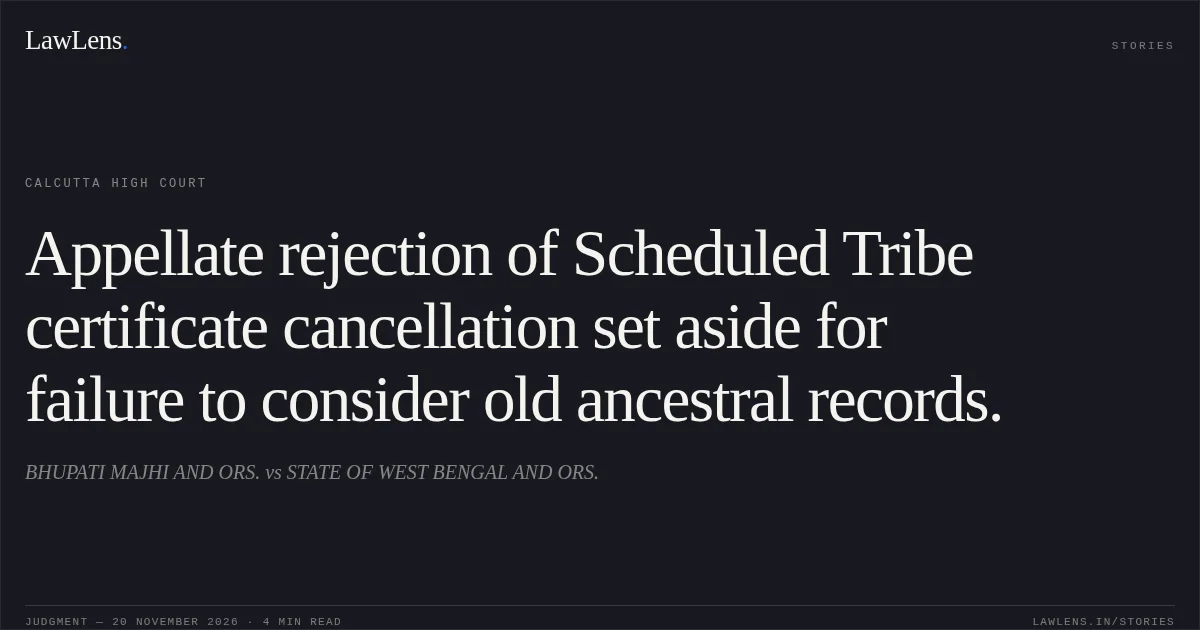
¶ 11The court found that the Appellate Authority had not considered the 1950 deed and the Record of Rights recording Joyram as Santal, which the court treated as "vital pieces of evidence" under Anand.
¶ 32–33, 35Because the material was not considered, the court held that the order was vitiated by non-consideration of relevant material, which falls within the recognised grounds of review.
¶ 31, 36The court refrained from deciding whether the Joyram in the Record of Rights is the petitioners' ancestor, since that is a disputed fact for the authority to determine.
¶ 34, 37The petitioners' rights were held to be at stake, so remand was appropriate rather than a final determination.
¶ 3605Holding
On issue 1, the Rule 3(3) violation did not afford relief because the ground was not raised before the Appellate Authority and no prejudice was shown.
¶ 28, 30On issues 2 and 3, the Appellate Authority's order was liable to be set aside because it failed to consider the 1950 deed and the Record of Rights, which are vital to the caste inquiry.
¶ 35–36The impugned order dated 04.09.2025 is set aside, and the matter is remanded to the Appellate Authority. The Appellate Authority must determine (a) whether the Joyram in the Election Commission identity card is the same person as the Joyram Majhi in the Record of Rights and the 1950 deed, and (b) whether that Joyram was the petitioners' ancestor. The authority must afford the petitioners a hearing within six weeks of communication of the order, pass a reasoned order within two weeks of the hearing, and may call for original records. The petitioners may produce further records. The writ petition is disposed of without costs.
¶ 36–41Original Court PDF
BHUPATI MAJHI AND ORS.vsSTATE OF WEST BENGAL AND ORS.
Click to open original judgment
Original judgment, available to read, download and summarize on LawLens.in