01Facts
A written complaint dated 17 December 2018 led to FIR No. 04 of 2019 at P.S. Ganj, District Rampur, under Sections 120-B, 420, 467, 468 and 471 IPC. The prosecution alleged a conspiracy to procure and use two conflicting birth certificates in the name of Mohammad Abdullah Azam Khan.
¶ 3 · pp. 2–3The Trial Court convicted all three accused on 18 October 2023, and the appellate court affirmed on 23 December 2023.
¶ 18 · p. 7The convicts filed criminal revisions before the High Court, along with applications under Section 389(1) r/w Sections 397/401 CrPC.
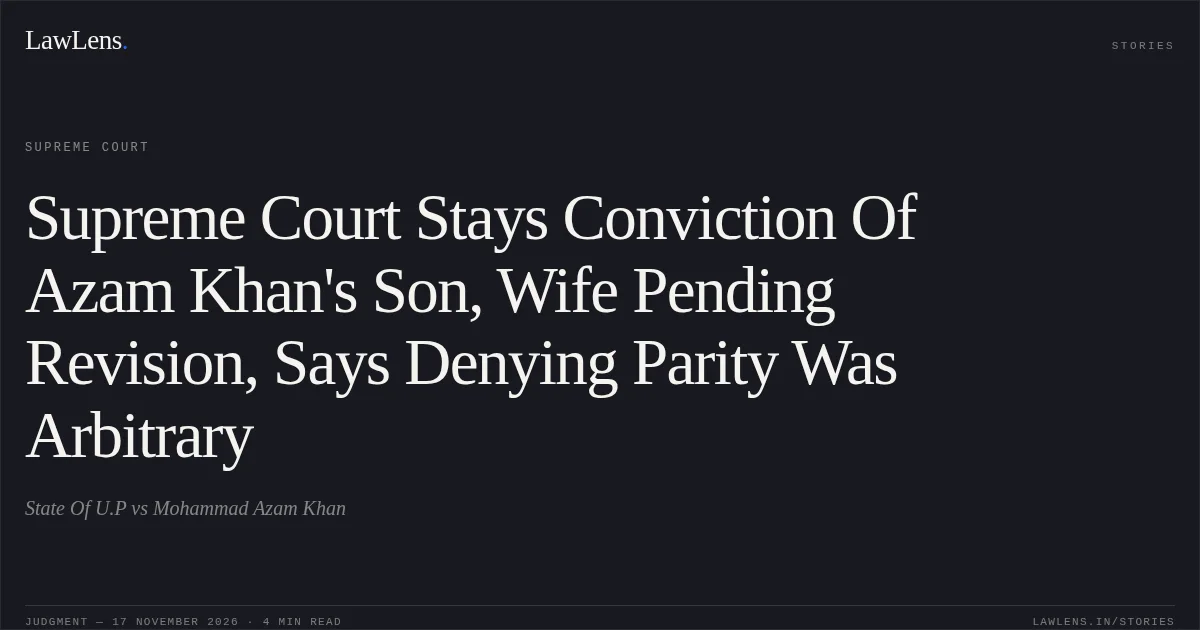
¶ 11 · p. 5By its judgment dated 24 May 2024, the High Court stayed Mohammad Azam Khan's conviction while suspending the sentences of all three and granting them bail. It refused a stay of conviction to Abdullah and Tazeen Fatma.
¶ 2 · p. 2 · ¶ 18 · pp. 7–8The High Court's reasons included the offence not being heinous, the convicts' bail conduct, their advanced age and ailments, no risk of absconding, and the periods already served (Azam Khan over 2 years 5 months; the others over 1 year 4 months, against a maximum of seven years).
¶ 18 · pp. 7–8The State appealed the stay granted to Azam Khan. Abdullah and Tazeen Fatma appealed the denial of stay to them.
¶ 2 · p. 202Issues
i.1. Whether a revisional court may grant a stay of conviction not sought in the prayer clause of the revision petition, without recording extraordinary reasons.
¶ 10–12 · pp. 4–5ii.2. Whether the grant of a stay of conviction to Mohammad Azam Khan is vitiated because the High Court did not separately record reasons for it.
¶ 13–16 · pp. 5–6iii.3. Whether the High Court was justified in denying Mohammad Abdullah Azam Khan and Dr. Tazeen Fatma a stay of conviction while granting it to Mohammad Azam Khan, who stood on the same evidentiary footing.
¶ 7–8 · pp. 3–4 · ¶ 18–19 · pp. 6–9 · ¶ 25–26 · pp. 11–1203Law Applied
Section 389(1) CrPC empowers appellate and revisional courts to suspend sentences and, as construed in Afjal Ansari v. State of U.P. (2024) 2 SCC 187, to stay convictions where their operation would cause irreparable harm that cannot be compensated if the convict is later acquitted.
¶ 9 · p. 4 · ¶ 21 · pp. 9–10Following Ravikant S. Patil v. Sarvabhouma S. Bagali (2007) 1 SCC 673, a stay of conviction is an exception requiring distinct justification.
¶ 9 · p. 4 · ¶ 21 · p. 9Article 14 embodies parity: equally situated persons must be treated alike unless an intelligible differentia with a rational nexus to the order's object justifies differential treatment, and an unreasoned departure is arbitrary.
¶ 19 · pp. 8–9Article 21 protects personal dignity and reputation, and a conviction inflicts irreversible stigma during pendency of revision.
¶ 20 · p. 9 · ¶ 22 · p. 10Political or electoral considerations are not a valid ground for a stay of conviction.
¶ 23 · pp. 10–11Article 136 governs the scope of interference with the High Court's discretion.
¶ 16 · p. 6Provisions in the judgment · 7 · Linked ones open on LawLens
Code of Criminal Procedure, 1973 Section 389Section 397Section 401
Indian Penal Code, 1860 Section 420Section 467Section 468Section 471
04Reasoning
On the first issue, the Court held that the High Court did not travel beyond the pleadings. The record of proceedings showed that all three revisionists had separately applied for a stay of conviction, connected with the Section 389(1) applications, so the objection was overruled.
¶ 11–12 · p. 5On the second issue, the Court accepted that the High Court gave no extensive reasons for staying Azam Khan's conviction. It found, however, that the reasons supporting suspension of his sentence (his substantial custody period, advanced age, and the absence of direct evidence that he personally forged the signatures) were valid grounds for a stay of conviction. Their exercise of discretion was not manifestly perverse, so the State's appeal failed.
¶ 13–17 · p. 6On the third issue, the Court found that the High Court gave no coherent reason for distinguishing the three convicts. All were convicted under the same conspiracy charge on the same documentary evidence, and no distinct overt act of forgery was attributed to Abdullah or Tazeen Fatma beyond their status as co-conspirators and beneficiaries. The High Court's own findings on the nature of the offence, bail conduct, age, health, and time served applied equally to all three. Its distinction of Azam Khan's case, which rested on the evidence against him, was not explained in terms that departed from parity.
¶ 18 · pp. 6–7 · ¶ 25–26 · pp. 11–12 · ¶ 18 · pp. 7–8 · ¶ 33 · p. 805Holding
A revisional court may grant interim relief beyond the prayer clause where the petition itself seeks suspension of sentence and the relief is pressed by a separate application.
¶ 12 · p. 5A stay of conviction is valid where the reasons for suspending sentence also justify a stay.
¶ 15 · p. 6Where similarly placed co-convicts seek a stay, a departure from parity must be expressly reasoned, failing which the order is arbitrary. The refusal was an arbitrary differentiation violating parity and a patent error of jurisdiction.
¶ 19 · pp. 8–9 · ¶ 25–26 · pp. 11–12The State's appeal against the stay of Mohammad Azam Khan's conviction is dismissed. The appeals of Mohammad Abdullah Azam Khan and Dr. Tazeen Fatma are allowed. The High Court's refusal of a stay of conviction to them is set aside, and their conviction and sentence dated 18 October 2023, as affirmed on 23 December 2023, remain stayed pending their criminal revisions. The High Court is directed to decide the revisions on their individual merits, uninfluenced by these observations, as expeditiously as possible.
¶ 17 · p. 6 · ¶ 27 · p. 12 · ¶ 28 · p. 12Original Court PDF
State Of U.PvsMohammad Azam Khan
Click to open original judgment
Original judgment, available to read, download and summarize on LawLens.in