01Facts
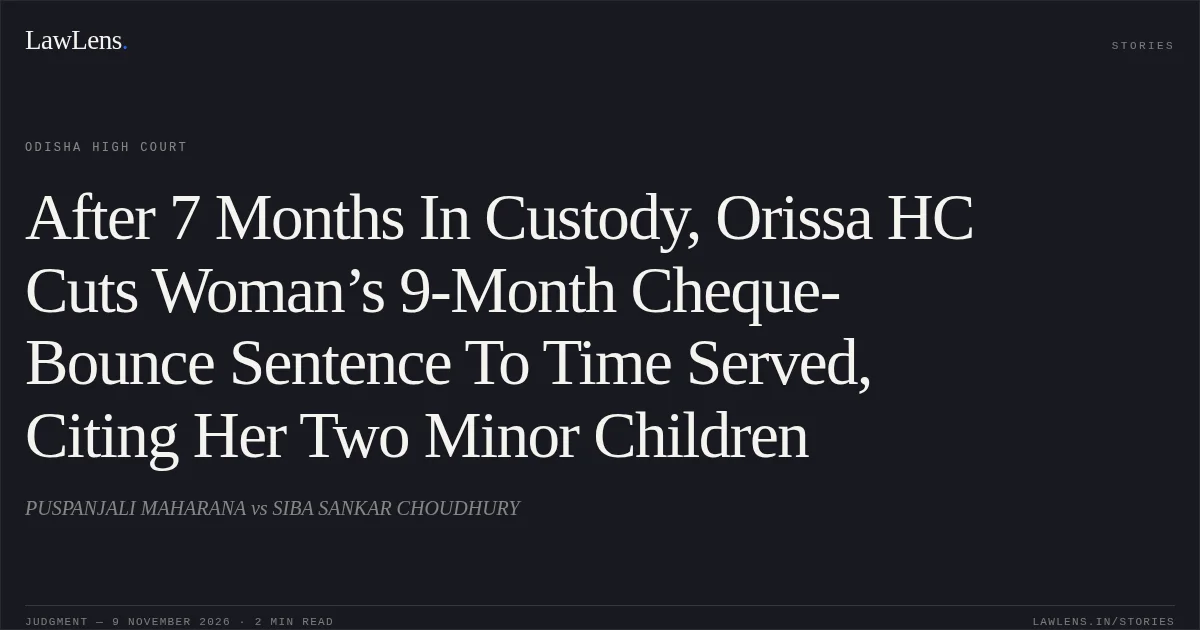
The petitioner was convicted under Section 138 of the Negotiable Instruments Act for issuing a cheque for ₹5,28,172, which was dishonoured.
p. 1The trial court sentenced her to nine months’ simple imprisonment and directed her to pay ₹9,76,344 as compensation under Section 357(3) of the Code of Criminal Procedure read with Section 117 of the Negotiable Instruments Act; default in payment attracted three months’ simple imprisonment.
pp. 1–2The appellate court affirmed the conviction and sentence.
p. 2In revision, the petitioner did not challenge her conviction and sought reduction of her substantive sentence to the period already undergone.
p. 3She had served 222 days as of 30 October 2026 and approximately 229 days by the date of judgment.
pp. 3–4The Court also noted that she was a 40-year-old woman with two minor children and that she claimed to have no means to pay the cheque amount.
p. 402Issues
i.1. Whether the petitioner’s substantive sentence should be reduced to the period already undergone, having regard to the circumstances advanced in mitigation.
pp. 3–5ii.2. Whether the compensation order and the consequence of default in payment should remain operative following any reduction of the substantive sentence.
pp. 2, 4–503Law Applied
The Court considered the petitioner’s conviction under Section 138 of the Negotiable Instruments Act and the compensation order under Section 357(3) of the Code of Criminal Procedure read with Section 117 of the Negotiable Instruments Act.
pp. 1–2It applied the sentencing principle that punishment is intended to deter offending, not merely to exact retribution, and that its purpose is not to “finish the criminal” but to “finish the crime”.
p. 4Provisions in the judgment · 5 · Linked ones open on LawLens
Code of Criminal Procedure, 1973 Section 401Section 357
Bharatiya Nagarik Suraksha Sanhita, 2023 Section 442
Negotiable Instruments Act, 1881 Section 138Section 117
04Reasoning
The petitioner expressly confined her revision to sentence and did not seek to challenge the conviction; the Court found no error in the concurrent judgments on the merits.
p. 3, 5In considering sentence, it weighed her nearly completed nine-month term, her status as a woman with two minor children, and the impact of continued custody on the children.
pp. 4–5The Court also considered that reducing the substantive sentence would not extinguish the compensation liability, which remained recoverable in accordance with law.
pp. 4–505Holding
The Court dismissed the revision but modified the sentence by reducing the substantive imprisonment to the period already undergone.
p. 5The compensation order remained in force, and the petitioner was directed to undergo 30 days’ imprisonment in default of payment of compensation.
p. 5The impugned judgments were otherwise confirmed.
p. 5Original Court PDF
PUSPANJALI MAHARANAvsSIBA SANKAR CHOUDHURY
Click to open original judgment
Original judgment, available to read, download and summarize on LawLens.in