01Facts
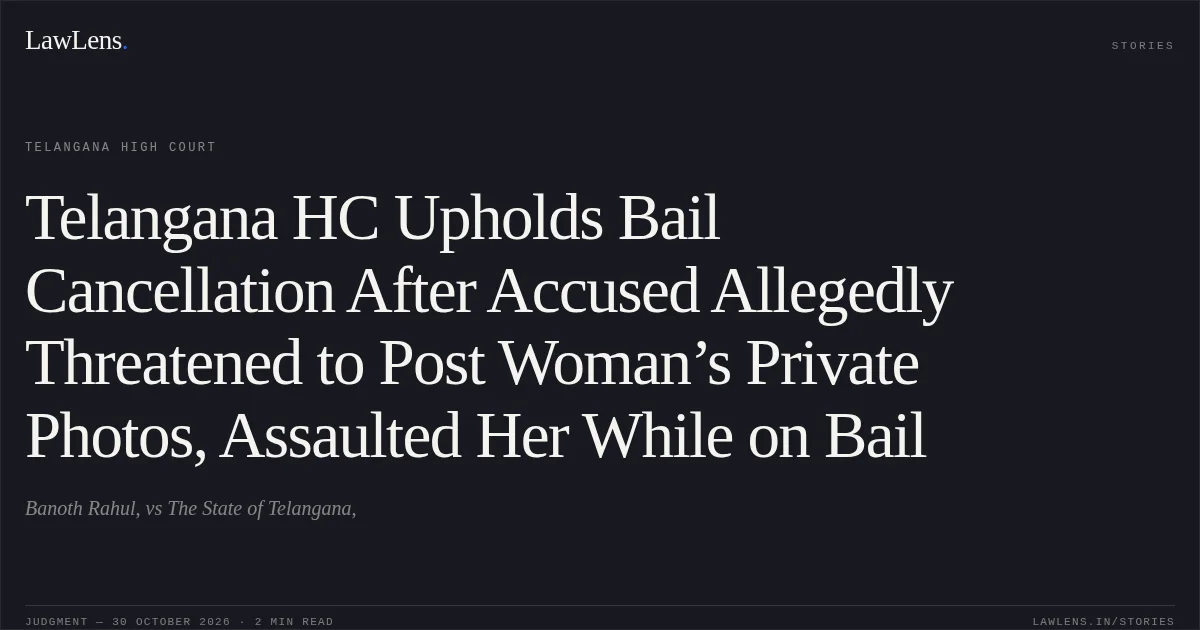
The petitioner, Accused No. 1 in Crime No. 69 of 2026, was granted bail on 23 February 2026, subject to a condition that he not threaten or induce witnesses.
¶ 1–2The complainant later alleged that, while on bail, he threatened to publish her private photographs and videos and, on 14 May 2026, assaulted and intimidated her with his brothers.
¶ 1–2A subsequent crime was registered against them, and the complainant sought cancellation of bail.
¶ 1–2On 7 October 2026, the trial court cancelled bail, finding that the petitioner had misused his liberty.
¶ 1–2He challenged that order before the High Court.
¶ 1–202Issues
i.Whether the trial court was justified in cancelling the petitioner’s bail on the basis of allegations that he threatened, assaulted and intimidated the complainant after his release
¶ 7–8, 11ii.Whether the subsequent crime’s registration, the alleged delay in the complaint, or the absence of supporting evidence required the cancellation order to be set aside
¶ 9–10, 15–1603Law Applied
The Court applied the principle that rejection of bail and cancellation of bail already granted are distinct matters: cancellation requires very cogent and overwhelming circumstances and cannot follow mechanically from the registration of a subsequent crime.
¶ 13Under Dolat Ram v. State of Haryana, bail may be cancelled where an accused abuses the concession, interferes with justice, threatens witnesses, or otherwise undermines a fair trial.
¶ 13Raghubir Singh v. State of Bihar recognises abuse of liberty, including by engaging in further unlawful acts, as a valid ground for cancellation.
¶ 17The Court also relied on Abdul Basit v. Abdul Kadir Choudhary and Phireram v. State of Uttar Pradesh, which identify post-bail criminal activity, witness intimidation, interference with investigation, and breach of bail conditions as grounds for cancellation.
¶ 18–20The petition invoked Section 528 of the BNSS; the cancellation application before the trial court was stated to have been filed under Section 483(3) CrPC.
¶ 8, 21Provisions in the judgment · 10 · Linked ones open on LawLens
Bharatiya Nyaya Sanhita, 2023 Section 69Section 115Section 126Section 351Section 3
Code of Criminal Procedure, 1973 Section 167Section 437Section 439Section 483
Bharatiya Nagarik Suraksha Sanhita, 2023 Section 528
04Reasoning
The High Court considered that the cancellation order rested not merely on the registration of Crime No. 437 of 2026, but on specific allegations that the petitioner had threatened the complainant and physically assaulted and intimidated her after bail.
¶ 11, 15, 20If established, those allegations prima facie showed misuse of liberty and breach of the express condition against threatening or inducing witnesses.
¶ 11, 15, 20The petitioner’s objections concerning delay and the lack of supporting material did not warrant interference at this stage: the record included material relating to a complaint made to Khairatabad Police Station and medical treatment, while investigation into the subsequent crime remained ongoing.
¶ 9–10, 16The Court held that the truth of those matters was for investigation and that the limited question was the validity of the cancellation order.
¶ 9–10, 1605Holding
The Court held that the trial court had sufficient grounds to cancel bail because the allegations, if true, showed that the petitioner had violated the bail condition and misused the liberty granted to him.
¶ 20–22Finding no ground to interfere under Section 528 of the BNSS, it dismissed the criminal petition and left the cancellation order in force.
¶ 20–22Original Court PDF
Banoth Rahul,vsThe State of Telangana,
Click to open original judgment
Original judgment, available to read, download and summarize on LawLens.in