01Facts
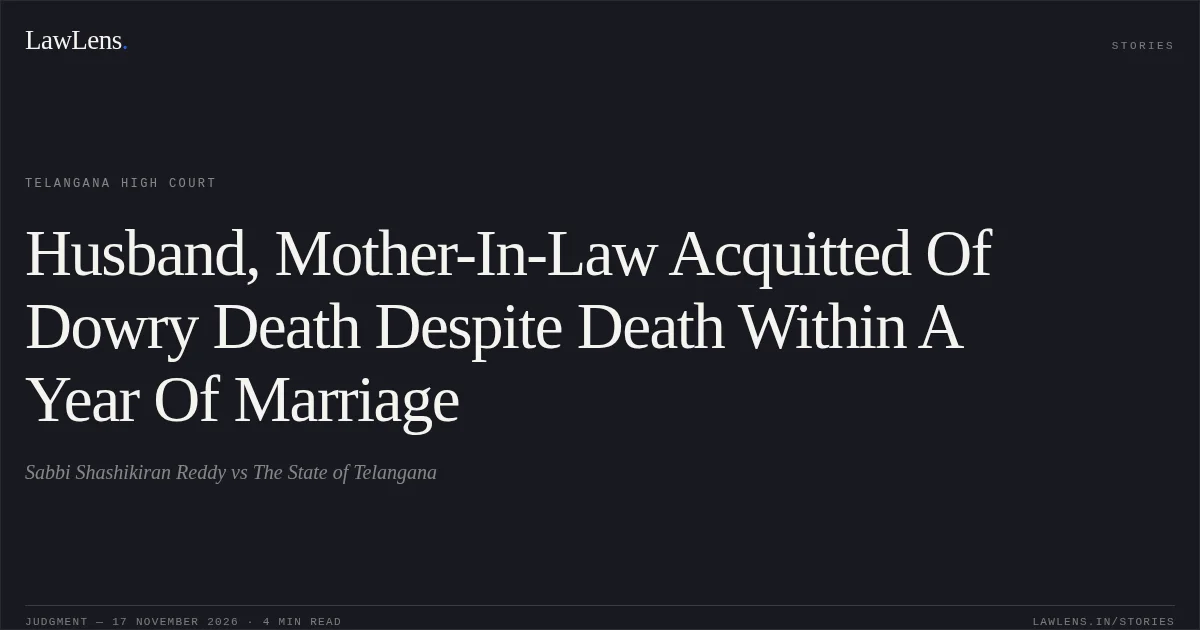
The appellants, accused Nos. 1 (husband) and 2 (mother-in-law), were convicted under Sections 498-A and 304-B IPC by the XVI Additional District and Sessions Judge, Ranga Reddy District, in S.C. No. 804 of 2017 on 08.12.2020 and sentenced to one year's and seven years' rigorous imprisonment, respectively.
¶ 1The marriage with the deceased was solemnised on 31.10.2015.
¶ 3.1The prosecution alleged dowry of Rs. 10,00,000, 10 tulas of gold and three acres of mango garden at marriage, followed by demands for Rs. 5,00,000, 15 tulas of gold and transfer of the garden.
¶ 3.1–3.2The deceased was found hanging at her matrimonial home on 13.06.2016. PW.1, her father, lodged the complaint the following day.
¶ 3.3Post-mortem by PW.10 recorded asphyxia due to hanging.
¶ 14Investigation was conducted by PW.13.
The trial court relied on PWs.1, 3, 4, 5, 6 and 7 and drew the Section 113-B presumption.
¶ 6, 8PW.2, the accused No. 1's uncle, was declared hostile and deposed to cordial marital relations.
¶ 32The appellants' counsel contended that the witnesses' evidence was riddled with omissions and that the death was not shown to be linked to dowry harassment.
¶ 7.1–7.5The State supported the conviction.
¶ 802Issues
i.1. Whether the prosecution proved beyond reasonable doubt that accused Nos. 1 and 2 subjected the deceased to cruelty within the meaning of Section 498-A IPC.
¶ 9, 52–55ii.2. Whether the prosecution established the ingredients of dowry death under Section 304-B IPC, particularly cruelty or harassment in connection with dowry "soon before" death, so as to attract the presumption under Section 113-B of the Indian Evidence Act.
¶ 9, 56–62iii.3. Whether the trial court's conviction and sentence warrant interference by the appellate court.
¶ 9, 63–6903Law Applied
Section 498-A IPC, under which "cruelty" is defined in its Explanation as wilful conduct likely to drive a woman to suicide or cause grave injury, or harassment to coerce an unlawful demand for property or valuable security.
¶ 10Section 304-B IPC requires that (i) the death be caused by burns, bodily injury, or occur otherwise than under normal circumstances; (ii) occur within seven years of marriage; (iii) be preceded "soon before" by cruelty or harassment by the husband or relative; and (iv) that cruelty be connected with a dowry demand.
¶ 11Under Section 113-B of the Indian Evidence Act, the presumption arises only after the prosecution establishes these foundational facts.
¶ 12Baijnath v. State of Madhya Pradesh, (2017) 1 SCC 101, holds that the presumption is contingent on proof of the 304-B ingredients beyond reasonable doubt and that an unnatural death within seven years is not, by itself, sufficient.
¶ 12"Soon before" is not synonymous with "immediately before" but requires a proximate and live link with the death.
¶ 56The burden never shifts to the accused merely because death occurred within seven years, accused must not be required to explain the death absent proof of foundational facts, and where two views are reasonably possible the view favourable to the accused prevails.
¶ 56, 62–63Provisions in the judgment · 3 · Linked ones open on LawLens
Indian Penal Code, 1860 Section 302
Code of Criminal Procedure, 1973 Section 313Section 437
04Reasoning
The court accepted that the first two ingredients of Section 304-B stood established: death by hanging, otherwise than under normal circumstances, within seven years of marriage.
¶ 14–16, 56PW.1 admitted to pooling funds from relatives who were neither named in the complaint nor cited as witnesses, and to lacking documentary proof of the dowry and land ownership.
¶ 18–19PW.3 admitted that his account of the deceased's post-marriage complaints, the job search and the 31.05.2016 interview was not disclosed to police.
¶ 22–24PW.5 admitted that the deceased never complained to him directly, and that he had told the media the disputes were trivial.
¶ 27–28PW.6's account of the mango-refusal incident four days before death was omitted from his police statement, a fact confirmed by PW.13.
¶ 36–38PW.7 conceded an omission recorded in Ex.D1.
¶ 40–41PW.4 did not inform police of the alleged disclosures, and no contemporaneous records or call detail records were collected.
¶ 34–35, 45, 48The court held that these lapses left the alleged harassment in the period proximate to death unproven, and that the vague evidence of weakness or job-seeking could not itself establish dowry-related cruelty.
¶ 59–60Because the foundational cruelty element failed, the Section 113-B presumption could not be invoked.
¶ 61The trial court's reliance on the accused's failure to explain the suicide was held to impermissibly shift the burden.
¶ 62, 65Accused No. 2 was found to have no specific role attributed to her beyond her relationship as mother-in-law, and PW.2's testimony undercut the allegations against the family.
¶ 54, 60, 66Applying the presumption of innocence, the court held that the trial court had not properly appreciated these omissions.
¶ 63–6405Holding
The prosecution failed to prove cruelty under Section 498-A IPC or the soon-before-death dowry-related cruelty required under Section 304-B IPC, so the Section 113-B presumption could not arise.
¶ 55, 61, 68The unnatural death within seven years was established but was held insufficient by itself to sustain conviction.
¶ 68The appeal is allowed. The judgment of 08.12.2020 in S.C. No. 804 of 2017 is set aside, and both appellants are acquitted and given the benefit of doubt.
¶ 68–69Their bail bonds stand cancelled subject to compliance with Section 437-A Cr.P.C., any fine paid is to be refunded in accordance with law, and pending miscellaneous applications are closed.
¶ 69Original Court PDF
Sabbi Shashikiran ReddyvsThe State of Telangana
Click to open original judgment
Original judgment, available to read, download and summarize on LawLens.in