Insolvency and Bankruptcy LawCommercial and Corporate Law
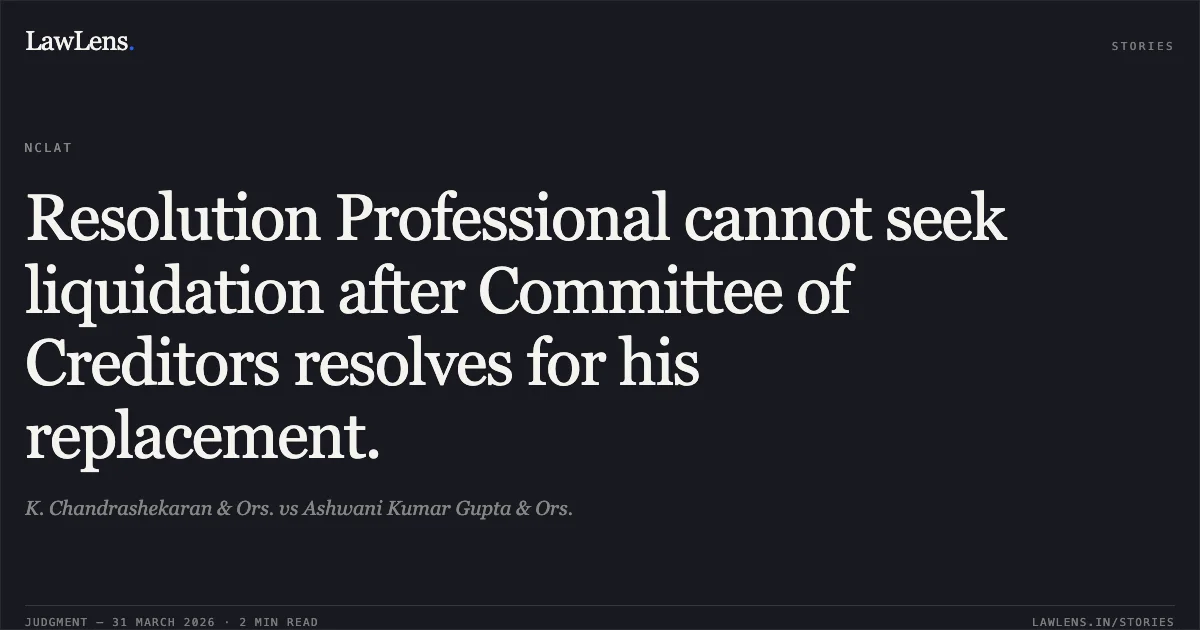
Resolution Professional cannot seek liquidation after Committee of Creditors resolves for his replacement.
The Committee of Creditors (CoC) of M/s. Infodrive Software Limited (Corporate Debtor) challenged an order dated 06.04.2022 passed by the NCLT, Chennai, which directed the liquidation of the Corporate Debtor.
2 MIN READ→
![Direction to Substitute Directors Premature During Pending Liquidation Where Certain Assets Remain Unsold. Amresh Shukla (Liquidator of Girdharilal Sugar and Allied Industries Limited) v. Radheshyam Dairy Through Mr. Tiaknarayn Purohit & Ors. [Company Appeal (AT) (Insolvency) No. 470 of 2026]. National Company Law Appellate Tribunal. LawLens](/stories/thumbnails/direction-to-substitute-directors-premature-during-pending-liquidation-where-certain-asset-43638365176c4b1bbc00f72349097bd8.webp)
![Admitted claims in Resolution Plans are extinguished upon approval, regardless of alleged communication failures in spam folders.. Income Tax Officer, Ward 1 (3), Jaipur v. M/s Solar Voltaic Power LLP & Anr. [Company Appeal (AT) (Ins.) No. 286 of 2025]. National Company Law Appellate Tribunal. LawLens](/stories/thumbnails/admitted-claims-in-resolution-plans-are-extinguished-upon-approval-regardless-of-alleged-c-2360d97cac1c49969f99147c1a433eec.webp)
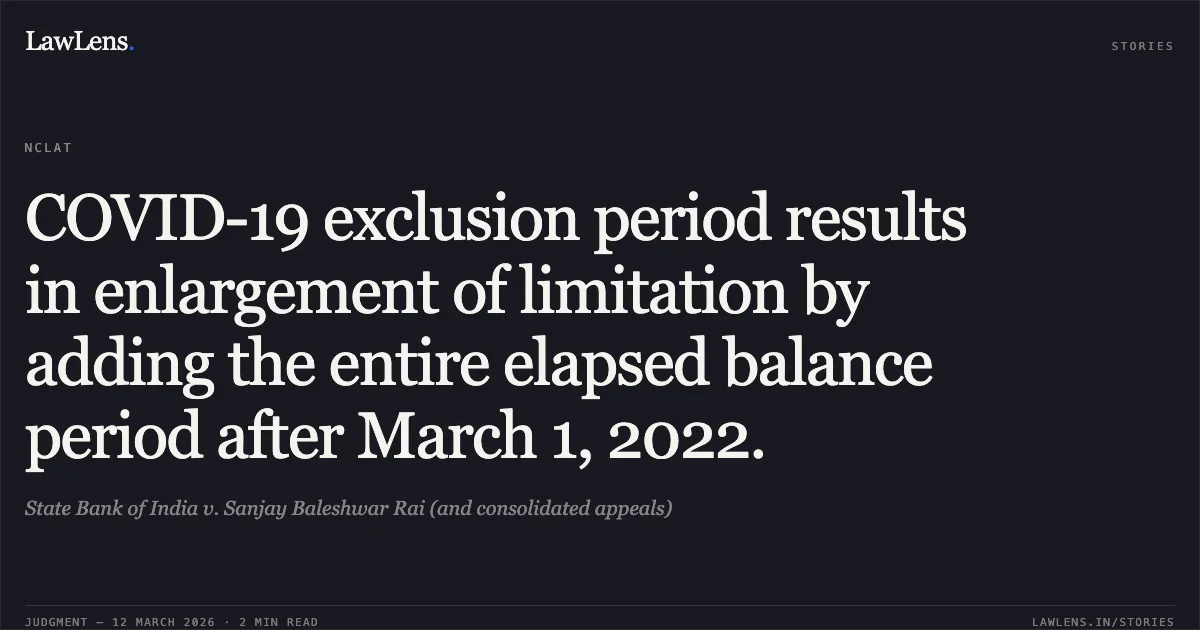
![COVID-19 pandemic exclusion applies to the entire balance period of limitation, not just ninety days.. State Bank of India v. Sanjay Baleshwar Rai (and connected appeals) [Company Appeal (AT) (Insolvency) Nos. 893, 894, 1280 & 1281 of 2024]. National Company Law Appellate Tribunal. LawLens](/stories/thumbnails/covid-19-pandemic-exclusion-applies-to-the-entire-balance-period-of-limitation-not-just-ni-ebd13e3b6d064f078e5feddbf1793ce8.webp)
![Limitation period calculation must exclude the entire COVID-19 pandemic period and grant the remaining balance thereafter.. State Bank of India v. Sanjay Baleshwar Rai [Company Appeal (AT) (Insolvency) No. 893, 894, 1280 & 1281 of 2024]. National Company Law Appellate Tribunal. LawLens](/stories/thumbnails/limitation-period-calculation-must-exclude-the-entire-covid-19-pandemic-period-and-grant-t-a929582aa70547979ceadb483ecbd366.webp)
![COVID-era limitation exclusion applies in full to balance periods exceeding ninety days under Suo Motu directions.. State Bank of India v. Sanjay Baleshwar Rai [Company Appeal (AT) (Insolvency) No. 893, 894, 1280 & 1281 of 2024]. National Company Law Appellate Tribunal. LawLens](/stories/thumbnails/covid-era-limitation-exclusion-applies-in-full-to-balance-periods-exceeding-ninety-days-un-8da9ecb40f824f7184f0061b59272e74.webp)
![Resolution Plan of Holding Company Does Not Extinguish Secured Debt of Subsidiary or Corporate Guarantor.. Era Infra Engineering Ltd. v. Alok Kumar Agarwal, IRP, Era Infrastructure (India) Ltd. & Ors. [Comp. App. (AT) (Insolvency) Nos. 1693, 1694, 1695 & 1697 of 2025]. NCLAT. LawLens](/stories/thumbnails/resolution-plan-of-holding-company-does-not-extinguish-secured-debt-of-subsidiary-or-corpo-f62267fa81e74eaea10a3182808e7a03.webp)
![Resolution plan of a holding company does not extinguish secured debts of its subsidiary companies.. Era Infra Engineering Ltd. v. Alok Kumar Agarwal, IRP, Era Infrastructure (India) Ltd. & Ors. [Company Appeal (AT) (Insolvency) Nos. 1693 – 1695 & 1697 of 2025]. NCLAT. LawLens](/stories/thumbnails/resolution-plan-of-a-holding-company-does-not-extinguish-secured-debts-of-its-subsidiary-c-4678d27ed3a449fe82a8e87e2fabcc05.webp)
![Resolution plan approval for a holding company does not extinguish separate secured debts of its subsidiaries.. Era Infra Engineering Ltd. v. Alok Kumar Agarwal, IRP, Era Infrastructure (India) Ltd. & Ors. [Comp. App. (AT) (Insolvency) No. 1693, 1694, 1695 & 1697 of 2025]. NCLAT. LawLens](/stories/thumbnails/resolution-plan-approval-for-a-holding-company-does-not-extinguish-separate-secured-debts--76f529608cb04f1e8c17f82b576666bf.webp)
![Resolution plan of holding company does not extinguish separate secured debts of its subsidiary companies.. Era Infra Engineering Ltd. v. Alok Kumar Agarwal, IRP, Era Infrastructure (India) Ltd. & Ors. [Company Appeal (AT) (Insolvency) Nos. 1693–1695 & 1697 of 2025]. NCLAT. LawLens](/stories/thumbnails/resolution-plan-of-holding-company-does-not-extinguish-separate-secured-debts-of-its-subsi-58c35f28ae7844ebaff4f4257f322f07.webp)
![Adjudicating Authority lacks jurisdiction to unilaterally fix or reduce Resolution Professional fees approved by Committee of Creditors.. Minita D Raja v. The Cosmos Co-Op Bank Limited [Comp. App. (AT) (Ins) No. 1799 of 2024 & I.A. No. 6569 of 2023]. NCLAT. LawLens](/stories/thumbnails/adjudicating-authority-lacks-jurisdiction-to-unilaterally-fix-or-reduce-resolution-profess-65af51ed5b1842e68bcbbb3d5e84693a.webp)
![Adjudicating Authority lacks jurisdiction to unilaterally fix or reduce Resolution Professional fees approved by Committee of Creditors.. Minita D Raja v. The Cosmos Co-Op Bank Limited [Comp. App. (AT) (Ins) No. 1799 of 2024]. NCLAT. LawLens](/stories/thumbnails/adjudicating-authority-lacks-jurisdiction-to-unilaterally-fix-or-reduce-resolution-profess-303802acee8a4a5aba27bdfb4a10f0a6.webp)
![De facto control and prior NPA association through connected persons trigger Section 29A ineligibility despite corporate restructuring.. Cosmic CRF Limited v. Myotic Trading Private Limited & Ors. [IA 4810 of 2025 in CA (AT) (Ins.) No. 859 of 2025]. NCLAT. LawLens](/stories/thumbnails/de-facto-control-and-prior-npa-association-through-connected-persons-trigger-section-29a-i-58f46bd4e15e4e33aafa09194bc78163.webp)
![Resolution Applicant ineligible under Section 29A due to de facto continued control over NPA assets.. Cosmic CRF Limited v. Myotic Trading Private Limited & Ors. [IA 4810 of 2025 in CA (AT) (Ins.) No. 859 of 2025]. NCLAT. LawLens](/stories/thumbnails/resolution-applicant-ineligible-under-section-29a-due-to-de-facto-continued-control-over-n-05cab30c856243f2bd379afc0c9da5ef.webp)
![### Legal Heir Entitlement to Share Transmission and Section 244 Maintainability Despite Disputed Gift Deeds. Pawan Kumar Ahluwalia v. Himangini Singh (Legal Heir of Late Shri KJS Ahluwalia & Ors.) [COMPANY APPEAL (AT) No. 59/2026]. NCLAT. LawLens](/stories/thumbnails/legal-heir-entitlement-to-share-transmission-and-section-244-maintainability-despite-dispu-216a76b44398400380cef55f49d12d97.webp)
![Provident Fund Claims Unsubstantiated by Statutory Assessment Orders Cannot Be Admitted in Insolvency Proceedings. Employees Provident Fund Organisation v. IPE-NPV Insolvency Professionals Pvt. Ltd. [Company Appeal (AT) (Insolvency) No. 1630 of 2025 & I.A. No. 6423 of 2025]. NCLAT. LawLens](/stories/thumbnails/provident-fund-claims-unsubstantiated-by-statutory-assessment-orders-cannot-be-admitted-in-6ade51d12a394375a891ca0990d5628f.webp)
![Auction confirmation prior to moratorium vests title in the purchaser; subsequent sale certificate is merely ministerial.. IDFC First Bank Ltd. v. Seikh Abdul Salam, Resolution Professional of Jai Gokul Towers Pvt. Ltd. & Ors. (with Quest Queen Vista LLP v. Seikh Abdul Salaam, RP) [Company Appeal (AT) (Ins.) Nos. 848 & 1009 of 2024]. NCLAT. LawLens](/stories/thumbnails/auction-confirmation-prior-to-moratorium-vests-title-in-the-purchaser-subsequent-sale-cert-bb74611089194e65b71d57178e31c1cd.webp)
![Auction sale confirmed before CIRP commencement remains absolute regardless of post-moratorium sale certificate issuance.. IDFC First Bank Ltd. v. Seikh Abdul Salam, Resolution Professional of Jai Gokul Towers Pvt. Ltd. & Ors. with Quest Queen Vista LLP v. Seikh Abdul Salaam, RP & Anr. [Company Appeal (AT) (Ins.) Nos. 848 & 1009 of 2024]. NCLAT. LawLens](/stories/thumbnails/auction-sale-confirmed-before-cirp-commencement-remains-absolute-regardless-of-post-morato-d10a54e9531b401e835ad90197c2ca2d.webp)
![### Third Parties with Affected Substantive Rights Are Necessary Parties Entitled to Impleadment and Hearing. Siddharth Gupta v. Isinox Ltd. (Through the IRP Gauri Pankaj Deshpande) & Anr. [Company Appeal (AT) (Ins) No. 1583 of 2024 & I.A. No. 6174, 6364 of 2025.]. NCLAT. LawLens](/stories/thumbnails/third-parties-with-affected-substantive-rights-are-necessary-parties-entitled-to-impleadme-620fb214e67c453695b91f0bb29f3860.webp)
![Parties with affected substantive rights are necessary and proper parties entitled to impleadment in insolvency appeals.. Siddharth Gupta v. Isinox Ltd. (Through IRP Gauri Pankaj Deshpande) & Anr. [Company Appeal (AT) (Ins) No. 1583 of 2024 & I.A. No. 6174, 6364 of 2025]. NCLAT. LawLens](/stories/thumbnails/parties-with-affected-substantive-rights-are-necessary-and-proper-parties-entitled-to-impl-d03f57f474bc4d2b8e476c9c2c689f1c.webp)
![Speculative investors and multiple-unit allottees qualify as financial creditors under Section 5(8)(f) of the IBC.. Tejinder Pal Setia v. Arvind Kumar & Ors. [Company Appeal (AT) (Insolvency) No. 1330 of 2025]. NCLAT. LawLens](/stories/thumbnails/speculative-investors-and-multiple-unit-allottees-qualify-as-financial-creditors-under-sec-7e8fb83b4efe427caa47e2060eefb206.webp)
![EPFO assessment proceedings and claims initiated during Section 14 moratorium are legally non-est and unenforceable.. Mr. Sunil Kumar Jain (RP of Vas Data Services Pvt. Ltd.) v. Employee's Provident Fund Organization & Anr. [Company Appeal (AT) (Insolvency) No. 701 & 793 of 2025]. NCLAT. LawLens](/stories/thumbnails/epfo-assessment-proceedings-and-claims-initiated-during-section-14-moratorium-are-legally--84a7c749e4e546f2adf7dc1213304ab0.webp)
![Individual Asset Sale Below Net Worth Threshold Does Not Constitute Disposal of an "Undertaking" Under Section 180.. Madhukar Anantrao Pathak v. MPTA Limited & Ors. [Company Appeal (AT) No. 109/2025 and 110/2025]. NCLAT. LawLens](/stories/thumbnails/individual-asset-sale-below-net-worth-threshold-does-not-constitute-disposal-of-an-underta-e7f3505517d9424cb931d535252ba9a0.webp)
![### Individual Asset Sale Below 20% Net Worth Threshold Does Not Constitute Disposal Of An Undertaking Under Section 180. Madhukar Anantrao Pathak v. MPTA Limited & Ors. [Company Appeal (AT) No. 109/2025 & 110/2025]. NCLAT. LawLens](/stories/thumbnails/individual-asset-sale-below-20-net-worth-threshold-does-not-constitute-disposal-of-an-unde-8962198def754ee5bf392873d3693a3b.webp)
![Existence of a pre-existing contractual dispute regarding debt apportionment precludes initiation of Corporate Insolvency Resolution Process.. Reliance Realty Limited v. Altruist Customer Management India Pvt. Ltd. [Company Appeal (AT) (Insolvency) No. 2077 of 2024]. NCLAT. LawLens](/stories/thumbnails/existence-of-a-pre-existing-contractual-dispute-regarding-debt-apportionment-precludes-ini-8453717c8eb04c1bae926f13474a6484.webp)
![### Suspended Director is neither a necessary nor proper party when CIRP is effectively represented by the RP.. SGK Agencies Pvt Ltd v. Bremels Rubber Industries Pvt Ltd & Anr. [IA No. 192/2026 in Company Appeal (AT) (CH) (Ins) No. 629/2025]. NCLAT. LawLens](/stories/thumbnails/suspended-director-is-neither-a-necessary-nor-proper-party-when-cirp-is-effectively-repres-9cb61779eb304e5387dfa4d5789f8afa.webp)
![Resolution plan reflecting higher of twelve months' entitlement or unsecured creditors' payout satisfies Section 30(2)(b).. Mohammed Ismail Ansari & Ors. v. Dr. Mamta Binani & Anr. [Company Appeal (AT) (Insolvency) No. 241 of 2026]. NCLAT. LawLens](/stories/thumbnails/resolution-plan-reflecting-higher-of-twelve-months-entitlement-or-unsecured-creditors-payo-37c77dd5c99e4e8cb9fdedb9b51dba9c.webp)
![Cost cannot be imposed on financial creditors for entering into a settlement and seeking withdrawal under Section 12A.. State Bank of India v. Ravi Bansal Interim Resolution Professional & Anr. [Comp. App. (AT) (Ins) No. 58, 138, and 276 of 2026]. NCLAT. LawLens](/stories/thumbnails/cost-cannot-be-imposed-on-financial-creditors-for-entering-into-a-settlement-and-seeking-w-ffab45d03b2a4565b588635758b93602.webp)
![Cost cannot be imposed on financial creditors for entering into a settlement and seeking withdrawal under Section 12A.. State Bank of India v. Ravi Bansal Interim Resolution Professional & Anr. [Comp. App. (AT) (Ins) No. 58, 138, & 276 of 2026]. NCLAT. LawLens](/stories/thumbnails/cost-cannot-be-imposed-on-financial-creditors-for-entering-into-a-settlement-and-seeking-w-194431312c8c4aceb8aa036aa7945863.webp)
![Adjudicating Authority cannot impose costs on Financial Creditors for entering into a settlement and seeking withdrawal under Section 12A.. State Bank of India v. Ravi Bansal Interim Resolution Professional & Anr. [Comp. App. (AT) (Ins) No. 58, 138, and 276 of 2026]. NCLAT. LawLens](/stories/thumbnails/adjudicating-authority-cannot-impose-costs-on-financial-creditors-for-entering-into-a-sett-c6f5775e21dd41a68faf20d6e2a9293a.webp)
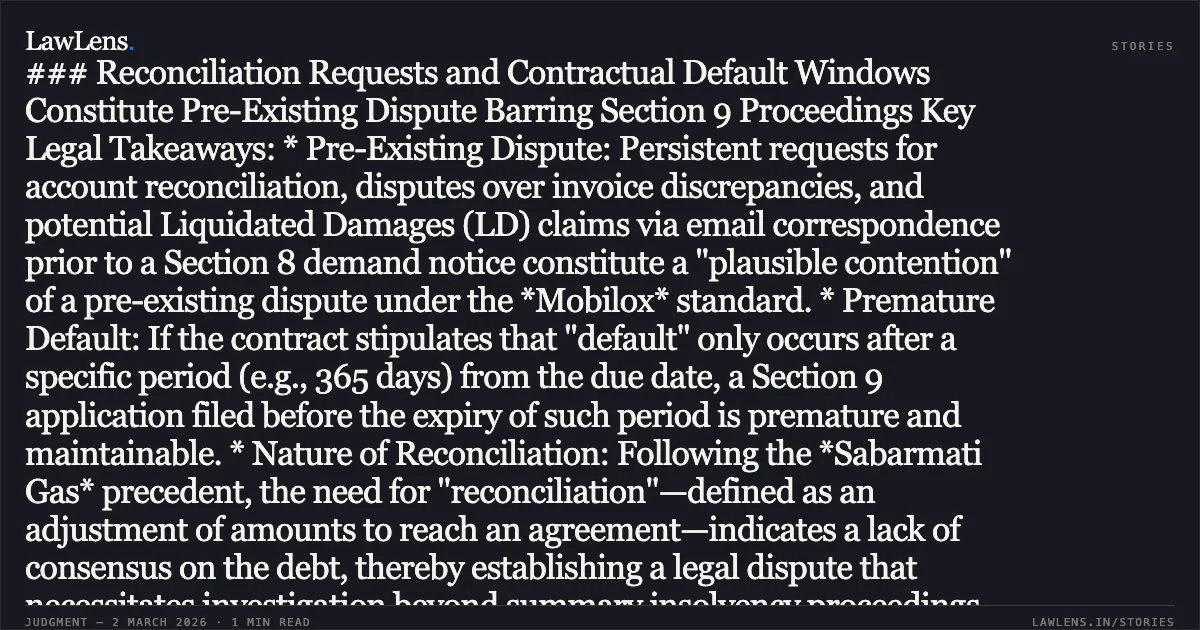
![### Reconciliation Requests and Contractual Default Clauses Establish Pre-Existing Disputes Barring Section 9 IBC Proceedings 1. Facts * Operational Debt: The Appellant (Operational Creditor), a partnership firm, executed wind energy projects for the Respondent (Corporate Debtor) under an MOU and various work orders. * The Claim: The Appellant claimed an outstanding debt of approx. ₹25.72 Crores (plus interest) based on 75 invoices raised between 2018 and 2019. * The Defense: The Respondent contended that there were pre-existing disputes regarding delays, liquidated damages (LD) paid to third parties, and tax issues. They further argued that the Section 9 petition was premature based on a contract clause (Clause 38) stating "default" only occurs 365 days after the due date. * Adjudicating Authority (AA): The NCLT Ahmedabad rejected the petition, citing pre-existing disputes evidenced by emails and the lack of a specific "date of default." 2. Issues * Whether there was a "pre-existing dispute" between the parties prior to the issuance of the Section 8 demand notice. * Whether a communication for "reconciliation" constitutes evidence of a dispute under the Insolvency and Bankruptcy Code (IBC). * Whether the Section 9 application was maintainable given the contractual definition of "default." 3. Decision * Pre-existing Dispute: The NCLAT affirmed that numerous emails exchanged between August 2018 and December 2018 (prior to the July 2019 demand notice) regarding invoice discrepancies and delay-linked losses established a "plausible contention" of dispute. * Reconciliation as Dispute: Relying on the Supreme Court’s ruling in *Sabarmati Gas Ltd. vs. Shah Alloys Ltd.*, the Tribunal held that requests for account reconciliation to adjust outstanding items (such as LD and generation losses) indicate a pre-existing dispute. * Prematurity of Default: The Tribunal noted that Clause 38 of the work order specifically defined "default" as expiring 365 days after the due date. Since the demand notice was issued before this period lapsed for several invoices, it was deemed premature. * Ongoing Arbitration: The fact that the parties were already in arbitration (where the Appellant’s counter-claim for the same amount had been rejected) further supported the existence of a substantial, non-spurious dispute. 4. Conclusion The Appellate Tribunal upheld the NCLT's dismissal, concluding that the dispute was not a "moonshine" defense but a genuine, pre-existing disagreement documented through correspondence. Section 9 proceedings cannot be used as a substitute for debt recovery when accounts remain unreconciled and subject to contractual LD claims.. M/s. Sri Bajrang Wind Park Developers v. M/s Inox Wind Infrastructure Services Limited & Ors. [Company Appeal (AT) (Insolvency) No. 630 of 2024]. NCLAT. LawLens](/stories/thumbnails/reconciliation-requests-and-contractual-default-clauses-establish-pre-existing-disputes-ba-9ad1c55f752e4e3898b7569c331aa5dd.webp)
![Imposition of cost on Financial Creditors for entering into settlement and seeking withdrawal under Section 12A is unsustainable.. State Bank of India v. Ravi Bansal Interim Resolution Professional & Anr. [Comp. App. (AT) (Ins) No. 58, 138, & 276 of 2026]. NCLAT. LawLens](/stories/thumbnails/imposition-of-cost-on-financial-creditors-for-entering-into-settlement-and-seeking-withdra-56aa4efa6a8d4a35afc439b5919d4ac9.webp)
![Unclaimed Assets in Approved Resolution Plans Stand Extinguished and Vest Voluntarily in the Successful Resolution Applicant. Mangalam Global Enterprise Limited v. Catalyst Trusteeship Limited & Ors. [Company Appeal (AT) (Insolvency) No. 114 of 2025]. NCLAT. LawLens](/stories/thumbnails/unclaimed-assets-in-approved-resolution-plans-stand-extinguished-and-vest-voluntarily-in-t-ca34338ab5f845bd85f5a943f3c21ab5.webp)