HCMONTHLY CASE LAW ARCHIVE

Calcutta High Court Judgments in June 2026: Case Law Digest

Read 49 LawLens analyses of Calcutta High Court judgments published in June 2026, covering key rulings, legal principles and case law.

← BACK TO CALCUTTA COURT REPORT

PERMANENT MONTHLY EDITIONS

Browse by month

AUTOMATICALLY UPDATED

June 2026 Judgments

49 ARTICLES · NEWEST FIRST
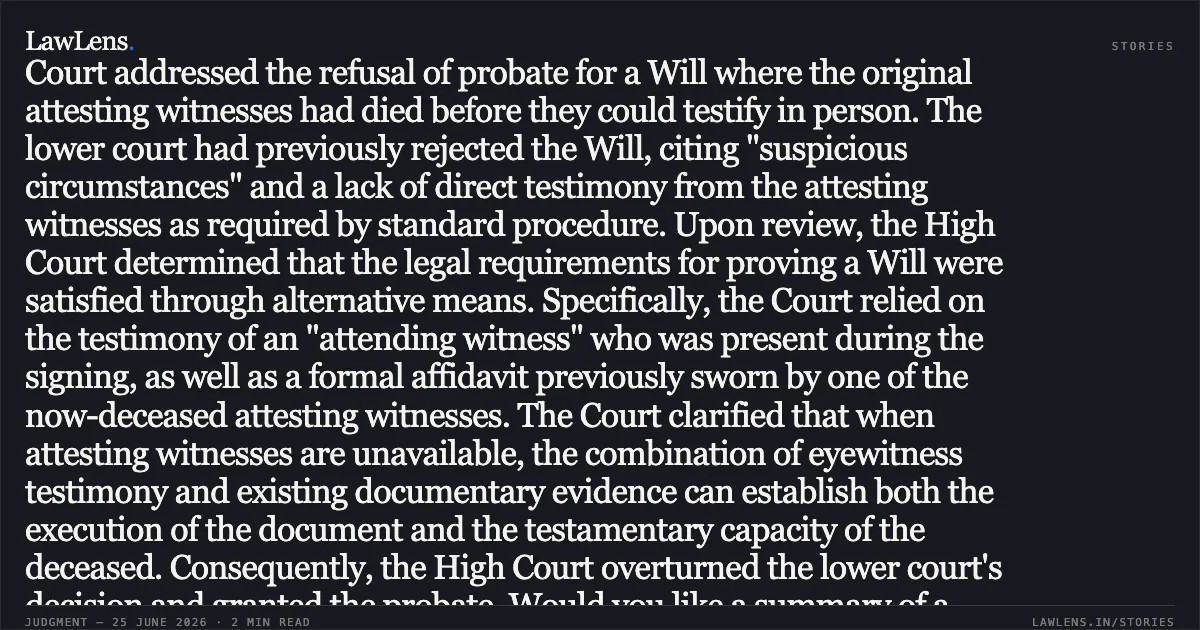
Testimony of attending witness and supporting affidavit of deceased attesting witness can prove a Will. In this appellate judgment, the Court addressed the refusal of probate for a Will where the original attesting witnesses had died before they could testify in person. The lower court had previously rejected the Will, citing "suspicious circumstances" and a lack of direct testimony from the attesting witnesses as required by standard procedure. Upon review, the High Court determined that the legal requirements for proving a Will were satisfied through alternative means. Specifically, the Court relied on the testimony of an "attending witness" who was present during the signing, as well as a formal affidavit previously sworn by one of the now-deceased attesting witnesses. The Court clarified that when attesting witnesses are unavailable, the combination of eyewitness testimony and existing documentary evidence can establish both the execution of the document and the testamentary capacity of the deceased. Consequently, the High Court overturned the lower court's decision and granted the probate. Would you like a summary of a different segment or a discussion on the specific statutes mentioned in this ruling?. IN THE GOODS OF SHRIMATI RAMA DATTA GUPTA, DECEASED -AND-IN THE MATTER OF GOPAL DAS AND ANR vs NA. Calcutta High Court. LawLens

Calcutta High Court·

Wills, Inheritance, and TrustsCivil Procedure and Evidence

Testimony of attending witness and supporting affidavit of deceased attesting witness can prove a Will. In this appellate judgment, the Court addressed the refusal of probate for a Will where the original attesting witnesses had died before they could testify in person. The lower court had previously rejected the Will, citing "suspicious circumstances" and a lack of direct testimony from the attesting witnesses as required by standard procedure. Upon review, the High Court determined that the legal requirements for proving a Will were satisfied through alternative means. Specifically, the Court relied on the testimony of an "attending witness" who was present during the signing, as well as a formal affidavit previously sworn by one of the now-deceased attesting witnesses. The Court clarified that when attesting witnesses are unavailable, the combination of eyewitness testimony and existing documentary evidence can establish both the execution of the document and the testamentary capacity of the deceased. Consequently, the High Court overturned the lower court's decision and granted the probate. Would you like a summary of a different segment or a discussion on the specific statutes mentioned in this ruling?

The appellants challenged a Single Judge's order dated April 23, 2025, which refused probate of the registered Will of late Rama Datta Gupta.

2 MIN READ