HCMONTHLY CASE LAW ARCHIVE

Calcutta High Court Judgments in May 2026: Case Law Digest

Read 286 LawLens analyses of Calcutta High Court judgments published in May 2026, covering key rulings, legal principles and case law.

← BACK TO CALCUTTA COURT REPORT

PERMANENT MONTHLY EDITIONS

Browse by month

AUTOMATICALLY UPDATED

May 2026 Judgments

286 ARTICLES · NEWEST FIRST
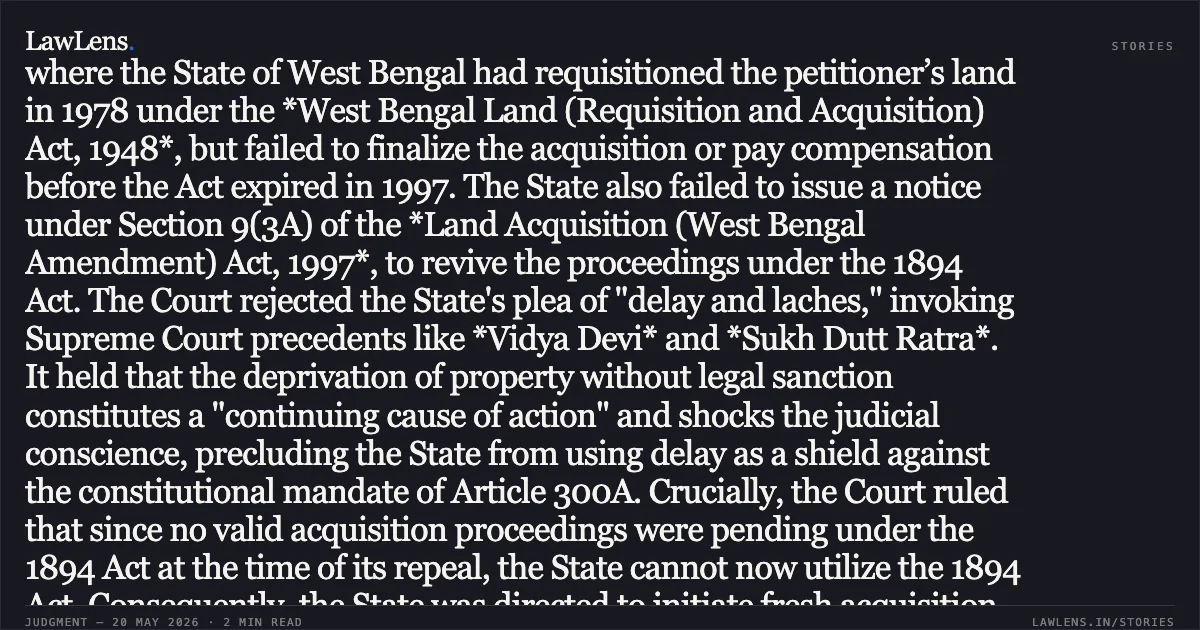
### Non-Payment of Compensation Following Expiry of Requisition under 1948 Act Mandates Fresh Acquisition under 2013 Act Summary of the Judgment: The High Court at Calcutta addressed a dispute where the State of West Bengal had requisitioned the petitioner’s land in 1978 under the *West Bengal Land (Requisition and Acquisition) Act, 1948*, but failed to finalize the acquisition or pay compensation before the Act expired in 1997. The State also failed to issue a notice under Section 9(3A) of the *Land Acquisition (West Bengal Amendment) Act, 1997*, to revive the proceedings under the 1894 Act. The Court rejected the State's plea of "delay and laches," invoking Supreme Court precedents like *Vidya Devi* and *Sukh Dutt Ratra*. It held that the deprivation of property without legal sanction constitutes a "continuing cause of action" and shocks the judicial conscience, precluding the State from using delay as a shield against the constitutional mandate of Article 300A. Crucially, the Court ruled that since no valid acquisition proceedings were pending under the 1894 Act at the time of its repeal, the State cannot now utilize the 1894 Act. Consequently, the State was directed to initiate fresh acquisition proceedings specifically under the *Right to Fair Compensation and Transparency in Land Acquisition, Rehabilitation and Resettlement Act, 2013*, to determine and pay fair compensation to the petitioner.. BIJOY KRISHNA BERA @ BIJOY BERA vs THE STATE OF WEST BENGAL AND ORS.. Calcutta High Court. LawLens

Calcutta High Court·

Property and Real Estate LawConstitutional Law

### Non-Payment of Compensation Following Expiry of Requisition under 1948 Act Mandates Fresh Acquisition under 2013 Act Summary of the Judgment: The High Court at Calcutta addressed a dispute where the State of West Bengal had requisitioned the petitioner’s land in 1978 under the *West Bengal Land (Requisition and Acquisition) Act, 1948*, but failed to finalize the acquisition or pay compensation before the Act expired in 1997. The State also failed to issue a notice under Section 9(3A) of the *Land Acquisition (West Bengal Amendment) Act, 1997*, to revive the proceedings under the 1894 Act. The Court rejected the State's plea of "delay and laches," invoking Supreme Court precedents like *Vidya Devi* and *Sukh Dutt Ratra*. It held that the deprivation of property without legal sanction constitutes a "continuing cause of action" and shocks the judicial conscience, precluding the State from using delay as a shield against the constitutional mandate of Article 300A. Crucially, the Court ruled that since no valid acquisition proceedings were pending under the 1894 Act at the time of its repeal, the State cannot now utilize the 1894 Act. Consequently, the State was directed to initiate fresh acquisition proceedings specifically under the *Right to Fair Compensation and Transparency in Land Acquisition, Rehabilitation and Resettlement Act, 2013*, to determine and pay fair compensation to the petitioner.

The petitioner is the recorded owner of several plots in Mouza Bural, Paschim Medinipur.

2 MIN READ

### Power to Determine Additional Compensation for Uncovered Periods Rests with Competent Authority at First Instance Analysis: The Court held that a claim for compensation for a time duration not covered by a prior award is a fresh claim for additional compensation, not a "review" or "enhancement." Thus, the Competent Authority retains jurisdiction under Section 10(1) of the 1962 Act to determine such compensation "at the first instance," and the doctrine of *functus officio* does not apply to these separate periods of loss.. SUBRATA HAIT vs INDIAN OIL CORPORATION LTD AND ORS. Calcutta High Court. LawLens

Calcutta High Court·

Property and Real Estate LawAdministrative and Public Law

### Power to Determine Additional Compensation for Uncovered Periods Rests with Competent Authority at First Instance Analysis: The Court held that a claim for compensation for a time duration not covered by a prior award is a fresh claim for additional compensation, not a "review" or "enhancement." Thus, the Competent Authority retains jurisdiction under Section 10(1) of the 1962 Act to determine such compensation "at the first instance," and the doctrine of *functus officio* does not apply to these separate periods of loss.

The appellants (landowners/leaseholders) were affected by the laying of a pipeline by Indian Oil Corporation Limited (IOCL).

2 MIN READ

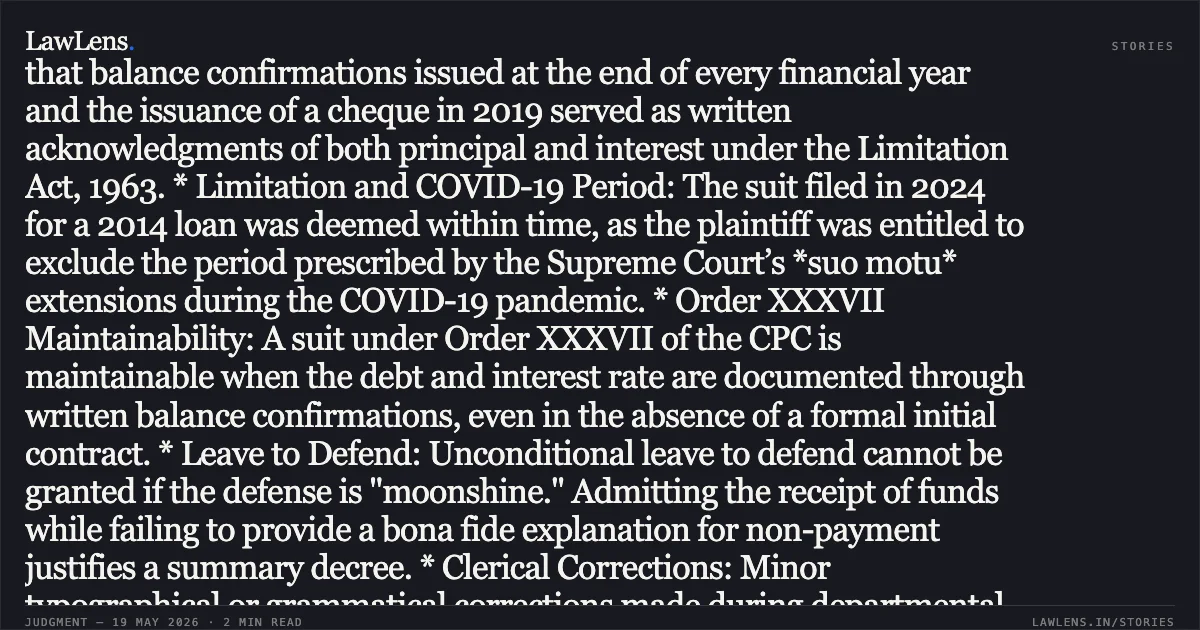
### Summary of Judgment: Skipper Furnishing Pvt. Ltd. v. Anubandh Financial Services Pvt. Ltd. Legal Headline: Annual written balance confirmations and issuance of cheques constitute valid acknowledgments of debt, defeating limitation pleas. Key Legal Principles & Findings: * Acknowledgment of Liability: The Court held that balance confirmations issued at the end of every financial year and the issuance of a cheque in 2019 served as written acknowledgments of both principal and interest under the Limitation Act, 1963. * Limitation and COVID-19 Period: The suit filed in 2024 for a 2014 loan was deemed within time, as the plaintiff was entitled to exclude the period prescribed by the Supreme Court’s *suo motu* extensions during the COVID-19 pandemic. * Order XXXVII Maintainability: A suit under Order XXXVII of the CPC is maintainable when the debt and interest rate are documented through written balance confirmations, even in the absence of a formal initial contract. * Leave to Defend: Unconditional leave to defend cannot be granted if the defense is "moonshine." Admitting the receipt of funds while failing to provide a bona fide explanation for non-payment justifies a summary decree. * Clerical Corrections: Minor typographical or grammatical corrections made during departmental scrutiny of a plaint do not constitute "amendments" that violate the procedural requirements of Order XXXVII. Conclusion: The Division Bench upheld the Single Judge's decree, finding no merit in the appellant's challenge regarding limitation or procedural non-compliance.. SKIPPER FURNISHING PRIVATE LIMITED vs ANUBANDH FINANCIAL SERVICES PRIVATE LIMITED AND ANOTHER. Calcutta High Court. LawLens

Calcutta High Court·

Civil Procedure and EvidenceContract Law

### Summary of Judgment: Skipper Furnishing Pvt. Ltd. v. Anubandh Financial Services Pvt. Ltd. Legal Headline: Annual written balance confirmations and issuance of cheques constitute valid acknowledgments of debt, defeating limitation pleas. Key Legal Principles & Findings: * Acknowledgment of Liability: The Court held that balance confirmations issued at the end of every financial year and the issuance of a cheque in 2019 served as written acknowledgments of both principal and interest under the Limitation Act, 1963. * Limitation and COVID-19 Period: The suit filed in 2024 for a 2014 loan was deemed within time, as the plaintiff was entitled to exclude the period prescribed by the Supreme Court’s *suo motu* extensions during the COVID-19 pandemic. * Order XXXVII Maintainability: A suit under Order XXXVII of the CPC is maintainable when the debt and interest rate are documented through written balance confirmations, even in the absence of a formal initial contract. * Leave to Defend: Unconditional leave to defend cannot be granted if the defense is "moonshine." Admitting the receipt of funds while failing to provide a bona fide explanation for non-payment justifies a summary decree. * Clerical Corrections: Minor typographical or grammatical corrections made during departmental scrutiny of a plaint do not constitute "amendments" that violate the procedural requirements of Order XXXVII. Conclusion: The Division Bench upheld the Single Judge's decree, finding no merit in the appellant's challenge regarding limitation or procedural non-compliance.

The Respondent (Anubandh Financial Services) advanced a loan of Rs. 30 lakhs to the Appellant in 2014.

2 MIN READ

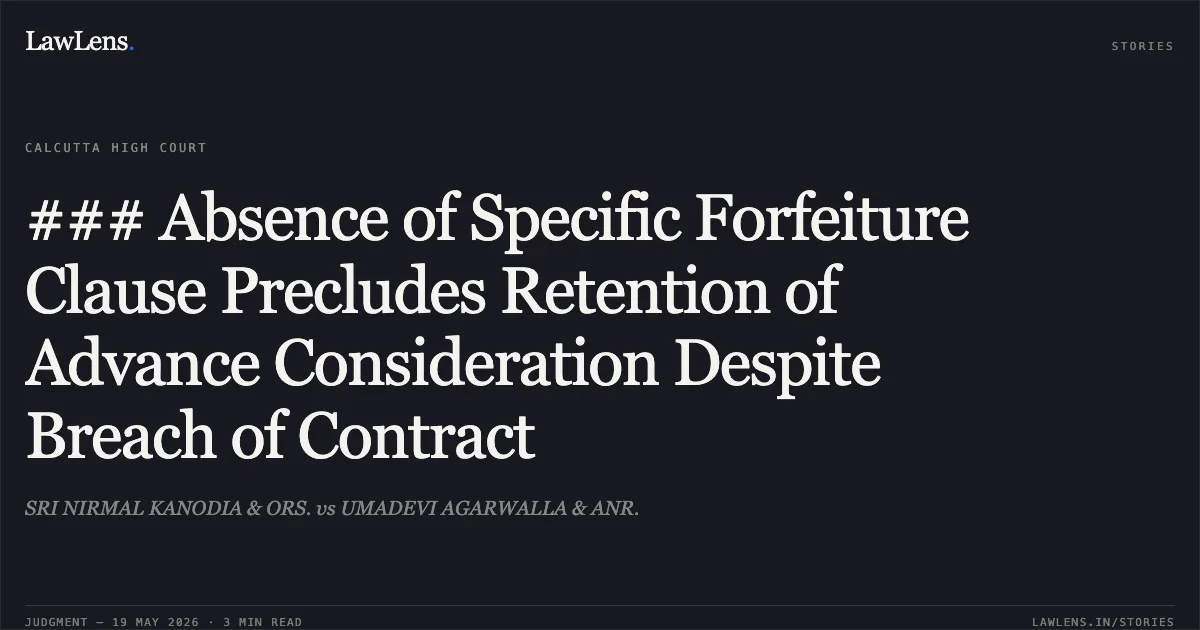
### Anticipatory Breach Requires Absolute Refusal to Perform; Advanced Payment Inextricable Without Express Forfeiture Clause Synopsis: In a consolidated judgment involving the transfer of controlling shares in a company (M/s Bhoomi Minerals), the High Court at Calcutta addressed two critical aspects of contract law: anticipatory breach and the forfeiture of earnest money. Anticipatory Breach (Section 39, Indian Contract Act): The purchasers (Kanodias) terminated the Memorandum of Understanding (M.O.U.) alleging an anticipatory breach after the sellers (Agarwallas) proposed amendments to security clauses. The Court ruled that for Section 39 to be invoked, there must be a "total refusal" to perform the contract in its entirety or an act that destroys the contract's core. Since the sellers remained willing to transfer the shares—merely proposing a novation of interregnum security terms—there was no "unqualified and positive refusal." Consequently, the purchasers' premature termination constituted a breach of contract, making them liable for damages. Damages and Forfeiture: 1. Damages: The Court upheld the sellers' claim for damages (the difference between the M.O.U. price and the eventual lower sale price to a third party) to put the aggrieved party in the position they would have been in had the contract been performed. 2. Forfeiture of Earnest Money: Following the principle in *Fateh Chand v. Balkishan Dass*, the Court held that in the absence of an "explicit and clear" forfeiture clause within the M.O.U., any advance payment or earnest money cannot be forfeited, even if the depositor is in breach. Conclusion: The Court decreed damages of ₹5.51 crores in favor of the sellers while simultaneously ordering the refund of the ₹1 crore advance to the purchasers, allowing for the adjustment of these amounts between the parties.. UMADEVI AGARWALLA & ORS. vs NIRMAL KANODIA & ORS.. Calcutta High Court. LawLens

Calcutta High Court·

Contract LawCivil Law

### Anticipatory Breach Requires Absolute Refusal to Perform; Advanced Payment Inextricable Without Express Forfeiture Clause Synopsis: In a consolidated judgment involving the transfer of controlling shares in a company (M/s Bhoomi Minerals), the High Court at Calcutta addressed two critical aspects of contract law: anticipatory breach and the forfeiture of earnest money. Anticipatory Breach (Section 39, Indian Contract Act): The purchasers (Kanodias) terminated the Memorandum of Understanding (M.O.U.) alleging an anticipatory breach after the sellers (Agarwallas) proposed amendments to security clauses. The Court ruled that for Section 39 to be invoked, there must be a "total refusal" to perform the contract in its entirety or an act that destroys the contract's core. Since the sellers remained willing to transfer the shares—merely proposing a novation of interregnum security terms—there was no "unqualified and positive refusal." Consequently, the purchasers' premature termination constituted a breach of contract, making them liable for damages. Damages and Forfeiture: 1. Damages: The Court upheld the sellers' claim for damages (the difference between the M.O.U. price and the eventual lower sale price to a third party) to put the aggrieved party in the position they would have been in had the contract been performed. 2. Forfeiture of Earnest Money: Following the principle in *Fateh Chand v. Balkishan Dass*, the Court held that in the absence of an "explicit and clear" forfeiture clause within the M.O.U., any advance payment or earnest money cannot be forfeited, even if the depositor is in breach. Conclusion: The Court decreed damages of ₹5.51 crores in favor of the sellers while simultaneously ordering the refund of the ₹1 crore advance to the purchasers, allowing for the adjustment of these amounts between the parties.

The Agarwallas (original plaintiffs in CS/124/2011) owned M/s Bhoomi Minerals Ltd., a company with a sponge iron unit in Jharkhand that was heavily indebted to the Indian Overseas Bank

3 MIN READ