HCMONTHLY CASE LAW ARCHIVE

Allahabad High Court Judgments in June 2026: Case Law Digest

Read 32 LawLens analyses of Allahabad High Court judgments published in June 2026, covering key rulings, legal principles and case law.

← BACK TO ALLAHABAD COURT REPORT

PERMANENT MONTHLY EDITIONS

Browse by month

AUTOMATICALLY UPDATED

June 2026 Judgments

32 ARTICLES · NEWEST FIRST
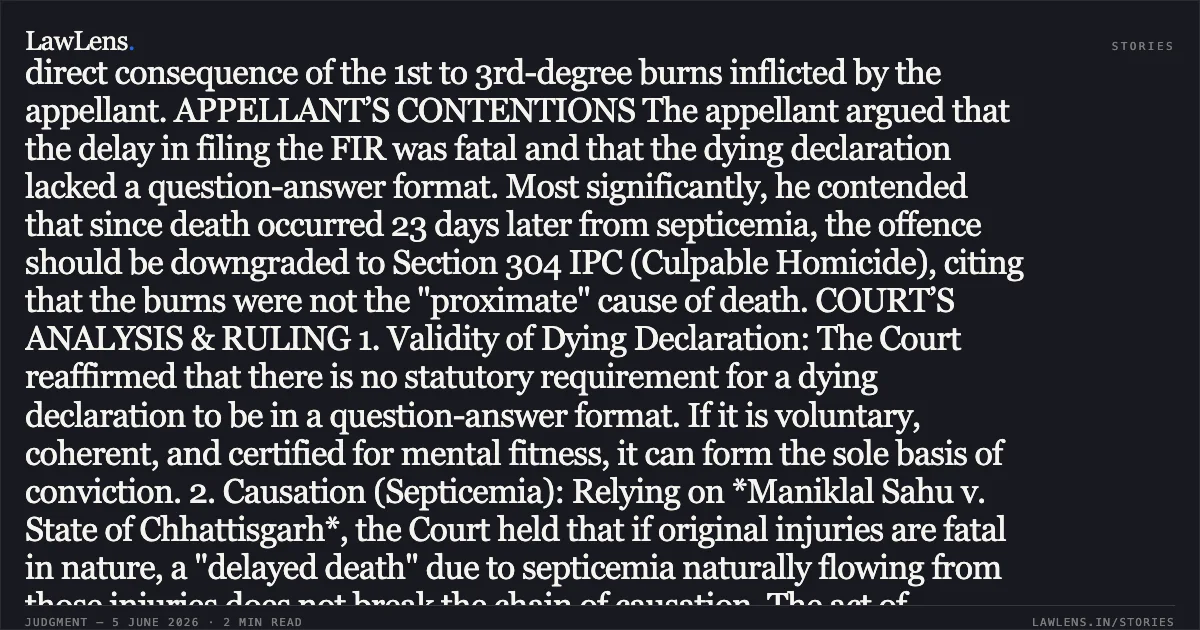
Dying Declaration and Intentional Burning of Pregnant Wife Establish Murder Despite Delayed Death from Septicemia FACTUAL MATRIX The appellant was convicted under Section 302 IPC for the murder of his eight-month pregnant wife, Ruchi. On November 28, 2010, the appellant took the deceased into a room, poured kerosene on her, set her ablaze, and bolted the door from the outside. The victim succumbed to her injuries 23 days later in the hospital. The Trial Court acquitted the appellant of dowry-related charges (Sections 304-B, 498-A IPC) but sentenced him to life imprisonment for murder. PROSECUTION CASE The prosecution relied primarily on a dying declaration recorded by an Executive Magistrate and certified by a medical officer. The declaration detailed the brutal nature of the assault. The medical evidence through PW-5 and PW-6 confirmed that while the immediate cause of death was septicemic shock, it was a direct consequence of the 1st to 3rd-degree burns inflicted by the appellant. APPELLANT’S CONTENTIONS The appellant argued that the delay in filing the FIR was fatal and that the dying declaration lacked a question-answer format. Most significantly, he contended that since death occurred 23 days later from septicemia, the offence should be downgraded to Section 304 IPC (Culpable Homicide), citing that the burns were not the "proximate" cause of death. COURT’S ANALYSIS & RULING 1. Validity of Dying Declaration: The Court reaffirmed that there is no statutory requirement for a dying declaration to be in a question-answer format. If it is voluntary, coherent, and certified for mental fitness, it can form the sole basis of conviction. 2. Causation (Septicemia): Relying on *Maniklal Sahu v. State of Chhattisgarh*, the Court held that if original injuries are fatal in nature, a "delayed death" due to septicemia naturally flowing from those injuries does not break the chain of causation. The act of pouring kerosene and bolting the door demonstrated a clear intention to cause death under Section 300 "Firstly" and "Fourthly" IPC. 3. Refusal of Exceptions: The Court rejected the plea for Exception 4 (Sudden Fight), noting that bolting the door from the outside negated any claim of acting without cruelty or in the heat of passion. 4. Proportionality of Sentence: While upholding the conviction, the Court exercised its constitutional power to modify the life sentence. Considering the appellant’s young age (21 at the time of the crime), his 15 years already served, and "good conduct" reports from jail, the Court commuted the life sentence to a fixed term of 20 years rigorous imprisonment without remission to balance deterrence with the possibility of reformation. CONCLUSION The conviction under Section 302 IPC was affirmed; however, the sentence was modified to a fixed 20-year term.. Manish vs State Of U.P.. Allahabad High Court. LawLens

Allahabad High Court·

Dying Declaration and Intentional Burning of Pregnant Wife Establish Murder Despite Delayed Death from Septicemia FACTUAL MATRIX The appellant was convicted under Section 302 IPC for the murder of his eight-month pregnant wife, Ruchi. On November 28, 2010, the appellant took the deceased into a room, poured kerosene on her, set her ablaze, and bolted the door from the outside. The victim succumbed to her injuries 23 days later in the hospital. The Trial Court acquitted the appellant of dowry-related charges (Sections 304-B, 498-A IPC) but sentenced him to life imprisonment for murder. PROSECUTION CASE The prosecution relied primarily on a dying declaration recorded by an Executive Magistrate and certified by a medical officer. The declaration detailed the brutal nature of the assault. The medical evidence through PW-5 and PW-6 confirmed that while the immediate cause of death was septicemic shock, it was a direct consequence of the 1st to 3rd-degree burns inflicted by the appellant. APPELLANT’S CONTENTIONS The appellant argued that the delay in filing the FIR was fatal and that the dying declaration lacked a question-answer format. Most significantly, he contended that since death occurred 23 days later from septicemia, the offence should be downgraded to Section 304 IPC (Culpable Homicide), citing that the burns were not the "proximate" cause of death. COURT’S ANALYSIS & RULING 1. Validity of Dying Declaration: The Court reaffirmed that there is no statutory requirement for a dying declaration to be in a question-answer format. If it is voluntary, coherent, and certified for mental fitness, it can form the sole basis of conviction. 2. Causation (Septicemia): Relying on *Maniklal Sahu v. State of Chhattisgarh*, the Court held that if original injuries are fatal in nature, a "delayed death" due to septicemia naturally flowing from those injuries does not break the chain of causation. The act of pouring kerosene and bolting the door demonstrated a clear intention to cause death under Section 300 "Firstly" and "Fourthly" IPC. 3. Refusal of Exceptions: The Court rejected the plea for Exception 4 (Sudden Fight), noting that bolting the door from the outside negated any claim of acting without cruelty or in the heat of passion. 4. Proportionality of Sentence: While upholding the conviction, the Court exercised its constitutional power to modify the life sentence. Considering the appellant’s young age (21 at the time of the crime), his 15 years already served, and "good conduct" reports from jail, the Court commuted the life sentence to a fixed term of 20 years rigorous imprisonment without remission to balance deterrence with the possibility of reformation. CONCLUSION The conviction under Section 302 IPC was affirmed; however, the sentence was modified to a fixed 20-year term.

The appellant, Manish, married the deceased, Ruchi, in 2007.

2 MIN READ