HCMONTHLY CASE LAW ARCHIVE

Allahabad High Court Judgments in July 2026: Case Law Digest

Read 181 LawLens analyses of Allahabad High Court judgments published in July 2026, covering key rulings, legal principles and case law.

← BACK TO ALLAHABAD COURT REPORT

PERMANENT MONTHLY EDITIONS

Browse by month

AUTOMATICALLY UPDATED

July 2026 Judgments

181 ARTICLES · NEWEST FIRST
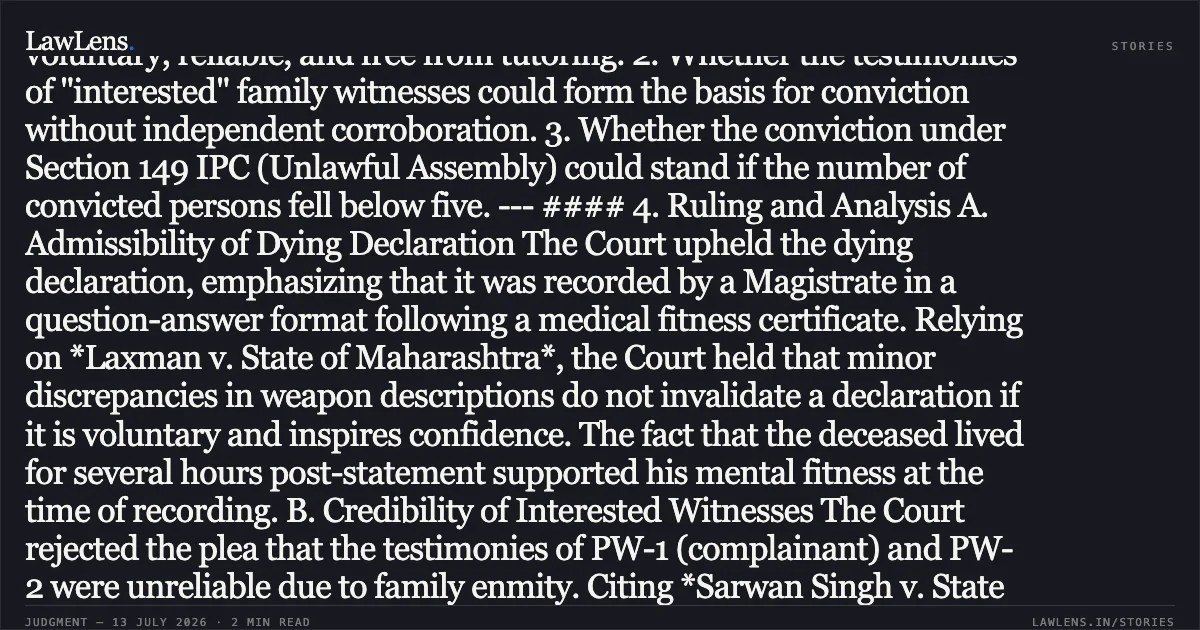
### Dying Declaration Reliability Upheld Amid Specific Role Discrepancies and Unlawful Assembly Quashed for Lack of Quorum Case Brief: *Ram Lal and 3 others v. State* (2026) Court: High Court of Judicature at Allahabad, Lucknow Bench Bench: Hon’ble Rajnish Kumar, J. and Hon’ble Mrs. Babita Rani, J. Decided on: July 08, 2026 --- #### 1. Legal Headline Conviction for common intention remains valid despite acquittal of co-accused negating unlawful assembly quorum. --- #### 2. Facts of the Case The prosecution alleged that on April 7, 1987, five accused persons (Ram Lal, Bateshwar, Ram Naresh, Phulla, and Ram Ratan) attacked the complainant's family over a property dispute. Deceased Subedar was shot, and three others sustained firearm and lathi injuries. Subedar’s dying declaration was recorded by a Magistrate after a fitness certification by a doctor. He succumbed to injuries the next day. The Trial Court convicted four appellants but acquitted Ram Ratan. Two appellants (Ram Lal and Phulla) died during the appeal's pendency. The remaining appellants challenged the conviction, citing inconsistencies in the dying declaration and the absence of independent witnesses. --- #### 3. Issues for Determination 1. Whether the dying declaration was voluntary, reliable, and free from tutoring. 2. Whether the testimonies of "interested" family witnesses could form the basis for conviction without independent corroboration. 3. Whether the conviction under Section 149 IPC (Unlawful Assembly) could stand if the number of convicted persons fell below five. --- #### 4. Ruling and Analysis A. Admissibility of Dying Declaration The Court upheld the dying declaration, emphasizing that it was recorded by a Magistrate in a question-answer format following a medical fitness certificate. Relying on *Laxman v. State of Maharashtra*, the Court held that minor discrepancies in weapon descriptions do not invalidate a declaration if it is voluntary and inspires confidence. The fact that the deceased lived for several hours post-statement supported his mental fitness at the time of recording. B. Credibility of Interested Witnesses The Court rejected the plea that the testimonies of PW-1 (complainant) and PW-2 were unreliable due to family enmity. Citing *Sarwan Singh v. State of Punjab*, the Court noted that independent witnesses often shun legal proceedings. It held that the "quality, not quantity" of evidence matters; since the medical reports corroborated the ocular evidence, the testimony of related witnesses was sufficient. C. Modification of Charges (Sections 149 vs. 34 IPC) The Court found a "patent illegality" in the Trial Court's judgment. Since one of the five accused (Ram Ratan) was acquitted and that acquittal was not challenged, the mandatory requirement of five or more persons to constitute an "unlawful assembly" under Section 141 IPC was not met. Consequently, the conviction under Sections 147 (rioting) and 148 (deadly weapons) was set aside. However, since the remaining accused acted with a shared objective, the Court substituted Section 149 with Section 34 (Common Intention) and maintained the life sentences for murder and attempt to murder. --- #### 5. Final Order - Acquittal: Appellants Bateshwar and Ram Naresh are acquitted of charges under Sections 147 and 148 IPC. - Maintenance of Conviction: Conviction under Sections 302/34, 307/34, and 323/34 IPC is affirmed. - Direction: The appellants' bail bonds are cancelled, and they are ordered to surrender within 15 days to serve the remainder of their life sentences.. Ram Lal And 3 Others vs State. Allahabad High Court. LawLens

Allahabad High Court·

Criminal LawCriminal Procedure and Evidence

### Dying Declaration Reliability Upheld Amid Specific Role Discrepancies and Unlawful Assembly Quashed for Lack of Quorum Case Brief: *Ram Lal and 3 others v. State* (2026) Court: High Court of Judicature at Allahabad, Lucknow Bench Bench: Hon’ble Rajnish Kumar, J. and Hon’ble Mrs. Babita Rani, J. Decided on: July 08, 2026 --- #### 1. Legal Headline Conviction for common intention remains valid despite acquittal of co-accused negating unlawful assembly quorum. --- #### 2. Facts of the Case The prosecution alleged that on April 7, 1987, five accused persons (Ram Lal, Bateshwar, Ram Naresh, Phulla, and Ram Ratan) attacked the complainant's family over a property dispute. Deceased Subedar was shot, and three others sustained firearm and lathi injuries. Subedar’s dying declaration was recorded by a Magistrate after a fitness certification by a doctor. He succumbed to injuries the next day. The Trial Court convicted four appellants but acquitted Ram Ratan. Two appellants (Ram Lal and Phulla) died during the appeal's pendency. The remaining appellants challenged the conviction, citing inconsistencies in the dying declaration and the absence of independent witnesses. --- #### 3. Issues for Determination 1. Whether the dying declaration was voluntary, reliable, and free from tutoring. 2. Whether the testimonies of "interested" family witnesses could form the basis for conviction without independent corroboration. 3. Whether the conviction under Section 149 IPC (Unlawful Assembly) could stand if the number of convicted persons fell below five. --- #### 4. Ruling and Analysis A. Admissibility of Dying Declaration The Court upheld the dying declaration, emphasizing that it was recorded by a Magistrate in a question-answer format following a medical fitness certificate. Relying on *Laxman v. State of Maharashtra*, the Court held that minor discrepancies in weapon descriptions do not invalidate a declaration if it is voluntary and inspires confidence. The fact that the deceased lived for several hours post-statement supported his mental fitness at the time of recording. B. Credibility of Interested Witnesses The Court rejected the plea that the testimonies of PW-1 (complainant) and PW-2 were unreliable due to family enmity. Citing *Sarwan Singh v. State of Punjab*, the Court noted that independent witnesses often shun legal proceedings. It held that the "quality, not quantity" of evidence matters; since the medical reports corroborated the ocular evidence, the testimony of related witnesses was sufficient. C. Modification of Charges (Sections 149 vs. 34 IPC) The Court found a "patent illegality" in the Trial Court's judgment. Since one of the five accused (Ram Ratan) was acquitted and that acquittal was not challenged, the mandatory requirement of five or more persons to constitute an "unlawful assembly" under Section 141 IPC was not met. Consequently, the conviction under Sections 147 (rioting) and 148 (deadly weapons) was set aside. However, since the remaining accused acted with a shared objective, the Court substituted Section 149 with Section 34 (Common Intention) and maintained the life sentences for murder and attempt to murder. --- #### 5. Final Order - Acquittal: Appellants Bateshwar and Ram Naresh are acquitted of charges under Sections 147 and 148 IPC. - Maintenance of Conviction: Conviction under Sections 302/34, 307/34, and 323/34 IPC is affirmed. - Direction: The appellants' bail bonds are cancelled, and they are ordered to surrender within 15 days to serve the remainder of their life sentences.

On April 7, 1987, at approximately 6:30 PM, four accused persons (Ram Lal, Bateshwar, Ram Naresh, and Phulla) attacked the complainant (PW-1) and his family members due to property disputes.

2 MIN READ

FIR Contents Not Provable Through Scribe if Informant’s Death Lacks Nexus to Crime Summary In this criminal appeal, the Court examined a conviction for murder originating from a 1990 incident involving a dispute over farm machinery. A primary legal issue was the evidentiary status of the First Information Report (FIR), as the informant had died of natural causes before the trial. The Court ruled that since the informant’s death had no nexus to the alleged crime, the FIR could not be treated as substantive evidence under Section 32 of the Evidence Act. While the scribe could verify the act of recording the statement, he could not prove the truth of its contents. Furthermore, the Court analyzed the prosecution's version of the shooting, which involved an improbable physical struggle where the accused allegedly used a victim as a human shield while firing multiple weapons. The Court found significant medical and logical inconsistencies, noting that the injuries sustained by the parties did not align with the described positions of the assailants and victims. Due to estasblished doubts regarding the manner of occurrence and the unreliable nature of the eye-witness accounts, the Court granted the appellant the benefit of doubt and set aside the conviction. Would you like the summary of the next segment of this judgment or another legal proceeding?. Khalid And Another vs State Of U.P.. Allahabad High Court. LawLens

Allahabad High Court·

Criminal Procedure and EvidenceCriminal Law

FIR Contents Not Provable Through Scribe if Informant’s Death Lacks Nexus to Crime Summary In this criminal appeal, the Court examined a conviction for murder originating from a 1990 incident involving a dispute over farm machinery. A primary legal issue was the evidentiary status of the First Information Report (FIR), as the informant had died of natural causes before the trial. The Court ruled that since the informant’s death had no nexus to the alleged crime, the FIR could not be treated as substantive evidence under Section 32 of the Evidence Act. While the scribe could verify the act of recording the statement, he could not prove the truth of its contents. Furthermore, the Court analyzed the prosecution's version of the shooting, which involved an improbable physical struggle where the accused allegedly used a victim as a human shield while firing multiple weapons. The Court found significant medical and logical inconsistencies, noting that the injuries sustained by the parties did not align with the described positions of the assailants and victims. Due to estasblished doubts regarding the manner of occurrence and the unreliable nature of the eye-witness accounts, the Court granted the appellant the benefit of doubt and set aside the conviction. Would you like the summary of the next segment of this judgment or another legal proceeding?

The appellants, Khalid and Nannu (now deceased), were convicted under Section 302/34 IPC for the murder of Sarafraz @ Pappu.

2 MIN READ

Title: Municipal Corporation estopped from claiming land as pond after executing valid sale deeds and long-term abadi recording. Summary of the Case: Facts: The petitioner sought a No-Objection Certificate (NOC) from Nagar Nigam, Varanasi, to construct a hotel based on an MoU with the State of UP. The Corporation refused, citing revenue records from 1884 (1291 Fasli) which recorded the land as a pond. However, the record showed that the Municipal Board had itself sold the land via registered deeds in 1913. Since 1954, the land was recorded as ‘abadi’ (settled) in revenue records, was situated in a densely populated area, and had housed a cinema hall for 50 years. Issues: 1. Whether the Corporation can deny an NOC based on ancient revenue entries (1884) when it has previously executed sale deeds for the same land. 2. Whether the principles laid down in *Hinch Lal Tiwari* regarding pond restoration apply to land recorded as abadi for over 70 years and held through valid title deeds. Court's Reasoning: * Doctrine of Promissory Estoppel: The Court held that the Corporation, having executed a registered sale deed in 1913 admitting the existence of structures, is estopped from claiming the land is a pond 113 years later. * Presumption of Validity: Registered sale deeds carry a presumption of genuineness under law which the State failed to displace. * Revenue Records: While a 1359 Fasli Khasra entry mentioned a pond, the Khatauni (Record of Rights) consistently showed 'abadi' since 1954. The Court noted that Khasra is a record of possession, while Khatauni is the record of title/rights. * Inapplicability of Hinch Lal Tiwari: The Court distinguished this case from precedents regarding pond restoration, noting that the petitioner held valid title, the land was in a densely populated urban area, and the State’s attempt to "restore" it was an afterthought triggered only by the litigation. * Discriminatory Action: The State singled out the petitioner’s plot while ignoring the rest of the original Arazi (0.668 hectares), violating Article 14. Conclusion: The High Court quashed the refusal letter and issued a writ of mandamus directing the Corporation to reconsider the NOC application, affirming that ancient revenue entries cannot override valid registered titles and long-standing urban land usage.. M/S Knots India Carpets Private Limited vs State Of Uttar Pradesh And 2 Others. Allahabad High Court. LawLens

Allahabad High Court·

Property and Real Estate LawAdministrative and Public Law

Title: Municipal Corporation estopped from claiming land as pond after executing valid sale deeds and long-term abadi recording. Summary of the Case: Facts: The petitioner sought a No-Objection Certificate (NOC) from Nagar Nigam, Varanasi, to construct a hotel based on an MoU with the State of UP. The Corporation refused, citing revenue records from 1884 (1291 Fasli) which recorded the land as a pond. However, the record showed that the Municipal Board had itself sold the land via registered deeds in 1913. Since 1954, the land was recorded as ‘abadi’ (settled) in revenue records, was situated in a densely populated area, and had housed a cinema hall for 50 years. Issues: 1. Whether the Corporation can deny an NOC based on ancient revenue entries (1884) when it has previously executed sale deeds for the same land. 2. Whether the principles laid down in *Hinch Lal Tiwari* regarding pond restoration apply to land recorded as abadi for over 70 years and held through valid title deeds. Court's Reasoning: * Doctrine of Promissory Estoppel: The Court held that the Corporation, having executed a registered sale deed in 1913 admitting the existence of structures, is estopped from claiming the land is a pond 113 years later. * Presumption of Validity: Registered sale deeds carry a presumption of genuineness under law which the State failed to displace. * Revenue Records: While a 1359 Fasli Khasra entry mentioned a pond, the Khatauni (Record of Rights) consistently showed 'abadi' since 1954. The Court noted that Khasra is a record of possession, while Khatauni is the record of title/rights. * Inapplicability of Hinch Lal Tiwari: The Court distinguished this case from precedents regarding pond restoration, noting that the petitioner held valid title, the land was in a densely populated urban area, and the State’s attempt to "restore" it was an afterthought triggered only by the litigation. * Discriminatory Action: The State singled out the petitioner’s plot while ignoring the rest of the original Arazi (0.668 hectares), violating Article 14. Conclusion: The High Court quashed the refusal letter and issued a writ of mandamus directing the Corporation to reconsider the NOC application, affirming that ancient revenue entries cannot override valid registered titles and long-standing urban land usage.

The Petitioner, owner of plot No. D-48/140-141 (Arazi Nos. 2404 and 2402) in Varanasi, applied for a No-Objection Certificate (NOC) from Nagar Nigam, Varanasi, to construct a hotel following a Memorandum of Understand...

3 MIN READ

Conviction set aside due to flawed identification, tainted investigation, and failure to prove SC/ST status. The judgment revolves around the 2011 conviction of seven individuals for crimes including gang rape and murder against members of a nomadic community. Following a nighttime assault on a temporary camp that left one man dead and a woman victimized, the appellants were sentenced to life imprisonment. On appeal, the High Court identified critical failures in the prosecution’s case. Central to the acquittal was the lack of reliable identification; the accused were not previously known to the witnesses, yet no Test Identification Parade was conducted. Instead, the victim was shown the accused in a police lock-up after being detained for several days, a procedure the court deemed legally invalid. Furthermore, the court found the investigation to be tainted and casual, citing major discrepancies such as the recovery of a different garment than the one analyzed by forensic experts and inconsistencies between oral testimony and medical findings. The court also ruled that the charges under the SC/ST Act were unsustainable because the prosecution failed to prove the victims belonged to a notified community or that the crime was motivated by caste. Ultimately, the court concluded that the prosecution failed to establish guilt beyond a reasonable doubt, granting the appellants the benefit of the doubt and ordering their release. Would you like a summary of the evidence regarding the firearm injuries or the specific findings on the SC/ST Act application?. Anwar Ali And Ors. vs State Of U.P.. Allahabad High Court. LawLens

Allahabad High Court·

Criminal Procedure and EvidenceCriminal Law

Conviction set aside due to flawed identification, tainted investigation, and failure to prove SC/ST status. The judgment revolves around the 2011 conviction of seven individuals for crimes including gang rape and murder against members of a nomadic community. Following a nighttime assault on a temporary camp that left one man dead and a woman victimized, the appellants were sentenced to life imprisonment. On appeal, the High Court identified critical failures in the prosecution’s case. Central to the acquittal was the lack of reliable identification; the accused were not previously known to the witnesses, yet no Test Identification Parade was conducted. Instead, the victim was shown the accused in a police lock-up after being detained for several days, a procedure the court deemed legally invalid. Furthermore, the court found the investigation to be tainted and casual, citing major discrepancies such as the recovery of a different garment than the one analyzed by forensic experts and inconsistencies between oral testimony and medical findings. The court also ruled that the charges under the SC/ST Act were unsustainable because the prosecution failed to prove the victims belonged to a notified community or that the crime was motivated by caste. Ultimately, the court concluded that the prosecution failed to establish guilt beyond a reasonable doubt, granting the appellants the benefit of the doubt and ordering their release. Would you like a summary of the evidence regarding the firearm injuries or the specific findings on the SC/ST Act application?

The Appellants were convicted by a trial court for offenses including gang rape and murder of members of a nomadic (Banjara) community

2 MIN READ