HCMONTHLY CASE LAW ARCHIVE

Allahabad High Court Judgments in May 2026: Case Law Digest

Read 115 LawLens analyses of Allahabad High Court judgments published in May 2026, covering key rulings, legal principles and case law.

← BACK TO ALLAHABAD COURT REPORT

PERMANENT MONTHLY EDITIONS

Browse by month

AUTOMATICALLY UPDATED

May 2026 Judgments

115 ARTICLES · NEWEST FIRST
Headline: Discrepancies regarding arrest, recovery, and eyewitness presence invalidate conviction where ocular testimony contradicts documentary evidence. Summary: The High Court of Judicature at Allahabad set aside a life imprisonment sentence, acquitting the appellant of murder charges under Section 302 IPC. The Court found that the prosecution's case was undermined by grave and irreconcilable contradictions between the ocular version and documentary evidence. Specifically, the eyewitnesses’ claims of overpowering and tying the accused to a tree were directly refuted by the Investigating Officer’s testimony and the arrest memo, which recorded a standard arrest from the appellant's doorstep. Furthermore, the unexplained delay of nearly a month in recording a key eyewitness's statement, combined with inconsistencies regarding the witnesses' physical locations during the night-time incident, rendered the evidence unreliable and insufficient to prove guilt beyond reasonable doubt.. Summilal Ahirwar vs State Of U.P.. Allahabad High Court. LawLens

Allahabad High Court·

Criminal LawCriminal Procedure and Evidence

Headline: Discrepancies regarding arrest, recovery, and eyewitness presence invalidate conviction where ocular testimony contradicts documentary evidence. Summary: The High Court of Judicature at Allahabad set aside a life imprisonment sentence, acquitting the appellant of murder charges under Section 302 IPC. The Court found that the prosecution's case was undermined by grave and irreconcilable contradictions between the ocular version and documentary evidence. Specifically, the eyewitnesses’ claims of overpowering and tying the accused to a tree were directly refuted by the Investigating Officer’s testimony and the arrest memo, which recorded a standard arrest from the appellant's doorstep. Furthermore, the unexplained delay of nearly a month in recording a key eyewitness's statement, combined with inconsistencies regarding the witnesses' physical locations during the night-time incident, rendered the evidence unreliable and insufficient to prove guilt beyond reasonable doubt.

The appellant was convicted by the Sessions Court under Section 302 IPC for the alleged murder of his cousin Prabhu on 10.05.2016.

2 MIN READ

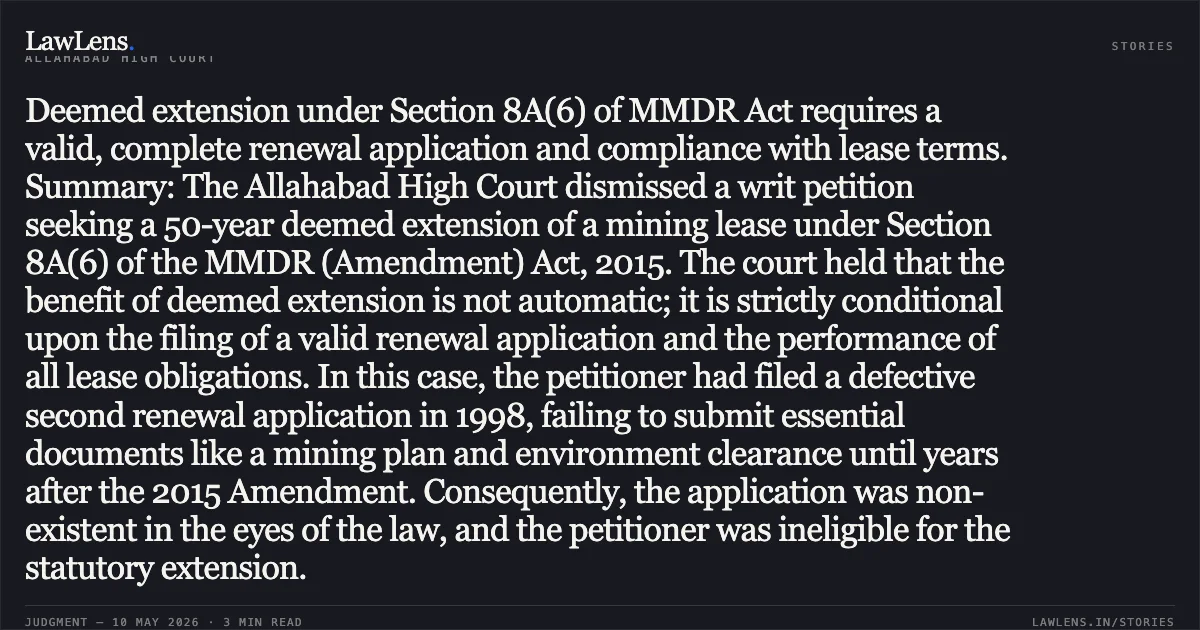
Deemed extension under Section 8A(6) of MMDR Act requires a valid, complete renewal application and compliance with lease terms. Summary: The Allahabad High Court dismissed a writ petition seeking a 50-year deemed extension of a mining lease under Section 8A(6) of the MMDR (Amendment) Act, 2015. The court held that the benefit of deemed extension is not automatic; it is strictly conditional upon the filing of a valid renewal application and the performance of all lease obligations. In this case, the petitioner had filed a defective second renewal application in 1998, failing to submit essential documents like a mining plan and environment clearance until years after the 2015 Amendment. Consequently, the application was non-existent in the eyes of the law, and the petitioner was ineligible for the statutory extension.. Rameshwar Dutt Awasthi vs State Of U.P. And 4 Others. Allahabad High Court. LawLens

Allahabad High Court·

Environmental LawAdministrative and Public Law

Deemed extension under Section 8A(6) of MMDR Act requires a valid, complete renewal application and compliance with lease terms. Summary: The Allahabad High Court dismissed a writ petition seeking a 50-year deemed extension of a mining lease under Section 8A(6) of the MMDR (Amendment) Act, 2015. The court held that the benefit of deemed extension is not automatic; it is strictly conditional upon the filing of a valid renewal application and the performance of all lease obligations. In this case, the petitioner had filed a defective second renewal application in 1998, failing to submit essential documents like a mining plan and environment clearance until years after the 2015 Amendment. Consequently, the application was non-existent in the eyes of the law, and the petitioner was ineligible for the statutory extension.

The petitioner’s predecessor was granted a mining lease for Silica Sand in 1979 for ten years

3 MIN READ