HCMONTHLY CASE LAW ARCHIVE

Jharkhand High Court Judgments in April 2026: Case Law Digest

Read 71 LawLens analyses of Jharkhand High Court judgments published in April 2026, covering key rulings, legal principles and case law.

← BACK TO JHARKHAND COURT REPORT

PERMANENT MONTHLY EDITIONS

Browse by month

AUTOMATICALLY UPDATED

April 2026 Judgments

71 ARTICLES · NEWEST FIRST
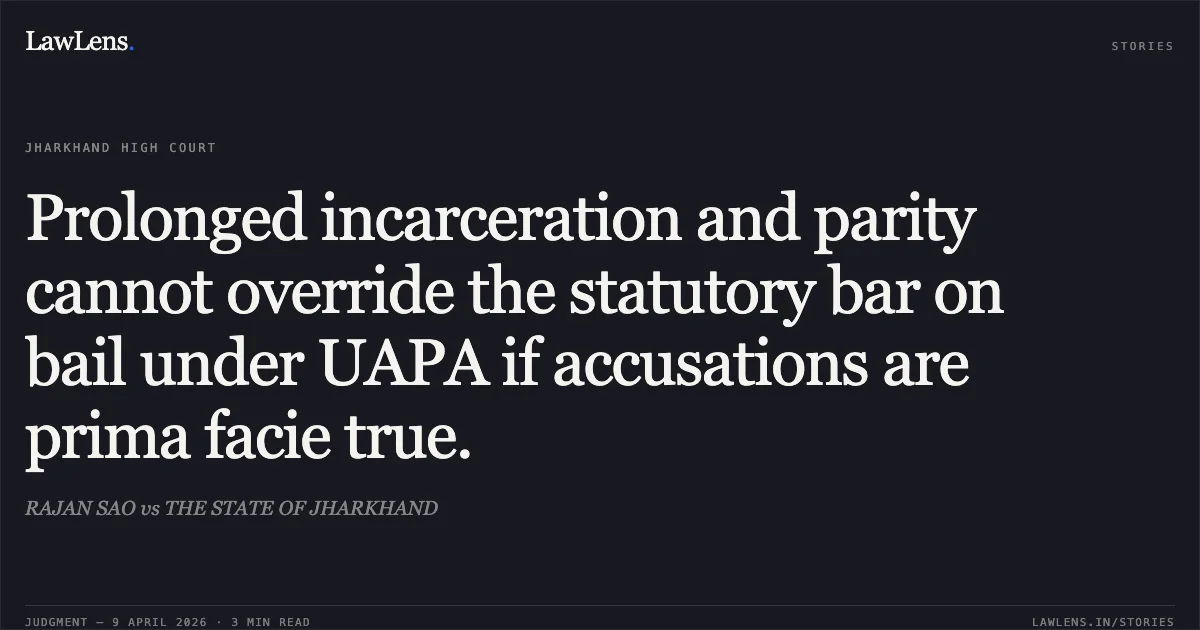
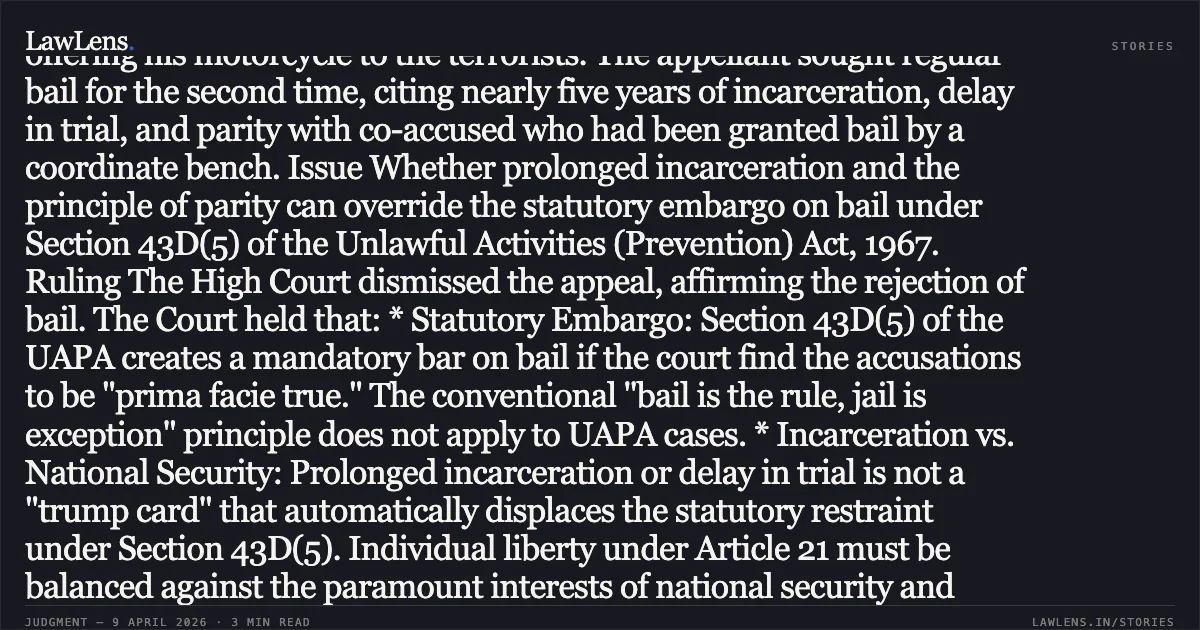
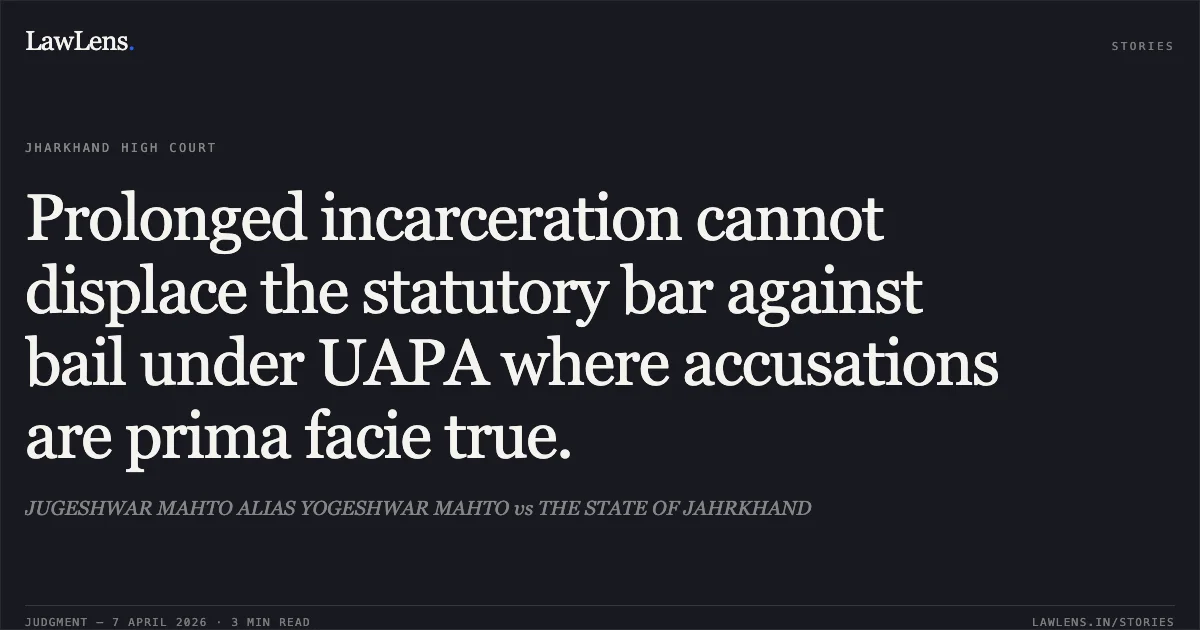
Headline: Section 43D(5) UAPA bail embargo prevails over prolonged incarceration if accusations are prima facie true Facts Four police personnel were killed and their arms looted during an indiscriminate ambush by the proscribed organization CPI (Maoist). The appellant (Accused No. 5) was arrested for allegedly acting as an overground worker (OGW), providing logistic support, conveying messages, and offering his motorcycle to the terrorists. The appellant sought regular bail for the second time, citing nearly five years of incarceration, delay in trial, and parity with co-accused who had been granted bail by a coordinate bench. Issue Whether prolonged incarceration and the principle of parity can override the statutory embargo on bail under Section 43D(5) of the Unlawful Activities (Prevention) Act, 1967. Ruling The High Court dismissed the appeal, affirming the rejection of bail. The Court held that: * Statutory Embargo: Section 43D(5) of the UAPA creates a mandatory bar on bail if the court find the accusations to be "prima facie true." The conventional "bail is the rule, jail is exception" principle does not apply to UAPA cases. * Incarceration vs. National Security: Prolonged incarceration or delay in trial is not a "trump card" that automatically displaces the statutory restraint under Section 43D(5). Individual liberty under Article 21 must be balanced against the paramount interests of national security and societal impact. * Limits of Parity: Parity in bail is not an absolute legal right. It requires a specific focus on the role of the accused. The appellant’s role as a logistic provider for a terrorist attack was distinct and supported by prima facie evidence, making parity inapplicable. * Trial Progress: Since sixteen witnesses had already been examined and the trial was progressing expeditiously, the plea of "probable delay" was rejected.. NARESH GANJHU vs UNION OF INDIA THROUGH NATIONAL INVESTIGATING AGENCY, NEW DELHI. Jharkhand High Court. LawLens

Jharkhand High Court·

Criminal Procedure and EvidenceMilitary and National Security Law

Headline: Section 43D(5) UAPA bail embargo prevails over prolonged incarceration if accusations are prima facie true Facts Four police personnel were killed and their arms looted during an indiscriminate ambush by the proscribed organization CPI (Maoist). The appellant (Accused No. 5) was arrested for allegedly acting as an overground worker (OGW), providing logistic support, conveying messages, and offering his motorcycle to the terrorists. The appellant sought regular bail for the second time, citing nearly five years of incarceration, delay in trial, and parity with co-accused who had been granted bail by a coordinate bench. Issue Whether prolonged incarceration and the principle of parity can override the statutory embargo on bail under Section 43D(5) of the Unlawful Activities (Prevention) Act, 1967. Ruling The High Court dismissed the appeal, affirming the rejection of bail. The Court held that: * Statutory Embargo: Section 43D(5) of the UAPA creates a mandatory bar on bail if the court find the accusations to be "prima facie true." The conventional "bail is the rule, jail is exception" principle does not apply to UAPA cases. * Incarceration vs. National Security: Prolonged incarceration or delay in trial is not a "trump card" that automatically displaces the statutory restraint under Section 43D(5). Individual liberty under Article 21 must be balanced against the paramount interests of national security and societal impact. * Limits of Parity: Parity in bail is not an absolute legal right. It requires a specific focus on the role of the accused. The appellant’s role as a logistic provider for a terrorist attack was distinct and supported by prima facie evidence, making parity inapplicable. * Trial Progress: Since sixteen witnesses had already been examined and the trial was progressing expeditiously, the plea of "probable delay" was rejected.

The Appellant (A-5) challenged the order dated 08.12.2025 passed by the Special Judge, NIA, Ranchi, which rejected his bail application in connection with RC Case No. 25/2020/NIA/DLI

3 MIN READ