HCMONTHLY CASE LAW ARCHIVE

Jharkhand High Court Judgments in May 2026: Case Law Digest

Read 171 LawLens analyses of Jharkhand High Court judgments published in May 2026, covering key rulings, legal principles and case law.

← BACK TO JHARKHAND COURT REPORT

PERMANENT MONTHLY EDITIONS

Browse by month

AUTOMATICALLY UPDATED

May 2026 Judgments

171 ARTICLES · NEWEST FIRST
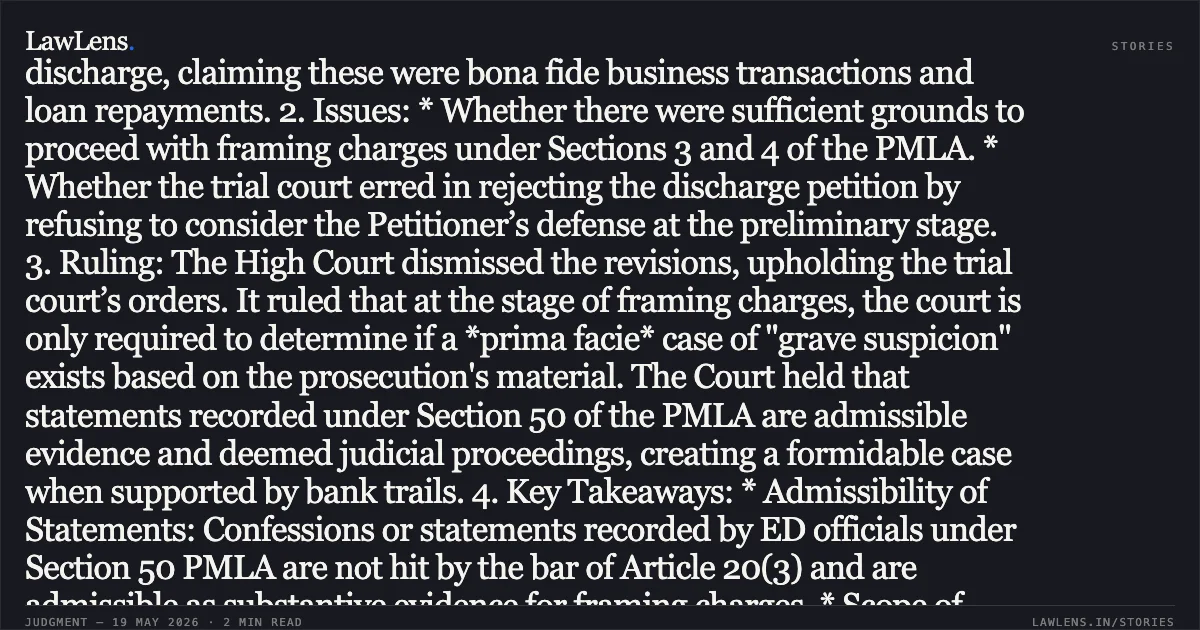
### Admissibility of Section 50 PMLA Statements and Financial Trails Establish Sufficient Grounds for Framing Charges 1. Facts: The Petitioner, a partner in M/s Shiv Machine Tools, was accused of paying ₹94.42 Lakhs as illegal gratification to a MECON official to secure tenders for projects at Bokaro and Durgapur Steel Plants. The Directorate of Enforcement (ED) alleged that the bribe was layered through sham transactions, including ₹70 Lakhs routed as a "machinery advance" to a tile vendor (M/s Naskar Ceramics) and "friendly loans" to the official’s relatives. The Petitioner sought discharge, claiming these were bona fide business transactions and loan repayments. 2. Issues: * Whether there were sufficient grounds to proceed with framing charges under Sections 3 and 4 of the PMLA. * Whether the trial court erred in rejecting the discharge petition by refusing to consider the Petitioner’s defense at the preliminary stage. 3. Ruling: The High Court dismissed the revisions, upholding the trial court’s orders. It ruled that at the stage of framing charges, the court is only required to determine if a *prima facie* case of "grave suspicion" exists based on the prosecution's material. The Court held that statements recorded under Section 50 of the PMLA are admissible evidence and deemed judicial proceedings, creating a formidable case when supported by bank trails. 4. Key Takeaways: * Admissibility of Statements: Confessions or statements recorded by ED officials under Section 50 PMLA are not hit by the bar of Article 20(3) and are admissible as substantive evidence for framing charges. * Scope of Discharge: A "mini-trial" is impermissible at the discharge stage; the court must assume prosecution materials are true and need not consider the accused's defense or documents unless they are of "sterling quality." * Layering as Offence: The use of banking channels to structure bribes as "loans" or "advances" through intermediary entities squarely meets the definition of laundering under Section 3 PMLA. * Standalone Offence: Money laundering is an independent offence; procedural regularity in the underlying tender process does not legitimize the illegal movement of proceeds of crime.. HITESH V. SHAH vs UNION OF INDIA THROUGH THE DIRECTORATE OF ENFORCEMENT. Jharkhand High Court. LawLens

Jharkhand High Court·

Criminal LawCriminal Procedure and Evidence

### Admissibility of Section 50 PMLA Statements and Financial Trails Establish Sufficient Grounds for Framing Charges 1. Facts: The Petitioner, a partner in M/s Shiv Machine Tools, was accused of paying ₹94.42 Lakhs as illegal gratification to a MECON official to secure tenders for projects at Bokaro and Durgapur Steel Plants. The Directorate of Enforcement (ED) alleged that the bribe was layered through sham transactions, including ₹70 Lakhs routed as a "machinery advance" to a tile vendor (M/s Naskar Ceramics) and "friendly loans" to the official’s relatives. The Petitioner sought discharge, claiming these were bona fide business transactions and loan repayments. 2. Issues: * Whether there were sufficient grounds to proceed with framing charges under Sections 3 and 4 of the PMLA. * Whether the trial court erred in rejecting the discharge petition by refusing to consider the Petitioner’s defense at the preliminary stage. 3. Ruling: The High Court dismissed the revisions, upholding the trial court’s orders. It ruled that at the stage of framing charges, the court is only required to determine if a *prima facie* case of "grave suspicion" exists based on the prosecution's material. The Court held that statements recorded under Section 50 of the PMLA are admissible evidence and deemed judicial proceedings, creating a formidable case when supported by bank trails. 4. Key Takeaways: * Admissibility of Statements: Confessions or statements recorded by ED officials under Section 50 PMLA are not hit by the bar of Article 20(3) and are admissible as substantive evidence for framing charges. * Scope of Discharge: A "mini-trial" is impermissible at the discharge stage; the court must assume prosecution materials are true and need not consider the accused's defense or documents unless they are of "sterling quality." * Layering as Offence: The use of banking channels to structure bribes as "loans" or "advances" through intermediary entities squarely meets the definition of laundering under Section 3 PMLA. * Standalone Offence: Money laundering is an independent offence; procedural regularity in the underlying tender process does not legitimize the illegal movement of proceeds of crime.

The petitioner, a partner in M/s Shiv Machine Tools, was implicated in a CBI FIR (2017) alleging a criminal conspiracy with a Senior Manager at MECON India Ltd (U.N. Mandal) to secure tenders at the Bokaro Steel Plant...

2 MIN READ

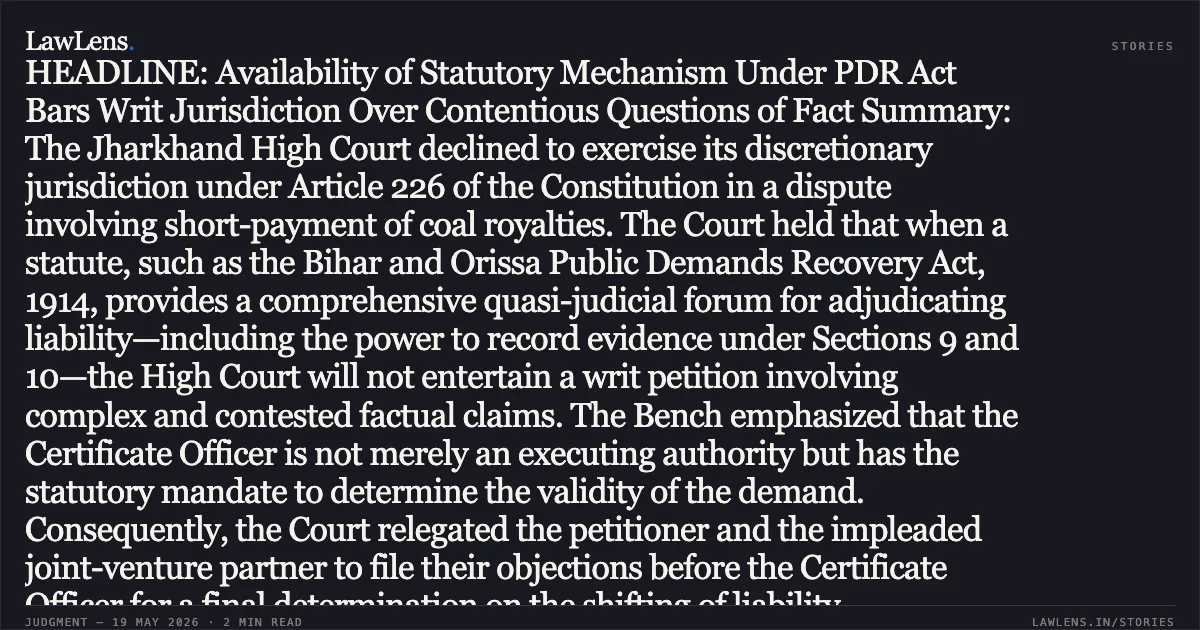
HEADLINE: Availability of Statutory Mechanism Under PDR Act Bars Writ Jurisdiction Over Contentious Questions of Fact Summary: The Jharkhand High Court declined to exercise its discretionary jurisdiction under Article 226 of the Constitution in a dispute involving short-payment of coal royalties. The Court held that when a statute, such as the Bihar and Orissa Public Demands Recovery Act, 1914, provides a comprehensive quasi-judicial forum for adjudicating liability—including the power to record evidence under Sections 9 and 10—the High Court will not entertain a writ petition involving complex and contested factual claims. The Bench emphasized that the Certificate Officer is not merely an executing authority but has the statutory mandate to determine the validity of the demand. Consequently, the Court relegated the petitioner and the impleaded joint-venture partner to file their objections before the Certificate Officer for a final determination on the shifting of liability.. PANEEM COAL MINES LTD THR ITS DIRECTOR BISWANATH DUTTA vs STATE OF JHARKHAND And ORS. Jharkhand High Court. LawLens

Jharkhand High Court·

Administrative and Public LawCivil Procedure and Evidence

HEADLINE: Availability of Statutory Mechanism Under PDR Act Bars Writ Jurisdiction Over Contentious Questions of Fact Summary: The Jharkhand High Court declined to exercise its discretionary jurisdiction under Article 226 of the Constitution in a dispute involving short-payment of coal royalties. The Court held that when a statute, such as the Bihar and Orissa Public Demands Recovery Act, 1914, provides a comprehensive quasi-judicial forum for adjudicating liability—including the power to record evidence under Sections 9 and 10—the High Court will not entertain a writ petition involving complex and contested factual claims. The Bench emphasized that the Certificate Officer is not merely an executing authority but has the statutory mandate to determine the validity of the demand. Consequently, the Court relegated the petitioner and the impleaded joint-venture partner to file their objections before the Certificate Officer for a final determination on the shifting of liability.

The petitioner, PANEM Coal Mines Ltd. (a joint venture involving Punjab State Power Corporation Ltd. [PSPCL]), was allotted the Pachwara Central Coal Block for captive supply to PSPCL.

2 MIN READ