SCMONTHLY CASE LAW ARCHIVE

June 2026 Supreme Court Judgments: Key Rulings and Case Law

Read 43 LawLens analyses of Supreme Court judgments published in June 2026, covering key rulings, legal principles and case law.

← BACK TO THE SUPREME COURT DESK

PERMANENT MONTHLY EDITIONS

Browse by month

AUTOMATICALLY UPDATED

June 2026 Judgments

43 ARTICLES · NEWEST FIRST
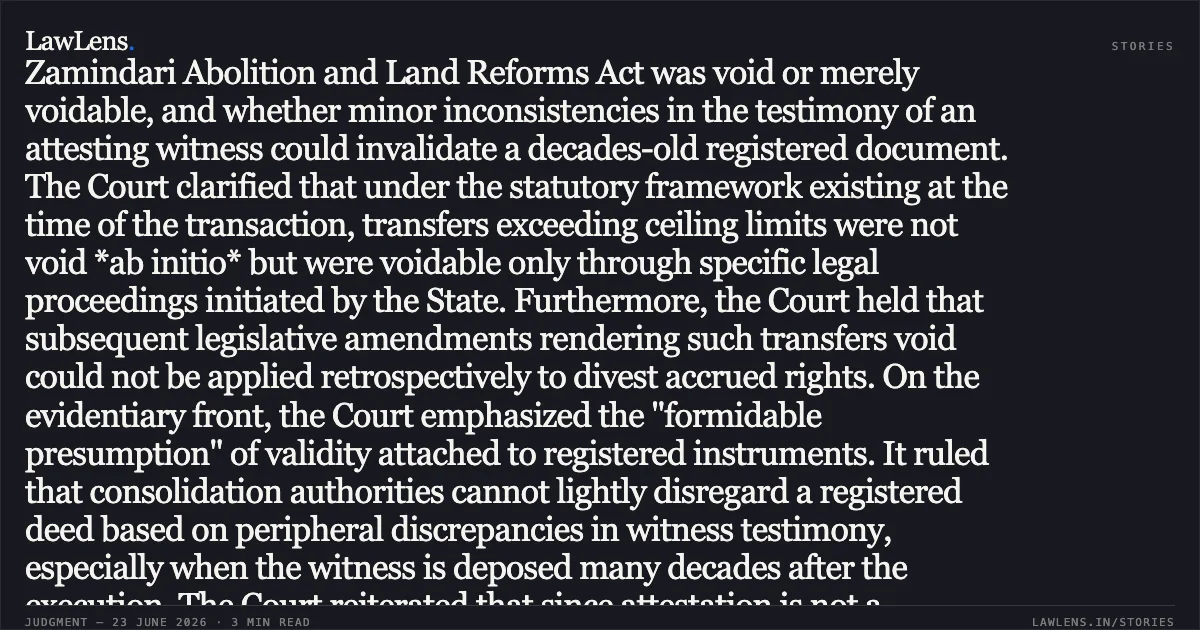
Registered Sale Deeds Prevail Over Minor Witness Discrepancies and Prospective Statutory Restrictions on Transfer In this judgment, the Supreme Court addressed a long-standing land dispute involving a registered sale deed from 1957. The primary legal issue was whether a transfer that allegedly exceeded statutory ceiling limits under the U.P. Zamindari Abolition and Land Reforms Act was void or merely voidable, and whether minor inconsistencies in the testimony of an attesting witness could invalidate a decades-old registered document. The Court clarified that under the statutory framework existing at the time of the transaction, transfers exceeding ceiling limits were not void *ab initio* but were voidable only through specific legal proceedings initiated by the State. Furthermore, the Court held that subsequent legislative amendments rendering such transfers void could not be applied retrospectively to divest accrued rights. On the evidentiary front, the Court emphasized the "formidable presumption" of validity attached to registered instruments. It ruled that consolidation authorities cannot lightly disregard a registered deed based on peripheral discrepancies in witness testimony, especially when the witness is deposed many decades after the execution. The Court reiterated that since attestation is not a mandatory requirement for a sale deed's validity, minor errors regarding a witness's details are insufficient to overcome the legal presumption of genuineness. Would you like a summary of the legal analysis regarding the retrospective application of statutes mentioned in the latter half of the judgment?. Sarafat Ali (Deceased) Through Lrs vs Deputy Director Of Consolidation Haridwar. Supreme Court. LawLens

Supreme Court·

Property and Real Estate LawCivil Procedure and Evidence

Registered Sale Deeds Prevail Over Minor Witness Discrepancies and Prospective Statutory Restrictions on Transfer In this judgment, the Supreme Court addressed a long-standing land dispute involving a registered sale deed from 1957. The primary legal issue was whether a transfer that allegedly exceeded statutory ceiling limits under the U.P. Zamindari Abolition and Land Reforms Act was void or merely voidable, and whether minor inconsistencies in the testimony of an attesting witness could invalidate a decades-old registered document. The Court clarified that under the statutory framework existing at the time of the transaction, transfers exceeding ceiling limits were not void *ab initio* but were voidable only through specific legal proceedings initiated by the State. Furthermore, the Court held that subsequent legislative amendments rendering such transfers void could not be applied retrospectively to divest accrued rights. On the evidentiary front, the Court emphasized the "formidable presumption" of validity attached to registered instruments. It ruled that consolidation authorities cannot lightly disregard a registered deed based on peripheral discrepancies in witness testimony, especially when the witness is deposed many decades after the execution. The Court reiterated that since attestation is not a mandatory requirement for a sale deed's validity, minor errors regarding a witness's details are insufficient to overcome the legal presumption of genuineness. Would you like a summary of the legal analysis regarding the retrospective application of statutes mentioned in the latter half of the judgment?

The appellants' predecessors (then minors) purchased 15 bigha, 11 biswa of land via a registered sale deed dated 04.06.1957

3 MIN READ