SCMONTHLY CASE LAW ARCHIVE

May 2026 Supreme Court Judgments: Key Rulings and Case Law

Read 163 LawLens analyses of Supreme Court judgments published in May 2026, covering key rulings, legal principles and case law.

← BACK TO THE SUPREME COURT DESK

PERMANENT MONTHLY EDITIONS

Browse by month

AUTOMATICALLY UPDATED

May 2026 Judgments

163 ARTICLES · NEWEST FIRST
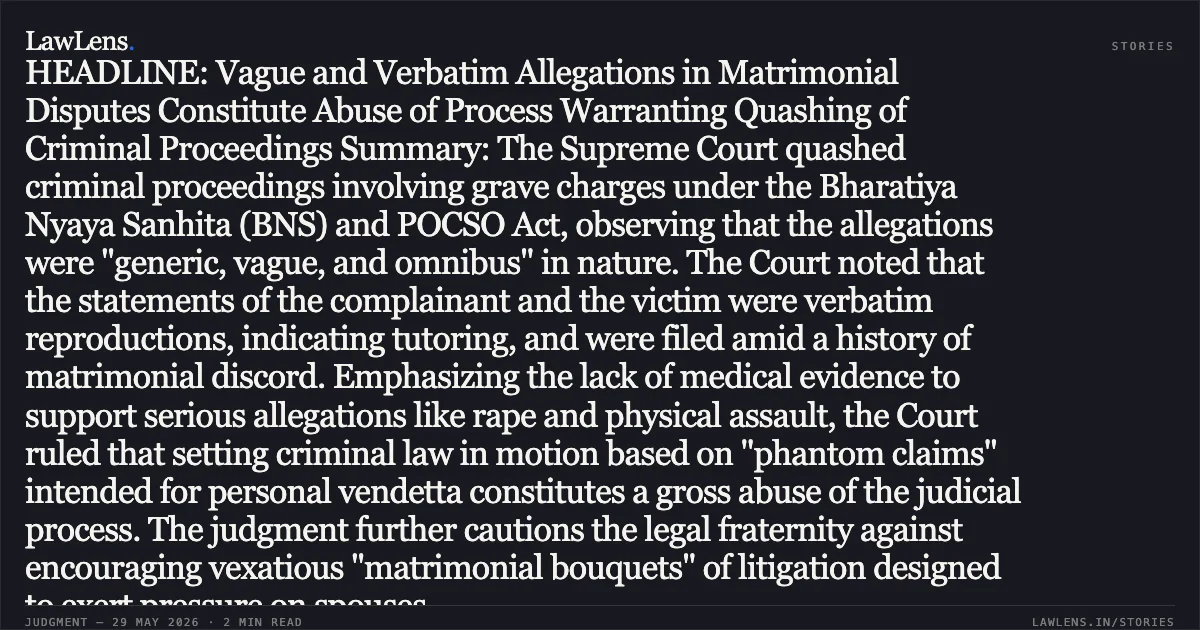
HEADLINE: Vague and Verbatim Allegations in Matrimonial Disputes Constitute Abuse of Process Warranting Quashing of Criminal Proceedings Summary: The Supreme Court quashed criminal proceedings involving grave charges under the Bharatiya Nyaya Sanhita (BNS) and POCSO Act, observing that the allegations were "generic, vague, and omnibus" in nature. The Court noted that the statements of the complainant and the victim were verbatim reproductions, indicating tutoring, and were filed amid a history of matrimonial discord. Emphasizing the lack of medical evidence to support serious allegations like rape and physical assault, the Court ruled that setting criminal law in motion based on "phantom claims" intended for personal vendetta constitutes a gross abuse of the judicial process. The judgment further cautions the legal fraternity against encouraging vexatious "matrimonial bouquets" of litigation designed to exert pressure on spouses.. Ishwar Chand Sharma vs State Of U.P.. Supreme Court. LawLens

Supreme Court·

Criminal Procedure and EvidenceCriminal Law

HEADLINE: Vague and Verbatim Allegations in Matrimonial Disputes Constitute Abuse of Process Warranting Quashing of Criminal Proceedings Summary: The Supreme Court quashed criminal proceedings involving grave charges under the Bharatiya Nyaya Sanhita (BNS) and POCSO Act, observing that the allegations were "generic, vague, and omnibus" in nature. The Court noted that the statements of the complainant and the victim were verbatim reproductions, indicating tutoring, and were filed amid a history of matrimonial discord. Emphasizing the lack of medical evidence to support serious allegations like rape and physical assault, the Court ruled that setting criminal law in motion based on "phantom claims" intended for personal vendetta constitutes a gross abuse of the judicial process. The judgment further cautions the legal fraternity against encouraging vexatious "matrimonial bouquets" of litigation designed to exert pressure on spouses.

The Appellants (husband, mother-in-law, sister-in-law, and brother-in-law of the Complainant) were embroiled in over ten civil and criminal litigations with Respondent No. 2 following a matrimonial separation in 2011.

2 MIN READ