BHCMONTHLY CASE LAW ARCHIVE

Bombay High Court Judgments in July 2026: Case Law Digest

Read 93 LawLens analyses of Bombay High Court judgments published in July 2026, covering key rulings, legal principles and case law.

← BACK TO THE BOMBAY LAW DESK

PERMANENT MONTHLY EDITIONS

Browse by month

AUTOMATICALLY UPDATED

July 2026 Judgments

93 ARTICLES · NEWEST FIRST
Headnote: Acquittal for Murder Sustained While Upholding Conviction Under Section 201 IPC for Destruction of Evidence. Case Summary: * Court: High Court of Judicature at Bombay * Bench: Justice Manish Pitale & Justice Shreeram V. Shirsat * Decided on: July 9, 2026 Facts: The Appellant, Prabhakar Kutty Shetty, was convicted by the Sessions Court for the murder (Section 302 IPC) and disappearance of evidence (Section 201 IPC) of Kanti Karunakar Shetty. The prosecution’s case rested on circumstantial evidence: the discovery of a female torso in a lake, identified via DNA; witnesses claiming they saw the Appellant disposing of the bag; and various recoveries (head, knife, and bloodstained articles). The Appellant challenged the conviction, arguing a failure to establish a complete chain of circumstances. Key Issues: 1. Whether the prosecution established an unbroken chain of circumstances to prove the charge of murder beyond reasonable doubt. 2. Whether conviction under Section 201 IPC (destruction of evidence) can be sustained in the event of an acquittal under Section 302 IPC. Court's Analysis and Ruling: * Section 302 IPC (Murder): The Court found the chain of circumstances for murder to be "snapped." It discredited the "last seen together" theory due to unreliable witness testimony (P.W. 5) and Call Detail Records (CDR) that indicated the presence of an unidentified third party at the scene. Furthermore, the recovery of the weapon (knife) was deemed weak as it was found in a public canal. Applying the principle of *Sharad Birdhichand Sarda*, the Court held that suspicion, however grave, cannot replace legal proof. The Appellant was acquitted of murder. * Section 201 IPC (Destruction of Evidence): The Court upheld the conviction for this charge. Reliable testimonies from P.W. 2 and P.W. 6 (who saw the Appellant dumping the torso) and the recovery of the head at the Appellant's instance established he had knowledge of the crime and intentionally caused evidence to disappear. Following the precedent in *V.L. Tresa v. State of Kerala*, the Court ruled that acquittal for the main offence (murder) does not automatically result in acquittal for screening the offender. Conclusion: The appeal was partly allowed. The conviction under Section 302 IPC was set aside, while the conviction and two-year sentence under Section 201 IPC were confirmed. As the Appellant had already served approximately 13 years, the Court ordered his immediate release.. Prabhakar Kutty Shetty vs The State Of Maharashtra. Bombay High Court. LawLens

Bombay High Court·

Criminal LawCriminal Procedure and Evidence

Headnote: Acquittal for Murder Sustained While Upholding Conviction Under Section 201 IPC for Destruction of Evidence. Case Summary: * Court: High Court of Judicature at Bombay * Bench: Justice Manish Pitale & Justice Shreeram V. Shirsat * Decided on: July 9, 2026 Facts: The Appellant, Prabhakar Kutty Shetty, was convicted by the Sessions Court for the murder (Section 302 IPC) and disappearance of evidence (Section 201 IPC) of Kanti Karunakar Shetty. The prosecution’s case rested on circumstantial evidence: the discovery of a female torso in a lake, identified via DNA; witnesses claiming they saw the Appellant disposing of the bag; and various recoveries (head, knife, and bloodstained articles). The Appellant challenged the conviction, arguing a failure to establish a complete chain of circumstances. Key Issues: 1. Whether the prosecution established an unbroken chain of circumstances to prove the charge of murder beyond reasonable doubt. 2. Whether conviction under Section 201 IPC (destruction of evidence) can be sustained in the event of an acquittal under Section 302 IPC. Court's Analysis and Ruling: * Section 302 IPC (Murder): The Court found the chain of circumstances for murder to be "snapped." It discredited the "last seen together" theory due to unreliable witness testimony (P.W. 5) and Call Detail Records (CDR) that indicated the presence of an unidentified third party at the scene. Furthermore, the recovery of the weapon (knife) was deemed weak as it was found in a public canal. Applying the principle of *Sharad Birdhichand Sarda*, the Court held that suspicion, however grave, cannot replace legal proof. The Appellant was acquitted of murder. * Section 201 IPC (Destruction of Evidence): The Court upheld the conviction for this charge. Reliable testimonies from P.W. 2 and P.W. 6 (who saw the Appellant dumping the torso) and the recovery of the head at the Appellant's instance established he had knowledge of the crime and intentionally caused evidence to disappear. Following the precedent in *V.L. Tresa v. State of Kerala*, the Court ruled that acquittal for the main offence (murder) does not automatically result in acquittal for screening the offender. Conclusion: The appeal was partly allowed. The conviction under Section 302 IPC was set aside, while the conviction and two-year sentence under Section 201 IPC were confirmed. As the Appellant had already served approximately 13 years, the Court ordered his immediate release.

On October 29, 2013, a woman’s torso was found in a plastic bag at Charai Lake, Chembur.

2 MIN READ

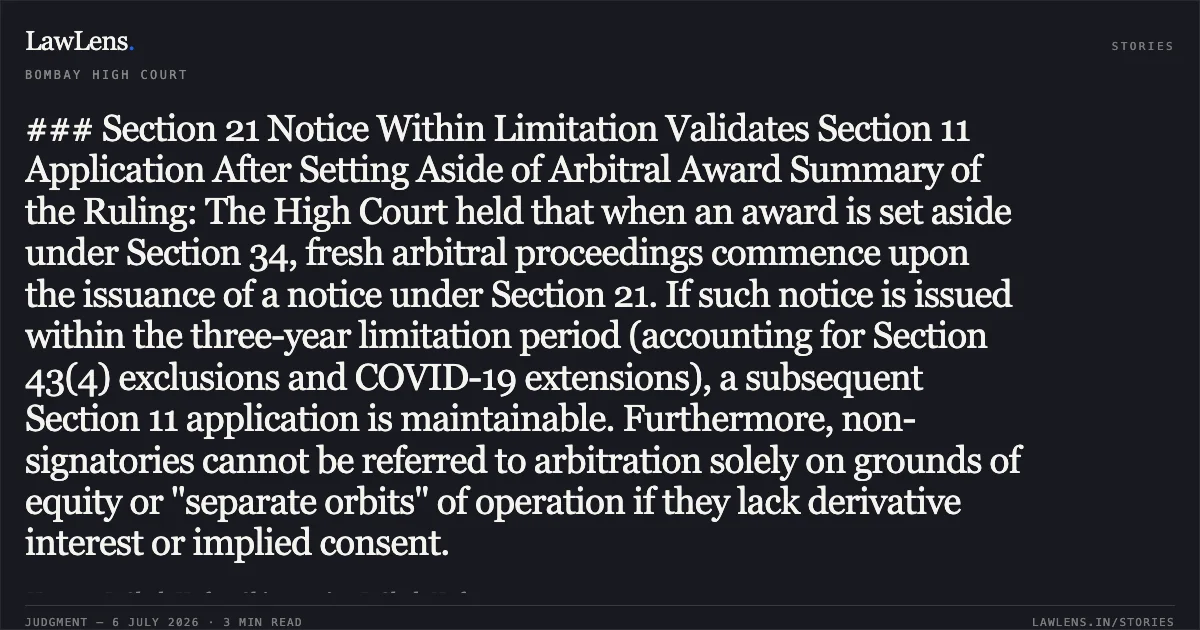
### Section 21 Notice Within Limitation Validates Section 11 Application After Setting Aside of Arbitral Award Summary of the Ruling: The High Court held that when an award is set aside under Section 34, fresh arbitral proceedings commence upon the issuance of a notice under Section 21. If such notice is issued within the three-year limitation period (accounting for Section 43(4) exclusions and COVID-19 extensions), a subsequent Section 11 application is maintainable. Furthermore, non-signatories cannot be referred to arbitration solely on grounds of equity or "separate orbits" of operation if they lack derivative interest or implied consent.. Hemant D Shah Huf vs Chittaranjan D Shah Huf. Bombay High Court. LawLens

Bombay High Court·

Arbitration and MediationCivil Procedure and Evidence

### Section 21 Notice Within Limitation Validates Section 11 Application After Setting Aside of Arbitral Award Summary of the Ruling: The High Court held that when an award is set aside under Section 34, fresh arbitral proceedings commence upon the issuance of a notice under Section 21. If such notice is issued within the three-year limitation period (accounting for Section 43(4) exclusions and COVID-19 extensions), a subsequent Section 11 application is maintainable. Furthermore, non-signatories cannot be referred to arbitration solely on grounds of equity or "separate orbits" of operation if they lack derivative interest or implied consent.

The Applicants sought the appointment of a sole arbitrator under Section 11 of the Arbitration and Conciliation Act, 1996, invoking a clause in a Partnership Deed dated December 9, 1985

3 MIN READ