KHCMONTHLY CASE LAW ARCHIVE

Karnataka High Court Judgments in April 2026: Case Law Digest

Read 67 LawLens analyses of Karnataka High Court judgments published in April 2026, covering key rulings, legal principles and case law.

← BACK TO THE KARNATAKA LAW DESK

PERMANENT MONTHLY EDITIONS

Browse by month

AUTOMATICALLY UPDATED

April 2026 Judgments

67 ARTICLES · NEWEST FIRST
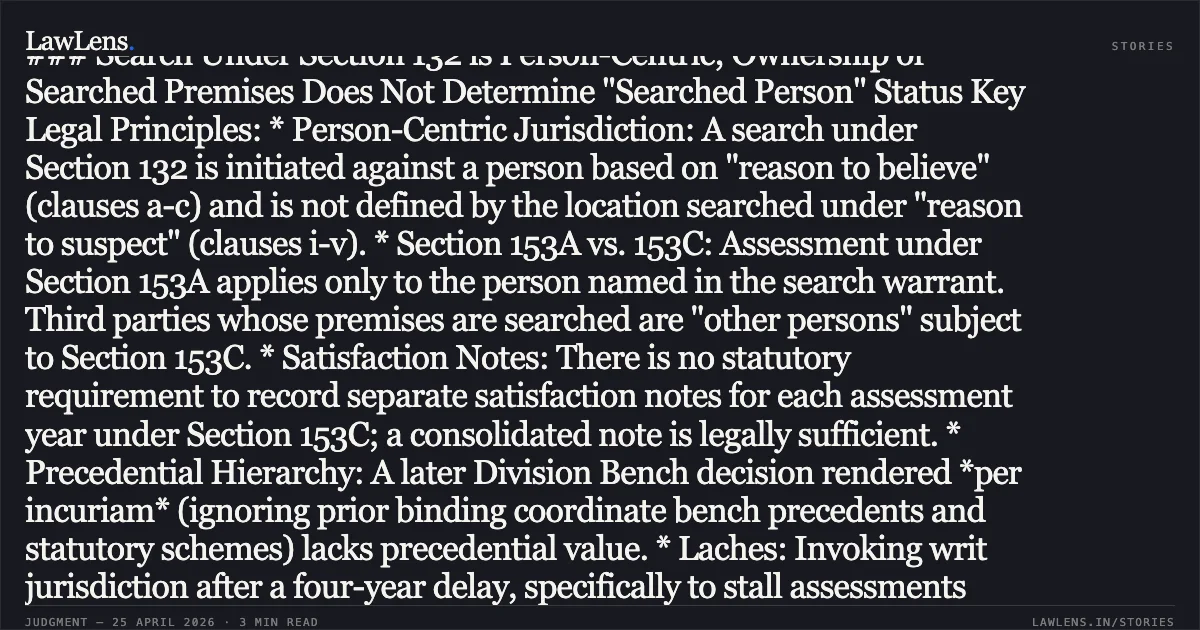
### Search Under Section 132 is Person-Centric; Ownership of Searched Premises Does Not Determine "Searched Person" Status Key Legal Principles: * Person-Centric Jurisdiction: A search under Section 132 is initiated against a person based on "reason to believe" (clauses a-c) and is not defined by the location searched under "reason to suspect" (clauses i-v). * Section 153A vs. 153C: Assessment under Section 153A applies only to the person named in the search warrant. Third parties whose premises are searched are "other persons" subject to Section 153C. * Satisfaction Notes: There is no statutory requirement to record separate satisfaction notes for each assessment year under Section 153C; a consolidated note is legally sufficient. * Precedential Hierarchy: A later Division Bench decision rendered *per incuriam* (ignoring prior binding coordinate bench precedents and statutory schemes) lacks precedential value. * Laches: Invoking writ jurisdiction after a four-year delay, specifically to stall assessments near the limitation deadline, constitutes laches.. THE DEPUTY COMMISSIONER OF INCOME TAX vs SRI C R RAM MOHAN RAJU. Karnataka High Court. LawLens

Karnataka High Court·

Tax LawAdministrative and Public Law

### Search Under Section 132 is Person-Centric; Ownership of Searched Premises Does Not Determine "Searched Person" Status Key Legal Principles: * Person-Centric Jurisdiction: A search under Section 132 is initiated against a person based on "reason to believe" (clauses a-c) and is not defined by the location searched under "reason to suspect" (clauses i-v). * Section 153A vs. 153C: Assessment under Section 153A applies only to the person named in the search warrant. Third parties whose premises are searched are "other persons" subject to Section 153C. * Satisfaction Notes: There is no statutory requirement to record separate satisfaction notes for each assessment year under Section 153C; a consolidated note is legally sufficient. * Precedential Hierarchy: A later Division Bench decision rendered *per incuriam* (ignoring prior binding coordinate bench precedents and statutory schemes) lacks precedential value. * Laches: Invoking writ jurisdiction after a four-year delay, specifically to stall assessments near the limitation deadline, constitutes laches.

A search under Section 132 of the Income Tax Act was initiated against Sri K. Narayan Raju.

3 MIN READ

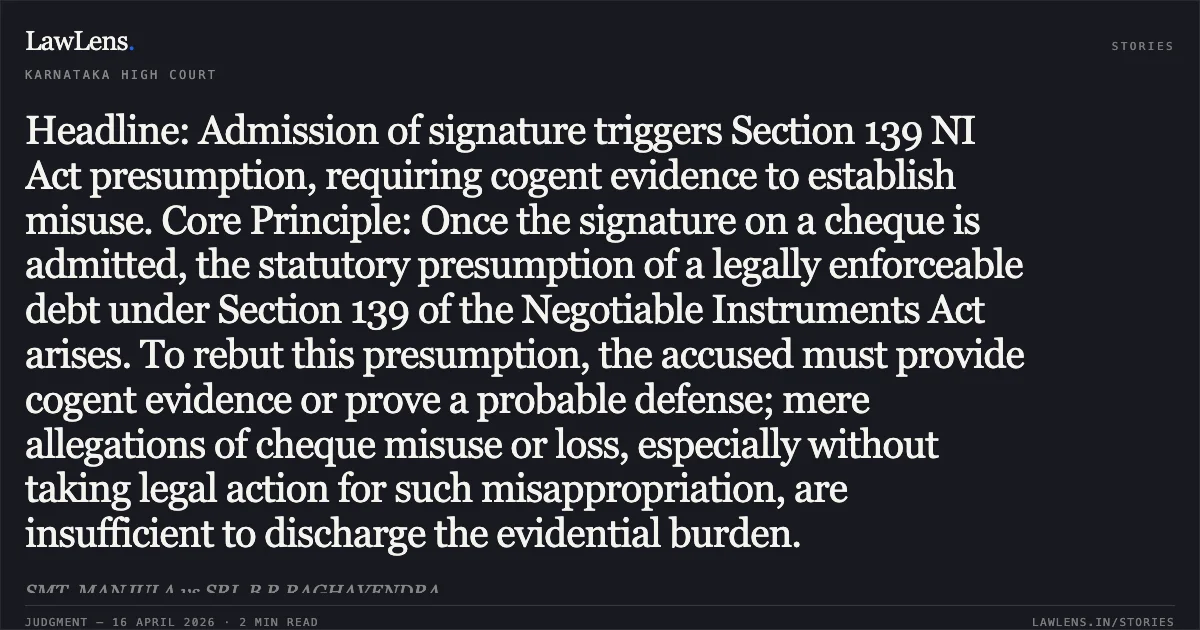
Headline: Admission of signature triggers Section 139 NI Act presumption, requiring cogent evidence to establish misuse. Core Principle: Once the signature on a cheque is admitted, the statutory presumption of a legally enforceable debt under Section 139 of the Negotiable Instruments Act arises. To rebut this presumption, the accused must provide cogent evidence or prove a probable defense; mere allegations of cheque misuse or loss, especially without taking legal action for such misappropriation, are insufficient to discharge the evidential burden.. SMT. MANJULA vs SRI. B R RAGHAVENDRA. Karnataka High Court. LawLens

Karnataka High Court·

Banking and Finance LawCriminal Procedure and Evidence

Headline: Admission of signature triggers Section 139 NI Act presumption, requiring cogent evidence to establish misuse. Core Principle: Once the signature on a cheque is admitted, the statutory presumption of a legally enforceable debt under Section 139 of the Negotiable Instruments Act arises. To rebut this presumption, the accused must provide cogent evidence or prove a probable defense; mere allegations of cheque misuse or loss, especially without taking legal action for such misappropriation, are insufficient to discharge the evidential burden.

The respondent-complainant alleged that he lent the petitioner-accused Rs. 5,00,000 in January 2017 for the purchase of a site.

2 MIN READ