KHCMONTHLY CASE LAW ARCHIVE

Karnataka High Court Judgments in June 2026: Case Law Digest

Read 81 LawLens analyses of Karnataka High Court judgments published in June 2026, covering key rulings, legal principles and case law.

← BACK TO THE KARNATAKA LAW DESK

PERMANENT MONTHLY EDITIONS

Browse by month

AUTOMATICALLY UPDATED

June 2026 Judgments

81 ARTICLES · NEWEST FIRST
### Judgment Procurement via Fraudulent Grant Orders for Public Water Bodies Is Non Est and Lacks Legal Sanctity Brief Summary: The Karnataka High Court set aside a Single Judge's order that had directed revenue entries based on a civil court decree. The Division Bench held that the underlying "Grant Order" was a fabricated document for land classified as a Government Lake (*Sarkari Kere*). Reaffirming that "fraud unravels everything," the Court ruled that judicial decrees obtained by deceiving the court are a nullity. Furthermore, it emphasized the State's constitutional obligation under Article 21 to protect community resources and natural bodies from illegal alienation.. STATE OF KARNATAKA vs SRI. L. N. GOVINDASWAMY. Karnataka High Court. LawLens

Karnataka High Court·

### Judgment Procurement via Fraudulent Grant Orders for Public Water Bodies Is Non Est and Lacks Legal Sanctity Brief Summary: The Karnataka High Court set aside a Single Judge's order that had directed revenue entries based on a civil court decree. The Division Bench held that the underlying "Grant Order" was a fabricated document for land classified as a Government Lake (*Sarkari Kere*). Reaffirming that "fraud unravels everything," the Court ruled that judicial decrees obtained by deceiving the court are a nullity. Furthermore, it emphasized the State's constitutional obligation under Article 21 to protect community resources and natural bodies from illegal alienation.

The Petitioner (Respondent No. 1) claimed title to 13 Acres 29 Guntas in Sy. Nos. 82, 52, and 61 of Dattagalli Village via a 1954 Grant Order

2 MIN READ

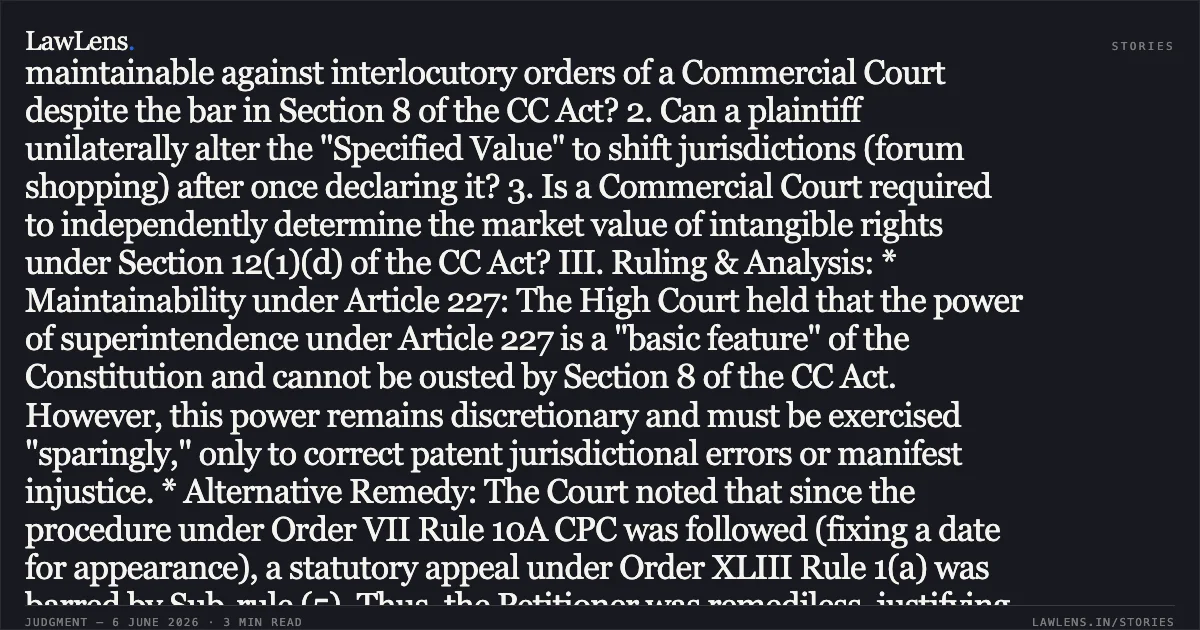
High Court Supervises Mandatory Valuation of Intangible Rights to Prevent Forum Shopping in Commercial Disputes Case Brief: I. Facts: The Respondent/Plaintiff initially filed a trademark infringement suit for "TULASI" in a regular Civil Court. After the Civil Court directed a disclosure of "Specified Value" under Section 12 of the Commercial Courts Act (CC Act), the Respondent filed a memo stating the value exceeded ₹3,00,000, leading to the transfer of the case to a Commercial Court. However, the Respondent later filed an application under Order VII Rule 10 CPC to return the plaint back to the Civil Court, claiming the value was actually below ₹3,00,000, citing a different order involving the same trademark. The Commercial Court allowed this return without independently verifying the market value of the intangible right. II. Issues for Consideration: 1. Is a petition under Article 227 of the Constitution maintainable against interlocutory orders of a Commercial Court despite the bar in Section 8 of the CC Act? 2. Can a plaintiff unilaterally alter the "Specified Value" to shift jurisdictions (forum shopping) after once declaring it? 3. Is a Commercial Court required to independently determine the market value of intangible rights under Section 12(1)(d) of the CC Act? III. Ruling & Analysis: * Maintainability under Article 227: The High Court held that the power of superintendence under Article 227 is a "basic feature" of the Constitution and cannot be ousted by Section 8 of the CC Act. However, this power remains discretionary and must be exercised "sparingly," only to correct patent jurisdictional errors or manifest injustice. * Alternative Remedy: The Court noted that since the procedure under Order VII Rule 10A CPC was followed (fixing a date for appearance), a statutory appeal under Order XLIII Rule 1(a) was barred by Sub-rule (5). Thus, the Petitioner was remediless, justifying interference under Article 227. * Mandatory Valuation under Section 12(1)(d): The Court ruled that for intangible rights (trademarks), the "Specified Value" must be determined based on the market value estimated by the plaintiff. The Commercial Court committed a jurisdictional error by relying on a separate case's finding rather than conducting an independent inquiry into the *bona fides* of the valuation in the present suit. * Forum Shopping: The Court emphasized that while a plaintiff is *dominus litis*, they cannot take inconsistent stands on valuation to wander between forums, as this defeats the CC Act’s objective of "speedy disposal." IV. Conclusion: The High Court set aside the order returning the plaint. It directed the Commercial Court to conduct a fresh enquiry into the "Specified Value" of the trademark to determine if it truly meets the ₹3,00,000 threshold for commercial jurisdiction.. KANPUR FLOWERCYCLING PRIVATE LIMITED vs M/S SARATHI INTERNATIONAL INC. Karnataka High Court. LawLens

Karnataka High Court·

High Court Supervises Mandatory Valuation of Intangible Rights to Prevent Forum Shopping in Commercial Disputes Case Brief: I. Facts: The Respondent/Plaintiff initially filed a trademark infringement suit for "TULASI" in a regular Civil Court. After the Civil Court directed a disclosure of "Specified Value" under Section 12 of the Commercial Courts Act (CC Act), the Respondent filed a memo stating the value exceeded ₹3,00,000, leading to the transfer of the case to a Commercial Court. However, the Respondent later filed an application under Order VII Rule 10 CPC to return the plaint back to the Civil Court, claiming the value was actually below ₹3,00,000, citing a different order involving the same trademark. The Commercial Court allowed this return without independently verifying the market value of the intangible right. II. Issues for Consideration: 1. Is a petition under Article 227 of the Constitution maintainable against interlocutory orders of a Commercial Court despite the bar in Section 8 of the CC Act? 2. Can a plaintiff unilaterally alter the "Specified Value" to shift jurisdictions (forum shopping) after once declaring it? 3. Is a Commercial Court required to independently determine the market value of intangible rights under Section 12(1)(d) of the CC Act? III. Ruling & Analysis: * Maintainability under Article 227: The High Court held that the power of superintendence under Article 227 is a "basic feature" of the Constitution and cannot be ousted by Section 8 of the CC Act. However, this power remains discretionary and must be exercised "sparingly," only to correct patent jurisdictional errors or manifest injustice. * Alternative Remedy: The Court noted that since the procedure under Order VII Rule 10A CPC was followed (fixing a date for appearance), a statutory appeal under Order XLIII Rule 1(a) was barred by Sub-rule (5). Thus, the Petitioner was remediless, justifying interference under Article 227. * Mandatory Valuation under Section 12(1)(d): The Court ruled that for intangible rights (trademarks), the "Specified Value" must be determined based on the market value estimated by the plaintiff. The Commercial Court committed a jurisdictional error by relying on a separate case's finding rather than conducting an independent inquiry into the *bona fides* of the valuation in the present suit. * Forum Shopping: The Court emphasized that while a plaintiff is *dominus litis*, they cannot take inconsistent stands on valuation to wander between forums, as this defeats the CC Act’s objective of "speedy disposal." IV. Conclusion: The High Court set aside the order returning the plaint. It directed the Commercial Court to conduct a fresh enquiry into the "Specified Value" of the trademark to determine if it truly meets the ₹3,00,000 threshold for commercial jurisdiction.

The Respondent (Plaintiff) initially filed a trademark infringement suit for the mark "TULASI" before a Civil Court

3 MIN READ

### Relative of Husband Under Section 80 BNS Limited to Relations by Blood, Marriage, or Adoption FACTS: The marriage between the deceased and Accused No. 1 (A1) took place in November 2024. Allegations of physical and mental cruelty, surveillance, and character assassination were made against A1 during their stay in the USA. Upon returning to India, the deceased was allegedly further humiliated by her in-laws (A2–A4) and their distant relatives (A5–A6). Following these events, the deceased committed suicide within five months of marriage, leaving a death note detailing the discord. A charge sheet was filed under Sections 80 (dowry death), 85 (cruelty), and 352 (insult) of the Bharatiya Nyaya Sanhita (BNS). ISSUE: Whether distant relatives and the husband's family can be prosecuted under Sections 80 and 85 of the BNS when there is a proximity of suicide to the alleged harassment, and whether distant relatives qualify as "relatives" under the Act. HELD: The Court partially allowed the petitions. 1. Scope of "Relative": Following settled precedent (e.g., *State of Punjab v. Gurmit Singh*), the Court held that the term "relative of the husband" in Sections 80 and 85 of the BNS is restricted to persons related by blood, marriage, or adoption. Consequently, proceedings against A5 and A6 (distant relatives) were quashed as they did not meet this definition. 2. "Soon Before Death": The Court reiterated that this is a relative term dependent on the facts of each case, implying a "proximity test" rather than a strict time limit. Given the immediate link between the alleged humiliation and the suicide, quashing proceedings against the husband and immediate in-laws (A1–A4) was refused. 3. Settlement in Serious Offences: The Court denied closure based on a settlement between the parties, noting that dowry death is a grave social evil that cannot be compounded or quashed solely on the basis of a private compromise.. MR VINAY KUMAR S vs STATE OF KARNATAKA. Karnataka High Court. LawLens

Karnataka High Court·

### Relative of Husband Under Section 80 BNS Limited to Relations by Blood, Marriage, or Adoption FACTS: The marriage between the deceased and Accused No. 1 (A1) took place in November 2024. Allegations of physical and mental cruelty, surveillance, and character assassination were made against A1 during their stay in the USA. Upon returning to India, the deceased was allegedly further humiliated by her in-laws (A2–A4) and their distant relatives (A5–A6). Following these events, the deceased committed suicide within five months of marriage, leaving a death note detailing the discord. A charge sheet was filed under Sections 80 (dowry death), 85 (cruelty), and 352 (insult) of the Bharatiya Nyaya Sanhita (BNS). ISSUE: Whether distant relatives and the husband's family can be prosecuted under Sections 80 and 85 of the BNS when there is a proximity of suicide to the alleged harassment, and whether distant relatives qualify as "relatives" under the Act. HELD: The Court partially allowed the petitions. 1. Scope of "Relative": Following settled precedent (e.g., *State of Punjab v. Gurmit Singh*), the Court held that the term "relative of the husband" in Sections 80 and 85 of the BNS is restricted to persons related by blood, marriage, or adoption. Consequently, proceedings against A5 and A6 (distant relatives) were quashed as they did not meet this definition. 2. "Soon Before Death": The Court reiterated that this is a relative term dependent on the facts of each case, implying a "proximity test" rather than a strict time limit. Given the immediate link between the alleged humiliation and the suicide, quashing proceedings against the husband and immediate in-laws (A1–A4) was refused. 3. Settlement in Serious Offences: The Court denied closure based on a settlement between the parties, noting that dowry death is a grave social evil that cannot be compounded or quashed solely on the basis of a private compromise.

The deceased (daughter of Respondent No. 3) married Accused No. 1 (Petitioner) on November 10, 2024

3 MIN READ