KHCMONTHLY CASE LAW ARCHIVE

Karnataka High Court Judgments in July 2026: Case Law Digest

Read 117 LawLens analyses of Karnataka High Court judgments published in July 2026, covering key rulings, legal principles and case law.

← BACK TO THE KARNATAKA LAW DESK

PERMANENT MONTHLY EDITIONS

Browse by month

AUTOMATICALLY UPDATED

July 2026 Judgments

117 ARTICLES · NEWEST FIRST
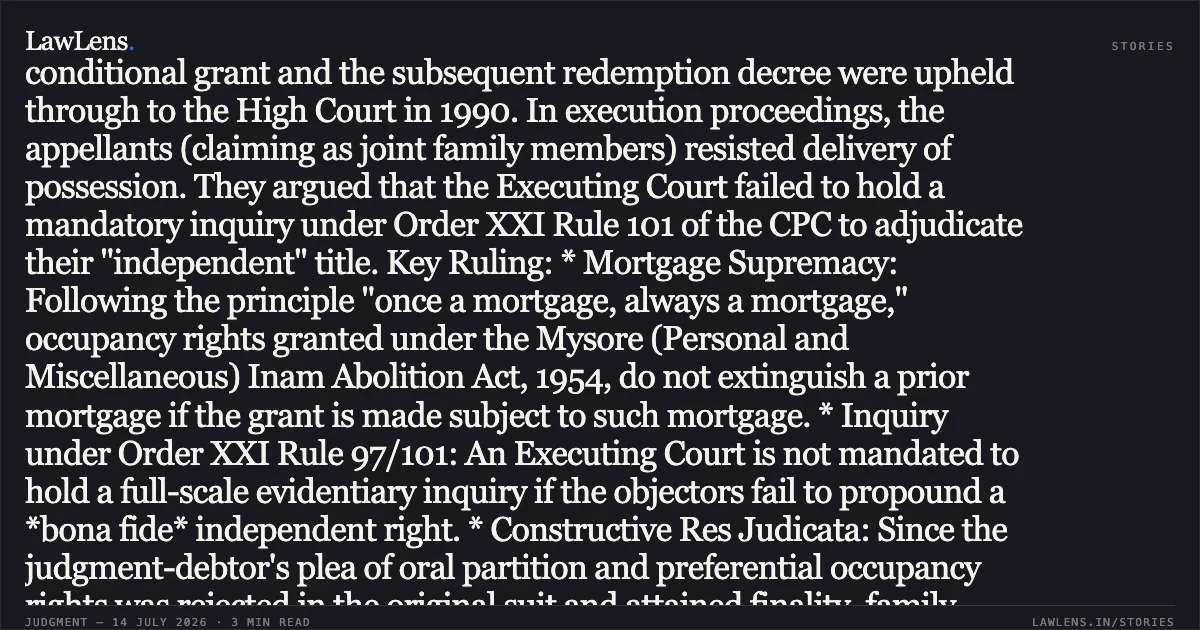
### Legal Summary: Redemption of Mortgage and Obstruction to Execution Legal Headline: Occupancy rights granted under Inam Abolition Acts remain subject to prior mortgages and cannot defeat redemption decrees. Case Brief: The appellants, claiming rights through a registered partition deed and the original judgment-debtor (Shankarappa), challenged the execution of a 1975 decree for redemption of mortgage. Shankarappa had been granted occupancy rights by the Deputy Commissioner, but the grant was explicitly made "subject to the rights of parties in the mortgage deed." This conditional grant and the subsequent redemption decree were upheld through to the High Court in 1990. In execution proceedings, the appellants (claiming as joint family members) resisted delivery of possession. They argued that the Executing Court failed to hold a mandatory inquiry under Order XXI Rule 101 of the CPC to adjudicate their "independent" title. Key Ruling: * Mortgage Supremacy: Following the principle "once a mortgage, always a mortgage," occupancy rights granted under the Mysore (Personal and Miscellaneous) Inam Abolition Act, 1954, do not extinguish a prior mortgage if the grant is made subject to such mortgage. * Inquiry under Order XXI Rule 97/101: An Executing Court is not mandated to hold a full-scale evidentiary inquiry if the objectors fail to propound a *bona fide* independent right. * Constructive Res Judicata: Since the judgment-debtor's plea of oral partition and preferential occupancy rights was rejected in the original suit and attained finality, family members claiming under him cannot re-litigate the same title in execution. * Independent Right Requirement: To stall execution, a third party must demonstrate a title *dehors* (outside) the judgment-debtor. Rights derived through a partition within the judgment-debtor’s family do not constitute an "independent right." Conclusion: The High Court dismissed the Second Appeal, affirming that the appellants were merely attempting to relitigate settled issues, and upheld the removal of obstructions to ensure the decree-holder finally received the fruits of a 50-year-old litigation.. SMT. LAKSHMAMMA vs SMT. K. S. JAYAVANI. Karnataka High Court. LawLens

Karnataka High Court·

Civil Procedure and EvidenceProperty and Real Estate Law

### Legal Summary: Redemption of Mortgage and Obstruction to Execution Legal Headline: Occupancy rights granted under Inam Abolition Acts remain subject to prior mortgages and cannot defeat redemption decrees. Case Brief: The appellants, claiming rights through a registered partition deed and the original judgment-debtor (Shankarappa), challenged the execution of a 1975 decree for redemption of mortgage. Shankarappa had been granted occupancy rights by the Deputy Commissioner, but the grant was explicitly made "subject to the rights of parties in the mortgage deed." This conditional grant and the subsequent redemption decree were upheld through to the High Court in 1990. In execution proceedings, the appellants (claiming as joint family members) resisted delivery of possession. They argued that the Executing Court failed to hold a mandatory inquiry under Order XXI Rule 101 of the CPC to adjudicate their "independent" title. Key Ruling: * Mortgage Supremacy: Following the principle "once a mortgage, always a mortgage," occupancy rights granted under the Mysore (Personal and Miscellaneous) Inam Abolition Act, 1954, do not extinguish a prior mortgage if the grant is made subject to such mortgage. * Inquiry under Order XXI Rule 97/101: An Executing Court is not mandated to hold a full-scale evidentiary inquiry if the objectors fail to propound a *bona fide* independent right. * Constructive Res Judicata: Since the judgment-debtor's plea of oral partition and preferential occupancy rights was rejected in the original suit and attained finality, family members claiming under him cannot re-litigate the same title in execution. * Independent Right Requirement: To stall execution, a third party must demonstrate a title *dehors* (outside) the judgment-debtor. Rights derived through a partition within the judgment-debtor’s family do not constitute an "independent right." Conclusion: The High Court dismissed the Second Appeal, affirming that the appellants were merely attempting to relitigate settled issues, and upheld the removal of obstructions to ensure the decree-holder finally received the fruits of a 50-year-old litigation.

The dispute originated from a 1975 suit (O.S. No. 74/1975) for the redemption of a mortgage executed in 1951 by Gururayachar in favor of Shankarappa.

3 MIN READ

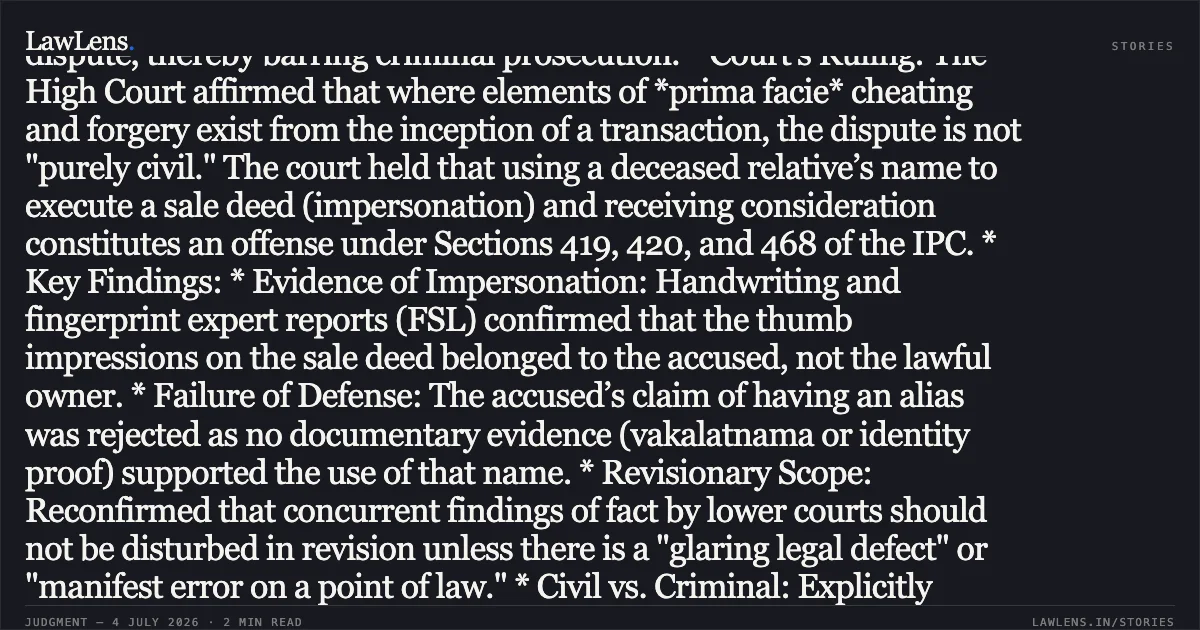
### Criminal Impersonation and Fraud in Property Sale Cannot Be Characterized as Purely Civil Disputes Legal Brief: * Core Issue: Whether the fraudulent sale of land through impersonation (pretending to be the owner/legal heir) constitutes a purely civil dispute, thereby barring criminal prosecution. * Court's Ruling: The High Court affirmed that where elements of *prima facie* cheating and forgery exist from the inception of a transaction, the dispute is not "purely civil." The court held that using a deceased relative’s name to execute a sale deed (impersonation) and receiving consideration constitutes an offense under Sections 419, 420, and 468 of the IPC. * Key Findings: * Evidence of Impersonation: Handwriting and fingerprint expert reports (FSL) confirmed that the thumb impressions on the sale deed belonged to the accused, not the lawful owner. * Failure of Defense: The accused’s claim of having an alias was rejected as no documentary evidence (vakalatnama or identity proof) supported the use of that name. * Revisionary Scope: Reconfirmed that concurrent findings of fact by lower courts should not be disturbed in revision unless there is a "glaring legal defect" or "manifest error on a point of law." * Civil vs. Criminal: Explicitly distinguished the *Bhajan Lal* precedent, noting that "criminal colour" is not being given to a civil dispute when the very act involves fabrication of documents to cause wrongful loss to the rightful owner. Conclusion: The revision petition was dismissed, upholding the conviction and sentence against the petitioners.. SRI N P RAJU @ SIDDEGOWDA vs THE STATE OF KARNATAKA. Karnataka High Court. LawLens

Karnataka High Court·

Criminal LawCriminal Procedure and Evidence

### Criminal Impersonation and Fraud in Property Sale Cannot Be Characterized as Purely Civil Disputes Legal Brief: * Core Issue: Whether the fraudulent sale of land through impersonation (pretending to be the owner/legal heir) constitutes a purely civil dispute, thereby barring criminal prosecution. * Court's Ruling: The High Court affirmed that where elements of *prima facie* cheating and forgery exist from the inception of a transaction, the dispute is not "purely civil." The court held that using a deceased relative’s name to execute a sale deed (impersonation) and receiving consideration constitutes an offense under Sections 419, 420, and 468 of the IPC. * Key Findings: * Evidence of Impersonation: Handwriting and fingerprint expert reports (FSL) confirmed that the thumb impressions on the sale deed belonged to the accused, not the lawful owner. * Failure of Defense: The accused’s claim of having an alias was rejected as no documentary evidence (vakalatnama or identity proof) supported the use of that name. * Revisionary Scope: Reconfirmed that concurrent findings of fact by lower courts should not be disturbed in revision unless there is a "glaring legal defect" or "manifest error on a point of law." * Civil vs. Criminal: Explicitly distinguished the *Bhajan Lal* precedent, noting that "criminal colour" is not being given to a civil dispute when the very act involves fabrication of documents to cause wrongful loss to the rightful owner. Conclusion: The revision petition was dismissed, upholding the conviction and sentence against the petitioners.

The complainant, Smt. Jayamma [P.W.1], alleged that the petitioners (Accused Nos. 1 and 2) executed a sale deed [Ex.P3] in 2005 for 56 guntas of land in favour of P.W.8.

2 MIN READ