HCMONTHLY CASE LAW ARCHIVE

Patna High Court Judgments in April 2026: Case Law Digest

Read 128 LawLens analyses of Patna High Court judgments published in April 2026, covering key rulings, legal principles and case law.

← BACK TO PATNA COURT REPORT

PERMANENT MONTHLY EDITIONS

Browse by month

AUTOMATICALLY UPDATED

April 2026 Judgments

128 ARTICLES · NEWEST FIRST
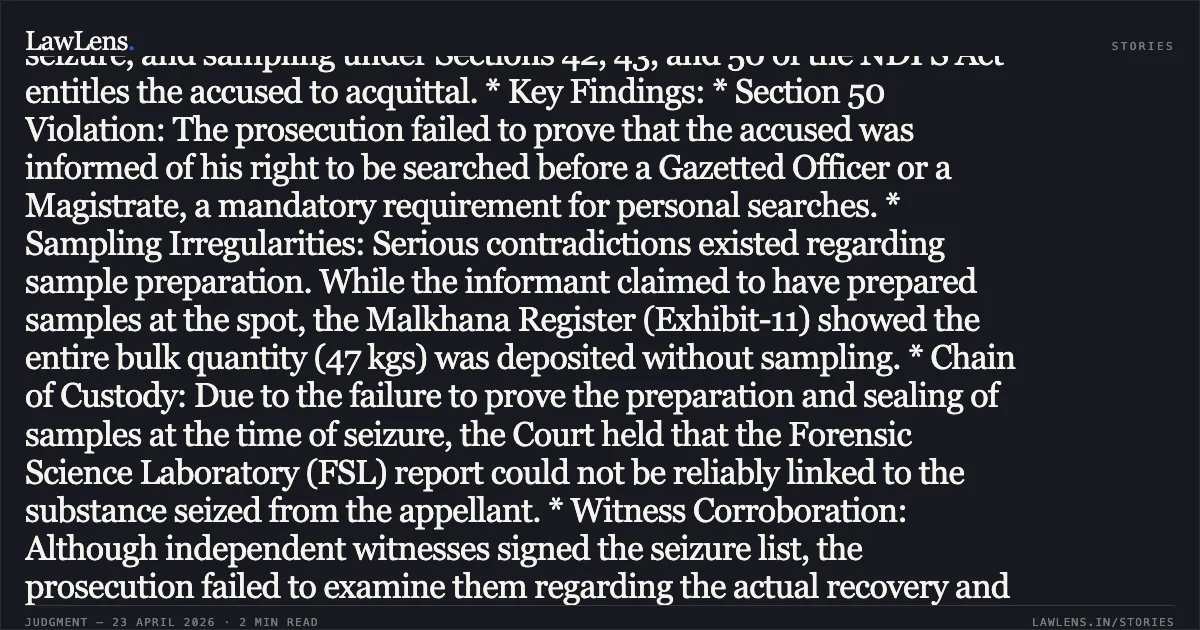
### Failure to Mandatorily Adhere to Search and Seizure Protocols Under NDPS Act Vitiates Conviction Legal Brief: * Core Issue: Whether the non-compliance with statutory procedures for search, seizure, and sampling under Sections 42, 43, and 50 of the NDPS Act entitles the accused to acquittal. * Key Findings: * Section 50 Violation: The prosecution failed to prove that the accused was informed of his right to be searched before a Gazetted Officer or a Magistrate, a mandatory requirement for personal searches. * Sampling Irregularities: Serious contradictions existed regarding sample preparation. While the informant claimed to have prepared samples at the spot, the Malkhana Register (Exhibit-11) showed the entire bulk quantity (47 kgs) was deposited without sampling. * Chain of Custody: Due to the failure to prove the preparation and sealing of samples at the time of seizure, the Court held that the Forensic Science Laboratory (FSL) report could not be reliably linked to the substance seized from the appellant. * Witness Corroboration: Although independent witnesses signed the seizure list, the prosecution failed to examine them regarding the actual recovery and apprehension, relying solely on police testimony. * Conclusion: The High Court set aside the conviction, ruling that fundamental procedural lapses in search and seizure create a reasonable doubt, necessitating the acquittal of the appellant.. Saurav Kumar @ Saurabh Kumar vs The State of Bihar. Patna High Court. LawLens

Patna High Court·

Criminal Procedure and EvidenceCriminal Law

### Failure to Mandatorily Adhere to Search and Seizure Protocols Under NDPS Act Vitiates Conviction Legal Brief: * Core Issue: Whether the non-compliance with statutory procedures for search, seizure, and sampling under Sections 42, 43, and 50 of the NDPS Act entitles the accused to acquittal. * Key Findings: * Section 50 Violation: The prosecution failed to prove that the accused was informed of his right to be searched before a Gazetted Officer or a Magistrate, a mandatory requirement for personal searches. * Sampling Irregularities: Serious contradictions existed regarding sample preparation. While the informant claimed to have prepared samples at the spot, the Malkhana Register (Exhibit-11) showed the entire bulk quantity (47 kgs) was deposited without sampling. * Chain of Custody: Due to the failure to prove the preparation and sealing of samples at the time of seizure, the Court held that the Forensic Science Laboratory (FSL) report could not be reliably linked to the substance seized from the appellant. * Witness Corroboration: Although independent witnesses signed the seizure list, the prosecution failed to examine them regarding the actual recovery and apprehension, relying solely on police testimony. * Conclusion: The High Court set aside the conviction, ruling that fundamental procedural lapses in search and seizure create a reasonable doubt, necessitating the acquittal of the appellant.

The appellant was convicted by the Trial Court under Sections 20B(ii)(C) and 22 of the NDPS Act and sentenced to 20 years’ rigorous imprisonment and a fine of Rs. 1 lakh

2 MIN READ