HCMONTHLY CASE LAW ARCHIVE

Patna High Court Judgments in July 2026: Case Law Digest

Read 537 LawLens analyses of Patna High Court judgments published in July 2026, covering key rulings, legal principles and case law.

← BACK TO PATNA COURT REPORT

PERMANENT MONTHLY EDITIONS

Browse by month

AUTOMATICALLY UPDATED

July 2026 Judgments

537 ARTICLES · NEWEST FIRST
HEADLINE: Dismissal set aside where enquiry report lacks evidentiary proof and violates principles of parity. Case Summary The High Court of Patna addressed a writ petition challenging a dismissal order and the subsequent rejection of a review petition. The petitioner, an Assistant Engineer, was terminated following a departmental enquiry into alleged financial irregularities. He contended that the proceedings were flawed due to a vague charge memo, a lack of oral evidence, and the failure to examine the authors of technical reports used against him. The Court observed that the disciplinary authorities had failed to provide independent reasoning or a detailed analysis of the petitioner’s defense, treating the second show-cause notice as a mere formality. Crucially, the Court found the petitioner’s situation identical to that of a previously exonerated colleague. Invoking the principle of parity and noting that the underlying enquiry was not based on legal evidence, the Court quashed the dismissal. The petitioner was ordered to be reinstated with all consequential benefits to match the relief granted to similarly situated employees. Would you like a summary of the next segment or a different judgment?. Ajit Kumar vs The State of Bihar. Patna High Court. LawLens

Patna High Court·

Employment and Labour LawAdministrative and Public Law

HEADLINE: Dismissal set aside where enquiry report lacks evidentiary proof and violates principles of parity. Case Summary The High Court of Patna addressed a writ petition challenging a dismissal order and the subsequent rejection of a review petition. The petitioner, an Assistant Engineer, was terminated following a departmental enquiry into alleged financial irregularities. He contended that the proceedings were flawed due to a vague charge memo, a lack of oral evidence, and the failure to examine the authors of technical reports used against him. The Court observed that the disciplinary authorities had failed to provide independent reasoning or a detailed analysis of the petitioner’s defense, treating the second show-cause notice as a mere formality. Crucially, the Court found the petitioner’s situation identical to that of a previously exonerated colleague. Invoking the principle of parity and noting that the underlying enquiry was not based on legal evidence, the Court quashed the dismissal. The petitioner was ordered to be reinstated with all consequential benefits to match the relief granted to similarly situated employees. Would you like a summary of the next segment or a different judgment?

The petitioner, an Assistant Engineer in the Water Resources Department, Bihar, was served a memorandum of charges in 2017 alleging financial irregularities related to excess payments.

2 MIN READ

### Aggravated penetrative sexual assault of minor proven through sterling testimony of victim and corroborative medical evidence. Summary of the Judgment: 1. Facts: The appellant was convicted for rape and attempt to murder under Sections 376 and 307 of the IPC, and Sections 4 and 6 of the POCSO Act. On August 22, 2021, the minor victim was intercepted while outdoors by the appellant, who smothered her, rendered her unconscious, and subjected her to a brutal sexual assault resulting in severe internal injuries requiring multiple surgeries at IGIMS, Patna. 2. Prosecution Evidence: * Sterling Testimony: The victim’s (PW-2) testimony was found to be consistent with her Section 164 Cr.P.C. statement and fardbeyan. The Court classified her as a "sterling witness" whose evidence was of exceptionally high quality. * Medical Corroboration: Doctors (PW-3, PW-8, PW-11) confirmed a midline perineal tear and anal wall rupture, characterizing the injuries as "grievous" and life-threatening. * Age Determination: School records (PW-10) and radiological scans established the victim's age between 15-16 years, attracting POCSO provisions. 3. Defense Contentions: The appellant alleged false implication due to a monetary dispute and argued that the absence of semen on the victim's clothes weakened the case. 4. Court’s Holding: * Presumption of Guilt: Under Sections 29 and 30 of the POCSO Act, once foundational facts are proven, the court must presume the accused's guilt and *mens rea*. The appellant failed to rebut this on a preponderance of probabilities. * Absence of Semen: The Court held that the absence of spermatozoa does not negate a charge of sexual assault when ocular and medical evidence of penetration/injury is overwhelming. * Section 307 IPC: The brutality of the assault, causing life-threatening sepsis and requiring three surgeries, sufficiently proved the intent/knowledge required for a conviction of attempt to murder. * Delay in FIR: The two-day delay was deemed natural given the victim's critical medical state and social stigmas relative to family prestige. The High Court affirmed the life imprisonment sentence and the compensation of ₹7,00,000 awarded to the victim.. KAILASH SAW @ KAILASH SAHU @ KAILASH SAH vs The State of Bihar. Patna High Court. LawLens

Patna High Court·

Criminal LawCriminal Procedure and Evidence

### Aggravated penetrative sexual assault of minor proven through sterling testimony of victim and corroborative medical evidence. Summary of the Judgment: 1. Facts: The appellant was convicted for rape and attempt to murder under Sections 376 and 307 of the IPC, and Sections 4 and 6 of the POCSO Act. On August 22, 2021, the minor victim was intercepted while outdoors by the appellant, who smothered her, rendered her unconscious, and subjected her to a brutal sexual assault resulting in severe internal injuries requiring multiple surgeries at IGIMS, Patna. 2. Prosecution Evidence: * Sterling Testimony: The victim’s (PW-2) testimony was found to be consistent with her Section 164 Cr.P.C. statement and fardbeyan. The Court classified her as a "sterling witness" whose evidence was of exceptionally high quality. * Medical Corroboration: Doctors (PW-3, PW-8, PW-11) confirmed a midline perineal tear and anal wall rupture, characterizing the injuries as "grievous" and life-threatening. * Age Determination: School records (PW-10) and radiological scans established the victim's age between 15-16 years, attracting POCSO provisions. 3. Defense Contentions: The appellant alleged false implication due to a monetary dispute and argued that the absence of semen on the victim's clothes weakened the case. 4. Court’s Holding: * Presumption of Guilt: Under Sections 29 and 30 of the POCSO Act, once foundational facts are proven, the court must presume the accused's guilt and *mens rea*. The appellant failed to rebut this on a preponderance of probabilities. * Absence of Semen: The Court held that the absence of spermatozoa does not negate a charge of sexual assault when ocular and medical evidence of penetration/injury is overwhelming. * Section 307 IPC: The brutality of the assault, causing life-threatening sepsis and requiring three surgeries, sufficiently proved the intent/knowledge required for a conviction of attempt to murder. * Delay in FIR: The two-day delay was deemed natural given the victim's critical medical state and social stigmas relative to family prestige. The High Court affirmed the life imprisonment sentence and the compensation of ₹7,00,000 awarded to the victim.

The Appellant was convicted by the Trial Court for raping and attempting to murder a minor girl (PW-2) on 22.08.2021.

3 MIN READ

Criminal prosecution cannot be used as a substitute for civil remedies in property disputes. Summary: The petitioner challenged an order taking cognizance for offences under Sections 420, 379, and 323 of the IPC arising from a property sale dispute. The complainant alleged that despite paying consideration, the accused failed to execute a sale deed and subsequently assaulted him. The High Court observed that the dispute was predominantly civil, noting that the petitioner was not a party to the original agreement and had already executed a sale deed for the portion of the amount he received. The Court found the allegations of theft and assault to be "super-additions" intended to criminalize a civil matter. Key Legal Principles: 1. Civil vs. Criminal Jurisdiction: Criminal courts are not intended for settling scores or pressurizing parties to resolve civil disputes or recover money. 2. Ingredients of Cheating: To attract Section 420 IPC, a fraudulent or dishonest intention must exist at the inception of the transaction; mere breach of contract does not constitute cheating. 3. Abuse of Process: Initiating criminal proceedings for a manifestly civil dispute with ulterior motives constitutes an abuse of the judicial process, warranting quashing under Section 482 CrPC.. Prabhat Kumar vs State Of Bihar and Anr. Patna High Court. LawLens

Patna High Court·

Criminal Procedure and EvidenceCriminal Law

Criminal prosecution cannot be used as a substitute for civil remedies in property disputes. Summary: The petitioner challenged an order taking cognizance for offences under Sections 420, 379, and 323 of the IPC arising from a property sale dispute. The complainant alleged that despite paying consideration, the accused failed to execute a sale deed and subsequently assaulted him. The High Court observed that the dispute was predominantly civil, noting that the petitioner was not a party to the original agreement and had already executed a sale deed for the portion of the amount he received. The Court found the allegations of theft and assault to be "super-additions" intended to criminalize a civil matter. Key Legal Principles: 1. Civil vs. Criminal Jurisdiction: Criminal courts are not intended for settling scores or pressurizing parties to resolve civil disputes or recover money. 2. Ingredients of Cheating: To attract Section 420 IPC, a fraudulent or dishonest intention must exist at the inception of the transaction; mere breach of contract does not constitute cheating. 3. Abuse of Process: Initiating criminal proceedings for a manifestly civil dispute with ulterior motives constitutes an abuse of the judicial process, warranting quashing under Section 482 CrPC.

The complainant (Opposite Party No. 2) entered into an agreement to purchase 1.5 katha of land from one Sudhir Prasad Singh (Accused No. 1).

3 MIN READ

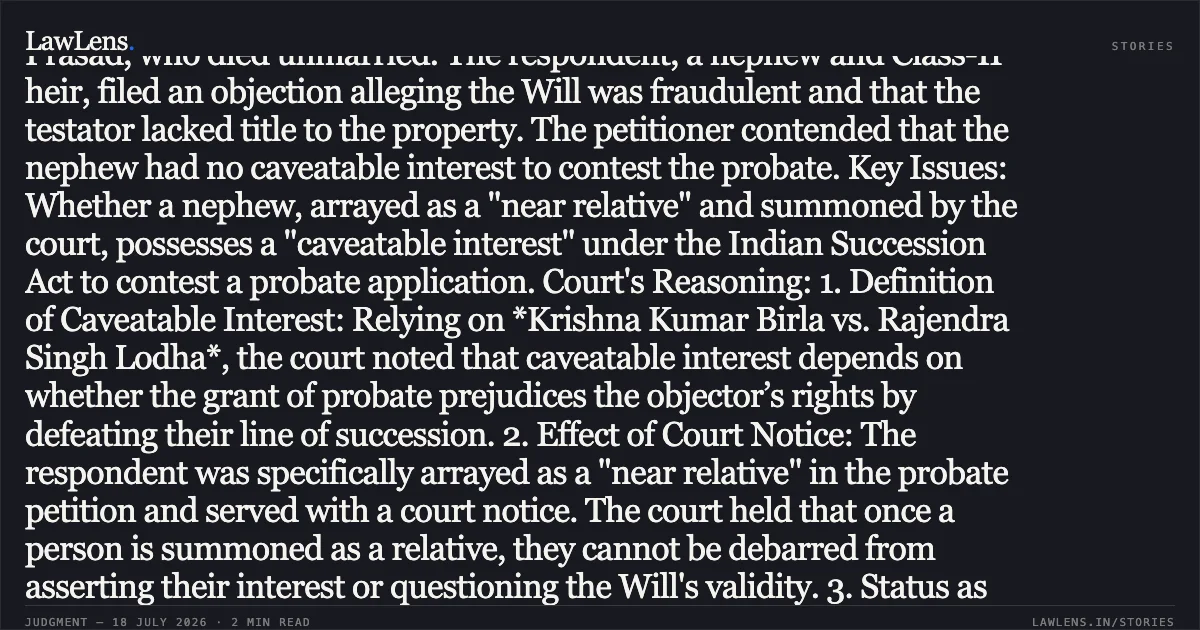
HEADING: Nephew arrayed as near relative in probate proceedings possesses caveatable interest to challenge Will’s genuineness. SUMMARY: Procedural History: The petitioner challenged an order passed by the VIIth Additional District Judge, Gaya, allowing a caveat filed by the respondent (the testator’s nephew) in a probate case concerning a registered Will dated 14.10.2009. Factual Background: The petitioner sought probate of a Will executed by late Ghanshyam Prasad, who died unmarried. The respondent, a nephew and Class-II heir, filed an objection alleging the Will was fraudulent and that the testator lacked title to the property. The petitioner contended that the nephew had no caveatable interest to contest the probate. Key Issues: Whether a nephew, arrayed as a "near relative" and summoned by the court, possesses a "caveatable interest" under the Indian Succession Act to contest a probate application. Court's Reasoning: 1. Definition of Caveatable Interest: Relying on *Krishna Kumar Birla vs. Rajendra Singh Lodha*, the court noted that caveatable interest depends on whether the grant of probate prejudices the objector’s rights by defeating their line of succession. 2. Effect of Court Notice: The respondent was specifically arrayed as a "near relative" in the probate petition and served with a court notice. The court held that once a person is summoned as a relative, they cannot be debarred from asserting their interest or questioning the Will's validity. 3. Status as Heir: Since the testator died unmarried and childless, the respondent (as a Class-II heir) would have an interest in the estate under the laws of intestate succession if the Will were found invalid. 4. Bona Fides: The court observed that the petitioner failed to array another surviving sister of the testator, suggesting a lack of bona fide intention. Conclusion: The High Court dismissed the petition, affirming that the respondent holds a caveatable interest and is entitled to contest the probate proceedings.. Tripurari Sharan Pandey vs Arun kumar Sinha. Patna High Court. LawLens

Patna High Court·

Wills, Inheritance, and TrustsCivil Procedure and Evidence

HEADING: Nephew arrayed as near relative in probate proceedings possesses caveatable interest to challenge Will’s genuineness. SUMMARY: Procedural History: The petitioner challenged an order passed by the VIIth Additional District Judge, Gaya, allowing a caveat filed by the respondent (the testator’s nephew) in a probate case concerning a registered Will dated 14.10.2009. Factual Background: The petitioner sought probate of a Will executed by late Ghanshyam Prasad, who died unmarried. The respondent, a nephew and Class-II heir, filed an objection alleging the Will was fraudulent and that the testator lacked title to the property. The petitioner contended that the nephew had no caveatable interest to contest the probate. Key Issues: Whether a nephew, arrayed as a "near relative" and summoned by the court, possesses a "caveatable interest" under the Indian Succession Act to contest a probate application. Court's Reasoning: 1. Definition of Caveatable Interest: Relying on *Krishna Kumar Birla vs. Rajendra Singh Lodha*, the court noted that caveatable interest depends on whether the grant of probate prejudices the objector’s rights by defeating their line of succession. 2. Effect of Court Notice: The respondent was specifically arrayed as a "near relative" in the probate petition and served with a court notice. The court held that once a person is summoned as a relative, they cannot be debarred from asserting their interest or questioning the Will's validity. 3. Status as Heir: Since the testator died unmarried and childless, the respondent (as a Class-II heir) would have an interest in the estate under the laws of intestate succession if the Will were found invalid. 4. Bona Fides: The court observed that the petitioner failed to array another surviving sister of the testator, suggesting a lack of bona fide intention. Conclusion: The High Court dismissed the petition, affirming that the respondent holds a caveatable interest and is entitled to contest the probate proceedings.

The petitioner filed Probate Case No. 08 of 2015 seeking probate of a registered Will dated 14.10.2009 executed by Late Ghanshyam Prasad

2 MIN READ

### Tendering Authority Cannot Cancel Bid Based on Expiry After Expressly Invoking Extension Procedures Brief Facts: The petitioner was the lowest (L-1) bidder in a tender for water supply schemes. During the process, the respondents repeatedly invoked Clause 15.2 of the Standard Bidding Document (SBD) to seek and obtain the petitioner’s consent for bid validity extensions. However, while a further extension proposal was pending, the respondents cancelled the tender via email without assigning reasons, later justifying it in court by citing the expiry of the original bid validity under Clause 15.1. Key Legal Issue: Can a tendering authority justify the cancellation of a tender based on the expiry of the original bid validity (Clause 15.1) after it has already invoked the specific mechanism for extension (Clause 15.2) and obtained bidder consent? Court's Reasoning: 1. Inconsistency of Conduct: The Court held that the respondents cannot concurrently invoke the machinery for extension under Clause 15.2 and then rely on the original expiry under Clause 15.1 to cancel the bid. Such an approach is contradictory and violates the scheme of the SBD. 2. Adherence to Terms: Citing *West Bengal State Electricity Board v. Patel Engineering Co. Ltd.*, the Court emphasized that tendering authorities are scrupulously bound by the terms of the tender document to ensure transparency and prevent arbitrariness. 3. Abuse of Discretion: Although Clause 24 of the NIT allowed cancellation without assigning reasons, this discretion must be exercised fairly. By ignoring the extension process they initiated, the respondents acted irrationally and in violation of procedural propriety. 4. Judicial Review: Under the principles of *Tata Cellular v. Union of India*, the Court found the decision-making process flawed as it was inconsistent with the governing tender conditions. Conclusion: The Patna High Court quashed the cancellation of the original tender and the subsequent re-tender. The matter was remitted to the competent authority to take a fresh, reasoned decision regarding the original tender strictly in accordance with the SBD terms.. J and S Joint Venture (JV) vs The State of Bihar. Patna High Court. LawLens

Patna High Court·

Administrative and Public LawContract Law

### Tendering Authority Cannot Cancel Bid Based on Expiry After Expressly Invoking Extension Procedures Brief Facts: The petitioner was the lowest (L-1) bidder in a tender for water supply schemes. During the process, the respondents repeatedly invoked Clause 15.2 of the Standard Bidding Document (SBD) to seek and obtain the petitioner’s consent for bid validity extensions. However, while a further extension proposal was pending, the respondents cancelled the tender via email without assigning reasons, later justifying it in court by citing the expiry of the original bid validity under Clause 15.1. Key Legal Issue: Can a tendering authority justify the cancellation of a tender based on the expiry of the original bid validity (Clause 15.1) after it has already invoked the specific mechanism for extension (Clause 15.2) and obtained bidder consent? Court's Reasoning: 1. Inconsistency of Conduct: The Court held that the respondents cannot concurrently invoke the machinery for extension under Clause 15.2 and then rely on the original expiry under Clause 15.1 to cancel the bid. Such an approach is contradictory and violates the scheme of the SBD. 2. Adherence to Terms: Citing *West Bengal State Electricity Board v. Patel Engineering Co. Ltd.*, the Court emphasized that tendering authorities are scrupulously bound by the terms of the tender document to ensure transparency and prevent arbitrariness. 3. Abuse of Discretion: Although Clause 24 of the NIT allowed cancellation without assigning reasons, this discretion must be exercised fairly. By ignoring the extension process they initiated, the respondents acted irrationally and in violation of procedural propriety. 4. Judicial Review: Under the principles of *Tata Cellular v. Union of India*, the Court found the decision-making process flawed as it was inconsistent with the governing tender conditions. Conclusion: The Patna High Court quashed the cancellation of the original tender and the subsequent re-tender. The matter was remitted to the competent authority to take a fresh, reasoned decision regarding the original tender strictly in accordance with the SBD terms.

The Petitioner, a Joint Venture, participated in a tender process (NIT No. 15/2024-25) for piped water supply schemes under the "Har Ghar Nal Jal" project

2 MIN READ

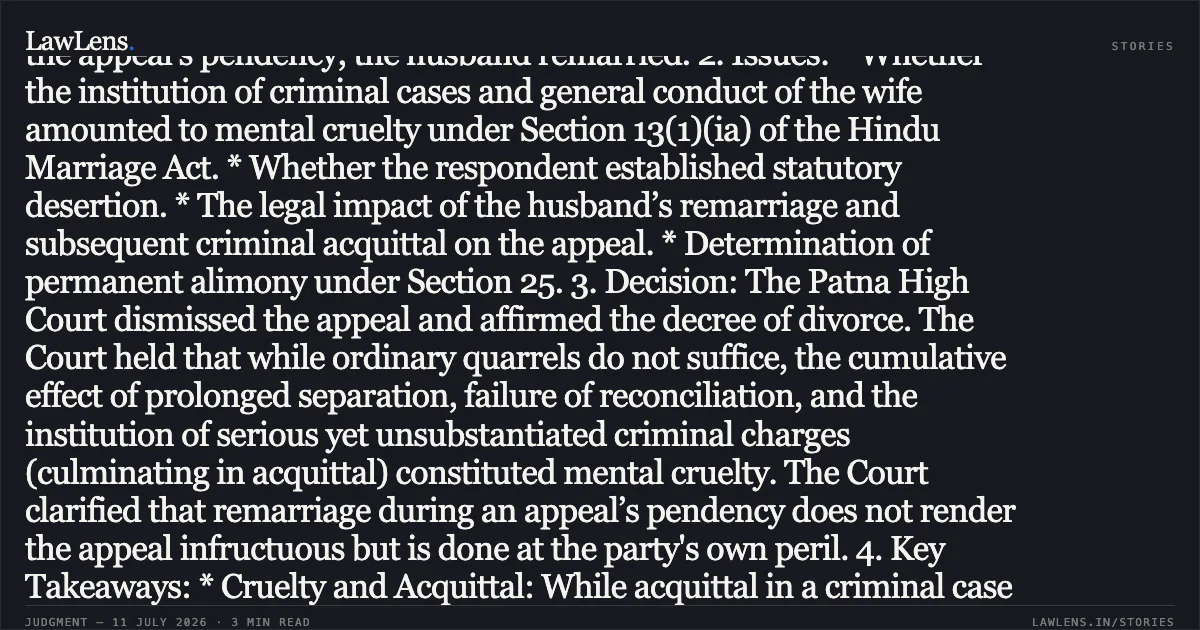
False Allegations of Grave Criminality Combined with Prolonged Matrimonial Discord Constitute Mental Cruelty and Justify Dissolution of Marriage Summary: 1. Facts: The parties married in 2010. After years of infertility treatment and increasing matrimonial discord, the appellant-wife left the matrimonial home. The respondent-husband filed for divorce on grounds of cruelty and desertion. Subsequently, the wife initiated criminal proceedings alleging dowry demand and attempt to murder (Sections 498A and 307 IPC), which resulted in the husband’s acquittal. The Family Court granted the divorce, which the wife challenged in this appeal. During the appeal's pendency, the husband remarried. 2. Issues: * Whether the institution of criminal cases and general conduct of the wife amounted to mental cruelty under Section 13(1)(ia) of the Hindu Marriage Act. * Whether the respondent established statutory desertion. * The legal impact of the husband’s remarriage and subsequent criminal acquittal on the appeal. * Determination of permanent alimony under Section 25. 3. Decision: The Patna High Court dismissed the appeal and affirmed the decree of divorce. The Court held that while ordinary quarrels do not suffice, the cumulative effect of prolonged separation, failure of reconciliation, and the institution of serious yet unsubstantiated criminal charges (culminating in acquittal) constituted mental cruelty. The Court clarified that remarriage during an appeal’s pendency does not render the appeal infructuous but is done at the party's own peril. 4. Key Takeaways: * Cruelty and Acquittal: While acquittal in a criminal case does not automatically prove cruelty, the pursuit of serious, unproven allegations of attempted murder and dowry harassment causes grave mental agony, justifying a decree of divorce. * Section 15 and Remarriage: Remarriage before the expiry of the limitation period for an appeal is a violation of Section 15 of the Hindu Marriage Act, though it does not prevent the Appellate Court from deciding the case on its merits. * Permanent Alimony: Applying the principles in *Rajnesh v. Neha*, the Court calculated alimony based on the husband's gross salary (ignoring voluntary deductions like loan EMIs), awarding the wife approximately one-third of the husband’s estimated future earnings (₹34.76 Lakhs).. Sunita Panday vs Binod Kumar Panday. Patna High Court. LawLens

Patna High Court·

Family LawReligious and Personal Law

False Allegations of Grave Criminality Combined with Prolonged Matrimonial Discord Constitute Mental Cruelty and Justify Dissolution of Marriage Summary: 1. Facts: The parties married in 2010. After years of infertility treatment and increasing matrimonial discord, the appellant-wife left the matrimonial home. The respondent-husband filed for divorce on grounds of cruelty and desertion. Subsequently, the wife initiated criminal proceedings alleging dowry demand and attempt to murder (Sections 498A and 307 IPC), which resulted in the husband’s acquittal. The Family Court granted the divorce, which the wife challenged in this appeal. During the appeal's pendency, the husband remarried. 2. Issues: * Whether the institution of criminal cases and general conduct of the wife amounted to mental cruelty under Section 13(1)(ia) of the Hindu Marriage Act. * Whether the respondent established statutory desertion. * The legal impact of the husband’s remarriage and subsequent criminal acquittal on the appeal. * Determination of permanent alimony under Section 25. 3. Decision: The Patna High Court dismissed the appeal and affirmed the decree of divorce. The Court held that while ordinary quarrels do not suffice, the cumulative effect of prolonged separation, failure of reconciliation, and the institution of serious yet unsubstantiated criminal charges (culminating in acquittal) constituted mental cruelty. The Court clarified that remarriage during an appeal’s pendency does not render the appeal infructuous but is done at the party's own peril. 4. Key Takeaways: * Cruelty and Acquittal: While acquittal in a criminal case does not automatically prove cruelty, the pursuit of serious, unproven allegations of attempted murder and dowry harassment causes grave mental agony, justifying a decree of divorce. * Section 15 and Remarriage: Remarriage before the expiry of the limitation period for an appeal is a violation of Section 15 of the Hindu Marriage Act, though it does not prevent the Appellate Court from deciding the case on its merits. * Permanent Alimony: Applying the principles in *Rajnesh v. Neha*, the Court calculated alimony based on the husband's gross salary (ignoring voluntary deductions like loan EMIs), awarding the wife approximately one-third of the husband’s estimated future earnings (₹34.76 Lakhs).

The parties married on 12.06.2010 but faced matrimonial discord primarily due to their inability to conceive despite prolonged fertility treatments

3 MIN READ

Absence of Penetration or Intent Evidence Reclassifies Attempted Rape to Outraging Modesty In this criminal appeal, the High Court scrutinized a conviction involving an alleged assault at a photo studio. The prosecution’s case relied primarily on the testimony of the victim and her father, asserting that the accused locked the premises and committed acts of molestation. However, the Court observed significant procedural and evidentiary gaps, including the non-examination of the Investigating Officer and the lack of medical evidence to support a charge of attempted rape. The Court analyzed whether the appellant's actions met the high threshold of an "attempt" under the Penal Code. Finding no evidence of an unequivocal intent to commit the specific act of rape, the Court determined that the conduct—while criminal—amounted to outraging the modesty of a woman rather than an attempt at the higher offense. Ultimately, the Court found the existing evidence insufficient to sustain the conviction for attempted rape and set aside the lower court's judgment, acquitting the appellant of the primary charges. Would you like a summary of the next segment of the judgment or a different case?. Himanshu Kr. Pathak @ Mithiya Pathak vs The State Of Bihar. Patna High Court. LawLens

Patna High Court·

Criminal LawCriminal Procedure and Evidence

Absence of Penetration or Intent Evidence Reclassifies Attempted Rape to Outraging Modesty In this criminal appeal, the High Court scrutinized a conviction involving an alleged assault at a photo studio. The prosecution’s case relied primarily on the testimony of the victim and her father, asserting that the accused locked the premises and committed acts of molestation. However, the Court observed significant procedural and evidentiary gaps, including the non-examination of the Investigating Officer and the lack of medical evidence to support a charge of attempted rape. The Court analyzed whether the appellant's actions met the high threshold of an "attempt" under the Penal Code. Finding no evidence of an unequivocal intent to commit the specific act of rape, the Court determined that the conduct—while criminal—amounted to outraging the modesty of a woman rather than an attempt at the higher offense. Ultimately, the Court found the existing evidence insufficient to sustain the conviction for attempted rape and set aside the lower court's judgment, acquitting the appellant of the primary charges. Would you like a summary of the next segment of the judgment or a different case?

The appellant, owner of a photography studio, was accused of confining a woman inside his premises on January 19, 2008.

2 MIN READ

Inordinate Delay and Laches Bar Writ Jurisdiction for Stale Claims Arising from Service Grievances Summary: The petitioner, a retired teacher, challenged the withdrawal of a senior pay scale that occurred in 1989. Despite superannuating in 2002, he raised no grievance for 30 years, filing his first representation in 2019. The Court dismissed the writ petition, holding that extraordinary jurisdiction under Article 226 cannot be invoked by "fence-sitters" who sleep over their rights. Citing Supreme Court and Division Bench precedents, the Court reaffirmed that equity aids the vigilant, not the indolent; inordinate delay, acquiescence, and the absence of a challenge to the original order at the appropriate time preclude judicial intervention for stale service claims.. Kripa Nath Mishra vs The State of Bihar. Patna High Court. LawLens

Patna High Court·

Administrative and Public LawEmployment and Labour Law

Inordinate Delay and Laches Bar Writ Jurisdiction for Stale Claims Arising from Service Grievances Summary: The petitioner, a retired teacher, challenged the withdrawal of a senior pay scale that occurred in 1989. Despite superannuating in 2002, he raised no grievance for 30 years, filing his first representation in 2019. The Court dismissed the writ petition, holding that extraordinary jurisdiction under Article 226 cannot be invoked by "fence-sitters" who sleep over their rights. Citing Supreme Court and Division Bench precedents, the Court reaffirmed that equity aids the vigilant, not the indolent; inordinate delay, acquiescence, and the absence of a challenge to the original order at the appropriate time preclude judicial intervention for stale service claims.

The petitioner was appointed as an Assistant Teacher in 1960 and was promoted from Junior to Senior Division effective 01.04.1981

2 MIN READ

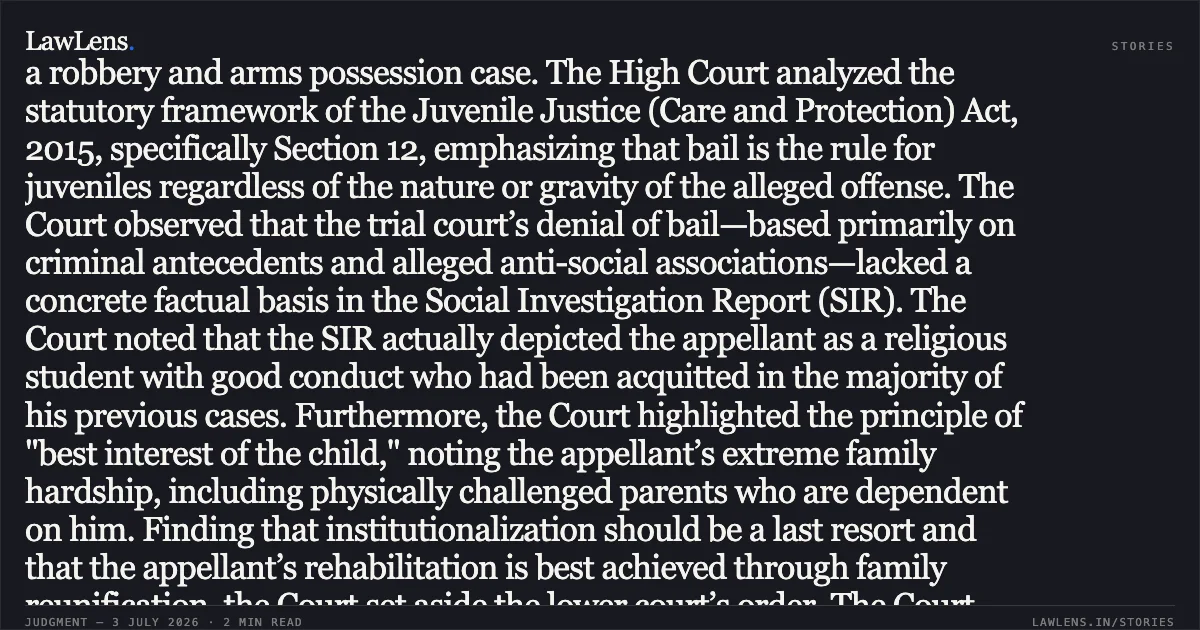
Legal Headline: Juvenile bail is mandatory under Section 12 unless specific evidence confirms association with known criminals. Summary: This judgment addresses a criminal appeal filed by a juvenile appellant against a trial court's refusal to grant regular bail in a robbery and arms possession case. The High Court analyzed the statutory framework of the Juvenile Justice (Care and Protection) Act, 2015, specifically Section 12, emphasizing that bail is the rule for juveniles regardless of the nature or gravity of the alleged offense. The Court observed that the trial court’s denial of bail—based primarily on criminal antecedents and alleged anti-social associations—lacked a concrete factual basis in the Social Investigation Report (SIR). The Court noted that the SIR actually depicted the appellant as a religious student with good conduct who had been acquitted in the majority of his previous cases. Furthermore, the Court highlighted the principle of "best interest of the child," noting the appellant’s extreme family hardship, including physically challenged parents who are dependent on him. Finding that institutionalization should be a last resort and that the appellant’s rehabilitation is best achieved through family reunification, the Court set aside the lower court’s order. The Court granted bail and notably directed the District Magistrate to assist the impoverished family with social welfare schemes to facilitate the appellant’s reintegration into society. Would you like a summary of a different segment or another judgment?. Bittu Kumar @ Bittu Yadav vs The State of Bihar. Patna High Court. LawLens

Patna High Court·

Criminal Procedure and EvidenceCriminal Law

Legal Headline: Juvenile bail is mandatory under Section 12 unless specific evidence confirms association with known criminals. Summary: This judgment addresses a criminal appeal filed by a juvenile appellant against a trial court's refusal to grant regular bail in a robbery and arms possession case. The High Court analyzed the statutory framework of the Juvenile Justice (Care and Protection) Act, 2015, specifically Section 12, emphasizing that bail is the rule for juveniles regardless of the nature or gravity of the alleged offense. The Court observed that the trial court’s denial of bail—based primarily on criminal antecedents and alleged anti-social associations—lacked a concrete factual basis in the Social Investigation Report (SIR). The Court noted that the SIR actually depicted the appellant as a religious student with good conduct who had been acquitted in the majority of his previous cases. Furthermore, the Court highlighted the principle of "best interest of the child," noting the appellant’s extreme family hardship, including physically challenged parents who are dependent on him. Finding that institutionalization should be a last resort and that the appellant’s rehabilitation is best achieved through family reunification, the Court set aside the lower court’s order. The Court granted bail and notably directed the District Magistrate to assist the impoverished family with social welfare schemes to facilitate the appellant’s reintegration into society. Would you like a summary of a different segment or another judgment?

The appellant, a juvenile, was implicated in Madhepura P.S. Case No. 879 of 2021 for robbery and arms possession (Sections 392, 397 IPC and 27 Arms Act).

2 MIN READ

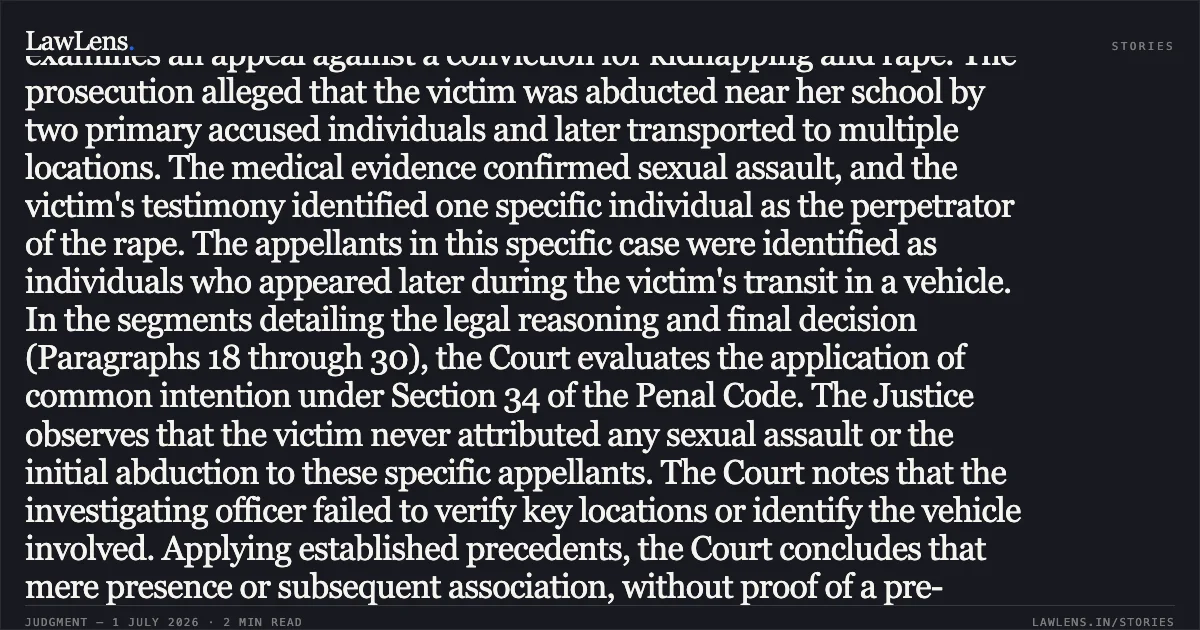
Presence in vehicle without overt act or evidence of prior meeting of minds cannot sustain conviction for rape. In the segment covering the trial proceedings and analysis (Paragraphs 1 through 17), the Court examines an appeal against a conviction for kidnapping and rape. The prosecution alleged that the victim was abducted near her school by two primary accused individuals and later transported to multiple locations. The medical evidence confirmed sexual assault, and the victim's testimony identified one specific individual as the perpetrator of the rape. The appellants in this specific case were identified as individuals who appeared later during the victim's transit in a vehicle. In the segments detailing the legal reasoning and final decision (Paragraphs 18 through 30), the Court evaluates the application of common intention under Section 34 of the Penal Code. The Justice observes that the victim never attributed any sexual assault or the initial abduction to these specific appellants. The Court notes that the investigating officer failed to verify key locations or identify the vehicle involved. Applying established precedents, the Court concludes that mere presence or subsequent association, without proof of a pre-arranged plan or active participation in the core offenses, is insufficient for a conviction. Consequently, the Court sets aside the lower court's judgment and acquits the appellants. Would you like a summary of the next segments of this or another judgment?. Shankar Singh and Anr. vs The State Of Bihar. Patna High Court. LawLens

Patna High Court·

Criminal LawCriminal Procedure and Evidence

Presence in vehicle without overt act or evidence of prior meeting of minds cannot sustain conviction for rape. In the segment covering the trial proceedings and analysis (Paragraphs 1 through 17), the Court examines an appeal against a conviction for kidnapping and rape. The prosecution alleged that the victim was abducted near her school by two primary accused individuals and later transported to multiple locations. The medical evidence confirmed sexual assault, and the victim's testimony identified one specific individual as the perpetrator of the rape. The appellants in this specific case were identified as individuals who appeared later during the victim's transit in a vehicle. In the segments detailing the legal reasoning and final decision (Paragraphs 18 through 30), the Court evaluates the application of common intention under Section 34 of the Penal Code. The Justice observes that the victim never attributed any sexual assault or the initial abduction to these specific appellants. The Court notes that the investigating officer failed to verify key locations or identify the vehicle involved. Applying established precedents, the Court concludes that mere presence or subsequent association, without proof of a pre-arranged plan or active participation in the core offenses, is insufficient for a conviction. Consequently, the Court sets aside the lower court's judgment and acquits the appellants. Would you like a summary of the next segments of this or another judgment?

The appellants, Shankar Singh and Raju Singh, were convicted by the Adhoc Additional Sessions Judge-1st, Saharsa, on April 4, 2013, for offenses under Sections 366-A/34 and 376/34 of the Indian Penal Code

2 MIN READ

Conviction Upheld for Dowry Death Based on Dying Declaration and Statutory Presumption of Cruelty In the judgment for Criminal Appeal (SJ) No. 134 of 2014 and No. 164 of 2014, the High Court of Judicature at Patna reviewed the conviction of a husband and mother-in-law under Sections 498A and 304B/34 of the Indian Penal Code. The case originated from the death of a woman who succumbed to extensive burn injuries within approximately one year of marriage. The prosecution alleged that the appellants subjected the deceased to persistent harassment and physical violence following demands for dowry items and cash, culminating in an incident where she was set ablaze. The defense argued that the death was accidental, pointing to the husband’s attempts to extinguish the fire and the high percentage of burns which they claimed would have rendered the deceased incapable of giving a coherent statement. They further contended that procedural lapses, such as the absence of a medical certification of mental fitness during the recording of the dying declaration, invalidated the evidence. The Court analyzed the testimony of the deceased’s parents and uncle, the medical evidence confirming dry heat burns, and the Investigating Officer's findings at the scene. It emphasized the legal framework regarding "soon before death" and the invocation of the statutory presumption under Section 113-B of the Evidence Act. The Court found that the prosecution successfully established the foundational facts of an unnatural death within seven years of marriage linked to dowry demands. Consequently, the Court upheld the conviction but modified the sentence to the period of imprisonment already served by the appellants. Would you like a summary of a different segment of this legal text?. Vikash Kumar Saw vs The State Of Bihar. Patna High Court. LawLens

Patna High Court·

Criminal LawCriminal Procedure and Evidence

Conviction Upheld for Dowry Death Based on Dying Declaration and Statutory Presumption of Cruelty In the judgment for Criminal Appeal (SJ) No. 134 of 2014 and No. 164 of 2014, the High Court of Judicature at Patna reviewed the conviction of a husband and mother-in-law under Sections 498A and 304B/34 of the Indian Penal Code. The case originated from the death of a woman who succumbed to extensive burn injuries within approximately one year of marriage. The prosecution alleged that the appellants subjected the deceased to persistent harassment and physical violence following demands for dowry items and cash, culminating in an incident where she was set ablaze. The defense argued that the death was accidental, pointing to the husband’s attempts to extinguish the fire and the high percentage of burns which they claimed would have rendered the deceased incapable of giving a coherent statement. They further contended that procedural lapses, such as the absence of a medical certification of mental fitness during the recording of the dying declaration, invalidated the evidence. The Court analyzed the testimony of the deceased’s parents and uncle, the medical evidence confirming dry heat burns, and the Investigating Officer's findings at the scene. It emphasized the legal framework regarding "soon before death" and the invocation of the statutory presumption under Section 113-B of the Evidence Act. The Court found that the prosecution successfully established the foundational facts of an unnatural death within seven years of marriage linked to dowry demands. Consequently, the Court upheld the conviction but modified the sentence to the period of imprisonment already served by the appellants. Would you like a summary of a different segment of this legal text?

The deceased, Bindu Devi, married appellant Vikash Kumar Saw on February 18, 2009.

2 MIN READ