DHCMONTHLY CASE LAW ARCHIVE

Delhi High Court Judgments in June 2026: Case Law Digest

Read 184 LawLens analyses of Delhi High Court judgments published in June 2026, covering key rulings, legal principles and case law.

← BACK TO THE CAPITAL COURT DESK

PERMANENT MONTHLY EDITIONS

Browse by month

AUTOMATICALLY UPDATED

June 2026 Judgments

184 ARTICLES · NEWEST FIRST
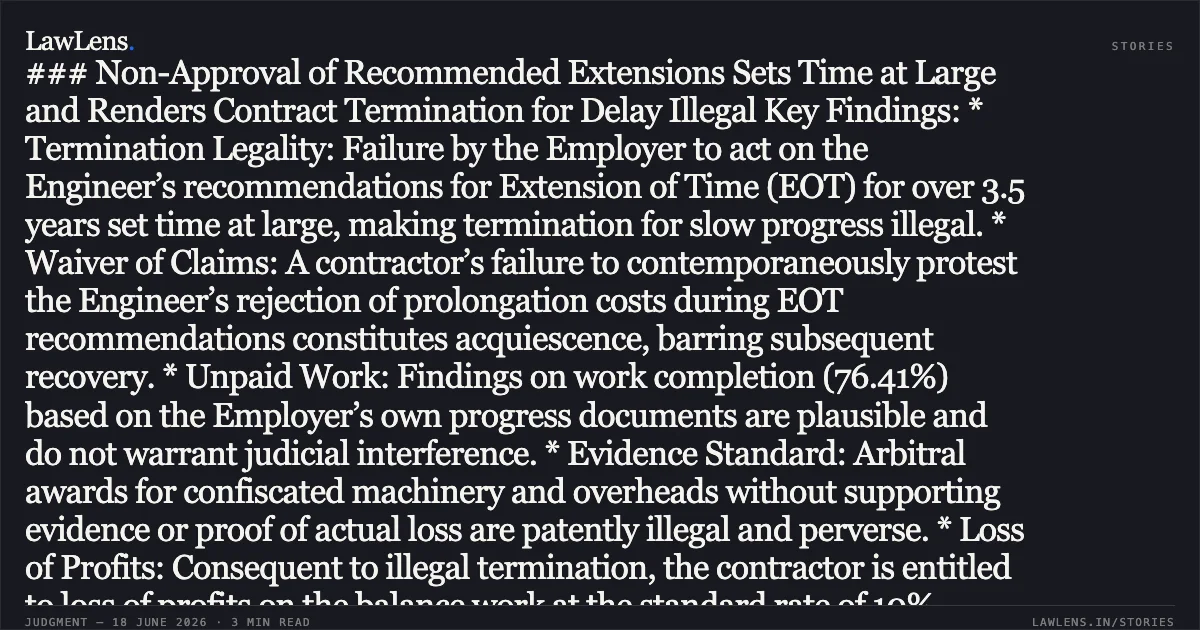
### Non-Approval of Recommended Extensions Sets Time at Large and Renders Contract Termination for Delay Illegal Key Findings: * Termination Legality: Failure by the Employer to act on the Engineer’s recommendations for Extension of Time (EOT) for over 3.5 years set time at large, making termination for slow progress illegal. * Waiver of Claims: A contractor’s failure to contemporaneously protest the Engineer’s rejection of prolongation costs during EOT recommendations constitutes acquiescence, barring subsequent recovery. * Unpaid Work: Findings on work completion (76.41%) based on the Employer’s own progress documents are plausible and do not warrant judicial interference. * Evidence Standard: Arbitral awards for confiscated machinery and overheads without supporting evidence or proof of actual loss are patently illegal and perverse. * Loss of Profits: Consequent to illegal termination, the contractor is entitled to loss of profits on the balance work at the standard rate of 10%.. National Highways Authority Of India vs Progressive Constructions Limited. Delhi High Court. LawLens

Delhi High Court·

Arbitration and MediationContract Law

### Non-Approval of Recommended Extensions Sets Time at Large and Renders Contract Termination for Delay Illegal Key Findings: * Termination Legality: Failure by the Employer to act on the Engineer’s recommendations for Extension of Time (EOT) for over 3.5 years set time at large, making termination for slow progress illegal. * Waiver of Claims: A contractor’s failure to contemporaneously protest the Engineer’s rejection of prolongation costs during EOT recommendations constitutes acquiescence, barring subsequent recovery. * Unpaid Work: Findings on work completion (76.41%) based on the Employer’s own progress documents are plausible and do not warrant judicial interference. * Evidence Standard: Arbitral awards for confiscated machinery and overheads without supporting evidence or proof of actual loss are patently illegal and perverse. * Loss of Profits: Consequent to illegal termination, the contractor is entitled to loss of profits on the balance work at the standard rate of 10%.

The Appellant (NHAI) entered into a contract with the Respondent (Progressive Constructions) on 08.09.2005 for highway widening in Assam.

3 MIN READ

Interim Restructuring of Remuneration Without Express Deferment Clauses Negates Contractual Entitlement to Salary Arrears Case Summary: * Facts: The Appellant, a former Project Manager at Aithent Technologies, challenged a Trial Court judgment that only partially decreed his suit for recovery. He claimed "deferred salary" and a "compensation bonus" arising from a 2002-2003 salary reduction exercise implemented during a financial crisis. The Respondent maintained the reduction was a permanent restructuring, not a deferment. * Key Issue: Whether the reduction of salary during financial exigency constituted a "deferment" creating a binding contractual obligation for repayment. * Court's Reasoning: * Documentary Evidence: The letter dated 01.04.2002, signed by the Appellant, explicitly used the term "restructuring" as an "interim measure" and contained no promise to repay the reduced component. * Admission by Conduct: The Appellant continued service for over a year after the alleged repayment date without raising a written demand. * Managerial Communications: Internal emails using the term "deferred salary" were deemed internal deliberations and did not create enforceable contractual rights for individual employees. * Precedent: The Court relied on a coordinate bench ruling in *Aithent Technologies vs. Archana Verma*, which rejected identical claims arising from the same restructuring exercise. * Decision: The High Court upheld the Trial Court's decree, finding no evidence of a concluded contract for the repayment of deferred amounts or bonuses. The appeal was dismissed.. Praveen Malik vs Aithent Technologies Pvt. Ltd.. Delhi High Court. LawLens

Delhi High Court·

Contract LawEmployment and Labour Law

Interim Restructuring of Remuneration Without Express Deferment Clauses Negates Contractual Entitlement to Salary Arrears Case Summary: * Facts: The Appellant, a former Project Manager at Aithent Technologies, challenged a Trial Court judgment that only partially decreed his suit for recovery. He claimed "deferred salary" and a "compensation bonus" arising from a 2002-2003 salary reduction exercise implemented during a financial crisis. The Respondent maintained the reduction was a permanent restructuring, not a deferment. * Key Issue: Whether the reduction of salary during financial exigency constituted a "deferment" creating a binding contractual obligation for repayment. * Court's Reasoning: * Documentary Evidence: The letter dated 01.04.2002, signed by the Appellant, explicitly used the term "restructuring" as an "interim measure" and contained no promise to repay the reduced component. * Admission by Conduct: The Appellant continued service for over a year after the alleged repayment date without raising a written demand. * Managerial Communications: Internal emails using the term "deferred salary" were deemed internal deliberations and did not create enforceable contractual rights for individual employees. * Precedent: The Court relied on a coordinate bench ruling in *Aithent Technologies vs. Archana Verma*, which rejected identical claims arising from the same restructuring exercise. * Decision: The High Court upheld the Trial Court's decree, finding no evidence of a concluded contract for the repayment of deferred amounts or bonuses. The appeal was dismissed.

The Appellant/Plaintiff was employed by the Respondent Company from 1996 until his resignation on April 14, 2004.

3 MIN READ

Daughter-in-law's permissive license in property not shared household lacks absolute, indefeasible right of residence. In this judgment, the Court examines an appeal regarding a daughter-in-law's right to occupy her mother-in-law’s property. The appellant argued that the premises constituted a shared household under the Protection of Women from Domestic Violence Act, granting her an irrevocable right of residence despite matrimonial discord with the respondent's son. Conversely, the owner maintained that the occupation was a mere temporary arrangement and a permissive license that had been formally terminated. The Court analyzed the nature of the residency, noting that for twelve years following the marriage, the appellant lived at her husband's various job postings rather than in the suit property. Evidence showed that once she did move in, the different floors functioned as independent units with separate kitchens and entrances. Relying on established precedents, the Court determined that a "shared household" requires living with a degree of permanency and a "domestic relationship" that involves a common household. Finding these elements absent, the Court reclassified the appellant as a permissive licensee rather than a protected resident under the Act. Ultimately, the Court balanced the statutory protections for women against the rights of senior citizens to enjoy their property in peace. It concluded that since the license was validly revoked, and the appellant received maintenance to cover alternative housing, the owner was entitled to recover possession. The Court upheld the eviction but denied the claim for back-rent due to a lack of evidence regarding market rates. Would you like a summary of the next segment or a different analysis of this ruling?. Smt. Upinder Kaur Malhotra vs Smt. Gurmeet Malhotra. Delhi High Court. LawLens

Delhi High Court·

Family LawProperty and Real Estate Law

Daughter-in-law's permissive license in property not shared household lacks absolute, indefeasible right of residence. In this judgment, the Court examines an appeal regarding a daughter-in-law's right to occupy her mother-in-law’s property. The appellant argued that the premises constituted a shared household under the Protection of Women from Domestic Violence Act, granting her an irrevocable right of residence despite matrimonial discord with the respondent's son. Conversely, the owner maintained that the occupation was a mere temporary arrangement and a permissive license that had been formally terminated. The Court analyzed the nature of the residency, noting that for twelve years following the marriage, the appellant lived at her husband's various job postings rather than in the suit property. Evidence showed that once she did move in, the different floors functioned as independent units with separate kitchens and entrances. Relying on established precedents, the Court determined that a "shared household" requires living with a degree of permanency and a "domestic relationship" that involves a common household. Finding these elements absent, the Court reclassified the appellant as a permissive licensee rather than a protected resident under the Act. Ultimately, the Court balanced the statutory protections for women against the rights of senior citizens to enjoy their property in peace. It concluded that since the license was validly revoked, and the appellant received maintenance to cover alternative housing, the owner was entitled to recover possession. The Court upheld the eviction but denied the claim for back-rent due to a lack of evidence regarding market rates. Would you like a summary of the next segment or a different analysis of this ruling?

The Appellant (daughter-in-law) challenged a trial court decree directing her to vacate the first floor of a property owned by the Respondent (mother-in-law).

2 MIN READ

### Territorial Jurisdiction Objections Under Section 21 CPC Cannot Be Raised For The First Time At Appellate Stage Case Summary: * Core Issue: The Appellant challenged an ex-parte eviction decree, primarily arguing that the Trial Court lacked territorial jurisdiction and that she was never properly served. * Court's Ruling on Jurisdiction: The High Court, affirming the District Judge's findings, held that under Section 21(1) of the CPC, objections to the "place of suing" must be raised at the earliest opportunity in the court of first instance. Since the Appellant failed to raise this in her Order IX Rule 13 application and demonstrated no "consequent failure of justice," the objection was waived. * Service and Identity: The Court rejected claims of misdescription of identity, noting the Appellant had signed the Rent Agreement and Tenant Verification Form. It further observed that service by affixation was valid, especially as the Appellant acknowledged receiving execution notices through the same method. * Conduct of Appellant: The Court severely criticized the Appellant for re-entering the premises by breaking locks after the decree was executed, terming it criminal trespass. * Conclusion: Finding no substantial question of law under Section 100 CPC, the Court dismissed the Second Appeal, upholding the eviction and recovery of arrears.. Arti Sharma Alias Arti & Anr. vs Kanta Kame. Delhi High Court. LawLens

Delhi High Court·

Civil Procedure and EvidenceProperty and Real Estate Law

### Territorial Jurisdiction Objections Under Section 21 CPC Cannot Be Raised For The First Time At Appellate Stage Case Summary: * Core Issue: The Appellant challenged an ex-parte eviction decree, primarily arguing that the Trial Court lacked territorial jurisdiction and that she was never properly served. * Court's Ruling on Jurisdiction: The High Court, affirming the District Judge's findings, held that under Section 21(1) of the CPC, objections to the "place of suing" must be raised at the earliest opportunity in the court of first instance. Since the Appellant failed to raise this in her Order IX Rule 13 application and demonstrated no "consequent failure of justice," the objection was waived. * Service and Identity: The Court rejected claims of misdescription of identity, noting the Appellant had signed the Rent Agreement and Tenant Verification Form. It further observed that service by affixation was valid, especially as the Appellant acknowledged receiving execution notices through the same method. * Conduct of Appellant: The Court severely criticized the Appellant for re-entering the premises by breaking locks after the decree was executed, terming it criminal trespass. * Conclusion: Finding no substantial question of law under Section 100 CPC, the Court dismissed the Second Appeal, upholding the eviction and recovery of arrears.

The Respondent (landlord) filed a suit for eviction and recovery of rent against the Appellant (tenant) regarding property 316-B, Sarita Vihar, New Delhi

3 MIN READ

### Summary Account Confirmation Signed by a Deponent Constitutes a Written Contract Under Order XXXVII CPC The High Court of Delhi affirmed that a Confirmation of Accounts, signed by the debtor, serves as a "written contract" for the purposes of a summary suit, rendering a bare plea of "signing under duress" a sham defence. The Court further clarified that while granting interest is discretionary under Section 34 CPC, future interest should generally be awarded in commercial disputes to compensate for the time value of money until actual realization.. Sandeep Goel vs Zavenir Developers Pvt Ltd. Delhi High Court. LawLens

Delhi High Court·

Civil Procedure and EvidenceContract Law

### Summary Account Confirmation Signed by a Deponent Constitutes a Written Contract Under Order XXXVII CPC The High Court of Delhi affirmed that a Confirmation of Accounts, signed by the debtor, serves as a "written contract" for the purposes of a summary suit, rendering a bare plea of "signing under duress" a sham defence. The Court further clarified that while granting interest is discretionary under Section 34 CPC, future interest should generally be awarded in commercial disputes to compensate for the time value of money until actual realization.

The Plaintiff (Zavenir Developers) filed a summary suit under Order XXXVII of the CPC for the recovery of ₹50,00,000/- advanced as a friendly loan to the Defendant, a Chartered Accountant, in September 2018.

3 MIN READ

Private Employment Contracts Providing for Termination without Reason to be Upheld under Contractual Jurisprudence Summary The High Court of Delhi dismissed a Second Appeal, affirming that a contract of personal service with a private employer is not specifically enforceable under Section 14 of the Specific Relief Act. The Court held that where an appointment letter contains a "termination without assigning reason" clause subject to notice pay, such termination is valid and does not necessitate adherence to principles of natural justice or a departmental inquiry. Furthermore, the court ruled that damages cannot be awarded in the absence of specific pleadings and evidence quantifying the loss.. Mahendra Kumar Misra vs Managing Director,Tata Aia Life Insurance Co. Ltd And Ors. Delhi High Court. LawLens

Delhi High Court·

Employment and Labour LawContract Law

Private Employment Contracts Providing for Termination without Reason to be Upheld under Contractual Jurisprudence Summary The High Court of Delhi dismissed a Second Appeal, affirming that a contract of personal service with a private employer is not specifically enforceable under Section 14 of the Specific Relief Act. The Court held that where an appointment letter contains a "termination without assigning reason" clause subject to notice pay, such termination is valid and does not necessitate adherence to principles of natural justice or a departmental inquiry. Furthermore, the court ruled that damages cannot be awarded in the absence of specific pleadings and evidence quantifying the loss.

The Appellant was employed as a Sales Manager by the Respondent (a private insurance company) on 04.08.2008 under an appointment letter which allowed termination without cause upon 30 days’ notice or pay in lieu thereof

2 MIN READ

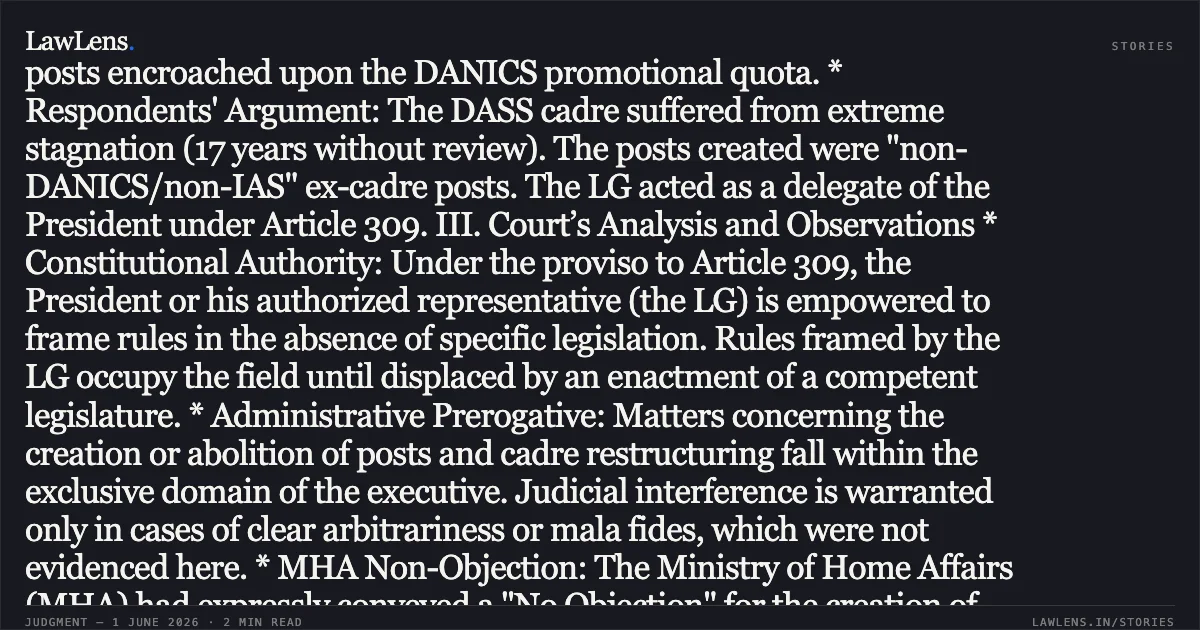
### Lieutenant Governor’s Authority to Frame Service Rules and Create Group 'A' Posts Under Article 309 SUMMARY OF THE JUDGMENT I. Core Legal Issue Whether the Lieutenant Governor (LG) of Delhi is competent to frame recruitment rules for the DASS cadre and create Group ‘A’ posts therein following the 19.05.2023 amendment to the GNCTD Act. II. Background and Facts * Conflict: DANICS officers (Petitioners) challenged the restructuring of the Delhi Administrative Subordinate Secretariat Service (DASS/GNCTDSS), which abolished approximately 217 ex-cadre posts to create a new "Senior Scale" (Level-11) within the DASS cadre. * Petitioner’s Argument: Following the GNCTD (Amendment) Act, 2023 (Section 45C), only the Central Government retains the power to make rules. They claimed the LG lacked competence and that the new posts encroached upon the DANICS promotional quota. * Respondents' Argument: The DASS cadre suffered from extreme stagnation (17 years without review). The posts created were "non-DANICS/non-IAS" ex-cadre posts. The LG acted as a delegate of the President under Article 309. III. Court’s Analysis and Observations * Constitutional Authority: Under the proviso to Article 309, the President or his authorized representative (the LG) is empowered to frame rules in the absence of specific legislation. Rules framed by the LG occupy the field until displaced by an enactment of a competent legislature. * Administrative Prerogative: Matters concerning the creation or abolition of posts and cadre restructuring fall within the exclusive domain of the executive. Judicial interference is warranted only in cases of clear arbitrariness or mala fides, which were not evidenced here. * MHA Non-Objection: The Ministry of Home Affairs (MHA) had expressly conveyed a "No Objection" for the creation of these posts, effectively providing the sanction of the Central Government. * Impact on DANICS: The Court noted that the posts being encadred into DASS were never formally part of the DANICS cadre; thus, no vested rights of the petitioners were violated. IV. Conclusion and Ruling The Court declined to stay the ongoing Departmental Promotion Committee (DPC) proceedings. It held that the LG is legally competent to frame recruitment rules and that the restructuring was a valid exercise of policy reached after administrative necessity. V. Interim Direction The DPC scheduled for June 12, 2026, was allowed to proceed. However, any consequential promotion orders are subject to the final outcome of the writ petitions, and promoted officers must provide an undertaking that they will not claim equity if the petitions succeed.. Dr Atul Pandey & Ors. vs Union Of India & Ors.. Delhi High Court. LawLens

Delhi High Court·

Administrative and Public LawConstitutional Law

### Lieutenant Governor’s Authority to Frame Service Rules and Create Group 'A' Posts Under Article 309 SUMMARY OF THE JUDGMENT I. Core Legal Issue Whether the Lieutenant Governor (LG) of Delhi is competent to frame recruitment rules for the DASS cadre and create Group ‘A’ posts therein following the 19.05.2023 amendment to the GNCTD Act. II. Background and Facts * Conflict: DANICS officers (Petitioners) challenged the restructuring of the Delhi Administrative Subordinate Secretariat Service (DASS/GNCTDSS), which abolished approximately 217 ex-cadre posts to create a new "Senior Scale" (Level-11) within the DASS cadre. * Petitioner’s Argument: Following the GNCTD (Amendment) Act, 2023 (Section 45C), only the Central Government retains the power to make rules. They claimed the LG lacked competence and that the new posts encroached upon the DANICS promotional quota. * Respondents' Argument: The DASS cadre suffered from extreme stagnation (17 years without review). The posts created were "non-DANICS/non-IAS" ex-cadre posts. The LG acted as a delegate of the President under Article 309. III. Court’s Analysis and Observations * Constitutional Authority: Under the proviso to Article 309, the President or his authorized representative (the LG) is empowered to frame rules in the absence of specific legislation. Rules framed by the LG occupy the field until displaced by an enactment of a competent legislature. * Administrative Prerogative: Matters concerning the creation or abolition of posts and cadre restructuring fall within the exclusive domain of the executive. Judicial interference is warranted only in cases of clear arbitrariness or mala fides, which were not evidenced here. * MHA Non-Objection: The Ministry of Home Affairs (MHA) had expressly conveyed a "No Objection" for the creation of these posts, effectively providing the sanction of the Central Government. * Impact on DANICS: The Court noted that the posts being encadred into DASS were never formally part of the DANICS cadre; thus, no vested rights of the petitioners were violated. IV. Conclusion and Ruling The Court declined to stay the ongoing Departmental Promotion Committee (DPC) proceedings. It held that the LG is legally competent to frame recruitment rules and that the restructuring was a valid exercise of policy reached after administrative necessity. V. Interim Direction The DPC scheduled for June 12, 2026, was allowed to proceed. However, any consequential promotion orders are subject to the final outcome of the writ petitions, and promoted officers must provide an undertaking that they will not claim equity if the petitions succeed.

The Petitioners, direct recruits of the DANICS cadre (2020-22), challenged an order dated 16.02.2026 passed by the Central Administrative Tribunal (CAT).

2 MIN READ