DHCMONTHLY CASE LAW ARCHIVE

Delhi High Court Judgments in July 2026: Case Law Digest

Read 702 LawLens analyses of Delhi High Court judgments published in July 2026, covering key rulings, legal principles and case law.

← BACK TO THE CAPITAL COURT DESK

PERMANENT MONTHLY EDITIONS

Browse by month

AUTOMATICALLY UPDATED

July 2026 Judgments

702 ARTICLES · NEWEST FIRST
Bank restricted to simple interest after illegally withholding education loan installment and causing hardship to student; appellate tribunal cannot arbitrarily interfere with lower tribunal's discretion.. Yogesh Jain & Anr. vs Central Bank Of India. Delhi High Court. LawLens

Delhi High Court·

Banking and Finance LawCivil Procedure and Evidence

Bank restricted to simple interest after illegally withholding education loan installment and causing hardship to student; appellate tribunal cannot arbitrarily interfere with lower tribunal's discretion.

The petitioners obtained a sanctioned education loan of Rs. 15,00,000 for overseas studies, but the respondent bank withheld the final installment of Rs. 3,75,000, demanding additional security not specified in the or...

3 MIN READ

### Oral Possession Claim Under Unauthorized Sale Agreement Cannot Defeat Registered Ownership Title In this appeal, the Court reviewed a decree for property recovery where the occupant claimed rights through an oral purchase agreement with a power of attorney holder. The Court found that the attorney lacked the specific authority to sell the property and that the occupant had previously made payments consistent with a tenancy. The Court concluded that in the absence of a registered sale deed or specific authorization to sell, the occupant could not establish legal title. Furthermore, the termination of the month-to-month tenancy via legal notice was held valid. The judgment affirmed the eviction order and the award of mesne profits, while allowing for the adjustment of excess payments made by the occupant. Would you like a summary of a specific legal issue addressed in this judgment?. Mrs. Naveen Chaudhary @ N Aveen Ahlawat vs Sh Siddharth Ganvir & Ors.. Delhi High Court. LawLens

Delhi High Court·

Property and Real Estate LawCivil Procedure and Evidence

### Oral Possession Claim Under Unauthorized Sale Agreement Cannot Defeat Registered Ownership Title In this appeal, the Court reviewed a decree for property recovery where the occupant claimed rights through an oral purchase agreement with a power of attorney holder. The Court found that the attorney lacked the specific authority to sell the property and that the occupant had previously made payments consistent with a tenancy. The Court concluded that in the absence of a registered sale deed or specific authorization to sell, the occupant could not establish legal title. Furthermore, the termination of the month-to-month tenancy via legal notice was held valid. The judgment affirmed the eviction order and the award of mesne profits, while allowing for the adjustment of excess payments made by the occupant. Would you like a summary of a specific legal issue addressed in this judgment?

The Respondents (owners of DDA Flat B-509, Rohini) filed a suit for recovery of possession, mesne profits, and arrears of rent against the Appellant.

2 MIN READ

Synergistic pharmaceutical combinations of independent active agents are patentable products and not excluded methods of treatment. SUMMARY 1. Facts: The Appellant challenged an order by the Deputy Controller of Patents refusing an application for a pharmaceutical combination (Encorafenib, an EGFR inhibitor, and an optional PI3K-α inhibitor). The Patent Office rejected the application on grounds of lack of inventive step (Section 2(1)(ja)), non-patentability as a "new form of a known substance" (Section 3(d)), and for being a "method of treatment" (Section 3(i)). 2. Issues: * Whether a combination of known independent active pharmaceutical agents (APAs) constitutes a "method of treatment" under Section 3(i). * Whether Section 3(d) applies to a combination of distinct active ingredients. * Whether the combination demonstrated technical advancement over cited prior art (D1-D4). 3. Court’s Reasoning: * Section 3(i): The Court held that Claim 1 was a product claim for a "pharmaceutical combination," not a process. Functional descriptors like "simultaneous or sequential administration" describe how the product is used but do not transform a product claim into a method of treatment. Working examples in the specification demonstrate feasibility but do not define the legal scope of the claims. * Section 3(d): Following established precedent, the Court ruled that Section 3(d) typically applies to new forms/derivatives of a *single* known substance. A combination of two or more separate active drugs (each with distinct chemical identities) does not fall under Section 3(d) as they are not "derivatives" of each other. * Inventive Step: The Court found the Controller’s analysis flawed. The cited prior arts (D1-D4) did not disclose the specific combination of the claimed inhibitors. Furthermore, the clinical data provided in the specification demonstrated significant tumor regression (synergy) which was not anticipated by the prior art. 4. Conclusion: The High Court set aside the impugned order, holding the findings on Sections 3(i), 3(d), and 2(1)(ja) unsustainable. The matter was remanded to the Controller for fresh consideration on merits within six months.. Array Biopharma Inc vs Deputy Controller Of Patents And Designs. Delhi High Court. LawLens

Delhi High Court·

Intellectual Property LawAdministrative and Public Law

Synergistic pharmaceutical combinations of independent active agents are patentable products and not excluded methods of treatment. SUMMARY 1. Facts: The Appellant challenged an order by the Deputy Controller of Patents refusing an application for a pharmaceutical combination (Encorafenib, an EGFR inhibitor, and an optional PI3K-α inhibitor). The Patent Office rejected the application on grounds of lack of inventive step (Section 2(1)(ja)), non-patentability as a "new form of a known substance" (Section 3(d)), and for being a "method of treatment" (Section 3(i)). 2. Issues: * Whether a combination of known independent active pharmaceutical agents (APAs) constitutes a "method of treatment" under Section 3(i). * Whether Section 3(d) applies to a combination of distinct active ingredients. * Whether the combination demonstrated technical advancement over cited prior art (D1-D4). 3. Court’s Reasoning: * Section 3(i): The Court held that Claim 1 was a product claim for a "pharmaceutical combination," not a process. Functional descriptors like "simultaneous or sequential administration" describe how the product is used but do not transform a product claim into a method of treatment. Working examples in the specification demonstrate feasibility but do not define the legal scope of the claims. * Section 3(d): Following established precedent, the Court ruled that Section 3(d) typically applies to new forms/derivatives of a *single* known substance. A combination of two or more separate active drugs (each with distinct chemical identities) does not fall under Section 3(d) as they are not "derivatives" of each other. * Inventive Step: The Court found the Controller’s analysis flawed. The cited prior arts (D1-D4) did not disclose the specific combination of the claimed inhibitors. Furthermore, the clinical data provided in the specification demonstrated significant tumor regression (synergy) which was not anticipated by the prior art. 4. Conclusion: The High Court set aside the impugned order, holding the findings on Sections 3(i), 3(d), and 2(1)(ja) unsustainable. The matter was remanded to the Controller for fresh consideration on merits within six months.

The Appellant filed Indian Patent Application No. 450/DELNP/2015 for a pharmaceutical combination comprising a B-Raf inhibitor (Encorafenib), an EGFR inhibitor (Cetuximab/Erlotinib), and optionally a PI3K-alpha inhibi...

2 MIN READ

### LMMV License Holders Authorized to Drive Transport Vehicles and Future Prospects Granted for Permanent Disability In these cross-appeals, the High Court of Delhi addressed disputes regarding compensation for injuries sustained in a motor vehicle accident. The court rejected the insurer’s challenge regarding the driver’s license, affirming that a person holding a Light Motor Vehicle (LMV) license can legally operate a transport vehicle within the specified weight threshold. It also modified the interest rate to align with prevailing bank rates during the claim period. Regarding the claimant's request for enhancement, the court applied established precedents to grant a 10% increase for future prospects, noting that permanent disability impairs future employability and marketability regardless of continued current employment. While the court declined requests for additional medical or diet expenses due to the short duration of initial treatment, it increased the award for conveyance. The final compensation was mathematically adjusted to include future prospects and higher conveyance costs, while the interest rate was reduced from 10% to 8.75% per annum. Would you like a summary of another judgment?. Oriental Insurance Co Ltd vs Murari Lal & Ors. Delhi High Court. LawLens

Delhi High Court·

Transport, Maritime, and Aviation LawInsurance Law

### LMMV License Holders Authorized to Drive Transport Vehicles and Future Prospects Granted for Permanent Disability In these cross-appeals, the High Court of Delhi addressed disputes regarding compensation for injuries sustained in a motor vehicle accident. The court rejected the insurer’s challenge regarding the driver’s license, affirming that a person holding a Light Motor Vehicle (LMV) license can legally operate a transport vehicle within the specified weight threshold. It also modified the interest rate to align with prevailing bank rates during the claim period. Regarding the claimant's request for enhancement, the court applied established precedents to grant a 10% increase for future prospects, noting that permanent disability impairs future employability and marketability regardless of continued current employment. While the court declined requests for additional medical or diet expenses due to the short duration of initial treatment, it increased the award for conveyance. The final compensation was mathematically adjusted to include future prospects and higher conveyance costs, while the interest rate was reduced from 10% to 8.75% per annum. Would you like a summary of another judgment?

On April 26, 2014, the claimant, a 57-year-old employee of the Delhi Jal Board, sustained injuries in a motor vehicle accident involving a motorcycle and a Tata Winger driven in a rash and negligent manner.

2 MIN READ

Locus Standi in Property Injunctions and Actionable Infringement of Easementary Rights This matter involves a challenge to a lower court’s dismissal of a suit seeking permanent and mandatory injunctions against alleged unauthorized construction. The appellants, acting as local social workers, argued that the construction would lead to increased congestion and parking issues in their neighborhood. However, the municipal authorities provided evidence that the property had already been sealed and the illegal portions demolished, rendering the initial prayers for relief largely satisfied. The appellate court examined whether the individuals had the necessary standing to maintain a suit against a neighbor’s construction. It was determined that merely residing in the same locality or acting out of public interest does not grant a private citizen the right to seek such injunctions. The court emphasized that a neighbor’s right to litigate arises only when the construction causes a substantial and material injury to their own established easementary rights, such as access to light and air. Ultimately, the court found that since the appellants failed to demonstrate any direct infringement of their personal legal rights or a specific injury beyond general public inconvenience, they lacked the *locus standi* to continue the litigation. Furthermore, the suit did not meet the procedural requirements for a public nuisance action. The appeal was dismissed as it failed to raise any substantial question of law. Would you like a summary of the next segment or a different judgment?. Ravinder Soni And Others vs Sanatan Dharam Sabha Hari Mandir Regd And Others. Delhi High Court. LawLens

Delhi High Court·

Property and Real Estate LawCivil Procedure and Evidence

Locus Standi in Property Injunctions and Actionable Infringement of Easementary Rights This matter involves a challenge to a lower court’s dismissal of a suit seeking permanent and mandatory injunctions against alleged unauthorized construction. The appellants, acting as local social workers, argued that the construction would lead to increased congestion and parking issues in their neighborhood. However, the municipal authorities provided evidence that the property had already been sealed and the illegal portions demolished, rendering the initial prayers for relief largely satisfied. The appellate court examined whether the individuals had the necessary standing to maintain a suit against a neighbor’s construction. It was determined that merely residing in the same locality or acting out of public interest does not grant a private citizen the right to seek such injunctions. The court emphasized that a neighbor’s right to litigate arises only when the construction causes a substantial and material injury to their own established easementary rights, such as access to light and air. Ultimately, the court found that since the appellants failed to demonstrate any direct infringement of their personal legal rights or a specific injury beyond general public inconvenience, they lacked the *locus standi* to continue the litigation. Furthermore, the suit did not meet the procedural requirements for a public nuisance action. The appeal was dismissed as it failed to raise any substantial question of law. Would you like a summary of the next segment or a different judgment?

The Appellants, residents and social workers of Nabi Karim, filed a suit for permanent and mandatory injunction against Respondents Nos. 2 to 6 (officials of Respondent No. 1) to stop and demolish alleged unauthorized...

2 MIN READ

### Non-recovery of journey ticket and inferential injury reports cannot negate claims of "untoward incidents" during rail travel. Summary This appeal challenged a tribunal's dismissal of a compensation claim following a fatal fall from a train. The lower tribunal had rejected the claim on two grounds: first, that the deceased was not a "bona fide passenger" because no ticket was recovered and witness testimonies regarding the start of the journey were inconsistent; and second, that the nature of the injuries suggested the deceased was run over while trespassing rather than falling from the carriage. The High Court overturned this decision, clarifying that the initial burden of proof on a claimant can be discharged via oral evidence and affidavits, shifts the burden to the Railways. The Court ruled that minor inconsistencies in how a passenger reached the station do not invalidate testimony regarding the purchase of a ticket. Furthermore, the Court held that medical and inquiry reports based on inference—labeling injuries as "run-over" without expert medical testimony or eyewitness accounts—are insufficient to categorize an event as something other than an "untoward incident." Finding that the location of the body supported a journey in progress, the Court remanded the matter for compensation assessment. Would you like a summary of the legal principles applied in the next segment of this case or a similar judgment?. Savitri vs Union Of India. Delhi High Court. LawLens

Delhi High Court·

Transport, Maritime, and Aviation LawCivil Procedure and Evidence

### Non-recovery of journey ticket and inferential injury reports cannot negate claims of "untoward incidents" during rail travel. Summary This appeal challenged a tribunal's dismissal of a compensation claim following a fatal fall from a train. The lower tribunal had rejected the claim on two grounds: first, that the deceased was not a "bona fide passenger" because no ticket was recovered and witness testimonies regarding the start of the journey were inconsistent; and second, that the nature of the injuries suggested the deceased was run over while trespassing rather than falling from the carriage. The High Court overturned this decision, clarifying that the initial burden of proof on a claimant can be discharged via oral evidence and affidavits, shifts the burden to the Railways. The Court ruled that minor inconsistencies in how a passenger reached the station do not invalidate testimony regarding the purchase of a ticket. Furthermore, the Court held that medical and inquiry reports based on inference—labeling injuries as "run-over" without expert medical testimony or eyewitness accounts—are insufficient to categorize an event as something other than an "untoward incident." Finding that the location of the body supported a journey in progress, the Court remanded the matter for compensation assessment. Would you like a summary of the legal principles applied in the next segment of this case or a similar judgment?

The appellant’s husband (the deceased) allegedly fell from a moving train on July 7, 2018, while traveling from Shikohabad to Etawah, resulting in his death.

2 MIN READ

Specific Deuterated Compounds Disclosed in Genus Patents Lack Novelty and Fail the Section 3(d) Therapeutic Efficacy Test Case Summary: 1. Facts: The Appellant challenged the Controller’s rejection of their patent application for deuterated heterocycle-fused gamma-carbolines. The application was refused on grounds of lack of novelty (Section 2(1)(j)), lack of inventive step (Section 2(1)(ja)), and non-patentability (Section 3(d)). The Appellant argued that the compounds were a specific species with improved metabolic stability compared to the known non-deuterated compound "Q". 2. Issue: * Whether specific deuterated compounds are novel if the base formula is covered by prior art Markush/genus disclosures. * Whether improved pharmacokinetic properties (bioavailability/metabolic stability) through deuteration satisfy the "enhanced therapeutic efficacy" requirement under Section 3(d). 3. Ruling: * Novelty: The Court upheld the lack of novelty. Following *AstraZeneca AB* and *Novartis AG*, the Court ruled that if a product is covered in the claims of a prior genus patent (D1 and D7), specific disclosure or "multiple selections" are immaterial. The claimed formulas were inherently disclosed in the prior art. * Section 3(d): The Court held the compounds were "new forms" of a known substance. Relying on *Novartis AG*, it clarified that "efficacy" means therapeutic efficacy, not just physicochemical or pharmacokinetic improvements. * Data Insufficiency: The Appellant's data—showing a 72% increase in parent drug exposure and reduced metabolite formation—demonstrated improved bioavailability/stability but failed to prove a superior therapeutic effect (i.e., treating the disease better). * Conclusion: Increased bioavailability must be specifically linked to enhanced therapeutic efficacy via research data to overcome Section 3(d). The appeal was dismissed.. Intra-Cellular Therapies, Inc. vs The Controller Of Patents. Delhi High Court. LawLens

Delhi High Court·

Intellectual Property LawAdministrative and Public Law

Specific Deuterated Compounds Disclosed in Genus Patents Lack Novelty and Fail the Section 3(d) Therapeutic Efficacy Test Case Summary: 1. Facts: The Appellant challenged the Controller’s rejection of their patent application for deuterated heterocycle-fused gamma-carbolines. The application was refused on grounds of lack of novelty (Section 2(1)(j)), lack of inventive step (Section 2(1)(ja)), and non-patentability (Section 3(d)). The Appellant argued that the compounds were a specific species with improved metabolic stability compared to the known non-deuterated compound "Q". 2. Issue: * Whether specific deuterated compounds are novel if the base formula is covered by prior art Markush/genus disclosures. * Whether improved pharmacokinetic properties (bioavailability/metabolic stability) through deuteration satisfy the "enhanced therapeutic efficacy" requirement under Section 3(d). 3. Ruling: * Novelty: The Court upheld the lack of novelty. Following *AstraZeneca AB* and *Novartis AG*, the Court ruled that if a product is covered in the claims of a prior genus patent (D1 and D7), specific disclosure or "multiple selections" are immaterial. The claimed formulas were inherently disclosed in the prior art. * Section 3(d): The Court held the compounds were "new forms" of a known substance. Relying on *Novartis AG*, it clarified that "efficacy" means therapeutic efficacy, not just physicochemical or pharmacokinetic improvements. * Data Insufficiency: The Appellant's data—showing a 72% increase in parent drug exposure and reduced metabolite formation—demonstrated improved bioavailability/stability but failed to prove a superior therapeutic effect (i.e., treating the disease better). * Conclusion: Increased bioavailability must be specifically linked to enhanced therapeutic efficacy via research data to overcome Section 3(d). The appeal was dismissed.

The Appellant filed Indian Patent Application No. 201817033732 seeking a patent for deuterated heterocycle-fused gamma-carbolines used for treating 5-HT 2A receptor-related disorders

2 MIN READ

### Employer Liable for Delay Damages if Arbitrary Provisional Extensions Render Contractual Time-Extension Provisions Inoperative Summary: The High Court of Delhi upheld an arbitral award holding the Employer liable for delays caused by site encumbrances and technical errors. The Court affirmed that granting "provisional" extensions while ignoring the Engineer’s assessment of Employer-led delays disentitled the Employer from levying liquidated damages and justified the award of overhead costs and bank guarantee charges to the Contractor.. Public Works Department Nh Wing And Anr vs Ms Gvr Infra Projects Ltd. Delhi High Court. LawLens

Delhi High Court·

Arbitration and MediationConstruction Law

### Employer Liable for Delay Damages if Arbitrary Provisional Extensions Render Contractual Time-Extension Provisions Inoperative Summary: The High Court of Delhi upheld an arbitral award holding the Employer liable for delays caused by site encumbrances and technical errors. The Court affirmed that granting "provisional" extensions while ignoring the Engineer’s assessment of Employer-led delays disentitled the Employer from levying liquidated damages and justified the award of overhead costs and bank guarantee charges to the Contractor.

The Petitioner (MORT&H/PWD) invited bids for the rehabilitation and upgradation of a section of NH-217 in Odisha. An agreement was signed on March 21, 2014, with a 730-day completion period.

3 MIN READ

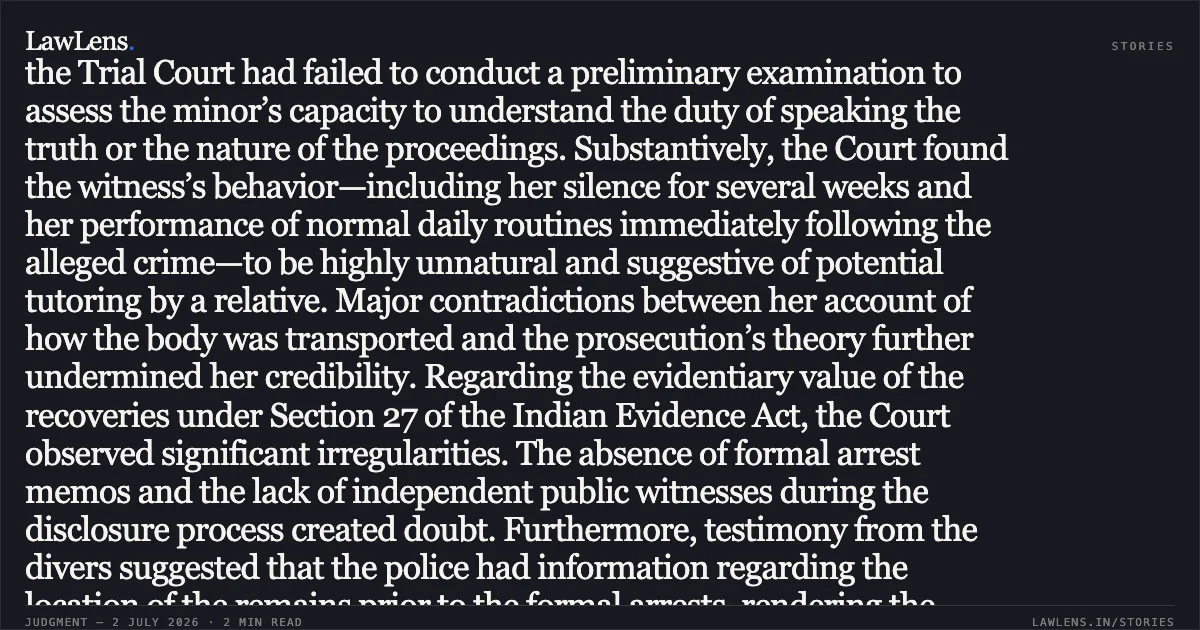
Legal Principle: Sole Eyewitness Testimony Must Be Reliable and Natural to Sustain Conviction Based on Circumstantial Recoveries In this appellate decision, the High Court overturned the conviction of multiple individuals accused of murder and the disposal of a body. The prosecution's case rested primarily on the testimony of the deceased's minor daughter and recoveries made following the arrest of the accused. The Court conducted an in-depth analysis of the child witness’s testimony, noting several critical infirmities. Procedurally, the Trial Court had failed to conduct a preliminary examination to assess the minor’s capacity to understand the duty of speaking the truth or the nature of the proceedings. Substantively, the Court found the witness’s behavior—including her silence for several weeks and her performance of normal daily routines immediately following the alleged crime—to be highly unnatural and suggestive of potential tutoring by a relative. Major contradictions between her account of how the body was transported and the prosecution’s theory further undermined her credibility. Regarding the evidentiary value of the recoveries under Section 27 of the Indian Evidence Act, the Court observed significant irregularities. The absence of formal arrest memos and the lack of independent public witnesses during the disclosure process created doubt. Furthermore, testimony from the divers suggested that the police had information regarding the location of the remains prior to the formal arrests, rendering the "discovery of fact" through the accused’s statements inadmissible. The Court ultimately concluded that the chain of circumstantial evidence was broken. While the prosecution established a potential motive involving an illicit relationship, this was insufficient to prove the act of murder beyond a reasonable doubt. Consequently, the High Court set aside the lower court's judgment and acquitted the appellants. Would you like a summary of the evidence regarding the DNA and medical reports analyzed in the later sections of the judgment?. Roshani & Anr vs State. Delhi High Court. LawLens

Delhi High Court·

Criminal Procedure and EvidenceCriminal Law

Legal Principle: Sole Eyewitness Testimony Must Be Reliable and Natural to Sustain Conviction Based on Circumstantial Recoveries In this appellate decision, the High Court overturned the conviction of multiple individuals accused of murder and the disposal of a body. The prosecution's case rested primarily on the testimony of the deceased's minor daughter and recoveries made following the arrest of the accused. The Court conducted an in-depth analysis of the child witness’s testimony, noting several critical infirmities. Procedurally, the Trial Court had failed to conduct a preliminary examination to assess the minor’s capacity to understand the duty of speaking the truth or the nature of the proceedings. Substantively, the Court found the witness’s behavior—including her silence for several weeks and her performance of normal daily routines immediately following the alleged crime—to be highly unnatural and suggestive of potential tutoring by a relative. Major contradictions between her account of how the body was transported and the prosecution’s theory further undermined her credibility. Regarding the evidentiary value of the recoveries under Section 27 of the Indian Evidence Act, the Court observed significant irregularities. The absence of formal arrest memos and the lack of independent public witnesses during the disclosure process created doubt. Furthermore, testimony from the divers suggested that the police had information regarding the location of the remains prior to the formal arrests, rendering the "discovery of fact" through the accused’s statements inadmissible. The Court ultimately concluded that the chain of circumstantial evidence was broken. While the prosecution established a potential motive involving an illicit relationship, this was insufficient to prove the act of murder beyond a reasonable doubt. Consequently, the High Court set aside the lower court's judgment and acquitted the appellants. Would you like a summary of the evidence regarding the DNA and medical reports analyzed in the later sections of the judgment?

The Appellants (Saleem, Maya, and Roshani) were convicted by the Trial Court under Sections 302/201/34 of the IPC for the murder of Dr. Ashok Kumar Bansal

2 MIN READ

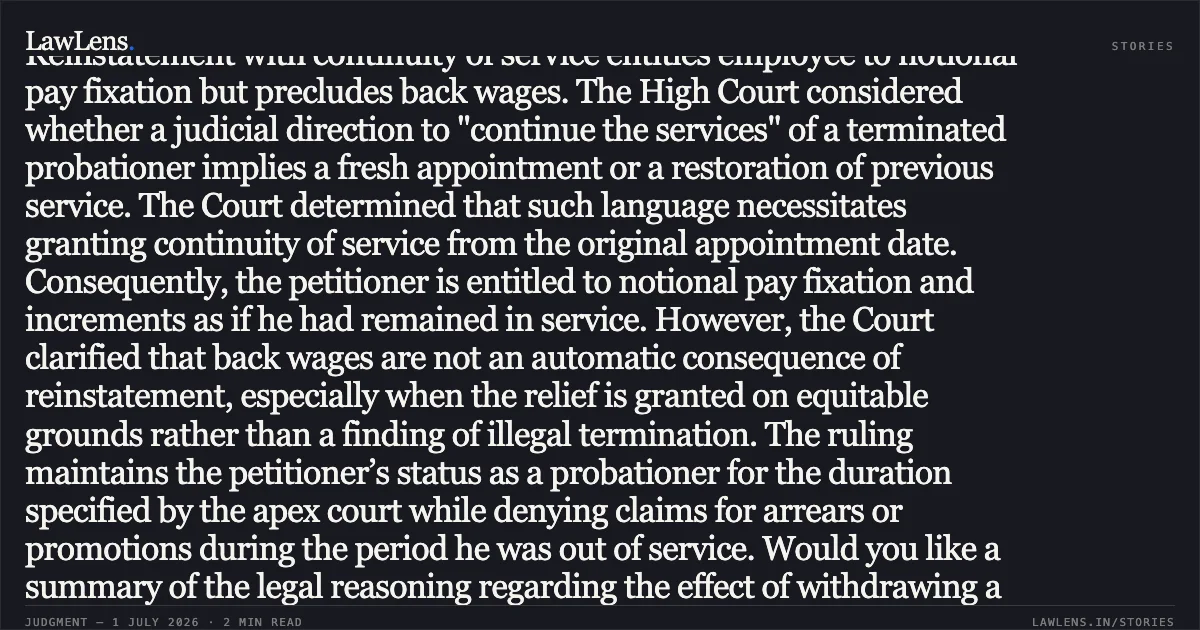
Reinstatement with continuity of service entitles employee to notional pay fixation but precludes back wages. The High Court considered whether a judicial direction to "continue the services" of a terminated probationer implies a fresh appointment or a restoration of previous service. The Court determined that such language necessitates granting continuity of service from the original appointment date. Consequently, the petitioner is entitled to notional pay fixation and increments as if he had remained in service. However, the Court clarified that back wages are not an automatic consequence of reinstatement, especially when the relief is granted on equitable grounds rather than a finding of illegal termination. The ruling maintains the petitioner’s status as a probationer for the duration specified by the apex court while denying claims for arrears or promotions during the period he was out of service. Would you like a summary of the legal reasoning regarding the effect of withdrawing a miscellaneous application before the higher court?. Gaurav Kumar vs High Court Of Delhi, Through Its Registrar General & Ors.. Delhi High Court. LawLens

Delhi High Court·

Employment and Labour LawAdministrative and Public Law

Reinstatement with continuity of service entitles employee to notional pay fixation but precludes back wages. The High Court considered whether a judicial direction to "continue the services" of a terminated probationer implies a fresh appointment or a restoration of previous service. The Court determined that such language necessitates granting continuity of service from the original appointment date. Consequently, the petitioner is entitled to notional pay fixation and increments as if he had remained in service. However, the Court clarified that back wages are not an automatic consequence of reinstatement, especially when the relief is granted on equitable grounds rather than a finding of illegal termination. The ruling maintains the petitioner’s status as a probationer for the duration specified by the apex court while denying claims for arrears or promotions during the period he was out of service. Would you like a summary of the legal reasoning regarding the effect of withdrawing a miscellaneous application before the higher court?

The Petitioner was appointed as a Temporary Chauffeur on probation in the Delhi High Court on 14.06.2013

2 MIN READ