![Look-Out Circulars cannot be continued indefinitely once tax proceedings conclude and no demand remains outstanding.. Gaurav Dalmia & Anr. v. Deputy Director of Income Tax Investigation Unit 2 (3) Delhi & Ors. [W.P.(C) 8352/2025 and W.P.(C) 11710/2025]. Delhi High Court. LawLens](/stories/thumbnails/look-out-circulars-cannot-be-continued-indefinitely-once-tax-proceedings-conclude-and-no-d-9bb3186cc9124a73bb9c86bc04a5bc6f.webp)
Constitutional LawTax Law
Look-Out Circulars cannot be continued indefinitely once tax proceedings conclude and no demand remains outstanding.
Following a search at the petitioners’ residential and business premises on March 17, 2021, a Look Out Circular (LOC) was issued against them in early 2021.
2 MIN READ→
![Lookout circular cannot be indefinitely sustained when tax proceedings have culminated and no demand remains outstanding.. Gaurav Dalmia v. Deputy Director of Income Tax Investigation Unit 2 (3) Delhi & Ors. [W.P.(C) 8352/2025 and W.P.(C) 11710/2025]. Delhi High Court. LawLens](/stories/thumbnails/lookout-circular-cannot-be-indefinitely-sustained-when-tax-proceedings-have-culminated-and-98fadd16c15248a58bed6e68b9ddd915.webp)
![Statutory remedies against closure reports must be exhausted before seeking writ jurisdiction for quashing of FIR.. Master Devarsh v. Union of India & Ors. [W.P.(CRL) 1092/2019] and Dr. Ritu Verma & Ors. v. State of NCT of Delhi & Anr. [W.P.(CRL) 3537/2019]. Delhi High Court. LawLens](/stories/thumbnails/statutory-remedies-against-closure-reports-must-be-exhausted-before-seeking-writ-jurisdict-65f7356982d44c3aa109ce6947f9f848.webp)
![Consultative process for appointing Public Prosecutors must clearly distinguish between Government Pleader and Prosecutor roles.. Adv. P.T. Joseph v. State of Kerala & Ors. [2026:KER:16591]. Kerala High Court. LawLens](/stories/thumbnails/consultative-process-for-appointing-public-prosecutors-must-clearly-distinguish-between-go-b49ae214193547f58ecc03f493e6eff8.webp)
![Consultation Process for Public Prosecutor Appointments Must Strictly Adhere to Notification Specifics and Statutory Primacy.. Adv.P.T. Joseph v. State of Kerala & Others [2026:KER:16591]. Kerala High Court. LawLens](/stories/thumbnails/consultation-process-for-public-prosecutor-appointments-must-strictly-adhere-to-notificati-7a2234586171408fb640b83fe2f8e8b5.webp)
![Section 9 application for interim measures is maintainable until the complete satisfaction of the arbitral award.. C.J. Charles Rajkumar v. Mrs. Rahamathunnisa (died) and Others [O.A. No.1188 of 2025 (2026:MHC:835)]. Madras High Court. LawLens](/stories/thumbnails/section-9-application-for-interim-measures-is-maintainable-until-the-complete-satisfaction-c591e114c5384cffa0160d84d0765ce3.webp)
![Civil Court Jurisdiction to Grant Injunction in Temple Title Suits Not Barred by HR&CE Act.. K. Lakshmi v. Arulmigu Balasubramaniya Swami Temple Devasthanam & Ors. [C.R.P.(MD)No.3632 of 2025 and batch]. Madras High Court. LawLens](/stories/thumbnails/civil-court-jurisdiction-to-grant-injunction-in-temple-title-suits-not-barred-by-hr-ce-act-f6be9a152521409d90dfbe9b944ece20.webp)
![### Cryptic ex parte judgment failing Order XX requirements is a nullity and inexecutable under Section 47 CPC.. R. Balasankar v. Ramalakshmi and Others [C.R.P.(MD)Nos.3025 and 3419 of 2025; 2026:MHC:834]. Madras High Court. LawLens](/stories/thumbnails/cryptic-ex-parte-judgment-failing-order-xx-requirements-is-a-nullity-and-inexecutable-unde-1f67b0d0061d476f91dd8f41657c56ae.webp)
![Failure to File Arbitral Award and Foundational Documents Renders Section 34 Petition Non-Est and Barred by Limitation. Union of India v. M/s Varindera Constructions Limited [2026:DHC:830]. Delhi High Court. LawLens](/stories/thumbnails/failure-to-file-arbitral-award-and-foundational-documents-renders-section-34-petition-non--d440d62d39dd4f9db7b9e35315013897.webp)
![Defence involving disputed questions of fact and age cannot be adjudicated at the stage of discharge.. Brishan Patel @ Brishin Patel v. The State of Bihar & Anr. [Criminal Miscellaneous No. 39375 of 2025]. Patna High Court. LawLens](/stories/thumbnails/defence-involving-disputed-questions-of-fact-and-age-cannot-be-adjudicated-at-the-stage-of-8f384571e84d41d19592b5de023faf65.webp)
![Registration of FIR against a Judicial Officer requires prior permission of the Chief Justice of the High Court.. Saurav Raj v. The State of Bihar & Anr. [Criminal Miscellaneous No. 70170 of 2024]. Patna High Court. LawLens](/stories/thumbnails/registration-of-fir-against-a-judicial-officer-requires-prior-permission-of-the-chief-just-1b2b5e2f61a9437e9e55074fd8ab2589.webp)
![### Judicial Review Cannot Be Invoked at the Threshold to Quash a Charge Memo Lacking a List of Witnesses. Union of India & Anr. v. Sameer Danyadev Wankhede [W.P.(C) 1053/2026]. Delhi High Court. LawLens](/stories/thumbnails/judicial-review-cannot-be-invoked-at-the-threshold-to-quash-a-charge-memo-lacking-a-list-o-137ea6e0ba72476f895b5162ea88012e.webp)
![### Contractual Employees Are Statutorily Entitled to Maternity Benefits Notwithstanding Inconsistent Service Agreements. Dhanashri Ramesh Karkhanis v. Municipal Corporation of Greater Mumbai & Ors. [2026:BHC-OS:5400-DB]. Bombay High Court. LawLens](/stories/thumbnails/contractual-employees-are-statutorily-entitled-to-maternity-benefits-notwithstanding-incon-52ff0ec51d764879ae7e9c91daaf8760.webp)
![Section 11 scrutiny is limited to prima facie existence of arbitration agreement, excluding questions of limitation.. Satnam Enterprises Private Limited v. Uppal Chadha Hi-Tech Developers Pvt. Ltd. [ARB.P. 634/2024 and connected matters.]. Delhi High Court. LawLens](/stories/thumbnails/section-11-scrutiny-is-limited-to-prima-facie-existence-of-arbitration-agreement-excluding-17e5a69dd26347d0b8b04067988182e1.webp)
![Grant of mining concessions in government land without transparent public notice or competitive bidding violates Article 14.. Anish Abraham v. State of Kerala & Others [2026:KER:17562]. Kerala High Court. LawLens](/stories/thumbnails/grant-of-mining-concessions-in-government-land-without-transparent-public-notice-or-compet-755160f8224942589093676356eef6a7.webp)
![Grant of mining NOC for government land without transparent public notice or competitive bidding is arbitrary and violates Article 14.. Karuvakunnel Enterprises v. State of Kerala & Others [W.P.(C). No. 40095 of 2018]. Kerala High Court. LawLens](/stories/thumbnails/grant-of-mining-noc-for-government-land-without-transparent-public-notice-or-competitive-b-d276f9ae9217424ca22e215c37de9580.webp)
![Grant of mining concessions on government land must follow transparent, competitive bidding to satisfy Article 14 and the Public Trust Doctrine.. Karuvakunnel Enterprises v. State of Kerala & Others [2026:KER:17562]. Kerala High Court. LawLens](/stories/thumbnails/grant-of-mining-concessions-on-government-land-must-follow-transparent-competitive-bidding-cf7804cae52a430d9727efd3200d4751.webp)
![Debt and default establish a mandatory basis for Section 7 admission regardless of alleged corporate viability.. Uday J. Desai v. Bank of India & Anr. [Comp. App. (AT) (Ins) No. 187 of 2023]. NCLAT. LawLens](/stories/thumbnails/debt-and-default-establish-a-mandatory-basis-for-section-7-admission-regardless-of-alleged-3eb4deb9ea4e45b7ba7039359592d5cd.webp)
![### High Court Cannot Revisit or Undone Benefits Granted by Supreme Court Orders to Non-Parties. Dr. Jiji K.S. & Ors. v. Shibu K & Ors. [2026 INSC 207]. Supreme Court. LawLens](/stories/thumbnails/high-court-cannot-revisit-or-undone-benefits-granted-by-supreme-court-orders-to-non-partie-54ad73c35f76439295004598f34c366c.webp)
![Referral court under Section 11 must confine scrutiny to prima facie existence of arbitration agreement.. Satnam Enterprises Private Limited v. Uppal Chadha Hi-Tech Developers Pvt. Ltd. [ARB.P. 634/2024]. Delhi High Court. LawLens](/stories/thumbnails/referral-court-under-section-11-must-confine-scrutiny-to-prima-facie-existence-of-arbitrat-5b4b476446b14d43a9cbabf86cbedfa1.webp)
![Judicial interference in answer keys is permissible where answers are palpably erroneous or demonstrably incorrect.. The Commissioner of Police and Anr. v. Amit Gulia and Ors. [W.P.(C) 2682/2026]. Delhi High Court. LawLens](/stories/thumbnails/judicial-interference-in-answer-keys-is-permissible-where-answers-are-palpably-erroneous-o-6bd7dadbf8914d21ba64041e3f8353a4.webp)
![### Doctrine of Commercial Wisdom Reaffirmed: Judicial Review of CoC Decisions Limited to Statutory Compliance and Procedural Fairness Analysis and Findings The Supreme Court dismissed the appeals filed by unsuccessful resolution applicants challenging the approval of Sarda Energy and Minerals Limited’s (SEML) Resolution Plan. The Court held that clarifications sought by the Resolution Professional (RP) regarding bank guarantees and payment options, under the direction of the Committee of Creditors (CoC), did not constitute a "material irregularity" or a modification of the bid. The Court emphasized that the "commercial wisdom" of the CoC is paramount and non-justiciable. Judicial review by the NCLT or NCLAT is strictly confined to ensuring compliance with Section 30(2) and Section 61(3) of the IBC. The Court cautioned against "strategic litigation" by unsuccessful bidders, noting that excessive judicial interference erodes the value of the corporate debtor and undermines the IBC’s objective of time-bound insolvency resolution. Key Takeaways * Non-Justiciability: The CoC's assessment of a plan's viability, valuation, and feasibility belongs exclusively to its commercial domain; courts cannot substitute their own assessment. * RP Conduct: An RP acting on CoC instructions to seek clarifications from all applicants does not commit a material irregularity. * Predictability and Finality: Predictability in the insolvency process is essential for market stability, and finality must be protected to prevent value-destructive delays. * Appellate Limits: Appeals under Section 62 of the IBC are restricted to substantive questions of law arising from the limited grounds specified in Section 61(3).. Torrent Power Ltd. v. Ashish Arjunkumar Rathi & Others [2026 INSC 206]. Supreme Court. LawLens](/stories/thumbnails/doctrine-of-commercial-wisdom-reaffirmed-judicial-review-of-coc-decisions-limited-to-statu-137e1dd3c0e748a0aae9b500495d2442.webp)
![Surety discharged only for transactions subsequent to unauthorized contract variance under Section 133.. Bhagyalaxmi Co-operative Bank Ltd. v. Babaldas Amtharam Patel (D) Through LRs & Others [2026 INSC 205]. Supreme Court. LawLens](/stories/thumbnails/surety-discharged-only-for-transactions-subsequent-to-unauthorized-contract-variance-under-3d282c9931f74bd788dd7e586e2d676a.webp)
![Reasonable accommodation for PwD candidates is a pre-requisite to assessing eligibility under the RPwD Act.. Asha Dhondiram Shinde v. Union of India & Anr. [Writ Petition No. 3672 of 2025; 2026:BHC-OS:5384-DB]. Bombay High Court. LawLens](/stories/thumbnails/reasonable-accommodation-for-pwd-candidates-is-a-pre-requisite-to-assessing-eligibility-un-4aff73c54b924dd3a347f18043e5d5be.webp)
![Generic Dictionary Words Used in Composite Marks Cannot Claim Monopoly Without Proof of Secondary Meaning. Mountain Valley Springs India Private Limited v. Baby Forest Ayurveda Private Limited (Formerly known as M/S Landsmill Healthcare Private Limited) & Ors. [FAO(OS)(COMM) 111/2024]. Delhi High Court. LawLens](/stories/thumbnails/generic-dictionary-words-used-in-composite-marks-cannot-claim-monopoly-without-proof-of-se-9a918b6ad42242fea8c533d3302fadb3.webp)
![Judicial scrutiny under Section 11 is confined to the prima facie existence of an arbitration agreement.. Satnam Enterprises Private Limited v. Uppal Chadha Hi-Tech Developers Pvt. Ltd. [ARB.P. 634/2024 and connected matters]. Delhi High Court. LawLens](/stories/thumbnails/judicial-scrutiny-under-section-11-is-confined-to-the-prima-facie-existence-of-an-arbitrat-6efe396f33aa410d8b198ef3c1d3f698.webp)
![NRI Students are Liable for Entire Tuition Fee Despite Invalidation of Corpus Fund Diversion. Govind Krishnan & Others v. State of Kerala & Others [2026:KER:1584]. Kerala High Court. LawLens](/stories/thumbnails/nri-students-are-liable-for-entire-tuition-fee-despite-invalidation-of-corpus-fund-diversi-6c3b1e6cdc0140858b73268850bac7ec.webp)
![NRI Students are Liable to Pay Entire Approved Fees Inclusive of Earmarked Corpus Fund Amounts. Govind Krishnan & Ors. v. State of Kerala & Ors. [W.P.(C) No. 38556 of 2023 and connected cases; 2026:KER:1584]. Kerala High Court. LawLens](/stories/thumbnails/nri-students-are-liable-to-pay-entire-approved-fees-inclusive-of-earmarked-corpus-fund-amo-40a50b7f833c41b2b9805eaeda826813.webp)
![NRI Students are Liable for Entire Tuition Fees Despite Illegal Creation of Cross-Subsidy Corpus Fund. Govind Krishnan & Ors. v. State of Kerala & Ors. [2026:KER:1584]. Kerala High Court. LawLens](/stories/thumbnails/nri-students-are-liable-for-entire-tuition-fees-despite-illegal-creation-of-cross-subsidy--cca5a019a8ff4cb4982fc7119a57ad99.webp)
![NRI students must pay the entire approved tuition fee, including portions previously diverted to illegal corpus funds.. Govind Krishnan & Ors. v. State of Kerala & Ors. [2026:KER:1584]. Kerala High Court. LawLens](/stories/thumbnails/nri-students-must-pay-the-entire-approved-tuition-fee-including-portions-previously-divert-fb1b18d57a6a46e0b4d1f3c6e9b628f8.webp)
![NRI Students Liable for Full Committee-Approved Fees Including Disputed Corpus Fund Components. Govind Krishnan & Others v. State of Kerala & Others [WP(C) No. 38556 of 2023 and connected cases; 2026:KER:1584]. Kerala High Court. LawLens](/stories/thumbnails/nri-students-liable-for-full-committee-approved-fees-including-disputed-corpus-fund-compon-668fddec0ab64e628ce916ee8396321c.webp)
![NRI Students are Liable to Pay Entire Approved Fees Inclusive of Corpus Fund Components. Govind Krishnan & Others v. State of Kerala & Others [WP(C) No. 38556 of 2023 and connected cases; 2026:KER:1584]. Kerala High Court. LawLens](/stories/thumbnails/nri-students-are-liable-to-pay-entire-approved-fees-inclusive-of-corpus-fund-components-9bf6f0847b9d45c79bc2d028d014dee7.webp)
![NRI Students Liable for Entire Tuition Fee Inclusive of Earmarked Corpus Fund Amounts. Govind Krishnan & Others v. State of Kerala & Others [2026:KER:1584]. Kerala High Court. LawLens](/stories/thumbnails/nri-students-liable-for-entire-tuition-fee-inclusive-of-earmarked-corpus-fund-amounts-75f306f0ef8149dab0164e377851881b.webp)
![NRI Students Liable for Entire Fixed Fee Despite Illegal Delegation to Corpus Fund. Govind Krishnan & Ors. v. State of Kerala & Ors. [2026:KER:1584]. Kerala High Court. LawLens](/stories/thumbnails/nri-students-liable-for-entire-fixed-fee-despite-illegal-delegation-to-corpus-fund-3879ffd1ad1e4efd8726e52f6274ec8e.webp)
![NRI Students are Liable for Entire Approved Fees Including Portions Earmarked for Corpus Funds. Govind Krishnan & Others v. State of Kerala & Others [WP(C) No. 38556 of 2023 and connected cases; 2026:KER:1584]. Kerala High Court. LawLens](/stories/thumbnails/nri-students-are-liable-for-entire-approved-fees-including-portions-earmarked-for-corpus-f-ecb9cff65c6b4d94ad981e6d2de605f3.webp)
![NRI Students are Liable for Entire Approved Fees Including Portions Disputed as Corpus Fund Remittances. Govind Krishnan and Ors. v. State of Kerala and Ors. [2026:KER:1584]. Kerala High Court. LawLens](/stories/thumbnails/nri-students-are-liable-for-entire-approved-fees-including-portions-disputed-as-corpus-fun-6465a160626546a387b84bc661af870e.webp)
![NRI Students Liable for Entire Approved Tuition Fee Despite Illegal Diversion to BPL Corpus Fund. Govind Krishnan & Ors. v. State of Kerala & Ors. [2026:KER:1584]. Kerala High Court. LawLens](/stories/thumbnails/nri-students-liable-for-entire-approved-tuition-fee-despite-illegal-diversion-to-bpl-corpu-96189612c6d54eeeb48b902c98879cfb.webp)
![NRI Students are Liable for Entire Approved Fees Including Portions Disputed as Corpus Fund Remittances. Govind Krishnan & Ors. v. State of Kerala & Ors. [W.P(C) No. 38556 of 2023 and connected cases (2026:KER:1584)]. Kerala High Court. LawLens](/stories/thumbnails/nri-students-are-liable-for-entire-approved-fees-including-portions-disputed-as-corpus-fun-56a346de991e47f0940f885d42645324.webp)
![NRI students must pay the entire approved tuition fee, including portions previously diverted to illegal corpus funds.. Govind Krishnan & Ors. v. State of Kerala & Ors. [W.P(C) No. 38556 of 2023 and connected cases [2026:KER:1584 0]]. Kerala High Court. LawLens](/stories/thumbnails/nri-students-must-pay-the-entire-approved-tuition-fee-including-portions-previously-divert-823aa7ca287f41c8a999716984bda06c.webp)
![NRI Students are Liable to Remit the Entire Committee-Approved Tuition Fee Without Bifurcation for Corpus Funds.. Govind Krishnan & Ors. v. State of Kerala & Ors. [W.P.(C) No. 38556 of 2023 and connected cases); 2026:KER:1584]. Kerala High Court. LawLens](/stories/thumbnails/nri-students-are-liable-to-remit-the-entire-committee-approved-tuition-fee-without-bifurca-e1f9390a81eb4666ba0ad00a913a562f.webp)
![NRI Students are Liable for Entire Approved Fees Including Portions Earmarked for Corpus Funds. Govind Krishnan & Ors. v. State of Kerala & Ors. [2026:KER:1584]. Kerala High Court. LawLens](/stories/thumbnails/nri-students-are-liable-for-entire-approved-fees-including-portions-earmarked-for-corpus-f-3833df9e4eeb4f4e994a734c5534ad21.webp)
![NRI Students are Liable for Entire Approved Fees Including Portions Earmarked for Corpus Funds. Govind Krishnan and Others v. State of Kerala and Others [2026:KER:1584]. Kerala High Court. LawLens](/stories/thumbnails/nri-students-are-liable-for-entire-approved-fees-including-portions-earmarked-for-corpus-f-5d07dfee8e7d4855837447e34e3122c4.webp)
![NRI Students are Liable for Entire Approved Fees Including Portions Earmarked for Corpus Funds. Govind Krishnan and others v. State of Kerala and others [2026:KER:1584]. Kerala High Court. LawLens](/stories/thumbnails/nri-students-are-liable-for-entire-approved-fees-including-portions-earmarked-for-corpus-f-01b1991ca9204db3ae6fda4c90a90a8f.webp)
![NRI Students Obligated to Pay Approved Tuition Fee Inclusive of Component Labeled as Corpus Fund. Govind Krishnan & Others v. State of Kerala & Others [2026:KER:1584]. Kerala High Court. LawLens](/stories/thumbnails/nri-students-obligated-to-pay-approved-tuition-fee-inclusive-of-component-labeled-as-corpu-307452a65b0d41a087bb5fbb0c3c03da.webp)
![Arbitral tribunal cannot award pre-reference or pendente lite interest where contract specifically prohibits such payment.. Union of India & Ors. v. Larsen & Tubro Limited (L&T) [2026 INSC 203]. Supreme Court. LawLens](/stories/thumbnails/arbitral-tribunal-cannot-award-pre-reference-or-pendente-lite-interest-where-contract-spec-00e1e8726e3d49a99aa0f92e9b993ce3.webp)
![Foreign Arbitral Award Enforceable Against Non-Signatory Group Company Providing Security for the Disputed Debt.. LSS Ocean Transport DMCC v. K.I. (International) Limited and Goyal Ispat Private Limited [2026:MHC:827; OSA(CAD) No. 15 of 2024]. Madras High Court. LawLens](/stories/thumbnails/foreign-arbitral-award-enforceable-against-non-signatory-group-company-providing-security--f02261a34eb3464e9723ce59bd5c83f5.webp)
![Revisional order under Section 156(3) CrPC passed without hearing prospective accused is legally unsustainable.. Sunil Singh Bhadouriya and Others v. Smt. Priyanka Singh Bhadauriya and Others [2026:MPHC-GWL:7588]. Madhya Pradesh High Court. LawLens](/stories/thumbnails/revisional-order-under-section-156-3-crpc-passed-without-hearing-prospective-accused-is-le-b5c9f778343747ad831af2fe7d266a3c.webp)
![### Bank account freeze based on cyber fraud allegations must comply with Section 102 Cr.P.C. procedure.. Goswami Traders Through Proprietor Santosh Giri v. Indian Overseas Bank and Others [2026:MPHC-IND:5783]. Madhya Pradesh High Court. LawLens](/stories/thumbnails/bank-account-freeze-based-on-cyber-fraud-allegations-must-comply-with-section-102-cr-p-c-p-0132a4e8b9cf429ca79c41f19d7fb776.webp)
![Referral Court’s Section 11 jurisdiction is confined to prima facie examination of arbitration agreement existence.. Satnam Enterprises Private Limited v. Uppal Chadha Hi-Tech Developers Pvt. Ltd. [ARB.P. 634/2024]. Delhi High Court. LawLens](/stories/thumbnails/referral-court-s-section-11-jurisdiction-is-confined-to-prima-facie-examination-of-arbitra-39e70489c95d44c6b4993a7cb7c7a28d.webp)
![### State Human Rights Commission cannot award compensation without establishing negligence through specific inquiry findings.. Municipal Corporation of Greater Mumbai v. G. D’souza & Anr. [Writ Petition No. 1047 of 2021]. Bombay High Court. LawLens](/stories/thumbnails/state-human-rights-commission-cannot-award-compensation-without-establishing-negligence-th-f056413340b14f7c972f3a9d8c0dbe52.webp)
![Look Out Circulars issued at the instance of Public Sector Banks are legally unsustainable and liable to be quashed.. Sridhar Lagadapati v. Union of India & Ors. [W.P.(C) 11023/2025]. Delhi High Court. LawLens](/stories/thumbnails/look-out-circulars-issued-at-the-instance-of-public-sector-banks-are-legally-unsustainable-7ff67beed3cc432388519bf0e171ba5c.webp)
![Cancellation of captive coal blocks constitutes a "Change in Law" entitling generators to compensation despite indemnity clauses.. West Bengal State Electricity Distribution Co. Ltd. v. Adhunik Power & Natural Resource Ltd. & Ors. [2026 INSC 202]. Supreme Court. LawLens](/stories/thumbnails/cancellation-of-captive-coal-blocks-constitutes-a-change-in-law-entitling-generators-to-co-26331cf93cd2457cb0f5eca2101741f6.webp)
![### Guest Lecturer experience counts toward direct recruitment teaching scores under UGC Regulations 2018.. Jovita James v. University of Kerala & Ors. [2026:KER:17033]. Kerala High Court. LawLens](/stories/thumbnails/guest-lecturer-experience-counts-toward-direct-recruitment-teaching-scores-under-ugc-regul-7e3f7e0839c44857a022d47799fc4fd6.webp)
![Guest Lecturer experience counts toward direct recruitment marks unless expressly excluded by specific service regulations.. Jovita James v. University of Kerala & Ors. [2026:KER:17033]. Kerala High Court. LawLens](/stories/thumbnails/guest-lecturer-experience-counts-toward-direct-recruitment-marks-unless-expressly-excluded-0673a8b0f80446f9a2f04747e60f3fd8.webp)
![### Guest Lecturer experience counts toward teaching marks for direct recruitment under UGC Regulations 2018.. Jovita James v. University of Kerala & Others (and connected cases) [2026:KER:17033]. Kerala High Court. LawLens](/stories/thumbnails/guest-lecturer-experience-counts-toward-teaching-marks-for-direct-recruitment-under-ugc-re-c0b3a472aa774b418d08a26c54560147.webp)
![Section 22(1) of the ID Act prohibits strikes by all persons employed in public utility services, including non-workmen.. The Federal Bank Ltd. v. Federal Bank Officers Association & Anr. [WA No. 1363 of 2025; 2026:KER:17176]. Kerala High Court. LawLens](/stories/thumbnails/section-22-1-of-the-id-act-prohibits-strikes-by-all-persons-employed-in-public-utility-ser-641a20d68d5f4f979bcbd86f5a0446e5.webp)
![Failure to provide reasoned justification for Section 197 certificates warrants interim reduction of tax withholding rates.. DocuSign Inc. v. The Income Tax Officer, Ward Int. Tax 1(2)(2) [W.P.(C) 1334/2026]. Delhi High Court. LawLens](/stories/thumbnails/failure-to-provide-reasoned-justification-for-section-197-certificates-warrants-interim-re-3efad32caa7849b4942613470b34967a.webp)
![Awarding damages exceeding the amount claimed in the plaint is permissible if based on FRAND royalty evidence.. Surinder Kumar Wadhwa & Anr. v. Koninklijke Philips N.V. [RFA(OS)(COMM) 13/2025]. Delhi High Court. LawLens](/stories/thumbnails/awarding-damages-exceeding-the-amount-claimed-in-the-plaint-is-permissible-if-based-on-fra-4ed2b454256e412a80ec1e64dd375ec1.webp)
![Absence of Plaint Amendment Does Not Warrant Absolute Stay Where Evidentiary Findings Support Grant of Damages at FRAND Rates. Surinder Kumar Wadhwa & Anr. v. Koninklijke Philips N.V. [RFA(OS)(COMM) 13/2025] and Maj (Retd.) Sukesh Behl Proprietor, M/S Pearl Engineering Company & Anr. v. Koninklijke Philips N.V. [RFA(OS)(COMM) 8/2025]. Delhi High Court. LawLens](/stories/thumbnails/absence-of-plaint-amendment-does-not-warrant-absolute-stay-where-evidentiary-findings-supp-6757daf1b03a4130be8d25026686a5af.webp)
![### Selection Process Deviating From Prospectus Guidelines Is Legally Vitiated Despite Candidate Participation Without Protest. Dr. Oishika Chakraborty v. All India Institute of Medical Sciences - AIIMS & Ors. [W.P.(C) 19812/2025]. Delhi High Court. LawLens](/stories/thumbnails/selection-process-deviating-from-prospectus-guidelines-is-legally-vitiated-despite-candida-b6b7661884a749b5b2d6832617f7e8a4.webp)
![Pre-CIRP statutory dues not filed through a claim are extinguished upon resolution plan approval under the clean slate principle.. Surat Municipal Corporation v. Akashganga Processors Pvt. Ltd. & Anr. [Comp. App. (AT) (Ins.) No. 1476 of 2025 & I.A. No. 5722, 5777 of 2025]. NCLAT. LawLens](/stories/thumbnails/pre-cirp-statutory-dues-not-filed-through-a-claim-are-extinguished-upon-resolution-plan-ap-f5b73edad89b4b9c926189f7c89d7c80.webp)
![Statutory pre-CIRP dues not claimed during insolvency process stand extinguished upon approval of Resolution Plan.. Surat Municipal Corporation v. Akashganga Processors Pvt. Ltd. & Anr. [Comp. App. (AT) (Ins.) No. 1476 of 2025]. NCLAT. LawLens](/stories/thumbnails/statutory-pre-cirp-dues-not-claimed-during-insolvency-process-stand-extinguished-upon-appr-a3fd9711bc2242c98f9ffe27fef205d0.webp)
![Pre-CIRP statutory dues not part of an approved resolution plan stand extinguished and must be refunded if paid under protest.. Surat Municipal Corporation v. Akashganga Processors Pvt. Ltd. & Anr. [Comp. App. (AT) (Insolvency) No. 1476 of 2025]. NCLAT. LawLens](/stories/thumbnails/pre-cirp-statutory-dues-not-part-of-an-approved-resolution-plan-stand-extinguished-and-mus-61be415e6e7e499eab3570952262b03b.webp)
![Migrants cannot claim OBC reservation benefits in a different State despite the caste sharing the same name.. Sadhna Sahu v. The State of Madhya Pradesh and Others [2026:MPHC-GWL:7616]. Madhya Pradesh High Court. LawLens](/stories/thumbnails/migrants-cannot-claim-obc-reservation-benefits-in-a-different-state-despite-the-caste-shar-6c4a70ba3b1444a38bc678421635d4f1.webp)
![Selection into unaided posts with prescribed pay scales precludes appointment as Shikshan Sevaks on consolidated honorarium.. Mr. Yogesh Chandrakant Gawali & Ors. v. The State of Maharashtra & Ors. [2026:BHC-AS:10003-DB]. Bombay High Court. LawLens](/stories/thumbnails/selection-into-unaided-posts-with-prescribed-pay-scales-precludes-appointment-as-shikshan--f498b35ce5f84db1af873e94973f70d6.webp)
![Recruitment of Teachers in Unaided Local Body Schools Must Be as Assistant Teachers on Regular Pay Scales.. Mr. Yogesh Chandrakant Gawali & Ors. v. The State of Maharashtra & Ors. [2026:BHC-AS:10003-DB]. Bombay High Court. LawLens](/stories/thumbnails/recruitment-of-teachers-in-unaided-local-body-schools-must-be-as-assistant-teachers-on-reg-6d1d763deb4d4f68ac6c001a52f5c569.webp)
![Interim ban on new stone crushing units is inapplicable to temporary captive plants for strategic national projects.. M/s Sarthi Construction and Infra Private Limited and Another v. State of Uttarakhand and Others [2026:UHC:1302-DB]. Uttarakhand High Court. LawLens](/stories/thumbnails/interim-ban-on-new-stone-crushing-units-is-inapplicable-to-temporary-captive-plants-for-st-d7b8de94402c4b3aa4e5ab942a787410.webp)
![Pre-determined mindset and procedural bias in disciplinary proceedings vitiate show cause notices and subsequent termination.. Md. Mizanul Hoque v. State of Assam and 3 Ors. [WP(C)/2888/2024 (2026:GAU-AS:2830)]. Gauhati High Court. LawLens](/stories/thumbnails/pre-determined-mindset-and-procedural-bias-in-disciplinary-proceedings-vitiate-show-cause--329f3a0bff624033af5b2b9fed1ec1c5.webp)
![Implied admissions of impersonation in pleadings justify a decree on admission under Order XII Rule 6.. Mohan Gangaram Narang v. City and Industrial Development Corporation Ltd (CIDCO) & Ors. [WRIT PETITION NO. 17668 OF 2024; 2026:BHC-AS:9986]. Bombay High Court. LawLens](/stories/thumbnails/implied-admissions-of-impersonation-in-pleadings-justify-a-decree-on-admission-under-order-9eadeb4e1b8c43a299d09acec477e5da.webp)
![GST Appellate Tribunal possesses inherent and incidental power to grant interim stay on recovery proceedings.. The Hongkong and Shanghai Banking Corporation Ltd. v. State of Maharashtra through the Secretary to the Government Revenue Dept & Ors. [2026:BHC-OS:5320-DB]. Bombay High Court. LawLens](/stories/thumbnails/gst-appellate-tribunal-possesses-inherent-and-incidental-power-to-grant-interim-stay-on-re-4ff91542c2144de98715a7c2299414ec.webp)
![Writ petition challenging expired tribunal notifications is infructuous and barred by lack of locus and territorial jurisdiction.. Vaiko v. Union of India & Ors. [2026:MHC:820]. Madras High Court. LawLens](/stories/thumbnails/writ-petition-challenging-expired-tribunal-notifications-is-infructuous-and-barred-by-lack-6788d589b1444d329dd6c4cd52063752.webp)
![Admissibility of a deceased victim’s statements regarding sexual torture and life imprisonment for the remainder of natural life.. Rahul Ravindra Barai & Ors. v. The State of Maharashtra & Anr. (Criminal Appeal No. 1165 of 2023 with connected appeals) [2026:BHC-AS:9936-DB]. Bombay High Court. LawLens](/stories/thumbnails/admissibility-of-a-deceased-victim-s-statements-regarding-sexual-torture-and-life-imprison-346095cb01084f5b993c9f2c036f5703.webp)
![Admissibility of Deceased's Prior Statements Regarding Sexual Assault and Torture as Res Gestae under Section 32(1). Rahul Ravindra Barai & Ors. v. The State of Maharashtra & Anr. [Criminal Appeal No. 1165 of 2023 with connected appeals]. Bombay High Court. LawLens](/stories/thumbnails/admissibility-of-deceased-s-prior-statements-regarding-sexual-assault-and-torture-as-res-g-864e019014ba4a8b99787cf2dcef1c88.webp)
![Sentencing Power of Trial Courts Restricted Regarding Natural Life Imprisonment Under Section 302 IPC. Rahul Ravindra Barai v. The State of Maharashtra & Ors. [2026:BHC-AS:9934-DB]. Bombay High Court. LawLens](/stories/thumbnails/sentencing-power-of-trial-courts-restricted-regarding-natural-life-imprisonment-under-sect-206978a3b29540788354a0094bbe853c.webp)
![High Court confirms life imprisonment for remainder of natural life in pre-planned gang rape and murder.. Rahul Ravindra Barai & Ors. v. The State of Maharashtra & Anr. [Criminal Appeal Nos. 1165/2023, 976/2023, and 976/2024]. Bombay High Court. LawLens](/stories/thumbnails/high-court-confirms-life-imprisonment-for-remainder-of-natural-life-in-pre-planned-gang-ra-12ccc97e8034485dbdb401ba9945dea5.webp)
![### A contract terminable only for cause and subject to a cure period is not "determinable" under Section 14(d).. Mahajan Imaging Pvt. Ltd. v. Pushpawati Singhania Research Institute & Anr. [O.M.P.(I) (COMM.) 29/2026]. Delhi High Court. LawLens](/stories/thumbnails/a-contract-terminable-only-for-cause-and-subject-to-a-cure-period-is-not-determinable-unde-ac9d4a02b83247538bf00f18a53015a4.webp)
![Writ Appeal is not maintainable against an order passed under Article 226 exercising criminal jurisdiction.. Mahendra Singh Batham and Hemant Batham vs State of Madhya Pradesh & Ors. [W.A. No. 450 of 2026 and W.A. No. 456 of 2026]. Madhya Pradesh High Court. LawLens](/stories/thumbnails/writ-appeal-is-not-maintainable-against-an-order-passed-under-article-226-exercising-crimi-8b3faa75eb6e464ea743be0622bccaa0.webp)
![Scrutiny Committee cannot multiply entries of a single individual to create a false record of contra-evidence.. Yashwant S/o. Manohar Ghodmare v. The Vice-Chairman/Member Secretary, Scheduled Tribe Caste Certificate Scrutiny Committee, Nagpur [Writ Petition No. 7398 of 2023]. Bombay High Court. LawLens](/stories/thumbnails/scrutiny-committee-cannot-multiply-entries-of-a-single-individual-to-create-a-false-record-af00c5e610c74a92b1e3003a01ec0931.webp)
![Subsequent Employment Post-Cut-Off Date Cannot Retrospectively Divest Vested Eligibility Rights or Overreach Binding Judicial Mandates.. Sachin S/o. Balasaheb Raner v. The State of Maharashtra & Ors. [2026:BHC-AUG:8581-DB]. Bombay High Court. LawLens](/stories/thumbnails/subsequent-employment-post-cut-off-date-cannot-retrospectively-divest-vested-eligibility-r-59205631a8164419b0c17cc2eeb49788.webp)
![### Fabricated steel superstructure is an unspecified commodity taxable at the higher rate in works contracts. Overview: Ircon International Ltd. challenged a reassessment order under the Bihar Value Added Tax Act, 2005, for the period 2014-15. The petitioner, engaged in a rail-cum-road bridge project, argued that structural steel used in the project should be taxed as "declared goods" (Section 14 of the CST Act) at 5% and that payments to sub-contractors for fabrication should be deductible. Key Legal Issues: 1. Classification of Goods: Whether fabricated "triangulated steel girders" retain the character of "iron and steel" or transform into a distinct, unspecified commodity. 2. Taxable Event & Valuation: Determining the point of incorporation in a works contract and whether fabrication/transportation costs form part of the taxable value. 3. Jurisdiction under Section 31: Whether the authority could invoke reassessment powers without a "change of opinion" bar. Court’s Observations: * Transformation & Marketability: The Court applied the "twin tests" from *Quippo Energy Ltd.*, ruling that raw structural steel underwent a fundamental change through fabrication to become a bridge superstructure. This transformation created a commercially distinct commodity with a different functional utility. * Taxable Value: Relying on *Gannon Dunkerley*, the Court held that since the property in goods passes only at the time of incorporation into the work, the measure of tax is the value of the goods at that specific moment. Consequently, costs incurred to bring the goods to their final form (fabrication, transportation, and erection) prior to incorporation are not deductible. * Consistency vs. Res Judicata: The Court clarified that principles of *res judicata* do not strictly apply to tax proceedings. The fact that the Department taxed the petitioner at 4-5% in previous years did not prevent a correct reassessment if the fundamental legal classification was never specifically adjudicated. * Sub-Contractor Turnover: The Court distinguished *Larsen & Toubro (2008)*, noting that the assessing officer did not improperly add the sub-contractor’s turnover but rather correctly valued the final fabricated structure transferred by the main contractor. Conclusion: The High Court dismissed the writ petitions, upholding the assessment at 13.5% (as unspecified goods) and affirming that fabrication and launching costs are part of the taxable value of the processed goods in a works contract.. Ircon International Ltd. v. The State of Bihar & Others [CWJC No. 3600 of 2020 with connected matters]. Patna High Court. LawLens](/stories/thumbnails/fabricated-steel-superstructure-is-an-unspecified-commodity-taxable-at-the-higher-rate-in--300a066dba63412eb9ccbeb451087df0.webp)
![FIR based on medical reports predating the alleged time of occurrence is an abuse of process.. Santosh Bidua v. The State of Bihar & Anr. [Criminal Miscellaneous No. 50339 of 2024]. Patna High Court. LawLens](/stories/thumbnails/fir-based-on-medical-reports-predating-the-alleged-time-of-occurrence-is-an-abuse-of-proce-e4dfb8ba618f4af59e949dc085043253.webp)
![Amalgamated Company may be transposed as Appellant by undertaking all liabilities and contingent obligations of the Transferor Company.. ArcelorMittal Nippon Steel India Limited v. SREI Infrastructure Finance Ltd. & Ors. [I.A. No. 1951 of 2025 in Company Appeal (AT) (Insolvency) No. 1038 of 2020]. NCLAT. LawLens](/stories/thumbnails/amalgamated-company-may-be-transposed-as-appellant-by-undertaking-all-liabilities-and-cont-293f9f49f56542c694044c6bc689f967.webp)
![Adjudicating Authority possesses jurisdiction to extend Personal Insolvency Resolution Process period beyond statutory timelines.. Purusottam Behera (Resolution Professional) vs State Bank of India & Ors. [Comp. App. (AT) (Insolvency) No. 258, 259, 260, 261, 262 & 292 of 2026]. NCLAT. LawLens](/stories/thumbnails/adjudicating-authority-possesses-jurisdiction-to-extend-personal-insolvency-resolution-pro-2706a05cf6e14734ae190281cd81b0da.webp)
![PIRP timelines are directory, and Adjudicating Authorities possess inherent jurisdiction to extend the process beyond 180 days.. Purusottam Behera (Resolution Professional) v. State Bank of India & Ors. [Comp. App. (AT) (Insolvency) No. 258 of 2026]. NCLAT. LawLens](/stories/thumbnails/pirp-timelines-are-directory-and-adjudicating-authorities-possess-inherent-jurisdiction-to-90ee4737a8934b18a53b7569d35a24ad.webp)
![Statutory period for Personal Insolvency Resolution Process is directory and extendable despite expiration of moratorium.. Purusottam Behera (RP) v. State Bank of India & Ors. [Comp. App. (AT) (Insolvency) No. 258 of 2026 (Consolidated with Nos. 259, 260, 261, 262 & 292 of 2026)]. NCLAT. LawLens](/stories/thumbnails/statutory-period-for-personal-insolvency-resolution-process-is-directory-and-extendable-de-3a9de911af754dfebd94b5d21c6bd43e.webp)
![Adjudicating Authority has jurisdiction to extend the PIRP period despite the 180-day statutory limit on moratorium.. Purusottam Behera (RP for Mrs. Manisha S Patil) v. State Bank of India & Ors. [Company Appeal (AT) (Insolvency) No. 258 of 2026 (Consolidated with Nos. 259, 260, 261, 262 & 292 of 2026)]. NCLAT. LawLens](/stories/thumbnails/adjudicating-authority-has-jurisdiction-to-extend-the-pirp-period-despite-the-180-day-stat-8f6c7a501daa4999bae48f2348c9c006.webp)
![PIRP timelines are directory; Adjudicating Authority may extend the process beyond one hundred eighty days.. Purusottam Behera (RP) v. State Bank of India & Ors. [Comp. App. (AT) (Insolvency) No. 258 of 2026]. NCLAT. LawLens](/stories/thumbnails/pirp-timelines-are-directory-adjudicating-authority-may-extend-the-process-beyond-one-hund-97f45e18523f4a5c991fa41a504ef6ea.webp)
![Unilateral appointment of a serving employee as arbitrator without express written waiver is void *ab initio*.. Railways Board, Ministry of Railways v. Titagarh Rail Systems Limited [2026:DHC:XXXX]. Delhi High Court. LawLens](/stories/thumbnails/unilateral-appointment-of-a-serving-employee-as-arbitrator-without-express-written-waiver--31ee17f3252549bb9f0e9cf575365ba5.webp)
![Simultaneous Corporate Insolvency Resolution Processes against both principal debtor and corporate guarantor are maintainable.. ICICI Bank Limited v. Era Infrastructure (India) Limited & Others [2026 INSC 201]. Supreme Court. LawLens](/stories/thumbnails/simultaneous-corporate-insolvency-resolution-processes-against-both-principal-debtor-and-c-5ac95ca2712b46f9bad53c50bf289d2e.webp)
![Ex-post facto approval by competent authority validates irregular appointments, barring subsequent disengagement after decade of service.. State of Manipur & Ors. v. Thounaojam Priyoranjan & Ors. [W.A. No. 108 of 2022]. Manipur High Court. LawLens](/stories/thumbnails/ex-post-facto-approval-by-competent-authority-validates-irregular-appointments-barring-sub-3a9b1d54f7a54d8d92c04363387f7a24.webp)
![Unauthorised occupants of railway land lack rehabilitation rights unless specifically eligible under a project-affected scheme.. Rajo Ransingh Tak v. The Union of India & Ors. [Writ Petition (L) No. 4938 of 2026]. Bombay High Court. LawLens](/stories/thumbnails/unauthorised-occupants-of-railway-land-lack-rehabilitation-rights-unless-specifically-elig-3c739bbb2771444e9516669dc8b3e9e1.webp)
![Unauthorised occupants on railway land are ineligible for rehabilitation benefits absent proof of project-affected status.. Rajo Ransingh Tak v. The Union of India & Ors. [with 24 connected petitions]. Bombay High Court. LawLens](/stories/thumbnails/unauthorised-occupants-on-railway-land-are-ineligible-for-rehabilitation-benefits-absent-p-ed28fef81f204fbc85773d9e9eb1b8a5.webp)
![Unauthorized occupants on railway land are ineligible for MUTP rehabilitation benefits if structures are not project-affected.. Rajo Ransingh Tak v. The Union of India & Ors. [With 24 Connected Petitions] [Writ Petition (L) No. 4938 of 2026]. Bombay High Court. LawLens](/stories/thumbnails/unauthorized-occupants-on-railway-land-are-ineligible-for-mutp-rehabilitation-benefits-if--7fac854860164355b03d2e0bd59e1afa.webp)
![Mandatory establishment and expansion of Open Correctional Institutions to ensure prisoner rehabilitation and gender-equal reformative justice.. Suhas Chakma v. Union of India and Ors. [2026 INSC 198]. Supreme Court. LawLens](/stories/thumbnails/mandatory-establishment-and-expansion-of-open-correctional-institutions-to-ensure-prisoner-45bbd2a23293410a91adf3e8d75061bd.webp)
![### Acquittal maintained as prosecution failed to prove conspiracy, identity of accused, or recovery of weapons.. The State Rep By The Deputy Superintendent Of Police, CBCID v. Maran @ Senguttavan & Others [CRL A No. 388 of 2019]. Madras High Court. LawLens](/stories/thumbnails/acquittal-maintained-as-prosecution-failed-to-prove-conspiracy-identity-of-accused-or-reco-35ddf1f957d44c84a72e158f795c83e3.webp)
![Mandatory coordination and scientific disposal of biomedical waste are essential facets of the right to life.. Jharkhand Human Rights Conference-JHRC v. The State of Jharkhand & Others [2026:JHHC:5689-DB]. Jharkhand High Court. LawLens](/stories/thumbnails/mandatory-coordination-and-scientific-disposal-of-biomedical-waste-are-essential-facets-of-d00b7d18c0cd4b348482114fe764d996.webp)
![Inherent power under Section 482 CrPC cannot reopen a conviction finality affirmed by the Supreme Court.. Mahavir @ Avnish v. The State of Madhya Pradesh Thr. [Misc. Criminal Case No. 24675 of 2018 (Neutral Citation No. 2026:MPHC-GWL:7263)]. Madhya Pradesh High Court. LawLens](/stories/thumbnails/inherent-power-under-section-482-crpc-cannot-reopen-a-conviction-finality-affirmed-by-the--078ce880b9af4b63b91ab7edc9c03e88.webp)
![### Section 105 of Mental Healthcare Act cannot be weaponized to challenge an adversary's legal capacity in litigation.. Jitendra Gorakh Megh v. Gorakh Govind Megh & Anr. [2026:BHC-OS:5270]. Bombay High Court. LawLens](/stories/thumbnails/section-105-of-mental-healthcare-act-cannot-be-weaponized-to-challenge-an-adversary-s-lega-ef9a4cb6f5bb4c28a0067ea9363e1ead.webp)
![Section 245 Class Actions Extend to Past Concluded Transactions and Remedies for Loss Caused to the Company.. Jindal Poly Films Limited v. Ankit Jain & Ors. [Company Appeal (AT) No. 47 of 2026]. NCLAT. LawLens](/stories/thumbnails/section-245-class-actions-extend-to-past-concluded-transactions-and-remedies-for-loss-caus-2dfd2776c5d549fb87c03f53d4aefd91.webp)
![Mandatory Participation of Victim in POCSO Bail Proceedings is Condition Precedent for Grant of Bail.. XXXXXXXXXX v. State of Kerala & Anr. [2026:KER:17222; Crl.M.C. No. 516 of 2026]. Kerala High Court. LawLens](/stories/thumbnails/mandatory-participation-of-victim-in-pocso-bail-proceedings-is-condition-precedent-for-gra-f81501fcaaeb4c848a2e9e6b11d1d8b9.webp)
![Reassessment is impermissible on material already examined during scrutiny where the original assessment proceedings were allowed to lapse.. Gulbrandsen Private Limited v. Dy. Commissioner of Income Tax, Circle 1(1)(1) Vadodara [R/Special Civil Application No. 15851 of 2025]. Gujarat High Court. LawLens](/stories/thumbnails/reassessment-is-impermissible-on-material-already-examined-during-scrutiny-where-the-origi-76add3ef303c4721816cfae10215ced3.webp)
![Temporary guest faculties hold no vested right to stall regular recruitment or claim automatic regularization.. Kanhaiya Lal Parmar and Others v. The State of Madhya Pradesh and Others [2026:MPHC-IND:5657]. Madhya Pradesh High Court. LawLens](/stories/thumbnails/temporary-guest-faculties-hold-no-vested-right-to-stall-regular-recruitment-or-claim-autom-02198515477343a2b66c7a274b304f2e.webp)
![Execution of a decree obtained by suppressing the filing of an appeal constitutes a fraud on the court.. Josephine Parimala & Others v. Arnald Arasu & Another [2026:MHC:814]. Madras High Court. LawLens](/stories/thumbnails/execution-of-a-decree-obtained-by-suppressing-the-filing-of-an-appeal-constitutes-a-fraud--f870af6b54404d33ba82ead589040d8d.webp)
![Mere Registration of FIR Without Judicial Cognizance Cannot Justify Impounding or Denial of Passport Renewal. Yogesh Raheja v. Union of India & Anr. [W.P.(C) 4795/2025]. Delhi High Court. LawLens](/stories/thumbnails/mere-registration-of-fir-without-judicial-cognizance-cannot-justify-impounding-or-denial-o-78deb6d0acb145b5b5de53fe3298047e.webp)
![Failure to deposit balance purchase money within the prescribed period renders an auction sale void.. M/S. Adishakti Developers v. The State of Maharashtra & Ors. [2026 INSC ...]. Supreme Court. LawLens](/stories/thumbnails/failure-to-deposit-balance-purchase-money-within-the-prescribed-period-renders-an-auction--3c55568746344474902a7f939398f745.webp)
![### Non-compliance with mandatory arrest procedures under BNSS renders arrest illegal, overriding Section 37 NDPS Act rigours.. Sebul Hussein Laskar v. The State of Assam [2026:GAU-AS:2769]. Gauhati High Court. LawLens](/stories/thumbnails/non-compliance-with-mandatory-arrest-procedures-under-bnss-renders-arrest-illegal-overridi-b85676411f7e4d98bb3ddf644eb8d29e.webp)
![Bail granted under UA(P)A where no prima facie material exists to connect seized cash to terrorist activities.. Imdadul Hoque Sarkar Alias Emdadul Hoque Sarkar v. The State of Assam [Bail Appln./458/2026 (2026:GAU-AS:2774)]. Gauhati High Court. LawLens](/stories/thumbnails/bail-granted-under-ua-p-a-where-no-prima-facie-material-exists-to-connect-seized-cash-to-t-e7131416499a42d9806ecce83eb2a98b.webp)
![Invalid service of notice on non-owners prior to statute repeal precludes automatic vesting of private forest land.. The State of Maharashtra v. D. Dayabhai and Co. Pvt. Ltd. [2026:BHC-AS:9748-DB]. Bombay High Court. LawLens](/stories/thumbnails/invalid-service-of-notice-on-non-owners-prior-to-statute-repeal-precludes-automatic-vestin-2cc9a21949ec4ced819daf4262c46d78.webp)
![Invalid service of Section 35(3) notice on owner precludes statutory vesting under Private Forests Act.. The State of Maharashtra v. D. Dayabhai and Co. Pvt. Ltd. & Ors. [2026:BHC-AS:9747]. Bombay High Court. LawLens](/stories/thumbnails/invalid-service-of-section-35-3-notice-on-owner-precludes-statutory-vesting-under-private--40b5e2cd9df04206907dd0326c492f5c.webp)
![Automatic Vesting Under Private Forest Act Requires Valid Service of Notice on Actual Landowner Before Repeal.. The State of Maharashtra v. D. Dayabhai and Co. Pvt. Ltd. & Ors. [2026:BHC-AS:9747]. Bombay High Court. LawLens](/stories/thumbnails/automatic-vesting-under-private-forest-act-requires-valid-service-of-notice-on-actual-land-98fa0fa4f6ee4baaa938516600d24cd6.webp)
![Trademark protection for product shape remains enforceable under the Trademarks Act despite expiry of design registration.. Reckitt Benckiser (India) Private Limited vs. Godrej Consumer Products Limited [IA NO. GA-COM/1/2026; IP-COM/3/2026]. Calcutta High Court. LawLens](/stories/thumbnails/trademark-protection-for-product-shape-remains-enforceable-under-the-trademarks-act-despit-c7f9a3a5fbb946f986c21a65fdee73cd.webp)
![Letters Patent Appeal is Not Maintainable Against Single Judge Orders Restoring or Dismissing First Appeals for Default. State Bank of India v. Kamal Kishore Singh & Ors. [2026:JHHC:5555-DB (L.P.A. No. 293 of 2024)]. Jharkhand High Court. LawLens](/stories/thumbnails/letters-patent-appeal-is-not-maintainable-against-single-judge-orders-restoring-or-dismiss-cd026cf8ee3846aa8b9c37c6fd5d5c4e.webp)
![State may validly amend service rules to introduce additional promotion qualifications and staff redeployment for administrative exigencies.. Nabamita Roy & Ors. v. The State of Tripura & Ors. [Consolidated: WP(C) No. 629 of 2024; WP(C) No. 630 of 2024; WP(C) No. 631 of 2024; WP(C) No. 503 of 2025]. Tripura High Court. LawLens](/stories/thumbnails/state-may-validly-amend-service-rules-to-introduce-additional-promotion-qualifications-and-1ab1eb9dd04940c3a01cc4de85f1820d.webp)
![State Permitted to Enhance Promotion Criteria and Rationalize Staff via Redeployment in Government-Aided Schools.. Smt. Nabamita Roy & Ors. v. The State of Tripura & Ors. [Consolidated: WP(C) No. 629 of 2024, 630 of 2024, 631 of 2024, and 503 of 2025]. Tripura High Court. LawLens](/stories/thumbnails/state-permitted-to-enhance-promotion-criteria-and-rationalize-staff-via-redeployment-in-go-a69c550c0be84f87b541bcddfe348303.webp)
![State May Validly Enhance Promotional Qualifications and Implement Staff Redeployment Rules for Grant-in-Aid Schools.. Nabamita Roy & Ors. v. The State of Tripura & Ors. (Consolidated: WP(C) No. 629 of 2024, 630 of 2024, 631 of 2024, and 503 of 2025). [2026] High Court of Tripura.. Tripura High Court. LawLens](/stories/thumbnails/state-may-validly-enhance-promotional-qualifications-and-implement-staff-redeployment-rule-4b16e3e9a6c1407092b8f3ba9f7f5784.webp)
![State Entitled to Enhance Promotion Eligibility Criteria and Mandate Redeployment for Rationalization in Grant-In-Aid Schools. Smt. Nabamita Roy & Ors. v. The State of Tripura & Ors. [Consolidated: WP(C) No. 629 of 2024, 630 of 2024, 631 of 2024, and 503 of 2025]. Tripura High Court. LawLens](/stories/thumbnails/state-entitled-to-enhance-promotion-eligibility-criteria-and-mandate-redeployment-for-rati-06a750413cdb4ef49f8341f75861f8fa.webp)
![Statutory termination following an invalidated employment policy does not violate natural justice under the "useless formality" doctrine.. Shri Pradip Debbarma & Others v. The State of Tripura & Others [WA No. 104 of 2024]. Tripura High Court. LawLens](/stories/thumbnails/statutory-termination-following-an-invalidated-employment-policy-does-not-violate-natural--cd548cb8c6224c0e910b6a9808b57b69.webp)
![Condition of being "boarded out" is a valid intelligible differentia for inter-se priority in CW quota admissions.. Master Atharva Tripathi & Anr. v. Union of India & Ors. [2026:DHC:XXXX]. Delhi High Court. LawLens](/stories/thumbnails/condition-of-being-boarded-out-is-a-valid-intelligible-differentia-for-inter-se-priority-i-12dd495003ce4b2cb13225b814f1eaa2.webp)
![Resolution proposing illegal divestment of Sarpanch's executive powers constitutes misconduct warranting removal under Village Panchayats Act.. Sau. Poonam Bharat Kudale v. The State of Maharashtra & Ors. [2026:BHC-AS:9733]. Bombay High Court. LawLens](/stories/thumbnails/resolution-proposing-illegal-divestment-of-sarpanch-s-executive-powers-constitutes-miscond-afa37c69abee495f9776100f09bbf16f.webp)
![University affiliation is a statutory regulatory function, not a taxable supply of service under GST.. Rajasthan Technical University v. Union of India & Ors. [2026:RJ-JD:9475-DB]. Rajasthan High Court. LawLens](/stories/thumbnails/university-affiliation-is-a-statutory-regulatory-function-not-a-taxable-supply-of-service--3eb179441ce04a35bd2e1197314081f0.webp)
![### Regulatory classification under food laws cannot override commercial parlance and essential character for fiscal tax categorization.. M/S Hamdard (Wakf) Laboratories v. Commissioner, Commercial Tax, U.P. Commercial [2026 INSC 195 (Civil Appeal Nos. 2557-2578 of 2026)]. Supreme Court. LawLens](/stories/thumbnails/regulatory-classification-under-food-laws-cannot-override-commercial-parlance-and-essentia-7c0fe4e299d34025b33df548a5514fc8.webp)
![Penalty for vehicle release under Prohibition Act must consider quantity of intoxicant and avoid unauthorized additional levies.. Alina Majumdar v. The State of Bihar & Ors. [CWJC No. 834 of 2026]. Patna High Court. LawLens](/stories/thumbnails/penalty-for-vehicle-release-under-prohibition-act-must-consider-quantity-of-intoxicant-and-e6c1c534f58b4df181a0689b050ce183.webp)
![Anticipatory Bail Inadmissible Post-Cognizance Under SC/ST Act Despite Police Closure Report and Procedural Irregularities. Sunil Kumar Singh & Anr. v. The State of Bihar & Anr. [Criminal Appeal (SJ) No. 4715 of 2025]. Patna High Court. LawLens](/stories/thumbnails/anticipatory-bail-inadmissible-post-cognizance-under-sc-st-act-despite-police-closure-repo-4cb97d1c65c542ffb7bd37e41a4075db.webp)
![Employment of a sibling does not automatically bar compassionate appointment without assessing financial support to the family.. Dhiraj Kumar Henry v. The State of Bihar & Others [CWJC No. 13819 of 2023]. Patna High Court. LawLens](/stories/thumbnails/employment-of-a-sibling-does-not-automatically-bar-compassionate-appointment-without-asses-ab91e504cd5b4de191a7ce7cb2f47abe.webp)
![### Meritorious Candidate Cannot Be Disqualified for Clerical/Typographical Errors in EWS Certificate Committed by Issuing Authority Summary of the Judgment: The High Court of Bombay set aside an order of the Maharashtra Administrative Tribunal (MAT) which had upheld the MPSC’s decision to exclude a candidate from the merit list due to a date error in her Economically Weaker Section (EWS) certificate. The petitioner, a highly meritorious candidate (scoring 545.75 marks against a category cutoff of 532.25), submitted an EWS certificate dated May 9, 2024. Although it correctly reflected her income for the 2023-2024 financial year, the Tahsildar erroneously labeled it as "valid for 2024-2025." The MPSC disqualified her, arguing she lacked a valid certificate for the recruitment year (2023-2024). Key Legal Principles & Observations: 1. Substance Over Form: The Court held that the MPSC focused excessively on the "form" rather than the "substance" of the certificate. Since the certificate was in the prescribed format and the issuing authority (Tahsildar) later clarified that the date was a typographical error, the eligibility criteria were deemed satisfied. 2. State Error Doctrine: A candidate cannot be made to suffer for a "patent error" or "inadvertent mistake" committed by a government official (the Tahsildar) when the underlying facts (income level) qualify the candidate for the benefit. 3. Distinguishing Strict Compliance: While acknowledging Supreme Court precedents (e.g., *Divya v. UPSC*) regarding strict deadlines and formats, the Court distinguished them by noting that the petitioner *did* possess the status and the document within the timeline; the issue was merely a clerical error by the State rather than a failure of the candidate to acquire eligibility. 4. Absence of Cut-off for Submission: The Court noted that the advertisement did not prescribe a rigid cut-off date for "possession" of the certificate, stating it should be produced during document verification. Conclusion: The Court directed the MPSC to include the petitioner in the select list at the appropriate rank, emphasizing that technicalities should not defeat the rights of a meritorious candidate when eligibility is factually established.. Ms. Heena Qasim Phoplunkar v. The State of Maharashtra & Ors. [Writ Petition No. 1746 of 2026]. Bombay High Court. LawLens](/stories/thumbnails/meritorious-candidate-cannot-be-disqualified-for-clerical-typographical-errors-in-ews-cert-35a0afb68b0b46ce9607c45aa3223cec.webp)
![### Limitation for Insolvency Proceedings Against Personal Guarantor Commences from Date of Demand Notice Invoking Guarantee. Rajkumar Nandlal Dhoot v. State Bank of India with Pradeep Nandlal Dhoot v. State Bank of India [Company Appeal (AT) (Insolvency) Nos. 1443 & 1444 of 2024]. NCLAT. LawLens](/stories/thumbnails/limitation-for-insolvency-proceedings-against-personal-guarantor-commences-from-date-of-de-4a756626b4304716b1783043ecb9cbfc.webp)
![### Entries in Audited Balance Sheets and Settlement Offers Constitute Valid Acknowledgment of Debt Extending Limitation Summary of the Judgment: The National Company Law Appellate Tribunal (NCLAT) upheld the admission of a Section 7 application against HIL (India) Ltd., a Government of India enterprise. The Appellant challenged the admission on the grounds of limitation, arguing that the default originated decades ago. Key Findings: * Limitation & Recovery Certificate: The Tribunal reaffirmed that the issuance of a Recovery Certificate by the Debt Recovery Tribunal (DRT) grants a fresh three-year period of limitation. * Acknowledgment under Section 18: Following the Supreme Court's ratio in *Asset Reconstruction Co. (India) Ltd. v. Bishal Jaiswal*, the NCLAT held that entries in the Corporate Debtor’s audited balance sheets (FY 2019-20 and 2020-21) acknowledging the corporate guarantee constituted a valid acknowledgment of debt under Section 18 of the Limitation Act, 1963. * Settlement Offers: Letters issued by the Corporate Debtor offering a settlement (OTS) within the extended limitation period (including the benefit of the Supreme Court's *Suo Moto* extension during COVID-19) further served as valid acknowledgments to extend limitation. * Post-Admission Settlement: While the parties reached a settlement during the appeal, the NCLAT maintained that the CIRP remains in rem and cannot be closed through a simple withdrawal of appeal. It directed the parties to follow the Section 12A procedure via the IRP for the formal withdrawal of the insolvency proceedings through the NCLT.. D.N.V. Srinivasa Raju vs. IDBI Bank Ltd. & Anr. [Company Appeal (AT) (Insolvency) No. 1189 of 2025]. NCLAT. LawLens](/stories/thumbnails/entries-in-audited-balance-sheets-and-settlement-offers-constitute-valid-acknowledgment-of-008101d70e824d41ab44e88a4297c088.webp)
![Entries in balance sheets and settlement offers constitute valid acknowledgments extending limitation under Section 18.. D.N.V. Srinivasa Raju, Suspended Director HIL (India) Ltd. v. IDBI Bank Ltd. & Anr. [Company Appeal (AT) (Insolvency) No. 1189 of 2025]. NCLAT. LawLens](/stories/thumbnails/entries-in-balance-sheets-and-settlement-offers-constitute-valid-acknowledgments-extending-5ed5a550a5034ad092dc7ffed86898a3.webp)
![Statutory regularisation of unauthorized occupation by eligible persons under Section 123 overrules non-agricultural declarations under Section 143.. Ram Narain (D) by LRs. & Ors. v. The Sub Divisional Officer & Ors. [2026 INSC 193; Civil Appeal No. 4587 of 2009 with S.L.P. (C) Nos. 3822-3823 of 2023]. Supreme Court. LawLens](/stories/thumbnails/statutory-regularisation-of-unauthorized-occupation-by-eligible-persons-under-section-123--1647b4180f064a0fab0d897cd629f26d.webp)
![### Entries in Audited Balance Sheets and Settlement Offers Constitute Valid Acknowledgment of Debt Extending Limitation Period Summary of the Judgment: The NCLAT dismissed the appeal of a Suspended Director against the admission of a Section 7 application under the IBC. The Tribunal held that despite the original guarantee being invoked decades ago, the issuance of a Recovery Certificate by the DRT in 2018 triggered a fresh period of limitation. Crucially, the Tribunal ruled that specific entries in the Corporate Debtor’s balance sheets (Notes on Accounts acknowledging counter-guarantees) and subsequent settlement offer letters (OTS) constituted valid acknowledgments under Section 18 of the Limitation Act, 1963. These entries, combined with the benefit of the Supreme Court’s *Suo Motu* extension of limitation during the COVID-19 pandemic, ensured the application filed in 2024 was within time. Having upheld the admission order, the Tribunal permitted the withdrawal of the appeal following a settlement with the Financial Creditor, directing the parties to follow the Section 12A withdrawal process.. D.N.V. Srinivasa Raju, Suspended Director HIL (India) Ltd. vs. IDBI Bank Ltd. & Anr. [Company Appeal (AT) (Insolvency) No. 1189 of 2025]. NCLAT. LawLens](/stories/thumbnails/entries-in-audited-balance-sheets-and-settlement-offers-constitute-valid-acknowledgment-of-7dc090ec6b5e45b6b4af3063cc4e5218.webp)
![### Transferred Winding-Up Petitions Converted to IBC Applications Must Independently Satisfy the Statutory Threshold of One Crore Rupees. Mr. Navin Ashokkumar Aswani (Suspended Director of Geeta Prints Ltd.) v. Falcon Industries & Anr. [Company Appeal (AT) (Insolvency) No. 109 of 2026]. NCLAT. LawLens](/stories/thumbnails/transferred-winding-up-petitions-converted-to-ibc-applications-must-independently-satisfy--f8a5c0f9022148c5b174fd8276eb4eb2.webp)
![### Anticipatory Bail Denied to Contractors Who Allegedly Abdicated Non-Delegable Safety Duties Resulting in Fatal Public Road Accidents Facts: Two directors of a company (KKSIL) sought anticipatory bail following the death of a motorcyclist who fell into an unguarded 14-foot-deep pit. Despite an NCLT suspension and a purported sub-contract, the directors remained in operational control. Investigation revealed the pit lacked mandatory barricades, blinkers, or signage required by the Delhi Jal Board contract and traffic police permissions. Post-accident, the accused allegedly attempted to cover the site with safety gear to suppress the lack of precautions rather than assisting the victim. Key Issues: 1. Whether suspended directors could be held liable for operational negligence during a moratorium period. 2. Whether the duty to ensure public safety at an excavation site is a non-delegable contractual and constitutional obligation. 3. Whether the conduct of the accused post-incident (failing to report and planting evidence) justified custodial interrogation. Court's Reasoning: 1. Non-Delegable Duty: The Court held that safety obligations—such as signage and barricading—are core project management functions that cannot be delegated to sub-contractors. The primary contractor remains "absolutely and solely responsible" for accidents. 2. Operational Control: Despite the NCLT order, CDR analysis and witness statements proved the applicants were actively managing day-to-day operations and coordinating with the sub-contractor. 3. Knowledge of Risk: Digging a deep pit on a busy road without safeguards reflects "knowledge of a high probability of human injury," potentially attracting Section 105 BNS (Culpable Homicide not amounting to murder). 4. Post-Incident Conduct: The failure to provide medical aid and the hurried attempt to place barricades after the death indicated a reckless disregard for life and a need for custodial interrogation to prevent evidence tampering. Conclusion: The High Court dismissed the applications, emphasizing that public contractors cannot treat human life as "collateral damage" by abdicating mandatory safety protocols.. Himanshu Gupta v. The State of NCT of Delhi and Kavish Gupta v. The State of NCT of Delhi [BAIL APPLN. 765/2026, BAIL APPLN. 766/2026]. Delhi High Court. LawLens](/stories/thumbnails/anticipatory-bail-denied-to-contractors-who-allegedly-abdicated-non-delegable-safety-dutie-002c40119c32499e925872f02a162569.webp)
![Statutory Rules Override Executive Circulars and Future Allotments Must Adhere to Prescribed Competitive Procedures. B. Gopakumar & Others v. State of Kerala & Others [2026:KER:17049]. Kerala High Court. LawLens](/stories/thumbnails/statutory-rules-override-executive-circulars-and-future-allotments-must-adhere-to-prescrib-b07ff94bbb0b42298a7cfc5184018a22.webp)
![### Statutory Rules Override Executive Circulars in Municipal Allotments for Reserved Categories. B. Gopakumar & Ors. v. State of Kerala & P.S. Vinod v. Kottayam Municipality [2026:KER:17049]. Kerala High Court. LawLens](/stories/thumbnails/statutory-rules-override-executive-circulars-in-municipal-allotments-for-reserved-categori-6bbec2243547424f9d2c81adf32e2233.webp)
![Confession under Section 108 Customs Act and Approver Testimony provide sufficient prima facie grounds to preclude discharge.. Yaser Arafat.K v. Central Bureau of Investigation [2026:KER:16934]. Kerala High Court. LawLens](/stories/thumbnails/confession-under-section-108-customs-act-and-approver-testimony-provide-sufficient-prima-f-a14c6962e963435f8749abcf375ff07a.webp)
![Procedural timelines for filing written statements in Family Courts are directory to advance substantive justice.. Simpy Singh v. Rahul Singh [MAT.APP.(F.C.) 358/2025 & CM APPL. 62518/2025]. Delhi High Court. LawLens](/stories/thumbnails/procedural-timelines-for-filing-written-statements-in-family-courts-are-directory-to-advan-470233d1e5ac461b81fe502494256e86.webp)
![Absence of express limitation period requires ESI Act Section 85-B penalty orders to be passed within reasonable time.. Regional Director, Employees' State Insurance Corporation v. M/s. Bombay Gymkhana Ltd. [2024:BHC-AS:9637]. Bombay High Court. LawLens](/stories/thumbnails/absence-of-express-limitation-period-requires-esi-act-section-85-b-penalty-orders-to-be-pa-56a8f2982e9d473bb42a39dd3ec71c13.webp)
![### Writ Jurisdiction Inadmissible in Private Disputes Involving Suppressio Veri and Interconnected Criminal Investigations. Pradeep P. Ghadi Amonkar and Anr. vs. State of Goa through its Chief Secretary and 11 Ors. [WP-74-2026; 2026:BHC-GOA:342-DB]. Bombay High Court. LawLens](/stories/thumbnails/writ-jurisdiction-inadmissible-in-private-disputes-involving-suppressio-veri-and-interconn-40143a2946f541ff845b514329c4d660.webp)
![Unilateral variance of public issue terms after successful closure statutorily discharges underwriters’ liability under Section 133.. Tommorrowland Limited v. HDFC Bank Ltd. & Ors. [FAO(OS) 38/2022 & connected matters; 2026:DHC:XXXX]. Delhi High Court. LawLens](/stories/thumbnails/unilateral-variance-of-public-issue-terms-after-successful-closure-statutorily-discharges--391b5a1995a249f3a1a7cbff09ebfad6.webp)
![Unilateral variance of contract terms without surety's consent discharges underwriting liability under the Indian Contract Act.. Tommorrowland Limited v. HDFC Bank Ltd. & Ors. [FAO(OS) 38/2022 & connected matters; 2026:DHC:XXXX (Neutral Citation Pending)]. Delhi High Court. LawLens](/stories/thumbnails/unilateral-variance-of-contract-terms-without-surety-s-consent-discharges-underwriting-lia-d58830de75ed47e5a3708de9949b3f59.webp)
![Personal penalty under Section 122(1A) cannot be imposed on employees without proof of personal benefit retention.. Amit Manilal Haria & Ors. v. The Joint Commissioner, CGST & Central Excise & Anr. [2026:BHC-AS:9556-DB]. Bombay High Court. LawLens](/stories/thumbnails/personal-penalty-under-section-122-1a-cannot-be-imposed-on-employees-without-proof-of-pers-ff6f149ab2a24b4a8f972d39ef0157f8.webp)
![Unilateral variance of public issue terms after successful closure discharges underwriters’ liability under Section 133, Contract Act.. Tommorrowland Limited v. HDFC Bank Ltd. & Ors. [FAO(OS) 38/2022 & connected matters]. Delhi High Court. LawLens](/stories/thumbnails/unilateral-variance-of-public-issue-terms-after-successful-closure-discharges-underwriters-6f6834a4a38c4fa1a6f0bf60917ee136.webp)
![### Unilateral variation of subscription terms without Underwriter's consent attracts statutory discharge under Section 133, Contract Act.. Tommorrowland Limited v. HDFC Bank Ltd. [2026:DHC:0220]. Delhi High Court. LawLens](/stories/thumbnails/unilateral-variation-of-subscription-terms-without-underwriter-s-consent-attracts-statutor-88dd1e36ec4543b794bebe115cebdfd3.webp)
![Unilateral Variation of Underlying Contract Without Surety’s Consent Discharges Underwriting Obligations Under Section 133 Contract Act.. Tommorrowland Limited v. HDFC Bank Ltd. & Others [FAO(OS) 38/2022 & connected matters; 2026:DHC:78-DB]. Delhi High Court. LawLens](/stories/thumbnails/unilateral-variation-of-underlying-contract-without-surety-s-consent-discharges-underwriti-9977d74450f5430ab5d75fc9b9c52008.webp)
![### Registrar Empowered to Correct Minor’s Surname to Reflect Maternal Lineage in Best Interest of Child. Ms. Priancy Saru Magar & Anr. v. Chief Registrar Births and Deaths Bengaluru & Anr. [WP No. 33465 of 2025 (2026:KHC:9735)]. Karnataka High Court. LawLens](/stories/thumbnails/registrar-empowered-to-correct-minor-s-surname-to-reflect-maternal-lineage-in-best-interes-81053e09134249518f645680c3bf66e3.webp)
![Master Plan silence does not divest State ownership of storm water drains or permit encroachment over public utilities.. Mantri Tranquil Apartments Owners Association & Anr. v. Bruhat Bengaluru Mahanagara Palike & Ors. [NC: 2026:KHC:7169; WP No. 40299 of 2014]. Karnataka High Court. LawLens](/stories/thumbnails/master-plan-silence-does-not-divest-state-ownership-of-storm-water-drains-or-permit-encroa-b079f35b809e4315b2c95552b1fa60b9.webp)
![Absence of storm water drains in Master Plans does not extinguish State ownership of 'B' Kharab lands.. Mantri Tranquil Apartments Owners Association & Anr. v. Bruhat Bengaluru Mahanagara Palike & Ors. [NC: 2026:KHC:7169]. Karnataka High Court. LawLens](/stories/thumbnails/absence-of-storm-water-drains-in-master-plans-does-not-extinguish-state-ownership-of-b-kha-6ba9c222f1c84a418ca3a3e0aebe9c2d.webp)
![Unilateral alteration of public issue terms by issuer discharges underwriting liability under the Indian Contract Act.. Tomorrowland Limited v. HDFC Bank Ltd. & Others [2026:DHC:XXXX]. Delhi High Court. LawLens](/stories/thumbnails/unilateral-alteration-of-public-issue-terms-by-issuer-discharges-underwriting-liability-un-3c9fed1984054101b862839b4c280b8b.webp)
![Unilateral variance of public issue terms after successful closure discharges underwriters from all statutory guarantee obligations.. Tomorrowland Limited v. HDFC Bank Ltd. & Others [2026:DHC:LeadCase]. Delhi High Court. LawLens](/stories/thumbnails/unilateral-variance-of-public-issue-terms-after-successful-closure-discharges-underwriters-31c027bbe0da465fbf9be149bd315584.webp)
![Pension credited to a bank account is not exempt from attachment for contractual loan recovery.. Dev Raj v. Jammu & Kashmir Bank Ltd. & Ors. [2026:JKLHC-JMU:518]. Jammu and Kashmir High Court. LawLens](/stories/thumbnails/pension-credited-to-a-bank-account-is-not-exempt-from-attachment-for-contractual-loan-reco-c19d29fb070449c5b83645083d6fcca3.webp)
![Pension credited to a bank account loses its exempt status and is liable for attachment or recovery.. Chuni Lal v. Jammu & Kashmir Bank Ltd. & Ors. [2026:JKLHC-JMU:517]. Jammu and Kashmir High Court. LawLens](/stories/thumbnails/pension-credited-to-a-bank-account-loses-its-exempt-status-and-is-liable-for-attachment-or-4664653479bf43fdb85b96c4b40ed31b.webp)
![Compulsory land acquisition without due process or compensation violates constitutional and human rights under Article 300A.. Ch. Mohd. Sadiq v. Union of India & Ors. [2026:JKLHC-JMU:516]. Jammu and Kashmir High Court. LawLens](/stories/thumbnails/compulsory-land-acquisition-without-due-process-or-compensation-violates-constitutional-an-d1a9cb6cc55945c998656d5832e658b5.webp)
![### Administrative Maneuvering Cannot Defeat Judicial Mandate Directing Reinstatement with All Consequential Benefits. Robkar v. Sanjeev Verma, Commissioner/Secretary, GAD, Jammu [ROBSW No. 4/2024 in CCP(S) No. 363/2022]. Jammu and Kashmir High Court. LawLens](/stories/thumbnails/administrative-maneuvering-cannot-defeat-judicial-mandate-directing-reinstatement-with-all-ef6eaee48ee142deaf099339e9101324.webp)
![Abserving work-charge employees for decades while regularizing juniors constitutes hostile discrimination and warrants retrospective regularization with consequential benefits.. Manojkumar Kanubhai Patel (Deceased) & Ors. v. Gujarat Maritime Board & Ors. [C/SCA/21409/2016]. Gujarat High Court. LawLens](/stories/thumbnails/abserving-work-charge-employees-for-decades-while-regularizing-juniors-constitutes-hostile-dd143cf7575742a2b7ba58e3da3fd7fb.webp)
![Sub-Registrar cannot refuse registration of sale deeds for alleged violations of the Fragmentation Act or lack of NA permission.. Siddharth Goel v. The Sub-Registrar Class II & Ors. [2026:BHC-AS:9479-DB]. Bombay High Court. LawLens](/stories/thumbnails/sub-registrar-cannot-refuse-registration-of-sale-deeds-for-alleged-violations-of-the-fragm-fb8f65889ab0440093f294bda00e56fb.webp)
![Registering authorities cannot refuse document registration for alleged violations of the Fragmentation Act or lack of Red Zone NOC.. Siddharth Goel v. The Sub-Registrar Class II & Ors. [2026:BHC-AS:9479-DB]. Bombay High Court. LawLens](/stories/thumbnails/registering-authorities-cannot-refuse-document-registration-for-alleged-violations-of-the--5b2c680f923248e6ac764f08263ef73b.webp)
![### Civil Court maintains jurisdiction over partition suits involving ancestral property despite SARFAESI Act bar.. Tourism Finance Corporation of India Limited v. Aishwarya Chetan Khedkar @ Aishwarya Sanjay Mali & Ors. [2026:BHC-AS:9476-DB]. Bombay High Court. LawLens](/stories/thumbnails/civil-court-maintains-jurisdiction-over-partition-suits-involving-ancestral-property-despi-fc6bf01dda704a5597488e449989f521.webp)
![Continuous service in perennial work despite technical breaks entitles contractual employees to regularization and post creation.. Supriya Parshuram Saynod v. The Union of India & Ors. [2026:BHC-AUG:8046-DB]. Bombay High Court. LawLens](/stories/thumbnails/continuous-service-in-perennial-work-despite-technical-breaks-entitles-contractual-employe-906e87316cf54e87a860b24922a1c0c3.webp)
![Contractual employees performing perennial work are entitled to regularization and creation of posts despite absence of sanctions.. Supriya Parshuram Saynod v. The Union of India & Ors. (with connected matters) [2026:BHC-AUG:8045-DB]. Bombay High Court. LawLens](/stories/thumbnails/contractual-employees-performing-perennial-work-are-entitled-to-regularization-and-creatio-20d0dde8dc7a4e32b1e5e41f318fe01d.webp)
![Contractual employees performing perennial work are entitled to regularization and creation of posts despite absence of sanctioned posts.. Supriya Parshuram Saynod v. The Union of India & Ors. [Writ Petition No. 2017 of 2021, 2026:BHC-AUG:8047-DB]. Bombay High Court. LawLens](/stories/thumbnails/contractual-employees-performing-perennial-work-are-entitled-to-regularization-and-creatio-f3bd5125d45a45dc93b788de23fabcc1.webp)
![Stoppage of increment with cumulative effect constitutes a major penalty requiring a regular departmental inquiry.. Mrs. Kiran Bhalchandra Bramhane v. The Chief Executive Officer, Ambernath Municipal Council & Ors. [2026:BHC-AS:9457-DB]. Bombay High Court. LawLens](/stories/thumbnails/stoppage-of-increment-with-cumulative-effect-constitutes-a-major-penalty-requiring-a-regul-08b2c7cab0ea490fb3f4350c2adfc847.webp)
![### Unilateral Variance in Terms of Underwriting Contract Discharges Surety by Operation of Law Key Takeaways: * Statutory Discharge: Underwriting agreements function as contracts of guarantee; any material variance via unilateral post-closure withdrawal options discharges the underwriter/surety under Section 133 of the Indian Contract Act. * Post-facto Extension: Courts retain discretionary power under Section 28 of the 1940 Arbitration Act to extend the time for making an award even after its pronouncement. * Appellate Scope: An order refusing to set aside an award is appealable under Section 39(1)(vi) of the 1940 Act, even if the decree is subsequently modified. * Merit of Claims: Liability cannot be resurrected once a surety is statutorily discharged, rendering subsequent devolvement notices legally inconsequential.. Tommorrowland Limited v. HDFC Bank Ltd. [FAO(OS) 38/2022 & Others, 2026:DHC]. Delhi High Court. LawLens](/stories/thumbnails/unilateral-variance-in-terms-of-underwriting-contract-discharges-surety-by-operation-of-la-d5cd49a9a7574ec891b3e2f3b0b8fb6e.webp)
![### Unilateral Post-Subscription Modification of Terms Discharges Underwriters from Contractual Guarantee Obligations under Indian Contract Act.. Tommorrowland Limited v. HDFC Bank Ltd. and connected matters, FAO(OS) 38/2022 & Ors. [2026:DHC:7]. Delhi High Court. LawLens](/stories/thumbnails/unilateral-post-subscription-modification-of-terms-discharges-underwriters-from-contractua-b006ec42634a439abe2f5a1877ff7aa5.webp)
![### Unilateral Post-Subscription Variance in Public Issue Terms Discharges Underwriting Obligations Under Section 133, Contract Act.. Tommorrowland Limited v. HDFC Bank Ltd. [FAO(OS) 38/2022 & connected matters]. Delhi High Court. LawLens](/stories/thumbnails/unilateral-post-subscription-variance-in-public-issue-terms-discharges-underwriting-obliga-adbbd29773884d30b5bc812c089f843a.webp)
![### Unilateral Post-Closure Variation of Public Issue Terms Discharges Underwriting Obligations Under Section 133, Contract Act. Tommorrowland Limited v. HDFC Bank Ltd. & Ors. [2026:DHC:XXXX]. Delhi High Court. LawLens](/stories/thumbnails/unilateral-post-closure-variation-of-public-issue-terms-discharges-underwriting-obligation-b82253f7a37c4d1fa73bf4689a293d8c.webp)
![### Unilateral Post-Closure Variation of Undersubscription Terms Statutorily Discharges Underwriter’s Liability as Surety under Contract Act.. Tommorrowland Limited v. HDFC Bank Ltd. & Ors. [FAO(OS) 38/2022 & connected matters; 2026:DHC:7-88]. Delhi High Court. LawLens](/stories/thumbnails/unilateral-post-closure-variation-of-undersubscription-terms-statutorily-discharges-underw-d72d5dcca2d848e396d902f7a0b501e0.webp)
![### Unilateral Post-Closure Variation of Public Issue Terms Discharges Underwriting Obligations Under Section 133, Contract Act.. Tommorrowland Limited v. HDFC Bank Ltd. & Ors. [FAO(OS) 38/2022 & connected matters; 2026:DHC:7]. Delhi High Court. LawLens](/stories/thumbnails/unilateral-post-closure-variation-of-public-issue-terms-discharges-underwriting-obligation-4030e77a0e2d4c2aafda44239447b3cf.webp)
![### Unilateral variation of underlying contract terms without surety’s consent discharges underwriting liability under Section 133 of the Indian Contract Act. Summary of the Case: The High Court of Delhi adjudicated a batch of 28 appeals concerning underwriting obligations for a 1995 public issue by Tommorrowland Ltd (formerly M.S. Shoes East Ltd). After the issue was successfully closed upon 90% subscription, SEBI directed the issuer to offer subscribers a withdrawal option due to disclosure lapses. Tommorrowland complied without the underwriters' consent, causing subscription to fall below the mandatory threshold. The Court held that since an underwriting agreement is a contract of guarantee, the issuer’s unilateral act of permitting withdrawals fundamentally altered the risk and terms of the underlying contract. Under Section 133 of the Indian Contract Act, 1872, such a variance without the surety's (underwriter's) consent resulted in the automatic and irrevocable discharge of the underwriters' liability, rendering the subsequent arbitral awards unsustainable.. Tommorrowland Limited v. HDFC Bank Ltd. & Ors. [2026:DHC:1234-DB]. Delhi High Court. LawLens](/stories/thumbnails/unilateral-variation-of-underlying-contract-terms-without-surety-s-consent-discharges-unde-f9e5cf463aaa44c8bba8a312e736c401.webp)
![### Unilateral Post-Subscription Variance in Underwriting Terms Discharges Surety by Operation of Law under Section 133 of Contract Act.. Tommorrowland Limited v. HDFC Bank Ltd. [FAO(OS) 38/2022 & connected matters]. Delhi High Court. LawLens](/stories/thumbnails/unilateral-post-subscription-variance-in-underwriting-terms-discharges-surety-by-operation-cf205e39cdcf47e3b5039e03e991677a.webp)
![### Unilateral mid-issue withdrawal of subscribers without underwriter's consent statutorily discharges the surety’s liability.. Tommorrowland Limited v. HDFC Bank Ltd. [FAO(OS) 38/2022 & Others, 2026:DHC: [Citation Pending]]. Delhi High Court. LawLens](/stories/thumbnails/unilateral-mid-issue-withdrawal-of-subscribers-without-underwriter-s-consent-statutorily-d-3f5df36992684155a02a64fa4510db54.webp)
![### Unilateral Variance in Terms of Underpinning Contract Discharges Underwriting Obligations Under Section 133, Indian Contract Act Case Brief: *Tommorrowland Limited v. HDFC Bank Ltd. & Connected Matters* Court: High Court of Delhi Bench: Hon’ble Mr. Justice Anil Kshetarpal & Hon’ble Mr. Justice Harish Vaidyanathan Shankar Judgment Date: February 20, 2026 --- ### 1. Legal Point at Issue Whether an underwriter, acting as a surety, stands discharged from liability under the Indian Contract Act, 1872, if the issuer (creditor) unilaterally alters the subscription framework after a public issue is successfully closed. ### 2. Potential Impact This judgment reinforces the status of an Underwriting Agreement as a contract of guarantee governed by Chapter VIII of the Indian Contract Act. It clarifies that regulatory-driven or unilateral changes to investor terms (like offering withdrawal options) without the underwriter's consent constitute a material variance, leading to an automatic and irreversible statutory discharge of the underwriter. ### 3. Fact Summary Tommorrowland Ltd. launched a public issue of Fully Convertible Debentures (FCDs), which was fully underwritten by various entities. The issue was closed on the "earliest closing date" after exceeding the 90% subscription threshold. Subsequently, SEBI directed the company to grant subscribers an option to withdraw due to anomalies in the prospectus. Upon withdrawal, subscription fell below 90%. Tommorrowland issued devolvement notices to underwriters and initiated arbitration when they refused to pay. The Arbitrator awarded damages against the underwriters, which the Single Judge affirmed with modifications. ### 4. Decisions * The Lead Appeals: The Division Bench allowed the Underwriters' appeals and dismissed Tommorrowland’s appeals. * On Guarantee Law: The Court held that an underwriter is a surety, the issuer is the creditor, and subscribers are principal debtors. * Statutory Discharge: Applying Section 133 of the Indian Contract Act, the Court ruled that Tommorrowland’s unilateral decision to allow withdrawals (even if SEBI-mandated) fundamentally altered the risk profile without the surety's consent. * Effect of Discharge: Once the surety stood discharged by operation of law, all contractual machinery for "devolvement notices" or "damages" under the Underwriting Agreement became non-est and unenforceable. * Powers under Order XLI Rule 33: The Court exercised its power to set aside the liability even for underwriters who had not filed appeals, ensuring legal consistency. --- ### 5. Key Takeaways for Legal Professionals * Strictissimi Juris: Underwriting liabilities are to be construed strictly; the "favoured debtor" principle applies to underwriters as sureties. * Section 133 Primacy: Any material variance in the underlying contract between the issuer and the public, made without the underwriter's consent, attracts an automatic discharge. * Arbitral Finality vs. Statutory Mandate: Arbitral awards that ignore mandatory statutory provisions (like Chapter VIII of the Contract Act) suffer from patent illegality and are liable to be set aside under Section 39 of the 1940 Act (or Section 34 of the 1996 Act). * Post-Facto Extension: Under Section 28 of the 1940 Act, courts have discretionary power to enlarge time for making an award even after the award is pronounced.. Tommorrowland Limited v. HDFC Bank Ltd. [FAO(OS) 38/2022 & connected matters]. Delhi High Court. LawLens](/stories/thumbnails/unilateral-variance-in-terms-of-underpinning-contract-discharges-underwriting-obligations--e31d140dc6924fdc9f8f5d73d7d15a32.webp)
![### Unilateral Post-Subcription Variance in Public Issue Terms Discharges Underwriting Obligations Under Section 133, Contract Act.. Tommorrowland Limited v. HDFC Bank Ltd. [FAO(OS) 38/2022 & connected matters]. Delhi High Court. LawLens](/stories/thumbnails/unilateral-post-subcription-variance-in-public-issue-terms-discharges-underwriting-obligat-0d68b045793d47e8932a0effc8ee371f.webp)
![### Unilateral Variance of Contract Terms Without Consent Discharges Underwriting Obligations Under Section 133, Contract Act. Tommorrowland Limited v. HDFC Bank Ltd. & Ors. [2026:DHC:7]. Delhi High Court. LawLens](/stories/thumbnails/unilateral-variance-of-contract-terms-without-consent-discharges-underwriting-obligations--5ac2cc85783b484da7e2e5e6b389e0b6.webp)
![### Unilateral Variance in Terms Discharges Underwriting Obligations Under Section 133, Indian Contract Act.. Tommorrowland Limited v. HDFC Bank Ltd. & Ors. [FAO(OS) 38/2022 & connected matters; 2026:DHC:XXXX]. Delhi High Court. LawLens](/stories/thumbnails/unilateral-variance-in-terms-discharges-underwriting-obligations-under-section-133-indian--e27b73b9b814496ca0eb8105edfcba9c.webp)
![### Unilateral Variance in Terms of Underpinning Contract Discharges Surety Under Section 133 of Contract Act Brief Summary: The High Court of Delhi set aside arbitral awards and decrees against underwriters, holding that if an issuer unilaterally permits subscribers to withdraw following a successful public issue, it fundamentally alters the risk profile. Under Section 133 of the Indian Contract Act, 1872, such an unauthorized variance in the tripartite relationship between the issuer (creditor), subscribers (principal debtors), and underwriters (sureties) results in the automatic and irrevocable discharge of the surety’s liability.. Tommorrowland Limited v. HDFC Bank Ltd. & Ors. [2026:DHC:Lead]. Delhi High Court. LawLens](/stories/thumbnails/unilateral-variance-in-terms-of-underpinning-contract-discharges-surety-under-section-133--6fdb611ae8364d58b63e8ecc77f00210.webp)
![### Unilateral variation of subscription terms without consent discharges underwriting liability under the Indian Contract Act.. Tommorrowland Limited v. HDFC Bank Ltd. [2026:DHC: Citation Pending]. Delhi High Court. LawLens](/stories/thumbnails/unilateral-variation-of-subscription-terms-without-consent-discharges-underwriting-liabili-898dff59518f42bf940c3a415cc2fb3d.webp)
![### Unilateral Variance of Contract Terms Without Consent Discharges Underwriting Obligations Under Section 133, Contract Act. Tommorrowland Limited v. HDFC Bank Ltd. & Ors. [FAO(OS) 38/2022 & connected matters; 2026:DHC:XXXX]. Delhi High Court. LawLens](/stories/thumbnails/unilateral-variance-of-contract-terms-without-consent-discharges-underwriting-obligations--983929c2b4af4a0abc622a1b41aaadaf.webp)
![### Unilateral variation of subscription terms without Underwriter's consent operates as statutory discharge of surety’s liability Case Summary: In a batch of twenty-eight appeals under the Arbitration Act, 1940, the Delhi High Court set aside arbitral awards and a Single Judge's decree involving Tommorrowland Ltd. and multiple Underwriters. The core dispute arose from a 1995 public issue where, following a successful subscription, SEBI directed the issuer to grant investors a withdrawal option due to disclosure anomalies. When subsequent withdrawals caused the subscription to fall below the mandatory 90% threshold, Tommorrowland sought to enforce underwriting obligations. The Court held that an Underwriting Agreement performs the function of a contract of guarantee under Chapter VIII of the Indian Contract Act, 1872. Applying Section 133, the Court ruled that Tommorrowland's unilateral act of permitting withdrawals—without the Underwriters' consent—fundamentally altered the contractual framework and the risk originally undertaken. This material variance resulted in an automatic and irrevocable statutory discharge of the Underwriters (sureties). Consequently, the Court found that no enforceable liability subsisted once the issue had been successfully closed, rendering the subsequent devolvement notices and arbitral awards legally unsustainable.. Tommorrowland Limited v. HDFC Bank Ltd. [FAO(OS) 38/2022 & connected matters]. Delhi High Court. LawLens](/stories/thumbnails/unilateral-variation-of-subscription-terms-without-underwriter-s-consent-operates-as-statu-d61a67b3f4604b65aaeaf2a313166c54.webp)
![### Unilateral Variance of Subscription Terms Without Consent Discharges Underwriter's Liability Under Contract of Guarantee. Tommorrowland Limited v. HDFC Bank Ltd. and connected matters, FAO(OS) 38/2022 & Others [20.02.2026]. Delhi High Court. LawLens](/stories/thumbnails/unilateral-variance-of-subscription-terms-without-consent-discharges-underwriter-s-liabili-9ed6ad37f1ce44c6b9da18ddbda639c7.webp)
![### Unilateral Variance in Terms of Public Issue After Successful Closure Discharges Underwriting Obligations of Surety I. CASE SUMMARY 1. Context and Objective A batch of 28 appeals was filed under Section 39 of the Arbitration Act, 1940, primarily involving Tomorrowland Ltd. (the Issuer) and various Underwriters. The core dispute centered on whether Underwriters were liable for "devolvement" (shortfall) after a public issue, which was initially fully subscribed, became undersubscribed because SEBI mandated a withdrawal option for investors due to the Issuer's misconduct. 2. Issues at Stake * Maintainability: Whether an appeal under Section 39(1)(vi) lies against an order refusing to set aside an award while modifying it. * Statutory Discharge: Whether the unilateral grant of withdrawal options to subscribers (creditors/principal debtors) by the Issuer (creditor) without the Underwriter's (surety) consent discharges the underwriter’s liability under Sections 133 and 134 of the Indian Contract Act, 1872. * Procedural: Validity of *ex-post-facto* extension of time for making an award under Section 28 of the 1940 Act. 3. Key Arguments * Issuer (Tomorrowland): Argued that underwriters are liable the moment subscription falls below 90% and that the Court cannot substantively modify an award's quantum under Section 15 of the 1940 Act. * Underwriters: Contended that their liability stood extinguished once the issue was initially fully subscribed. They argued that SEBI's withdrawal mandate was a result of the Issuer's fraud/omissions, and the Issuer's unilateral compliance with SEBI (without Underwriters' consent) discharged them as sureties. 4. Court's Reasoning and Judgment * Surety Relationship: The Court classified the Underwriting Agreement as a contract of guarantee under Section 126 of the Contract Act. The Underwriter is the 'surety', the Issuer is the 'creditor', and the public subscribers are the 'principal debtors'. * Discharge of Surety: Applying Section 133, the Court held that the Issuer's unilateral decision to allow subscribers to withdraw—post-closure of a successful issue—fundamentally altered the risk. This "variance" without the surety’s consent resulted in an automatic and irrevocable statutory discharge of the Underwriters. * Error of Law: The Arbitrator and the Single Judge erred by failing to apply the mandatory provisions of Chapter VIII (Indemnity and Guarantee) of the Contract Act. An award disregarding such statutory mandates is patently illegal. * Final Decision: The Court allowed the appeals of the Underwriters and set aside the Arbitral Awards and Impugned Judgments. The appeals by Tomorrowland were dismissed as infructuous. II. LEGAL STANDING * Doctrine of Strictissimi Juris: A surety's liability must be construed strictly and cannot be extended by implication or unilateral variance of contractual terms. * Underworking as Guarantee: Underwriting agreements are subject to the discharge provisions of the Indian Contract Act, 1872. * Section 39 (1940 Act): An appeal is maintainable against an order that "refuses to set aside an award" even if the order is styled as a decree in a suit. * Order XLI Rule 33 CPC: The High Court exercised its power to grant relief to Underwriters who had not even filed appeals, ensuring consistency across identical claims.. Tommorrowland Limited v. HDFC Bank Ltd. & Ors. [FAO(OS) 38/2022 & connected matters; 2026:DHC:XXXX]. Delhi High Court. LawLens](/stories/thumbnails/unilateral-variance-in-terms-of-public-issue-after-successful-closure-discharges-underwrit-23427e31eb324dadbd7e39d2e502139f.webp)
![### Unilateral variation of subscription terms without underwriters' consent discharges underwriting liability under the Contract Act.. Tommorrowland Limited v. HDFC Bank Ltd. & Ors. [FAO(OS) 38/2022 & connected matters; 2026:DHC:Lead-88]. Delhi High Court. LawLens](/stories/thumbnails/unilateral-variation-of-subscription-terms-without-underwriters-consent-discharges-underwr-2436a30d79e141a0965feee881d394d7.webp)
![Mandatory Recourse to Section 173(4) BNSS Prevails Over Writ Jurisdiction if Preliminary Enquiry Finds No Cognizable Offence.. Ranjit Debbarma, MLA v. The State of Tripura & Others [WP(C) 110/2026]. Tripura High Court. LawLens](/stories/thumbnails/mandatory-recourse-to-section-173-4-bnss-prevails-over-writ-jurisdiction-if-preliminary-en-ff6f6090d95244a9897e3ab4ccf812af.webp)
![Implementation of revised pay scales precludes denial of consequential enhanced gratuity on grounds of financial affordability.. The Chairman-cum-Managing Director, Madras Fertilizers Ltd. v. V. Venkataraman & Ors. [2026:MHC:782]. Madras High Court. LawLens](/stories/thumbnails/implementation-of-revised-pay-scales-precludes-denial-of-consequential-enhanced-gratuity-o-37cef8a15d4b4594b1d82a8c979edb46.webp)
![### Acquittal in Custodial Torture Case Due to Lack of Medical Corroboration and Failure to Complain Before Magistrate Summary: The Gujarat High Court set aside the conviction of a police officer for custodial torture and grievous hurt under Sections 331, 348, 352, and 365 IPC. The Court observed that the complainant failed to prove he was in police custody on the alleged dates of torture and noted the absence of medical evidence corroborating the specific injuries described. Crucially, the Court held that the complainant’s failure to report the alleged ill-treatment to the Magistrate during his initial production in a related Arms Act case, combined with an unexplained delay in filing a private complaint, created reasonable doubt, vitiating the prosecution's case.. Shabbirhusein Shekhadam Khandvawala & Ors. v. State of Gujarat & State of Gujarat v. Shabbirhusein Shekhadam Khandvawala & Ors. [Criminal Appeal Nos. 1195 of 2003 and 1509 of 2003]. Gujarat High Court. LawLens](/stories/thumbnails/acquittal-in-custodial-torture-case-due-to-lack-of-medical-corroboration-and-failure-to-co-64fcbee9abbc435fb380b8d54a221ff2.webp)
![Registrar of Co-operative Societies lacks statutory power to blacklist Chartered Accountant firms under Bihar Co-operative Societies Act.. M/s A.K. Mishra and Associates v. The State of Bihar & Others [CWJC No. 8101 of 2025]. Patna High Court. LawLens](/stories/thumbnails/registrar-of-co-operative-societies-lacks-statutory-power-to-blacklist-chartered-accountan-08267f81fc2040dfa34cc5ded0c50d7e.webp)
![### NCLT Lacks Jurisdiction to Challenge Benami Property Attachment Orders or Sovereign Forfeiture Actions The Supreme Court of India held that the National Company Law Tribunal (NCLT) does not have the jurisdiction under Section 60(5) of the Insolvency and Bankruptcy Code, 2016 (IBC) to adjudicate challenges against attachment orders passed under the Prohibition of Benami Property Transactions Act, 1988 (Benami Act). The Court clarified that while the IBC is an exhaustive code for insolvency, it cannot override sovereign penal actions or determinations of title under public law. Furthermore, the moratorium under Section 14 of the IBC applies to creditor recovery actions but does not interdict proceedings for the confiscation of "tainted" assets held in a benami capacity, as such properties do not form part of the liquidation estate. Aggrieved parties, including liquidators, must exhaust the specialized appellate remedies provided under the Benami Act.. S. Rajendran v. The Deputy Commissioner of Income Tax (Benami Prohibition) & Ors. [2026 INSC 187]. Supreme Court. LawLens](/stories/thumbnails/nclt-lacks-jurisdiction-to-challenge-benami-property-attachment-orders-or-sovereign-forfei-ab90b96ecd724f47999089752bdb61eb.webp)
![IBC Proceedings Overriding Section 391 Companies Act Schemes Despite Pendency or Sanction in High Court. Omkara Assets Reconstruction Private Limited v. Amit Chaturvedi and Ors. [2026 INSC 189]. Supreme Court. LawLens](/stories/thumbnails/ibc-proceedings-overriding-section-391-companies-act-schemes-despite-pendency-or-sanction--1bd8c8f36c324d9c83de6b12a9b825b8.webp)
![### Informal Negotiations Cannot Override Contractually Mandated Procedures for Modifying Debt Terms Under Section 7 IBC. Catalyst Trusteeship Ltd. v. Ecstasy Realty Pvt. Ltd. [2026 INSC 186]. Supreme Court. LawLens](/stories/thumbnails/informal-negotiations-cannot-override-contractually-mandated-procedures-for-modifying-debt-72b8c4a90c8c41d3baa19d3f88b0959f.webp)
![Benefits under the 2006 Rules replacing lost pay are deductible from motor accident compensation to prevent double recovery.. Reliance General Insurance Company Limited v. Kanika & Ors. [2026 INSC 188]. Supreme Court. LawLens](/stories/thumbnails/benefits-under-the-2006-rules-replacing-lost-pay-are-deductible-from-motor-accident-compen-26af1ef82aa440dc8657cfbbd6e3fb4d.webp)
![Failure to Furnish Written Grounds of Arrest to Accused Vitiates Arrest and Mandates Grant of Bail. Babula Khara v. State of NCT of Delhi [BAIL APPLN. 4797/2025 (2026:DHC: [Neutral Citation Pending])]. Delhi High Court. LawLens](/stories/thumbnails/failure-to-furnish-written-grounds-of-arrest-to-accused-vitiates-arrest-and-mandates-grant-62636f474e234d5aab342ca6199b3a1b.webp)
![### Committee of Creditors possesses locus to litigate in its name but is not a necessary party regarding membership disputes. SUMMARY: Facts: The Resolution Professional (RP) of Think and Learn Pvt. Ltd. reconstituted the Committee of Creditors (CoC) by removing GLAS Trust LLC and Aditya Birla Capital Ltd. The NCLT later restored these members. Subsequently, a suspended director filed an application (IA 466/2025) to remove GLAS Trust from the CoC. The CoC sought to implead itself in this proceeding, which the NCLT denied, ruling that the CoC lacks legal character and can only be represented by the RP. Issues: 1. Whether the CoC has the legal character or juristic personality to litigate in its own name under the IBC. 2. Whether the RP is the sole authorized representative of the CoC in legal proceedings. 3. Whether the CoC is a necessary or proper party in a dispute concerning the removal of an individual member. Ruling: The NCLAT held that while the CoC is not a "juristic person" in the classical sense, it is a statutory entity under Section 3(23)(g) of the IBC. For functional efficacy, the CoC may litigate in its own name, provided that in multi-member setups, all individual members are arrayed as respondents to prevent procedural prejudice. The Court rejected the view that only the RP can represent the CoC, noting they are distinct entities with separate statutory roles. However, the appeal was dismissed because the CoC is neither a necessary nor a proper party to a dispute regarding the validity of a specific financial creditor's claim; such disputes are personal to the individual member and the Corporate Debtor.. Committee of Creditors of Think and Learn Pvt. Ltd. v. Riju Ravindran & Ors. [Company Appeal (AT) (CH) (Ins) No.475/2025]. NCLAT. LawLens](/stories/thumbnails/committee-of-creditors-possesses-locus-to-litigate-in-its-name-but-is-not-a-necessary-part-af0e50ff00f141f2a00f3c476754ae27.webp)
![### Committee of Creditors has a limited legal character to litigate in its name under IBC.. Committee of Creditors of Think and Learn Pvt. Ltd. v. Riju Ravindran & Ors. [Company Appeal (AT) (CH) (Ins) No. 475/2025]. NCLAT. LawLens](/stories/thumbnails/committee-of-creditors-has-a-limited-legal-character-to-litigate-in-its-name-under-ibc-50ab604d42a84db190a0253dc14bf794.webp)
![Committee of Creditors possesses legal standing to litigate in its name within IBC framework.. Committee of Creditors of Think and Learn Pvt. Ltd. v. Riju Ravindran & Ors. [Company Appeal (AT) (CH) (Ins) No. 475/2025]. NCLAT. LawLens](/stories/thumbnails/committee-of-creditors-possesses-legal-standing-to-litigate-in-its-name-within-ibc-framewo-9ca40ef38b7e414d91d40cdc4f6617bf.webp)
![Direct disbursement to corporate debtor is not prerequisite for debt to qualify as secured financial debt.. Vistra ITCL (India) Limited v. Vithal Madhukar Dahake & Ors. [Comp. App. (AT) (Ins) No. 1110 of 2024]. NCLAT. LawLens](/stories/thumbnails/direct-disbursement-to-corporate-debtor-is-not-prerequisite-for-debt-to-qualify-as-secured-b3316b09afab414ab16a6402f5d17315.webp)
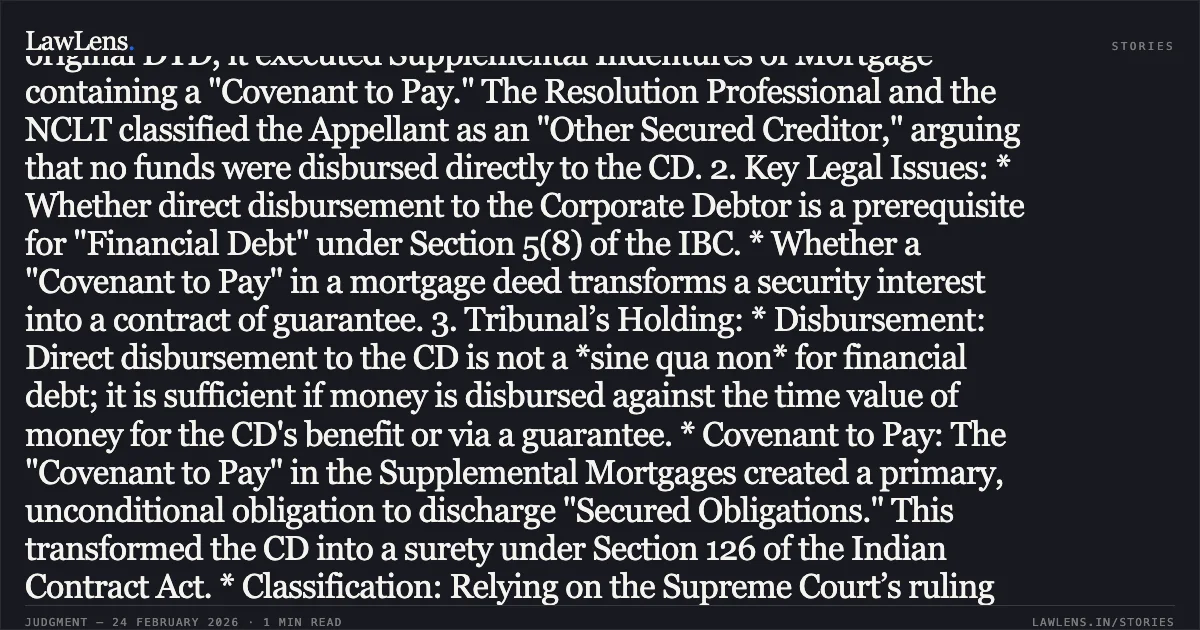
![Income Tax Department cannot set off tax refunds against past dues during liquidation without filing a claim.. Principal Commissioner of Income-Tax-3, Ahmedabad v. Kiran Shah, Liquidator of Shri Jalaram Rice Industries Pvt. Ltd. [Company Appeal (AT) (Insolvency) No. 1705 of 2025]. NCLAT. LawLens](/stories/thumbnails/income-tax-department-cannot-set-off-tax-refunds-against-past-dues-during-liquidation-with-d5376e041a594e8c9347abb1ea3930d8.webp)
![Income Tax Returns Are Exempt Personal Information Under RTI Unless Overriding Public Interest Is Established. Income Tax Officer and CPIO v. Smt. Gulsanober Bano Zafar Ali Ansari and Another [NC: 2026:KHC:11056]. Karnataka High Court. LawLens](/stories/thumbnails/income-tax-returns-are-exempt-personal-information-under-rti-unless-overriding-public-inte-c5abb34e39194d6e8aa6fdbb5a98842c.webp)
![Systemic malpractice and procedural irregularities in examinations justify cancellation of selection process despite absence of direct evidence.. Anand Sagar Bisi & Others v. State of Chhattisgarh & Others [WA No. 135 of 2026]. Chhattisgarh High Court. LawLens](/stories/thumbnails/systemic-malpractice-and-procedural-irregularities-in-examinations-justify-cancellation-of-beedae0f4fe74b4686e682f3f875c9da.webp)
![Bail denied in multi-crore economic offence involving organized conspiracy, manipulation of public procurement, and potential witness tampering.. Basant Kumar Kaushik v. State of Chhattisgarh [MCRC No. 1839 of 2026 (2026:CGHC:9326)]. Chhattisgarh High Court. LawLens](/stories/thumbnails/bail-denied-in-multi-crore-economic-offence-involving-organized-conspiracy-manipulation-of-9f19141e9a68439f929f31d2f28c0019.webp)
![Sole testimony of a credible sexual assault victim is sufficient for conviction without independent corroboration.. State of Chhattisgarh v. Philomina Kerketta & Ors. [2026:CGHC:9424-DB (ACQA No. 227 of 2018)]. Chhattisgarh High Court. LawLens](/stories/thumbnails/sole-testimony-of-a-credible-sexual-assault-victim-is-sufficient-for-conviction-without-in-82b8e0ada2564e4cb31e75c5ab3edded.webp)
![Commutation of Death Penalty to Fixed-Term Life Imprisonment Excluding Remission for Twenty Years.. Gourab Mondal @ Shanu & Anr. v. State of West Bengal [2026 INSC 184]. Supreme Court. LawLens](/stories/thumbnails/commutation-of-death-penalty-to-fixed-term-life-imprisonment-excluding-remission-for-twent-203e66d6d4304d958985c5f47d9f568d.webp)
![Patent Revocation Petitions Survive Expiry of Patent Term and Simultaneous Defensive Pleas of Invalidity. Boehringer Ingelheim Pharma GMBH and Co KG v. The Controller of Patents & Anr. [LPA 129/2025]. Delhi High Court. LawLens](/stories/thumbnails/patent-revocation-petitions-survive-expiry-of-patent-term-and-simultaneous-defensive-pleas-254714f7127f4dab8798f42a70e40c35.webp)
![### Decree Obtained Against a Dead Person is a Nullity and Unenforceable for Property Mutation Purposes. Nagar Nigam Ghaziabad and Another v. Indra Mohan Sachdev [FIRST APPEAL No. – 702 of 2025 (Neutral Citation: 2026:AHC:40819)]. Allahabad High Court. LawLens](/stories/thumbnails/decree-obtained-against-a-dead-person-is-a-nullity-and-unenforceable-for-property-mutation-1cf3ff04bd074b65b48e1a1fcefbcdf3.webp)
![Pending civil litigation and property rivalry negate prima facie case for bar on anticipatory bail under SC/ST Act.. Aboobacker N.K. v. State of Kerala & Others [2026:KER:16176 (Crl.A No. 174 of 2026)]. Kerala High Court. LawLens](/stories/thumbnails/pending-civil-litigation-and-property-rivalry-negate-prima-facie-case-for-bar-on-anticipat-e082a0e641934c069bb0f023332a85d3.webp)
![Ultimate Beneficiary Status or Institutional Funding Does Not Establish Privity for Impleadment of Non-Signatories in Arbitration.. M/S Ramacivil India Construction Pvt Ltd v. Central Public Works Department (CPWD) & Anr. [ARB.P. 1787/2025 & connected matters]. Delhi High Court. LawLens](/stories/thumbnails/ultimate-beneficiary-status-or-institutional-funding-does-not-establish-privity-for-implea-e0147e00f6f74a29bf5edf55486e242f.webp)