LRTHE NATIONAL MONTHLY LEDGER

Indian Court Judgments in July 2026: LawLens Monthly Reporter

Explore 1168 LawLens reports on Indian court judgments published in July 2026, with case summaries, legal issues and key holdings.

← BACK TO LAWLENS REPORTER

PERMANENT MONTHLY EDITIONS

Browse by month

AUTOMATICALLY UPDATED

July 2026 Judgments

1168 ARTICLES · NEWEST FIRST
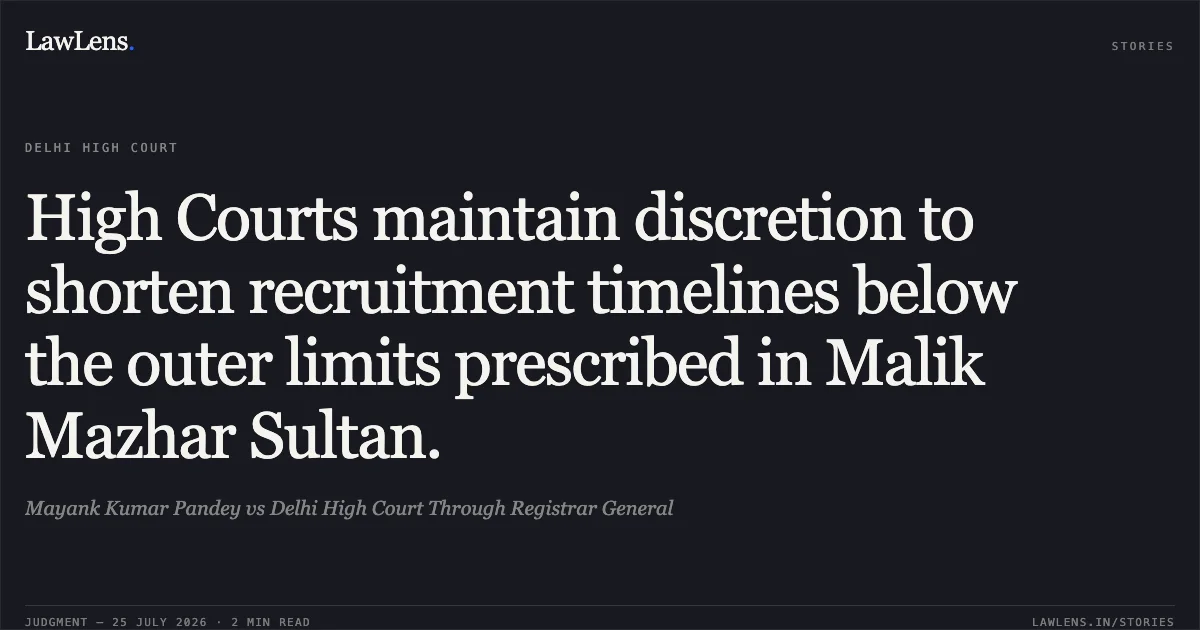
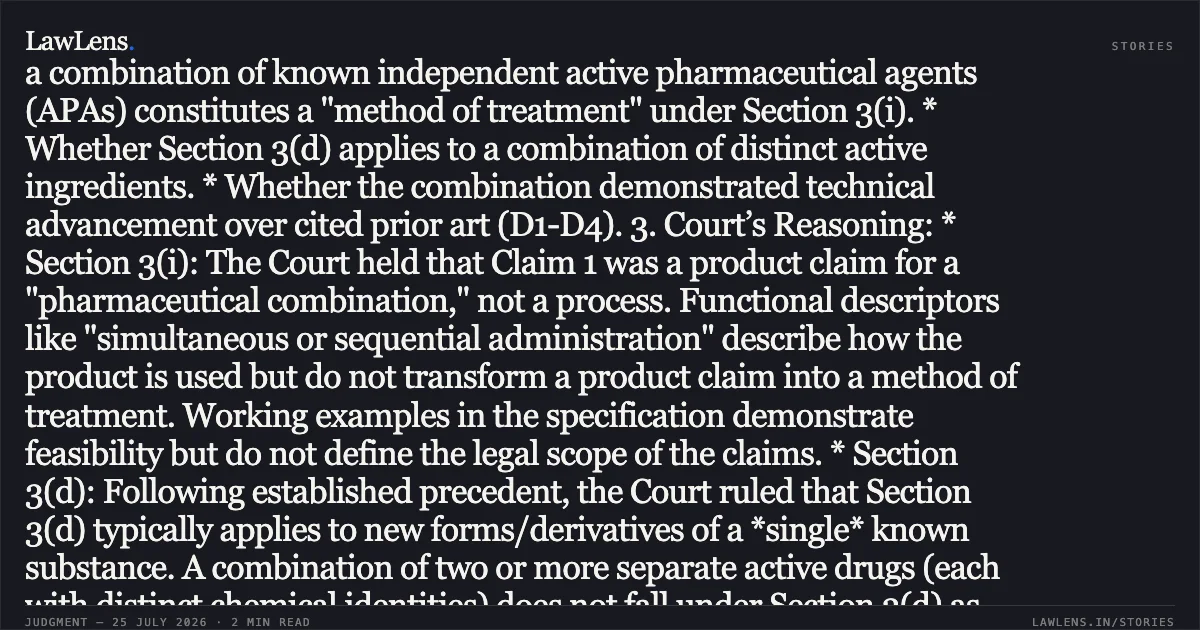
Synergistic pharmaceutical combinations of independent active agents are patentable products and not excluded methods of treatment. SUMMARY 1. Facts: The Appellant challenged an order by the Deputy Controller of Patents refusing an application for a pharmaceutical combination (Encorafenib, an EGFR inhibitor, and an optional PI3K-α inhibitor). The Patent Office rejected the application on grounds of lack of inventive step (Section 2(1)(ja)), non-patentability as a "new form of a known substance" (Section 3(d)), and for being a "method of treatment" (Section 3(i)). 2. Issues: * Whether a combination of known independent active pharmaceutical agents (APAs) constitutes a "method of treatment" under Section 3(i). * Whether Section 3(d) applies to a combination of distinct active ingredients. * Whether the combination demonstrated technical advancement over cited prior art (D1-D4). 3. Court’s Reasoning: * Section 3(i): The Court held that Claim 1 was a product claim for a "pharmaceutical combination," not a process. Functional descriptors like "simultaneous or sequential administration" describe how the product is used but do not transform a product claim into a method of treatment. Working examples in the specification demonstrate feasibility but do not define the legal scope of the claims. * Section 3(d): Following established precedent, the Court ruled that Section 3(d) typically applies to new forms/derivatives of a *single* known substance. A combination of two or more separate active drugs (each with distinct chemical identities) does not fall under Section 3(d) as they are not "derivatives" of each other. * Inventive Step: The Court found the Controller’s analysis flawed. The cited prior arts (D1-D4) did not disclose the specific combination of the claimed inhibitors. Furthermore, the clinical data provided in the specification demonstrated significant tumor regression (synergy) which was not anticipated by the prior art. 4. Conclusion: The High Court set aside the impugned order, holding the findings on Sections 3(i), 3(d), and 2(1)(ja) unsustainable. The matter was remanded to the Controller for fresh consideration on merits within six months.. Array Biopharma Inc vs Deputy Controller Of Patents And Designs. Delhi High Court. LawLens

Delhi High Court·

Synergistic pharmaceutical combinations of independent active agents are patentable products and not excluded methods of treatment. SUMMARY 1. Facts: The Appellant challenged an order by the Deputy Controller of Patents refusing an application for a pharmaceutical combination (Encorafenib, an EGFR inhibitor, and an optional PI3K-α inhibitor). The Patent Office rejected the application on grounds of lack of inventive step (Section 2(1)(ja)), non-patentability as a "new form of a known substance" (Section 3(d)), and for being a "method of treatment" (Section 3(i)). 2. Issues: * Whether a combination of known independent active pharmaceutical agents (APAs) constitutes a "method of treatment" under Section 3(i). * Whether Section 3(d) applies to a combination of distinct active ingredients. * Whether the combination demonstrated technical advancement over cited prior art (D1-D4). 3. Court’s Reasoning: * Section 3(i): The Court held that Claim 1 was a product claim for a "pharmaceutical combination," not a process. Functional descriptors like "simultaneous or sequential administration" describe how the product is used but do not transform a product claim into a method of treatment. Working examples in the specification demonstrate feasibility but do not define the legal scope of the claims. * Section 3(d): Following established precedent, the Court ruled that Section 3(d) typically applies to new forms/derivatives of a *single* known substance. A combination of two or more separate active drugs (each with distinct chemical identities) does not fall under Section 3(d) as they are not "derivatives" of each other. * Inventive Step: The Court found the Controller’s analysis flawed. The cited prior arts (D1-D4) did not disclose the specific combination of the claimed inhibitors. Furthermore, the clinical data provided in the specification demonstrated significant tumor regression (synergy) which was not anticipated by the prior art. 4. Conclusion: The High Court set aside the impugned order, holding the findings on Sections 3(i), 3(d), and 2(1)(ja) unsustainable. The matter was remanded to the Controller for fresh consideration on merits within six months.

The Appellant filed Indian Patent Application No. 450/DELNP/2015 for a pharmaceutical combination comprising a B-Raf inhibitor (Encorafenib), an EGFR inhibitor (Cetuximab/Erlotinib), and optionally a PI3K-alpha inhibi...

2 MIN READ

### Aggravated penetrative sexual assault of minor proven through sterling testimony of victim and corroborative medical evidence. Summary of the Judgment: 1. Facts: The appellant was convicted for rape and attempt to murder under Sections 376 and 307 of the IPC, and Sections 4 and 6 of the POCSO Act. On August 22, 2021, the minor victim was intercepted while outdoors by the appellant, who smothered her, rendered her unconscious, and subjected her to a brutal sexual assault resulting in severe internal injuries requiring multiple surgeries at IGIMS, Patna. 2. Prosecution Evidence: * Sterling Testimony: The victim’s (PW-2) testimony was found to be consistent with her Section 164 Cr.P.C. statement and fardbeyan. The Court classified her as a "sterling witness" whose evidence was of exceptionally high quality. * Medical Corroboration: Doctors (PW-3, PW-8, PW-11) confirmed a midline perineal tear and anal wall rupture, characterizing the injuries as "grievous" and life-threatening. * Age Determination: School records (PW-10) and radiological scans established the victim's age between 15-16 years, attracting POCSO provisions. 3. Defense Contentions: The appellant alleged false implication due to a monetary dispute and argued that the absence of semen on the victim's clothes weakened the case. 4. Court’s Holding: * Presumption of Guilt: Under Sections 29 and 30 of the POCSO Act, once foundational facts are proven, the court must presume the accused's guilt and *mens rea*. The appellant failed to rebut this on a preponderance of probabilities. * Absence of Semen: The Court held that the absence of spermatozoa does not negate a charge of sexual assault when ocular and medical evidence of penetration/injury is overwhelming. * Section 307 IPC: The brutality of the assault, causing life-threatening sepsis and requiring three surgeries, sufficiently proved the intent/knowledge required for a conviction of attempt to murder. * Delay in FIR: The two-day delay was deemed natural given the victim's critical medical state and social stigmas relative to family prestige. The High Court affirmed the life imprisonment sentence and the compensation of ₹7,00,000 awarded to the victim.. KAILASH SAW @ KAILASH SAHU @ KAILASH SAH vs The State of Bihar. Patna High Court. LawLens

Patna High Court·

### Aggravated penetrative sexual assault of minor proven through sterling testimony of victim and corroborative medical evidence. Summary of the Judgment: 1. Facts: The appellant was convicted for rape and attempt to murder under Sections 376 and 307 of the IPC, and Sections 4 and 6 of the POCSO Act. On August 22, 2021, the minor victim was intercepted while outdoors by the appellant, who smothered her, rendered her unconscious, and subjected her to a brutal sexual assault resulting in severe internal injuries requiring multiple surgeries at IGIMS, Patna. 2. Prosecution Evidence: * Sterling Testimony: The victim’s (PW-2) testimony was found to be consistent with her Section 164 Cr.P.C. statement and fardbeyan. The Court classified her as a "sterling witness" whose evidence was of exceptionally high quality. * Medical Corroboration: Doctors (PW-3, PW-8, PW-11) confirmed a midline perineal tear and anal wall rupture, characterizing the injuries as "grievous" and life-threatening. * Age Determination: School records (PW-10) and radiological scans established the victim's age between 15-16 years, attracting POCSO provisions. 3. Defense Contentions: The appellant alleged false implication due to a monetary dispute and argued that the absence of semen on the victim's clothes weakened the case. 4. Court’s Holding: * Presumption of Guilt: Under Sections 29 and 30 of the POCSO Act, once foundational facts are proven, the court must presume the accused's guilt and *mens rea*. The appellant failed to rebut this on a preponderance of probabilities. * Absence of Semen: The Court held that the absence of spermatozoa does not negate a charge of sexual assault when ocular and medical evidence of penetration/injury is overwhelming. * Section 307 IPC: The brutality of the assault, causing life-threatening sepsis and requiring three surgeries, sufficiently proved the intent/knowledge required for a conviction of attempt to murder. * Delay in FIR: The two-day delay was deemed natural given the victim's critical medical state and social stigmas relative to family prestige. The High Court affirmed the life imprisonment sentence and the compensation of ₹7,00,000 awarded to the victim.

The Appellant was convicted by the Trial Court for raping and attempting to murder a minor girl (PW-2) on 22.08.2021.

3 MIN READ

Interim orders under Section 36(3) are not appealable under Section 37 of the Arbitration Act. ### Case Summary Background The appellant, a Government undertaking, challenged an arbitral award under Section 34 of the Arbitration and Conciliation Act. The Commercial Court granted a stay on the award's enforcement but conditioned it upon the deposit of the entire awarded amount. The appellant appealed this condition, arguing it was arbitrary and ignored the merits of their challenge. Key Legal Issue The central question was whether an appeal lies against an interim order passed under Section 36(3) of the Arbitration Act (concerning the stay of an award) by invoking Section 13 of the Commercial Courts Act, 2015. Court's Analysis and Ruling The High Court dismissed the appeal as non-maintainable, reasoning that: * Exclusionary Nature of Section 37: Section 37 of the Arbitration Act is an exhaustive code that lists specific appealable orders. Since Section 36(3) is not mentioned, appeals against such orders are barred. * Restrictive Scope of Commercial Courts Act: Section 13 of the Commercial Courts Act does not create new appellate rights; it merely provides the forum for appeals already authorized under Section 37. The court emphasized that the Arbitration Act is a self-contained code that overrides general appellate provisions. * Policy Against Interlocutory Litigation: Permitting appeals against conditional stays would defeat the legislative intent of speedy enforcement and minimal judicial interference in arbitration. The Court concluded that while the appellant remains free to seek supervisory relief under Article 227 of the Constitution, no statutory appeal exists for this specific interlocutory order. Would you like a summary of the next segment or another judgment?. RAJSTHAN STATE WAREHOUSING CORPORATION vs ORIGO COMMODITIES INDIA PRIVATE LIMITED. Rajasthan High Court. LawLens

Rajasthan High Court·

Interim orders under Section 36(3) are not appealable under Section 37 of the Arbitration Act. ### Case Summary Background The appellant, a Government undertaking, challenged an arbitral award under Section 34 of the Arbitration and Conciliation Act. The Commercial Court granted a stay on the award's enforcement but conditioned it upon the deposit of the entire awarded amount. The appellant appealed this condition, arguing it was arbitrary and ignored the merits of their challenge. Key Legal Issue The central question was whether an appeal lies against an interim order passed under Section 36(3) of the Arbitration Act (concerning the stay of an award) by invoking Section 13 of the Commercial Courts Act, 2015. Court's Analysis and Ruling The High Court dismissed the appeal as non-maintainable, reasoning that: * Exclusionary Nature of Section 37: Section 37 of the Arbitration Act is an exhaustive code that lists specific appealable orders. Since Section 36(3) is not mentioned, appeals against such orders are barred. * Restrictive Scope of Commercial Courts Act: Section 13 of the Commercial Courts Act does not create new appellate rights; it merely provides the forum for appeals already authorized under Section 37. The court emphasized that the Arbitration Act is a self-contained code that overrides general appellate provisions. * Policy Against Interlocutory Litigation: Permitting appeals against conditional stays would defeat the legislative intent of speedy enforcement and minimal judicial interference in arbitration. The Court concluded that while the appellant remains free to seek supervisory relief under Article 227 of the Constitution, no statutory appeal exists for this specific interlocutory order. Would you like a summary of the next segment or another judgment?

The Appellant and Respondent entered into a PPP Contract Agreement on 25.06.2020 for warehouse management

2 MIN READ

### Mandatory Hearing of All Legal Heirs is Essential for Valid Partition Under Section 178A of MPLRC Summary: The High Court of Madhya Pradesh set aside an order of the Additional Commissioner, Sagar, emphasizing that under Section 178A of the M.P. Land Revenue Code, 1959, the Tahsildar must hear all legal heirs before ordering a partition during a Bhumiswami's lifetime. The Court held that the exclusion of the daughters from the partition proceedings conducted by the Tahsildar rendered the process and the subsequent order void. Citing the precedent in *Bhogiram vs. Gannibai*, the Court reaffirmed that "legal heirs" includes all eligible successors, and failure to implead them or issue notices violates mandatory statutory provisions and the principles of natural justice. The matter was remanded to the Tahsildar to conduct fresh proceedings after impleading all legal heirs, including the daughters.. Smt. Amrita Singh vs Smt. Anita Singh Chouhan. Madhya Pradesh High Court. LawLens

Madhya Pradesh High Court·

### Mandatory Hearing of All Legal Heirs is Essential for Valid Partition Under Section 178A of MPLRC Summary: The High Court of Madhya Pradesh set aside an order of the Additional Commissioner, Sagar, emphasizing that under Section 178A of the M.P. Land Revenue Code, 1959, the Tahsildar must hear all legal heirs before ordering a partition during a Bhumiswami's lifetime. The Court held that the exclusion of the daughters from the partition proceedings conducted by the Tahsildar rendered the process and the subsequent order void. Citing the precedent in *Bhogiram vs. Gannibai*, the Court reaffirmed that "legal heirs" includes all eligible successors, and failure to implead them or issue notices violates mandatory statutory provisions and the principles of natural justice. The matter was remanded to the Tahsildar to conduct fresh proceedings after impleading all legal heirs, including the daughters.

The petitioners (daughters of late Bahadur Singh) challenged an order passed by the Additional Commissioner, Sagar, which set aside a previous order of the Sub-Divisional Officer (SDO).

2 MIN READ

### Delay Condoned and Writ Appeal Restored Subject to Voluntary Community Service Reporting Summary of the Judgment: The High Court of Madhya Pradesh condoned a 52-day delay and restored a Writ Appeal (W.A. No. 3425/2025) that had been dismissed for procedural defaults. Applying settled law, the Court ruled that litigants should not suffer for the lapses of their counsel. Notably, the Court introduced a "Social Audit" concept, directing the Officer-In-Charge and counsel to visit a school for the speech and hearing impaired as a form of community service. The restoration of the appeal is contingent upon the submission of a report detailing their visit and observations regarding the institution's welfare standards.. The State Of Madhya Pradesh vs Ram Prasad Chikwa. Madhya Pradesh High Court. LawLens

Madhya Pradesh High Court·

### Delay Condoned and Writ Appeal Restored Subject to Voluntary Community Service Reporting Summary of the Judgment: The High Court of Madhya Pradesh condoned a 52-day delay and restored a Writ Appeal (W.A. No. 3425/2025) that had been dismissed for procedural defaults. Applying settled law, the Court ruled that litigants should not suffer for the lapses of their counsel. Notably, the Court introduced a "Social Audit" concept, directing the Officer-In-Charge and counsel to visit a school for the speech and hearing impaired as a form of community service. The restoration of the appeal is contingent upon the submission of a report detailing their visit and observations regarding the institution's welfare standards.

The State of Madhya Pradesh filed a Writ Appeal (W.A. No.3425/2025) which was dismissed on February 27, 2026, for non-compliance with a common conditional order regarding the curing of defaults.

2 MIN READ

### ADOPTION OF A FEMALE CHILD IS NOT LEGALLY RECOGNIZED UNDER ANCIENT HINDU LAW PRIOR TO 1956. SYNOPSIS * Core Question: Whether the adoption of a female child (specifically an *Angaliyat* child) was legally valid and conferred inheritance rights under Shastric Hindu Law prior to the enactment of the Hindu Adoptions and Maintenance Act, 1956. * Factum of Adoption: The Plaintiff claimed she was adopted in 1949 by her mother’s second husband, Bhovanbhai, under a pre-condition of marriage. She asserted status as a Class-I heir to inherit his agricultural lands. * Legal Standing of Female Adoption: The High Court observed that according to ancient Hindu texts (Manu, Vasishta, and Saunaka), adoption was strictly restricted to male children for the religious purposes of performing *pinda-dan* and providing spiritual benefit. * Status of *Angaliyat*: The Court found that while the Plaintiff was absorbed into the stepfather’s household as an *Angaliyat* (foster child), this social arrangement did not transform her into a legally adopted daughter with rights of succession under ancient Hindu law. * Preservation of Biological Ties: The Plaintiff admitted to inheriting property from her biological father. Under Hindu law, a valid adoption requires the total severance of ties with the biological family and renunciation of inheritance therein, which was absent here. * Outcome: The High Court upheld the Trial Court’s dismissal of the suit, ruling that in the absence of a valid legal adoption, the Plaintiff could not claim ownership of the deceased’s properties through inheritance.. HIRUBEN PPARBATBHAI SATASIYA vs BHAGWANJIBHAI POPATBHAI RANPARIA. Gujarat High Court. LawLens

Gujarat High Court·

### ADOPTION OF A FEMALE CHILD IS NOT LEGALLY RECOGNIZED UNDER ANCIENT HINDU LAW PRIOR TO 1956. SYNOPSIS * Core Question: Whether the adoption of a female child (specifically an *Angaliyat* child) was legally valid and conferred inheritance rights under Shastric Hindu Law prior to the enactment of the Hindu Adoptions and Maintenance Act, 1956. * Factum of Adoption: The Plaintiff claimed she was adopted in 1949 by her mother’s second husband, Bhovanbhai, under a pre-condition of marriage. She asserted status as a Class-I heir to inherit his agricultural lands. * Legal Standing of Female Adoption: The High Court observed that according to ancient Hindu texts (Manu, Vasishta, and Saunaka), adoption was strictly restricted to male children for the religious purposes of performing *pinda-dan* and providing spiritual benefit. * Status of *Angaliyat*: The Court found that while the Plaintiff was absorbed into the stepfather’s household as an *Angaliyat* (foster child), this social arrangement did not transform her into a legally adopted daughter with rights of succession under ancient Hindu law. * Preservation of Biological Ties: The Plaintiff admitted to inheriting property from her biological father. Under Hindu law, a valid adoption requires the total severance of ties with the biological family and renunciation of inheritance therein, which was absent here. * Outcome: The High Court upheld the Trial Court’s dismissal of the suit, ruling that in the absence of a valid legal adoption, the Plaintiff could not claim ownership of the deceased’s properties through inheritance.

The Appellant (Plaintiff) filed a suit for declaration and possession of immovable properties belonging to the deceased, Bhovanbhai.

2 MIN READ

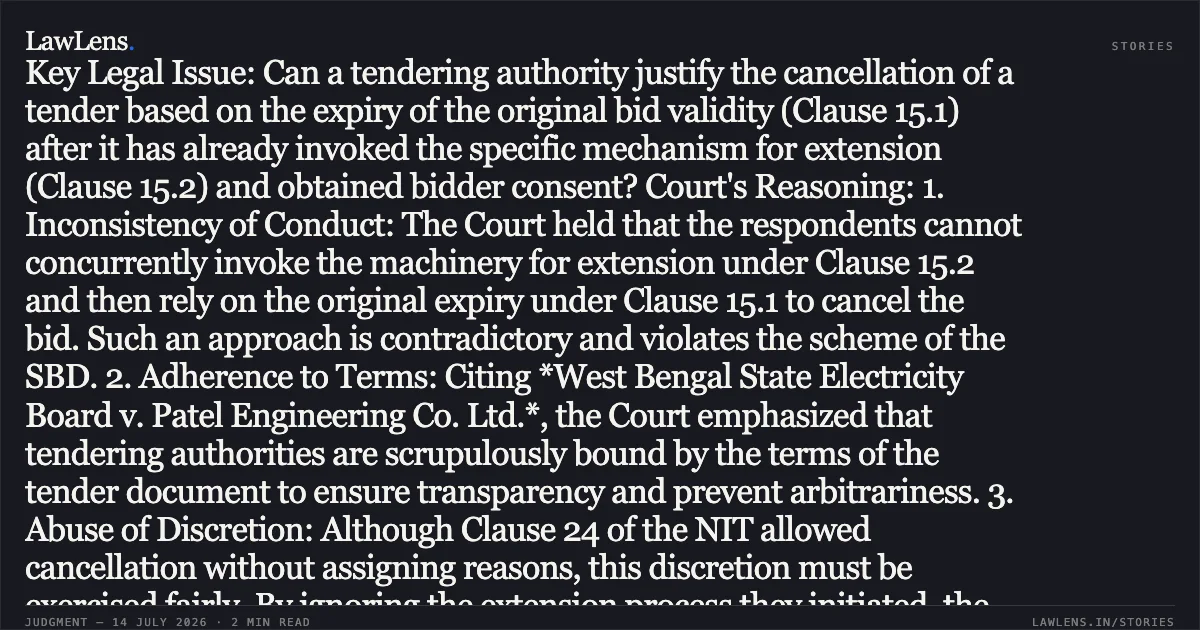
### Tendering Authority Cannot Cancel Bid Based on Expiry After Expressly Invoking Extension Procedures Brief Facts: The petitioner was the lowest (L-1) bidder in a tender for water supply schemes. During the process, the respondents repeatedly invoked Clause 15.2 of the Standard Bidding Document (SBD) to seek and obtain the petitioner’s consent for bid validity extensions. However, while a further extension proposal was pending, the respondents cancelled the tender via email without assigning reasons, later justifying it in court by citing the expiry of the original bid validity under Clause 15.1. Key Legal Issue: Can a tendering authority justify the cancellation of a tender based on the expiry of the original bid validity (Clause 15.1) after it has already invoked the specific mechanism for extension (Clause 15.2) and obtained bidder consent? Court's Reasoning: 1. Inconsistency of Conduct: The Court held that the respondents cannot concurrently invoke the machinery for extension under Clause 15.2 and then rely on the original expiry under Clause 15.1 to cancel the bid. Such an approach is contradictory and violates the scheme of the SBD. 2. Adherence to Terms: Citing *West Bengal State Electricity Board v. Patel Engineering Co. Ltd.*, the Court emphasized that tendering authorities are scrupulously bound by the terms of the tender document to ensure transparency and prevent arbitrariness. 3. Abuse of Discretion: Although Clause 24 of the NIT allowed cancellation without assigning reasons, this discretion must be exercised fairly. By ignoring the extension process they initiated, the respondents acted irrationally and in violation of procedural propriety. 4. Judicial Review: Under the principles of *Tata Cellular v. Union of India*, the Court found the decision-making process flawed as it was inconsistent with the governing tender conditions. Conclusion: The Patna High Court quashed the cancellation of the original tender and the subsequent re-tender. The matter was remitted to the competent authority to take a fresh, reasoned decision regarding the original tender strictly in accordance with the SBD terms.. J and S Joint Venture (JV) vs The State of Bihar. Patna High Court. LawLens

Patna High Court·

### Tendering Authority Cannot Cancel Bid Based on Expiry After Expressly Invoking Extension Procedures Brief Facts: The petitioner was the lowest (L-1) bidder in a tender for water supply schemes. During the process, the respondents repeatedly invoked Clause 15.2 of the Standard Bidding Document (SBD) to seek and obtain the petitioner’s consent for bid validity extensions. However, while a further extension proposal was pending, the respondents cancelled the tender via email without assigning reasons, later justifying it in court by citing the expiry of the original bid validity under Clause 15.1. Key Legal Issue: Can a tendering authority justify the cancellation of a tender based on the expiry of the original bid validity (Clause 15.1) after it has already invoked the specific mechanism for extension (Clause 15.2) and obtained bidder consent? Court's Reasoning: 1. Inconsistency of Conduct: The Court held that the respondents cannot concurrently invoke the machinery for extension under Clause 15.2 and then rely on the original expiry under Clause 15.1 to cancel the bid. Such an approach is contradictory and violates the scheme of the SBD. 2. Adherence to Terms: Citing *West Bengal State Electricity Board v. Patel Engineering Co. Ltd.*, the Court emphasized that tendering authorities are scrupulously bound by the terms of the tender document to ensure transparency and prevent arbitrariness. 3. Abuse of Discretion: Although Clause 24 of the NIT allowed cancellation without assigning reasons, this discretion must be exercised fairly. By ignoring the extension process they initiated, the respondents acted irrationally and in violation of procedural propriety. 4. Judicial Review: Under the principles of *Tata Cellular v. Union of India*, the Court found the decision-making process flawed as it was inconsistent with the governing tender conditions. Conclusion: The Patna High Court quashed the cancellation of the original tender and the subsequent re-tender. The matter was remitted to the competent authority to take a fresh, reasoned decision regarding the original tender strictly in accordance with the SBD terms.

The Petitioner, a Joint Venture, participated in a tender process (NIT No. 15/2024-25) for piped water supply schemes under the "Har Ghar Nal Jal" project

2 MIN READ

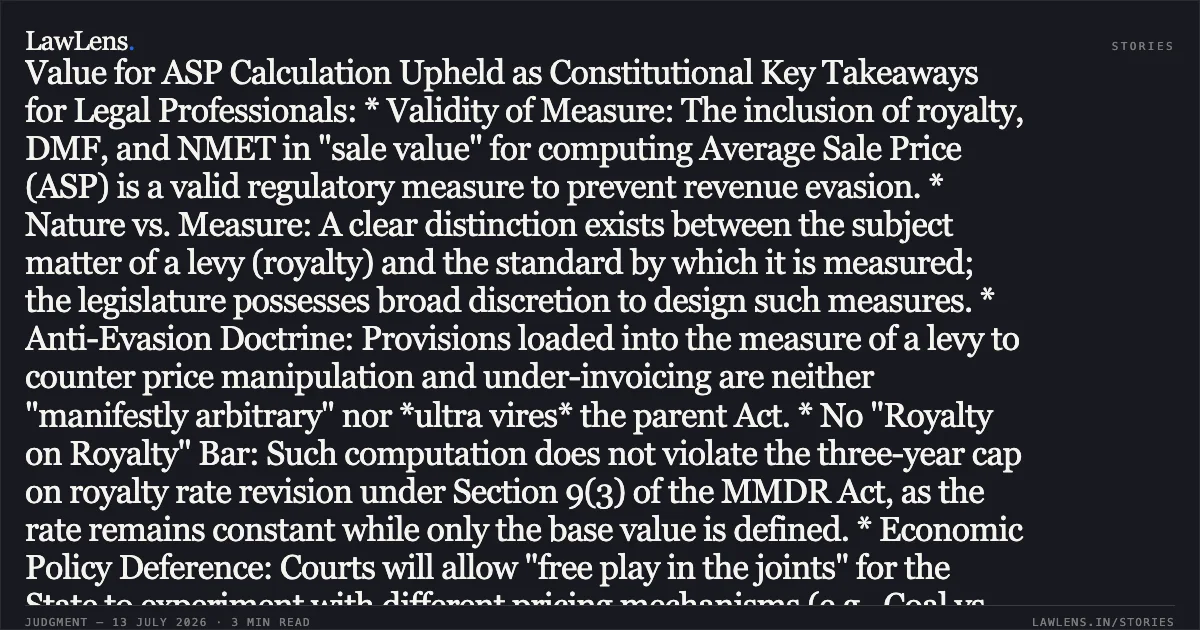
### Exclusion of Royalty and Statutory Contributions from Sale Value for ASP Calculation Upheld as Constitutional Key Takeaways for Legal Professionals: * Validity of Measure: The inclusion of royalty, DMF, and NMET in "sale value" for computing Average Sale Price (ASP) is a valid regulatory measure to prevent revenue evasion. * Nature vs. Measure: A clear distinction exists between the subject matter of a levy (royalty) and the standard by which it is measured; the legislature possesses broad discretion to design such measures. * Anti-Evasion Doctrine: Provisions loaded into the measure of a levy to counter price manipulation and under-invoicing are neither "manifestly arbitrary" nor *ultra vires* the parent Act. * No "Royalty on Royalty" Bar: Such computation does not violate the three-year cap on royalty rate revision under Section 9(3) of the MMDR Act, as the rate remains constant while only the base value is defined. * Economic Policy Deference: Courts will allow "free play in the joints" for the State to experiment with different pricing mechanisms (e.g., Coal vs. Iron Ore) based on market realities.. Kirloskar Ferrous Industries Limited vs Union Of India. Supreme Court. LawLens

Supreme Court·

### Exclusion of Royalty and Statutory Contributions from Sale Value for ASP Calculation Upheld as Constitutional Key Takeaways for Legal Professionals: * Validity of Measure: The inclusion of royalty, DMF, and NMET in "sale value" for computing Average Sale Price (ASP) is a valid regulatory measure to prevent revenue evasion. * Nature vs. Measure: A clear distinction exists between the subject matter of a levy (royalty) and the standard by which it is measured; the legislature possesses broad discretion to design such measures. * Anti-Evasion Doctrine: Provisions loaded into the measure of a levy to counter price manipulation and under-invoicing are neither "manifestly arbitrary" nor *ultra vires* the parent Act. * No "Royalty on Royalty" Bar: Such computation does not violate the three-year cap on royalty rate revision under Section 9(3) of the MMDR Act, as the rate remains constant while only the base value is defined. * Economic Policy Deference: Courts will allow "free play in the joints" for the State to experiment with different pricing mechanisms (e.g., Coal vs. Iron Ore) based on market realities.

The petitioners, holders of mining leases for iron ore acquired through auctions post-2015, challenged the constitutional validity of the Explanations to Rule 38 of the Minerals (Other than Atomic and Hydro Carbons En...

3 MIN READ

False Allegations of Grave Criminality Combined with Prolonged Matrimonial Discord Constitute Mental Cruelty and Justify Dissolution of Marriage Summary: 1. Facts: The parties married in 2010. After years of infertility treatment and increasing matrimonial discord, the appellant-wife left the matrimonial home. The respondent-husband filed for divorce on grounds of cruelty and desertion. Subsequently, the wife initiated criminal proceedings alleging dowry demand and attempt to murder (Sections 498A and 307 IPC), which resulted in the husband’s acquittal. The Family Court granted the divorce, which the wife challenged in this appeal. During the appeal's pendency, the husband remarried. 2. Issues: * Whether the institution of criminal cases and general conduct of the wife amounted to mental cruelty under Section 13(1)(ia) of the Hindu Marriage Act. * Whether the respondent established statutory desertion. * The legal impact of the husband’s remarriage and subsequent criminal acquittal on the appeal. * Determination of permanent alimony under Section 25. 3. Decision: The Patna High Court dismissed the appeal and affirmed the decree of divorce. The Court held that while ordinary quarrels do not suffice, the cumulative effect of prolonged separation, failure of reconciliation, and the institution of serious yet unsubstantiated criminal charges (culminating in acquittal) constituted mental cruelty. The Court clarified that remarriage during an appeal’s pendency does not render the appeal infructuous but is done at the party's own peril. 4. Key Takeaways: * Cruelty and Acquittal: While acquittal in a criminal case does not automatically prove cruelty, the pursuit of serious, unproven allegations of attempted murder and dowry harassment causes grave mental agony, justifying a decree of divorce. * Section 15 and Remarriage: Remarriage before the expiry of the limitation period for an appeal is a violation of Section 15 of the Hindu Marriage Act, though it does not prevent the Appellate Court from deciding the case on its merits. * Permanent Alimony: Applying the principles in *Rajnesh v. Neha*, the Court calculated alimony based on the husband's gross salary (ignoring voluntary deductions like loan EMIs), awarding the wife approximately one-third of the husband’s estimated future earnings (₹34.76 Lakhs).. Sunita Panday vs Binod Kumar Panday. Patna High Court. LawLens

Patna High Court·

False Allegations of Grave Criminality Combined with Prolonged Matrimonial Discord Constitute Mental Cruelty and Justify Dissolution of Marriage Summary: 1. Facts: The parties married in 2010. After years of infertility treatment and increasing matrimonial discord, the appellant-wife left the matrimonial home. The respondent-husband filed for divorce on grounds of cruelty and desertion. Subsequently, the wife initiated criminal proceedings alleging dowry demand and attempt to murder (Sections 498A and 307 IPC), which resulted in the husband’s acquittal. The Family Court granted the divorce, which the wife challenged in this appeal. During the appeal's pendency, the husband remarried. 2. Issues: * Whether the institution of criminal cases and general conduct of the wife amounted to mental cruelty under Section 13(1)(ia) of the Hindu Marriage Act. * Whether the respondent established statutory desertion. * The legal impact of the husband’s remarriage and subsequent criminal acquittal on the appeal. * Determination of permanent alimony under Section 25. 3. Decision: The Patna High Court dismissed the appeal and affirmed the decree of divorce. The Court held that while ordinary quarrels do not suffice, the cumulative effect of prolonged separation, failure of reconciliation, and the institution of serious yet unsubstantiated criminal charges (culminating in acquittal) constituted mental cruelty. The Court clarified that remarriage during an appeal’s pendency does not render the appeal infructuous but is done at the party's own peril. 4. Key Takeaways: * Cruelty and Acquittal: While acquittal in a criminal case does not automatically prove cruelty, the pursuit of serious, unproven allegations of attempted murder and dowry harassment causes grave mental agony, justifying a decree of divorce. * Section 15 and Remarriage: Remarriage before the expiry of the limitation period for an appeal is a violation of Section 15 of the Hindu Marriage Act, though it does not prevent the Appellate Court from deciding the case on its merits. * Permanent Alimony: Applying the principles in *Rajnesh v. Neha*, the Court calculated alimony based on the husband's gross salary (ignoring voluntary deductions like loan EMIs), awarding the wife approximately one-third of the husband’s estimated future earnings (₹34.76 Lakhs).

The parties married on 12.06.2010 but faced matrimonial discord primarily due to their inability to conceive despite prolonged fertility treatments

3 MIN READ

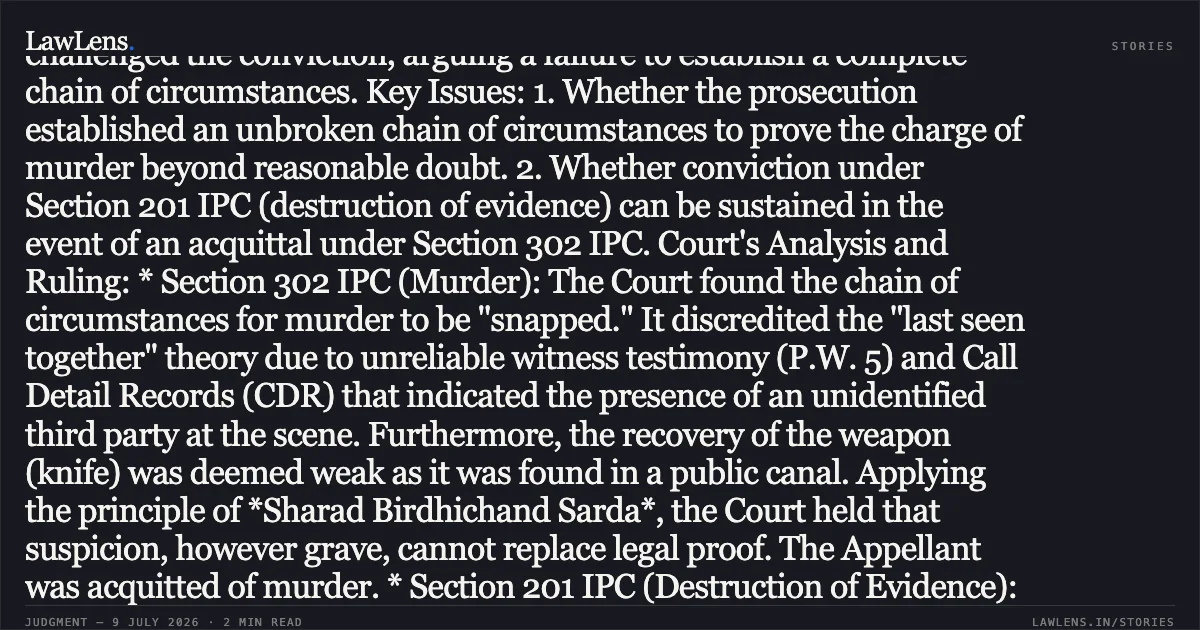
Headnote: Acquittal for Murder Sustained While Upholding Conviction Under Section 201 IPC for Destruction of Evidence. Case Summary: * Court: High Court of Judicature at Bombay * Bench: Justice Manish Pitale & Justice Shreeram V. Shirsat * Decided on: July 9, 2026 Facts: The Appellant, Prabhakar Kutty Shetty, was convicted by the Sessions Court for the murder (Section 302 IPC) and disappearance of evidence (Section 201 IPC) of Kanti Karunakar Shetty. The prosecution’s case rested on circumstantial evidence: the discovery of a female torso in a lake, identified via DNA; witnesses claiming they saw the Appellant disposing of the bag; and various recoveries (head, knife, and bloodstained articles). The Appellant challenged the conviction, arguing a failure to establish a complete chain of circumstances. Key Issues: 1. Whether the prosecution established an unbroken chain of circumstances to prove the charge of murder beyond reasonable doubt. 2. Whether conviction under Section 201 IPC (destruction of evidence) can be sustained in the event of an acquittal under Section 302 IPC. Court's Analysis and Ruling: * Section 302 IPC (Murder): The Court found the chain of circumstances for murder to be "snapped." It discredited the "last seen together" theory due to unreliable witness testimony (P.W. 5) and Call Detail Records (CDR) that indicated the presence of an unidentified third party at the scene. Furthermore, the recovery of the weapon (knife) was deemed weak as it was found in a public canal. Applying the principle of *Sharad Birdhichand Sarda*, the Court held that suspicion, however grave, cannot replace legal proof. The Appellant was acquitted of murder. * Section 201 IPC (Destruction of Evidence): The Court upheld the conviction for this charge. Reliable testimonies from P.W. 2 and P.W. 6 (who saw the Appellant dumping the torso) and the recovery of the head at the Appellant's instance established he had knowledge of the crime and intentionally caused evidence to disappear. Following the precedent in *V.L. Tresa v. State of Kerala*, the Court ruled that acquittal for the main offence (murder) does not automatically result in acquittal for screening the offender. Conclusion: The appeal was partly allowed. The conviction under Section 302 IPC was set aside, while the conviction and two-year sentence under Section 201 IPC were confirmed. As the Appellant had already served approximately 13 years, the Court ordered his immediate release.. Prabhakar Kutty Shetty vs The State Of Maharashtra. Bombay High Court. LawLens

Bombay High Court·

Headnote: Acquittal for Murder Sustained While Upholding Conviction Under Section 201 IPC for Destruction of Evidence. Case Summary: * Court: High Court of Judicature at Bombay * Bench: Justice Manish Pitale & Justice Shreeram V. Shirsat * Decided on: July 9, 2026 Facts: The Appellant, Prabhakar Kutty Shetty, was convicted by the Sessions Court for the murder (Section 302 IPC) and disappearance of evidence (Section 201 IPC) of Kanti Karunakar Shetty. The prosecution’s case rested on circumstantial evidence: the discovery of a female torso in a lake, identified via DNA; witnesses claiming they saw the Appellant disposing of the bag; and various recoveries (head, knife, and bloodstained articles). The Appellant challenged the conviction, arguing a failure to establish a complete chain of circumstances. Key Issues: 1. Whether the prosecution established an unbroken chain of circumstances to prove the charge of murder beyond reasonable doubt. 2. Whether conviction under Section 201 IPC (destruction of evidence) can be sustained in the event of an acquittal under Section 302 IPC. Court's Analysis and Ruling: * Section 302 IPC (Murder): The Court found the chain of circumstances for murder to be "snapped." It discredited the "last seen together" theory due to unreliable witness testimony (P.W. 5) and Call Detail Records (CDR) that indicated the presence of an unidentified third party at the scene. Furthermore, the recovery of the weapon (knife) was deemed weak as it was found in a public canal. Applying the principle of *Sharad Birdhichand Sarda*, the Court held that suspicion, however grave, cannot replace legal proof. The Appellant was acquitted of murder. * Section 201 IPC (Destruction of Evidence): The Court upheld the conviction for this charge. Reliable testimonies from P.W. 2 and P.W. 6 (who saw the Appellant dumping the torso) and the recovery of the head at the Appellant's instance established he had knowledge of the crime and intentionally caused evidence to disappear. Following the precedent in *V.L. Tresa v. State of Kerala*, the Court ruled that acquittal for the main offence (murder) does not automatically result in acquittal for screening the offender. Conclusion: The appeal was partly allowed. The conviction under Section 302 IPC was set aside, while the conviction and two-year sentence under Section 201 IPC were confirmed. As the Appellant had already served approximately 13 years, the Court ordered his immediate release.

On October 29, 2013, a woman’s torso was found in a plastic bag at Charai Lake, Chembur.

2 MIN READ

Specific Deuterated Compounds Disclosed in Genus Patents Lack Novelty and Fail the Section 3(d) Therapeutic Efficacy Test Case Summary: 1. Facts: The Appellant challenged the Controller’s rejection of their patent application for deuterated heterocycle-fused gamma-carbolines. The application was refused on grounds of lack of novelty (Section 2(1)(j)), lack of inventive step (Section 2(1)(ja)), and non-patentability (Section 3(d)). The Appellant argued that the compounds were a specific species with improved metabolic stability compared to the known non-deuterated compound "Q". 2. Issue: * Whether specific deuterated compounds are novel if the base formula is covered by prior art Markush/genus disclosures. * Whether improved pharmacokinetic properties (bioavailability/metabolic stability) through deuteration satisfy the "enhanced therapeutic efficacy" requirement under Section 3(d). 3. Ruling: * Novelty: The Court upheld the lack of novelty. Following *AstraZeneca AB* and *Novartis AG*, the Court ruled that if a product is covered in the claims of a prior genus patent (D1 and D7), specific disclosure or "multiple selections" are immaterial. The claimed formulas were inherently disclosed in the prior art. * Section 3(d): The Court held the compounds were "new forms" of a known substance. Relying on *Novartis AG*, it clarified that "efficacy" means therapeutic efficacy, not just physicochemical or pharmacokinetic improvements. * Data Insufficiency: The Appellant's data—showing a 72% increase in parent drug exposure and reduced metabolite formation—demonstrated improved bioavailability/stability but failed to prove a superior therapeutic effect (i.e., treating the disease better). * Conclusion: Increased bioavailability must be specifically linked to enhanced therapeutic efficacy via research data to overcome Section 3(d). The appeal was dismissed.. Intra-Cellular Therapies, Inc. vs The Controller Of Patents. Delhi High Court. LawLens

Delhi High Court·

Specific Deuterated Compounds Disclosed in Genus Patents Lack Novelty and Fail the Section 3(d) Therapeutic Efficacy Test Case Summary: 1. Facts: The Appellant challenged the Controller’s rejection of their patent application for deuterated heterocycle-fused gamma-carbolines. The application was refused on grounds of lack of novelty (Section 2(1)(j)), lack of inventive step (Section 2(1)(ja)), and non-patentability (Section 3(d)). The Appellant argued that the compounds were a specific species with improved metabolic stability compared to the known non-deuterated compound "Q". 2. Issue: * Whether specific deuterated compounds are novel if the base formula is covered by prior art Markush/genus disclosures. * Whether improved pharmacokinetic properties (bioavailability/metabolic stability) through deuteration satisfy the "enhanced therapeutic efficacy" requirement under Section 3(d). 3. Ruling: * Novelty: The Court upheld the lack of novelty. Following *AstraZeneca AB* and *Novartis AG*, the Court ruled that if a product is covered in the claims of a prior genus patent (D1 and D7), specific disclosure or "multiple selections" are immaterial. The claimed formulas were inherently disclosed in the prior art. * Section 3(d): The Court held the compounds were "new forms" of a known substance. Relying on *Novartis AG*, it clarified that "efficacy" means therapeutic efficacy, not just physicochemical or pharmacokinetic improvements. * Data Insufficiency: The Appellant's data—showing a 72% increase in parent drug exposure and reduced metabolite formation—demonstrated improved bioavailability/stability but failed to prove a superior therapeutic effect (i.e., treating the disease better). * Conclusion: Increased bioavailability must be specifically linked to enhanced therapeutic efficacy via research data to overcome Section 3(d). The appeal was dismissed.

The Appellant filed Indian Patent Application No. 201817033732 seeking a patent for deuterated heterocycle-fused gamma-carbolines used for treating 5-HT 2A receptor-related disorders

2 MIN READ

### Section 21 Notice Within Limitation Validates Section 11 Application After Setting Aside of Arbitral Award Summary of the Ruling: The High Court held that when an award is set aside under Section 34, fresh arbitral proceedings commence upon the issuance of a notice under Section 21. If such notice is issued within the three-year limitation period (accounting for Section 43(4) exclusions and COVID-19 extensions), a subsequent Section 11 application is maintainable. Furthermore, non-signatories cannot be referred to arbitration solely on grounds of equity or "separate orbits" of operation if they lack derivative interest or implied consent.. Hemant D Shah Huf vs Chittaranjan D Shah Huf. Bombay High Court. LawLens

Bombay High Court·

### Section 21 Notice Within Limitation Validates Section 11 Application After Setting Aside of Arbitral Award Summary of the Ruling: The High Court held that when an award is set aside under Section 34, fresh arbitral proceedings commence upon the issuance of a notice under Section 21. If such notice is issued within the three-year limitation period (accounting for Section 43(4) exclusions and COVID-19 extensions), a subsequent Section 11 application is maintainable. Furthermore, non-signatories cannot be referred to arbitration solely on grounds of equity or "separate orbits" of operation if they lack derivative interest or implied consent.

The Applicants sought the appointment of a sole arbitrator under Section 11 of the Arbitration and Conciliation Act, 1996, invoking a clause in a Partnership Deed dated December 9, 1985

3 MIN READ

FIR Contents Not Provable Through Scribe if Informant’s Death Lacks Nexus to Crime Summary In this criminal appeal, the Court examined a conviction for murder originating from a 1990 incident involving a dispute over farm machinery. A primary legal issue was the evidentiary status of the First Information Report (FIR), as the informant had died of natural causes before the trial. The Court ruled that since the informant’s death had no nexus to the alleged crime, the FIR could not be treated as substantive evidence under Section 32 of the Evidence Act. While the scribe could verify the act of recording the statement, he could not prove the truth of its contents. Furthermore, the Court analyzed the prosecution's version of the shooting, which involved an improbable physical struggle where the accused allegedly used a victim as a human shield while firing multiple weapons. The Court found significant medical and logical inconsistencies, noting that the injuries sustained by the parties did not align with the described positions of the assailants and victims. Due to estasblished doubts regarding the manner of occurrence and the unreliable nature of the eye-witness accounts, the Court granted the appellant the benefit of doubt and set aside the conviction. Would you like the summary of the next segment of this judgment or another legal proceeding?. Khalid And Another vs State Of U.P.. Allahabad High Court. LawLens

Allahabad High Court·

FIR Contents Not Provable Through Scribe if Informant’s Death Lacks Nexus to Crime Summary In this criminal appeal, the Court examined a conviction for murder originating from a 1990 incident involving a dispute over farm machinery. A primary legal issue was the evidentiary status of the First Information Report (FIR), as the informant had died of natural causes before the trial. The Court ruled that since the informant’s death had no nexus to the alleged crime, the FIR could not be treated as substantive evidence under Section 32 of the Evidence Act. While the scribe could verify the act of recording the statement, he could not prove the truth of its contents. Furthermore, the Court analyzed the prosecution's version of the shooting, which involved an improbable physical struggle where the accused allegedly used a victim as a human shield while firing multiple weapons. The Court found significant medical and logical inconsistencies, noting that the injuries sustained by the parties did not align with the described positions of the assailants and victims. Due to estasblished doubts regarding the manner of occurrence and the unreliable nature of the eye-witness accounts, the Court granted the appellant the benefit of doubt and set aside the conviction. Would you like the summary of the next segment of this judgment or another legal proceeding?

The appellants, Khalid and Nannu (now deceased), were convicted under Section 302/34 IPC for the murder of Sarafraz @ Pappu.

2 MIN READ

Legal Headline: Juvenile bail is mandatory under Section 12 unless specific evidence confirms association with known criminals. Summary: This judgment addresses a criminal appeal filed by a juvenile appellant against a trial court's refusal to grant regular bail in a robbery and arms possession case. The High Court analyzed the statutory framework of the Juvenile Justice (Care and Protection) Act, 2015, specifically Section 12, emphasizing that bail is the rule for juveniles regardless of the nature or gravity of the alleged offense. The Court observed that the trial court’s denial of bail—based primarily on criminal antecedents and alleged anti-social associations—lacked a concrete factual basis in the Social Investigation Report (SIR). The Court noted that the SIR actually depicted the appellant as a religious student with good conduct who had been acquitted in the majority of his previous cases. Furthermore, the Court highlighted the principle of "best interest of the child," noting the appellant’s extreme family hardship, including physically challenged parents who are dependent on him. Finding that institutionalization should be a last resort and that the appellant’s rehabilitation is best achieved through family reunification, the Court set aside the lower court’s order. The Court granted bail and notably directed the District Magistrate to assist the impoverished family with social welfare schemes to facilitate the appellant’s reintegration into society. Would you like a summary of a different segment or another judgment?. Bittu Kumar @ Bittu Yadav vs The State of Bihar. Patna High Court. LawLens

Patna High Court·

Legal Headline: Juvenile bail is mandatory under Section 12 unless specific evidence confirms association with known criminals. Summary: This judgment addresses a criminal appeal filed by a juvenile appellant against a trial court's refusal to grant regular bail in a robbery and arms possession case. The High Court analyzed the statutory framework of the Juvenile Justice (Care and Protection) Act, 2015, specifically Section 12, emphasizing that bail is the rule for juveniles regardless of the nature or gravity of the alleged offense. The Court observed that the trial court’s denial of bail—based primarily on criminal antecedents and alleged anti-social associations—lacked a concrete factual basis in the Social Investigation Report (SIR). The Court noted that the SIR actually depicted the appellant as a religious student with good conduct who had been acquitted in the majority of his previous cases. Furthermore, the Court highlighted the principle of "best interest of the child," noting the appellant’s extreme family hardship, including physically challenged parents who are dependent on him. Finding that institutionalization should be a last resort and that the appellant’s rehabilitation is best achieved through family reunification, the Court set aside the lower court’s order. The Court granted bail and notably directed the District Magistrate to assist the impoverished family with social welfare schemes to facilitate the appellant’s reintegration into society. Would you like a summary of a different segment or another judgment?

The appellant, a juvenile, was implicated in Madhepura P.S. Case No. 879 of 2021 for robbery and arms possession (Sections 392, 397 IPC and 27 Arms Act).

2 MIN READ

### Employer Liable for Delay Damages if Arbitrary Provisional Extensions Render Contractual Time-Extension Provisions Inoperative Summary: The High Court of Delhi upheld an arbitral award holding the Employer liable for delays caused by site encumbrances and technical errors. The Court affirmed that granting "provisional" extensions while ignoring the Engineer’s assessment of Employer-led delays disentitled the Employer from levying liquidated damages and justified the award of overhead costs and bank guarantee charges to the Contractor.. Public Works Department Nh Wing And Anr vs Ms Gvr Infra Projects Ltd. Delhi High Court. LawLens

Delhi High Court·

### Employer Liable for Delay Damages if Arbitrary Provisional Extensions Render Contractual Time-Extension Provisions Inoperative Summary: The High Court of Delhi upheld an arbitral award holding the Employer liable for delays caused by site encumbrances and technical errors. The Court affirmed that granting "provisional" extensions while ignoring the Engineer’s assessment of Employer-led delays disentitled the Employer from levying liquidated damages and justified the award of overhead costs and bank guarantee charges to the Contractor.

The Petitioner (MORT&H/PWD) invited bids for the rehabilitation and upgradation of a section of NH-217 in Odisha. An agreement was signed on March 21, 2014, with a 730-day completion period.

3 MIN READ

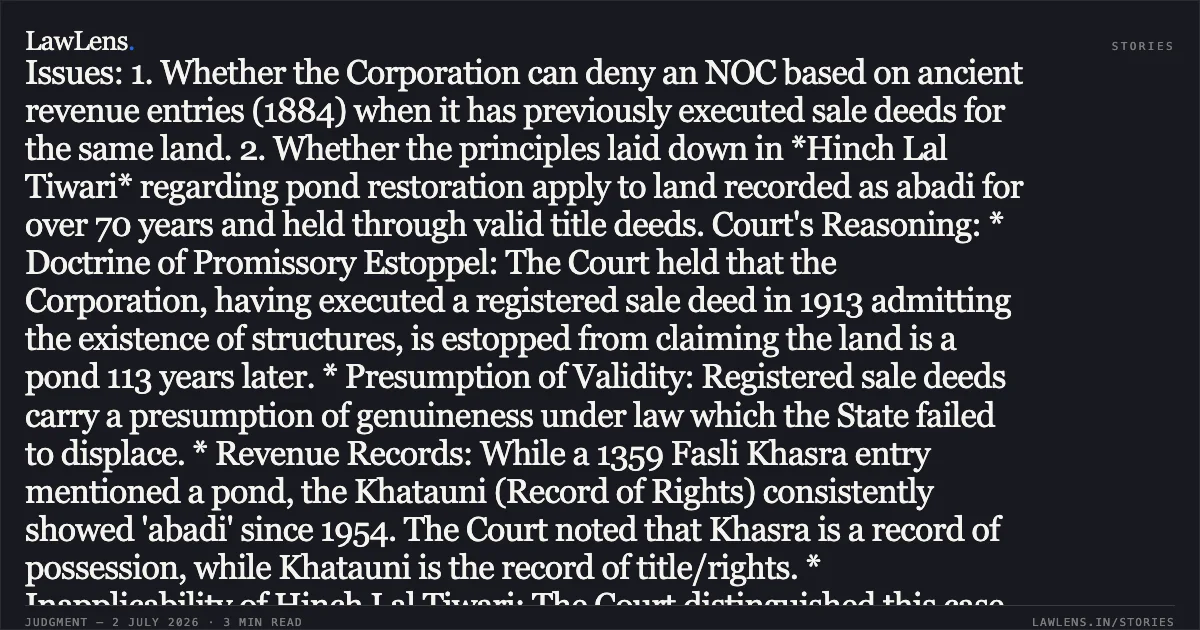
Title: Municipal Corporation estopped from claiming land as pond after executing valid sale deeds and long-term abadi recording. Summary of the Case: Facts: The petitioner sought a No-Objection Certificate (NOC) from Nagar Nigam, Varanasi, to construct a hotel based on an MoU with the State of UP. The Corporation refused, citing revenue records from 1884 (1291 Fasli) which recorded the land as a pond. However, the record showed that the Municipal Board had itself sold the land via registered deeds in 1913. Since 1954, the land was recorded as ‘abadi’ (settled) in revenue records, was situated in a densely populated area, and had housed a cinema hall for 50 years. Issues: 1. Whether the Corporation can deny an NOC based on ancient revenue entries (1884) when it has previously executed sale deeds for the same land. 2. Whether the principles laid down in *Hinch Lal Tiwari* regarding pond restoration apply to land recorded as abadi for over 70 years and held through valid title deeds. Court's Reasoning: * Doctrine of Promissory Estoppel: The Court held that the Corporation, having executed a registered sale deed in 1913 admitting the existence of structures, is estopped from claiming the land is a pond 113 years later. * Presumption of Validity: Registered sale deeds carry a presumption of genuineness under law which the State failed to displace. * Revenue Records: While a 1359 Fasli Khasra entry mentioned a pond, the Khatauni (Record of Rights) consistently showed 'abadi' since 1954. The Court noted that Khasra is a record of possession, while Khatauni is the record of title/rights. * Inapplicability of Hinch Lal Tiwari: The Court distinguished this case from precedents regarding pond restoration, noting that the petitioner held valid title, the land was in a densely populated urban area, and the State’s attempt to "restore" it was an afterthought triggered only by the litigation. * Discriminatory Action: The State singled out the petitioner’s plot while ignoring the rest of the original Arazi (0.668 hectares), violating Article 14. Conclusion: The High Court quashed the refusal letter and issued a writ of mandamus directing the Corporation to reconsider the NOC application, affirming that ancient revenue entries cannot override valid registered titles and long-standing urban land usage.. M/S Knots India Carpets Private Limited vs State Of Uttar Pradesh And 2 Others. Allahabad High Court. LawLens

Allahabad High Court·

Title: Municipal Corporation estopped from claiming land as pond after executing valid sale deeds and long-term abadi recording. Summary of the Case: Facts: The petitioner sought a No-Objection Certificate (NOC) from Nagar Nigam, Varanasi, to construct a hotel based on an MoU with the State of UP. The Corporation refused, citing revenue records from 1884 (1291 Fasli) which recorded the land as a pond. However, the record showed that the Municipal Board had itself sold the land via registered deeds in 1913. Since 1954, the land was recorded as ‘abadi’ (settled) in revenue records, was situated in a densely populated area, and had housed a cinema hall for 50 years. Issues: 1. Whether the Corporation can deny an NOC based on ancient revenue entries (1884) when it has previously executed sale deeds for the same land. 2. Whether the principles laid down in *Hinch Lal Tiwari* regarding pond restoration apply to land recorded as abadi for over 70 years and held through valid title deeds. Court's Reasoning: * Doctrine of Promissory Estoppel: The Court held that the Corporation, having executed a registered sale deed in 1913 admitting the existence of structures, is estopped from claiming the land is a pond 113 years later. * Presumption of Validity: Registered sale deeds carry a presumption of genuineness under law which the State failed to displace. * Revenue Records: While a 1359 Fasli Khasra entry mentioned a pond, the Khatauni (Record of Rights) consistently showed 'abadi' since 1954. The Court noted that Khasra is a record of possession, while Khatauni is the record of title/rights. * Inapplicability of Hinch Lal Tiwari: The Court distinguished this case from precedents regarding pond restoration, noting that the petitioner held valid title, the land was in a densely populated urban area, and the State’s attempt to "restore" it was an afterthought triggered only by the litigation. * Discriminatory Action: The State singled out the petitioner’s plot while ignoring the rest of the original Arazi (0.668 hectares), violating Article 14. Conclusion: The High Court quashed the refusal letter and issued a writ of mandamus directing the Corporation to reconsider the NOC application, affirming that ancient revenue entries cannot override valid registered titles and long-standing urban land usage.

The Petitioner, owner of plot No. D-48/140-141 (Arazi Nos. 2404 and 2402) in Varanasi, applied for a No-Objection Certificate (NOC) from Nagar Nigam, Varanasi, to construct a hotel following a Memorandum of Understand...

3 MIN READ

Non-consideration of a prior binding Supreme Court precedent constitutes an error apparent on the record warranting review. The High Court allowed a review petition after realizing its previous judgment—which had declared a trial court decree a nullity for jurisdictional errors—conflicted with a Supreme Court ruling delivered just days earlier. The Court held that even if a binding precedent is not brought to its attention by counsel, its omission provides sufficient grounds for review under Order 47 Rule 1 of the Code of Civil Procedure. Consequently, the Court recalled its previous order and transferred the appeal to the Commercial Division for a hearing on the merits. Would you like a summary of the facts and arguments presented by the parties in this matter?. B.N.NOBBIS AND CO AND ORS vs KAMALES MALLIK AND ORS. Calcutta High Court. LawLens

Calcutta High Court·

Non-consideration of a prior binding Supreme Court precedent constitutes an error apparent on the record warranting review. The High Court allowed a review petition after realizing its previous judgment—which had declared a trial court decree a nullity for jurisdictional errors—conflicted with a Supreme Court ruling delivered just days earlier. The Court held that even if a binding precedent is not brought to its attention by counsel, its omission provides sufficient grounds for review under Order 47 Rule 1 of the Code of Civil Procedure. Consequently, the Court recalled its previous order and transferred the appeal to the Commercial Division for a hearing on the merits. Would you like a summary of the facts and arguments presented by the parties in this matter?

The respondent filed a suit for recovery of possession and mesne profit regarding property used for commercial purposes

3 MIN READ

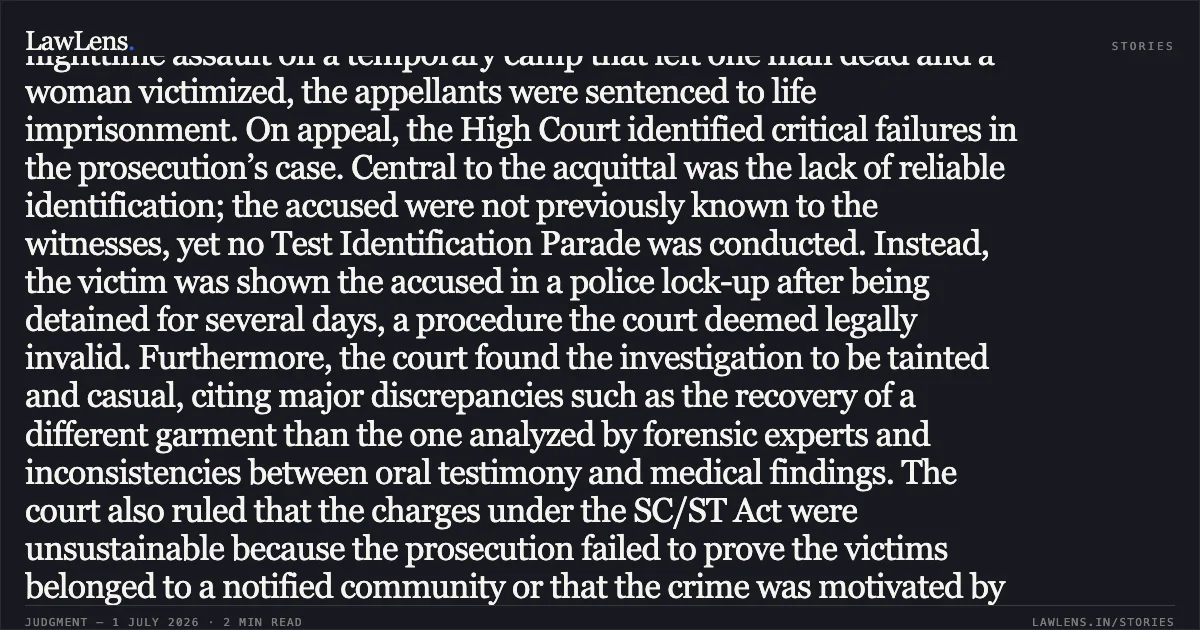
Conviction set aside due to flawed identification, tainted investigation, and failure to prove SC/ST status. The judgment revolves around the 2011 conviction of seven individuals for crimes including gang rape and murder against members of a nomadic community. Following a nighttime assault on a temporary camp that left one man dead and a woman victimized, the appellants were sentenced to life imprisonment. On appeal, the High Court identified critical failures in the prosecution’s case. Central to the acquittal was the lack of reliable identification; the accused were not previously known to the witnesses, yet no Test Identification Parade was conducted. Instead, the victim was shown the accused in a police lock-up after being detained for several days, a procedure the court deemed legally invalid. Furthermore, the court found the investigation to be tainted and casual, citing major discrepancies such as the recovery of a different garment than the one analyzed by forensic experts and inconsistencies between oral testimony and medical findings. The court also ruled that the charges under the SC/ST Act were unsustainable because the prosecution failed to prove the victims belonged to a notified community or that the crime was motivated by caste. Ultimately, the court concluded that the prosecution failed to establish guilt beyond a reasonable doubt, granting the appellants the benefit of the doubt and ordering their release. Would you like a summary of the evidence regarding the firearm injuries or the specific findings on the SC/ST Act application?. Anwar Ali And Ors. vs State Of U.P.. Allahabad High Court. LawLens

Allahabad High Court·

Conviction set aside due to flawed identification, tainted investigation, and failure to prove SC/ST status. The judgment revolves around the 2011 conviction of seven individuals for crimes including gang rape and murder against members of a nomadic community. Following a nighttime assault on a temporary camp that left one man dead and a woman victimized, the appellants were sentenced to life imprisonment. On appeal, the High Court identified critical failures in the prosecution’s case. Central to the acquittal was the lack of reliable identification; the accused were not previously known to the witnesses, yet no Test Identification Parade was conducted. Instead, the victim was shown the accused in a police lock-up after being detained for several days, a procedure the court deemed legally invalid. Furthermore, the court found the investigation to be tainted and casual, citing major discrepancies such as the recovery of a different garment than the one analyzed by forensic experts and inconsistencies between oral testimony and medical findings. The court also ruled that the charges under the SC/ST Act were unsustainable because the prosecution failed to prove the victims belonged to a notified community or that the crime was motivated by caste. Ultimately, the court concluded that the prosecution failed to establish guilt beyond a reasonable doubt, granting the appellants the benefit of the doubt and ordering their release. Would you like a summary of the evidence regarding the firearm injuries or the specific findings on the SC/ST Act application?

The Appellants were convicted by a trial court for offenses including gang rape and murder of members of a nomadic (Banjara) community

2 MIN READ