LRTHE NATIONAL MONTHLY LEDGER

Indian Court Judgments in June 2026: LawLens Monthly Reporter

Explore 566 LawLens reports on Indian court judgments published in June 2026, with case summaries, legal issues and key holdings.

← BACK TO LAWLENS REPORTER

PERMANENT MONTHLY EDITIONS

Browse by month

AUTOMATICALLY UPDATED

June 2026 Judgments

566 ARTICLES · NEWEST FIRST
Registered Sale Deeds Prevail Over Minor Witness Discrepancies and Prospective Statutory Restrictions on Transfer In this judgment, the Supreme Court addressed a long-standing land dispute involving a registered sale deed from 1957. The primary legal issue was whether a transfer that allegedly exceeded statutory ceiling limits under the U.P. Zamindari Abolition and Land Reforms Act was void or merely voidable, and whether minor inconsistencies in the testimony of an attesting witness could invalidate a decades-old registered document. The Court clarified that under the statutory framework existing at the time of the transaction, transfers exceeding ceiling limits were not void *ab initio* but were voidable only through specific legal proceedings initiated by the State. Furthermore, the Court held that subsequent legislative amendments rendering such transfers void could not be applied retrospectively to divest accrued rights. On the evidentiary front, the Court emphasized the "formidable presumption" of validity attached to registered instruments. It ruled that consolidation authorities cannot lightly disregard a registered deed based on peripheral discrepancies in witness testimony, especially when the witness is deposed many decades after the execution. The Court reiterated that since attestation is not a mandatory requirement for a sale deed's validity, minor errors regarding a witness's details are insufficient to overcome the legal presumption of genuineness. Would you like a summary of the legal analysis regarding the retrospective application of statutes mentioned in the latter half of the judgment?. Sarafat Ali (Deceased) Through Lrs vs Deputy Director Of Consolidation Haridwar. Supreme Court. LawLens

Supreme Court·

Registered Sale Deeds Prevail Over Minor Witness Discrepancies and Prospective Statutory Restrictions on Transfer In this judgment, the Supreme Court addressed a long-standing land dispute involving a registered sale deed from 1957. The primary legal issue was whether a transfer that allegedly exceeded statutory ceiling limits under the U.P. Zamindari Abolition and Land Reforms Act was void or merely voidable, and whether minor inconsistencies in the testimony of an attesting witness could invalidate a decades-old registered document. The Court clarified that under the statutory framework existing at the time of the transaction, transfers exceeding ceiling limits were not void *ab initio* but were voidable only through specific legal proceedings initiated by the State. Furthermore, the Court held that subsequent legislative amendments rendering such transfers void could not be applied retrospectively to divest accrued rights. On the evidentiary front, the Court emphasized the "formidable presumption" of validity attached to registered instruments. It ruled that consolidation authorities cannot lightly disregard a registered deed based on peripheral discrepancies in witness testimony, especially when the witness is deposed many decades after the execution. The Court reiterated that since attestation is not a mandatory requirement for a sale deed's validity, minor errors regarding a witness's details are insufficient to overcome the legal presumption of genuineness. Would you like a summary of the legal analysis regarding the retrospective application of statutes mentioned in the latter half of the judgment?

The appellants' predecessors (then minors) purchased 15 bigha, 11 biswa of land via a registered sale deed dated 04.06.1957

3 MIN READ

### Non-Approval of Recommended Extensions Sets Time at Large and Renders Contract Termination for Delay Illegal Key Findings: * Termination Legality: Failure by the Employer to act on the Engineer’s recommendations for Extension of Time (EOT) for over 3.5 years set time at large, making termination for slow progress illegal. * Waiver of Claims: A contractor’s failure to contemporaneously protest the Engineer’s rejection of prolongation costs during EOT recommendations constitutes acquiescence, barring subsequent recovery. * Unpaid Work: Findings on work completion (76.41%) based on the Employer’s own progress documents are plausible and do not warrant judicial interference. * Evidence Standard: Arbitral awards for confiscated machinery and overheads without supporting evidence or proof of actual loss are patently illegal and perverse. * Loss of Profits: Consequent to illegal termination, the contractor is entitled to loss of profits on the balance work at the standard rate of 10%.. National Highways Authority Of India vs Progressive Constructions Limited. Delhi High Court. LawLens

Delhi High Court·

### Non-Approval of Recommended Extensions Sets Time at Large and Renders Contract Termination for Delay Illegal Key Findings: * Termination Legality: Failure by the Employer to act on the Engineer’s recommendations for Extension of Time (EOT) for over 3.5 years set time at large, making termination for slow progress illegal. * Waiver of Claims: A contractor’s failure to contemporaneously protest the Engineer’s rejection of prolongation costs during EOT recommendations constitutes acquiescence, barring subsequent recovery. * Unpaid Work: Findings on work completion (76.41%) based on the Employer’s own progress documents are plausible and do not warrant judicial interference. * Evidence Standard: Arbitral awards for confiscated machinery and overheads without supporting evidence or proof of actual loss are patently illegal and perverse. * Loss of Profits: Consequent to illegal termination, the contractor is entitled to loss of profits on the balance work at the standard rate of 10%.

The Appellant (NHAI) entered into a contract with the Respondent (Progressive Constructions) on 08.09.2005 for highway widening in Assam.

3 MIN READ

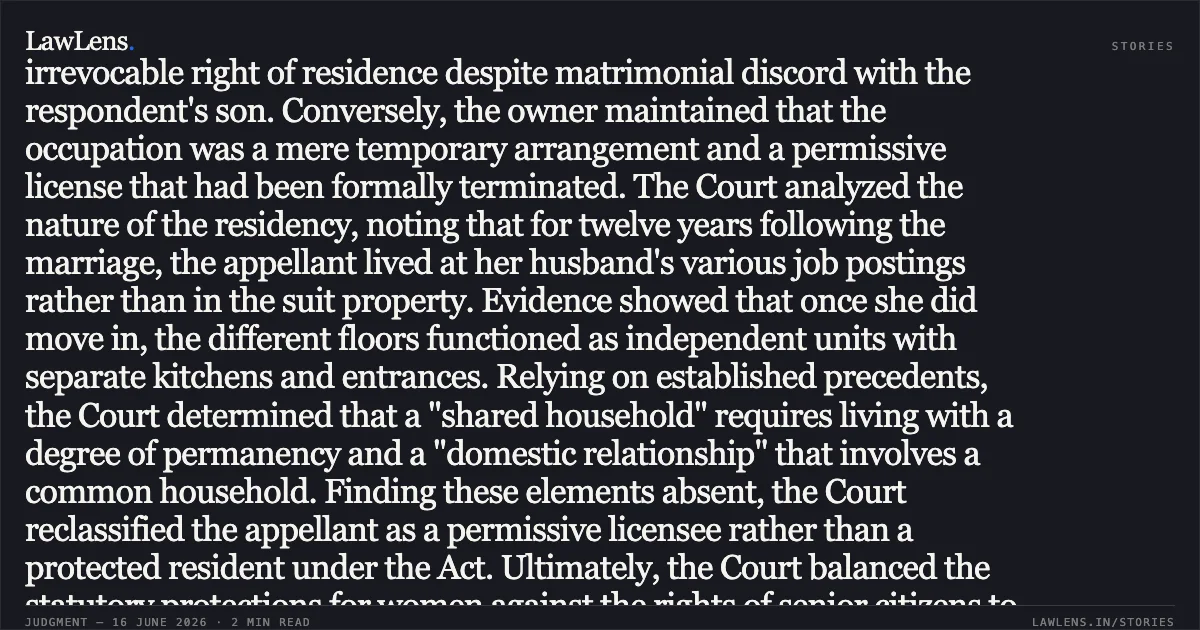
Daughter-in-law's permissive license in property not shared household lacks absolute, indefeasible right of residence. In this judgment, the Court examines an appeal regarding a daughter-in-law's right to occupy her mother-in-law’s property. The appellant argued that the premises constituted a shared household under the Protection of Women from Domestic Violence Act, granting her an irrevocable right of residence despite matrimonial discord with the respondent's son. Conversely, the owner maintained that the occupation was a mere temporary arrangement and a permissive license that had been formally terminated. The Court analyzed the nature of the residency, noting that for twelve years following the marriage, the appellant lived at her husband's various job postings rather than in the suit property. Evidence showed that once she did move in, the different floors functioned as independent units with separate kitchens and entrances. Relying on established precedents, the Court determined that a "shared household" requires living with a degree of permanency and a "domestic relationship" that involves a common household. Finding these elements absent, the Court reclassified the appellant as a permissive licensee rather than a protected resident under the Act. Ultimately, the Court balanced the statutory protections for women against the rights of senior citizens to enjoy their property in peace. It concluded that since the license was validly revoked, and the appellant received maintenance to cover alternative housing, the owner was entitled to recover possession. The Court upheld the eviction but denied the claim for back-rent due to a lack of evidence regarding market rates. Would you like a summary of the next segment or a different analysis of this ruling?. Smt. Upinder Kaur Malhotra vs Smt. Gurmeet Malhotra. Delhi High Court. LawLens

Delhi High Court·

Daughter-in-law's permissive license in property not shared household lacks absolute, indefeasible right of residence. In this judgment, the Court examines an appeal regarding a daughter-in-law's right to occupy her mother-in-law’s property. The appellant argued that the premises constituted a shared household under the Protection of Women from Domestic Violence Act, granting her an irrevocable right of residence despite matrimonial discord with the respondent's son. Conversely, the owner maintained that the occupation was a mere temporary arrangement and a permissive license that had been formally terminated. The Court analyzed the nature of the residency, noting that for twelve years following the marriage, the appellant lived at her husband's various job postings rather than in the suit property. Evidence showed that once she did move in, the different floors functioned as independent units with separate kitchens and entrances. Relying on established precedents, the Court determined that a "shared household" requires living with a degree of permanency and a "domestic relationship" that involves a common household. Finding these elements absent, the Court reclassified the appellant as a permissive licensee rather than a protected resident under the Act. Ultimately, the Court balanced the statutory protections for women against the rights of senior citizens to enjoy their property in peace. It concluded that since the license was validly revoked, and the appellant received maintenance to cover alternative housing, the owner was entitled to recover possession. The Court upheld the eviction but denied the claim for back-rent due to a lack of evidence regarding market rates. Would you like a summary of the next segment or a different analysis of this ruling?

The Appellant (daughter-in-law) challenged a trial court decree directing her to vacate the first floor of a property owned by the Respondent (mother-in-law).

2 MIN READ

### Judgment Procurement via Fraudulent Grant Orders for Public Water Bodies Is Non Est and Lacks Legal Sanctity Brief Summary: The Karnataka High Court set aside a Single Judge's order that had directed revenue entries based on a civil court decree. The Division Bench held that the underlying "Grant Order" was a fabricated document for land classified as a Government Lake (*Sarkari Kere*). Reaffirming that "fraud unravels everything," the Court ruled that judicial decrees obtained by deceiving the court are a nullity. Furthermore, it emphasized the State's constitutional obligation under Article 21 to protect community resources and natural bodies from illegal alienation.. STATE OF KARNATAKA vs SRI. L. N. GOVINDASWAMY. Karnataka High Court. LawLens

Karnataka High Court·

### Judgment Procurement via Fraudulent Grant Orders for Public Water Bodies Is Non Est and Lacks Legal Sanctity Brief Summary: The Karnataka High Court set aside a Single Judge's order that had directed revenue entries based on a civil court decree. The Division Bench held that the underlying "Grant Order" was a fabricated document for land classified as a Government Lake (*Sarkari Kere*). Reaffirming that "fraud unravels everything," the Court ruled that judicial decrees obtained by deceiving the court are a nullity. Furthermore, it emphasized the State's constitutional obligation under Article 21 to protect community resources and natural bodies from illegal alienation.

The Petitioner (Respondent No. 1) claimed title to 13 Acres 29 Guntas in Sy. Nos. 82, 52, and 61 of Dattagalli Village via a 1954 Grant Order

2 MIN READ

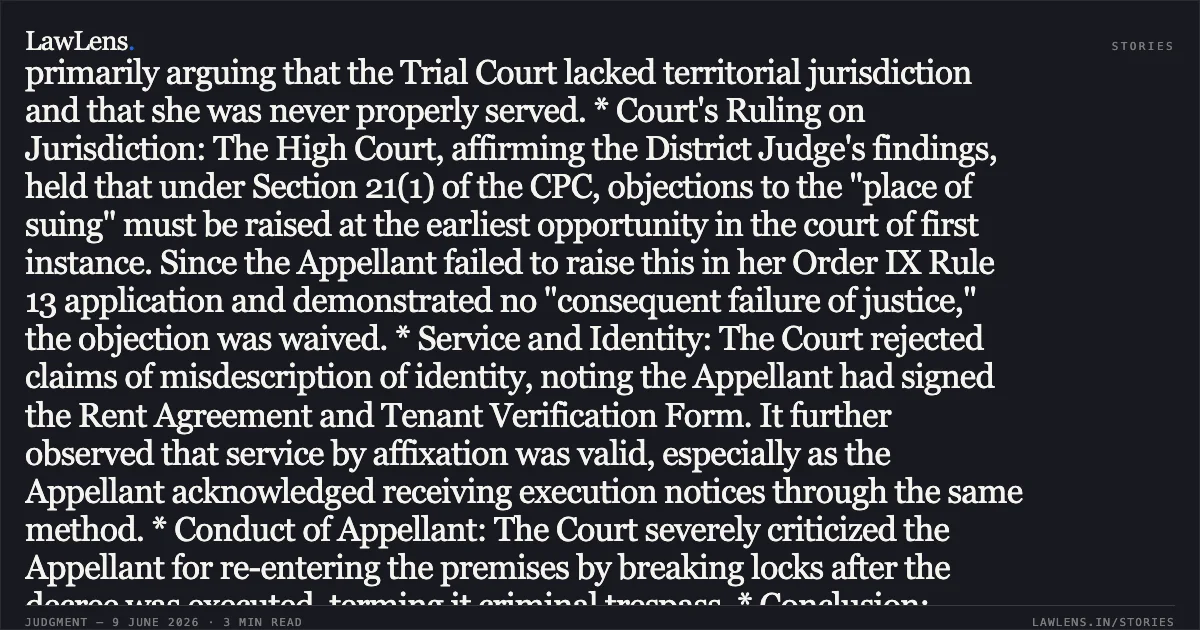
### Territorial Jurisdiction Objections Under Section 21 CPC Cannot Be Raised For The First Time At Appellate Stage Case Summary: * Core Issue: The Appellant challenged an ex-parte eviction decree, primarily arguing that the Trial Court lacked territorial jurisdiction and that she was never properly served. * Court's Ruling on Jurisdiction: The High Court, affirming the District Judge's findings, held that under Section 21(1) of the CPC, objections to the "place of suing" must be raised at the earliest opportunity in the court of first instance. Since the Appellant failed to raise this in her Order IX Rule 13 application and demonstrated no "consequent failure of justice," the objection was waived. * Service and Identity: The Court rejected claims of misdescription of identity, noting the Appellant had signed the Rent Agreement and Tenant Verification Form. It further observed that service by affixation was valid, especially as the Appellant acknowledged receiving execution notices through the same method. * Conduct of Appellant: The Court severely criticized the Appellant for re-entering the premises by breaking locks after the decree was executed, terming it criminal trespass. * Conclusion: Finding no substantial question of law under Section 100 CPC, the Court dismissed the Second Appeal, upholding the eviction and recovery of arrears.. Arti Sharma Alias Arti & Anr. vs Kanta Kame. Delhi High Court. LawLens

Delhi High Court·

### Territorial Jurisdiction Objections Under Section 21 CPC Cannot Be Raised For The First Time At Appellate Stage Case Summary: * Core Issue: The Appellant challenged an ex-parte eviction decree, primarily arguing that the Trial Court lacked territorial jurisdiction and that she was never properly served. * Court's Ruling on Jurisdiction: The High Court, affirming the District Judge's findings, held that under Section 21(1) of the CPC, objections to the "place of suing" must be raised at the earliest opportunity in the court of first instance. Since the Appellant failed to raise this in her Order IX Rule 13 application and demonstrated no "consequent failure of justice," the objection was waived. * Service and Identity: The Court rejected claims of misdescription of identity, noting the Appellant had signed the Rent Agreement and Tenant Verification Form. It further observed that service by affixation was valid, especially as the Appellant acknowledged receiving execution notices through the same method. * Conduct of Appellant: The Court severely criticized the Appellant for re-entering the premises by breaking locks after the decree was executed, terming it criminal trespass. * Conclusion: Finding no substantial question of law under Section 100 CPC, the Court dismissed the Second Appeal, upholding the eviction and recovery of arrears.

The Respondent (landlord) filed a suit for eviction and recovery of rent against the Appellant (tenant) regarding property 316-B, Sarita Vihar, New Delhi

3 MIN READ

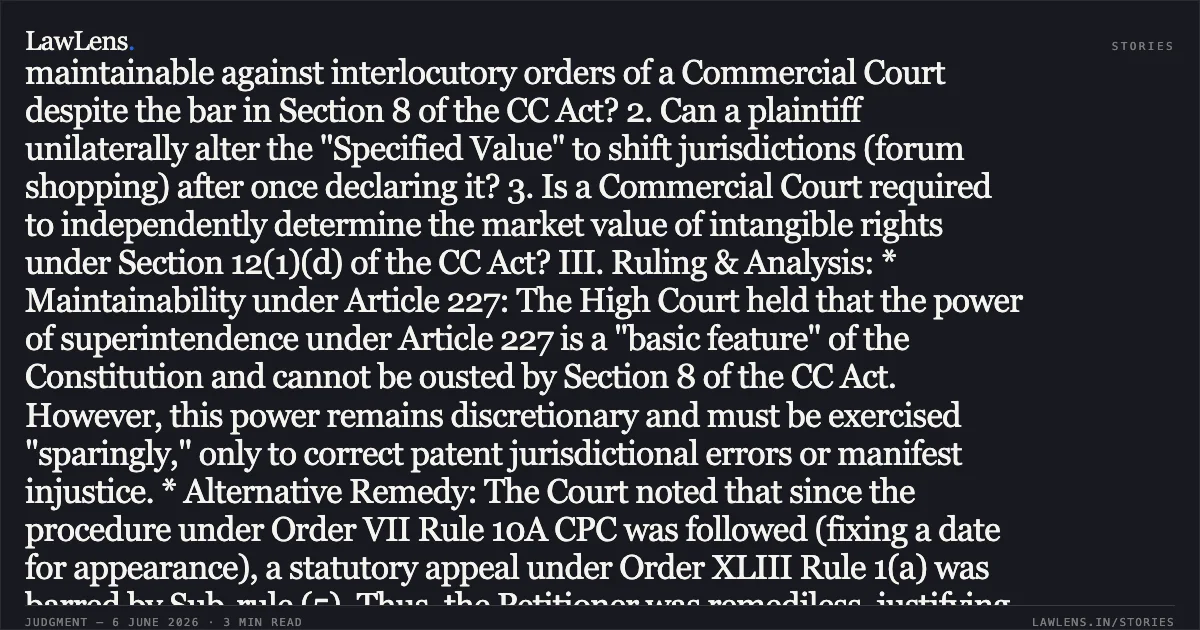
High Court Supervises Mandatory Valuation of Intangible Rights to Prevent Forum Shopping in Commercial Disputes Case Brief: I. Facts: The Respondent/Plaintiff initially filed a trademark infringement suit for "TULASI" in a regular Civil Court. After the Civil Court directed a disclosure of "Specified Value" under Section 12 of the Commercial Courts Act (CC Act), the Respondent filed a memo stating the value exceeded ₹3,00,000, leading to the transfer of the case to a Commercial Court. However, the Respondent later filed an application under Order VII Rule 10 CPC to return the plaint back to the Civil Court, claiming the value was actually below ₹3,00,000, citing a different order involving the same trademark. The Commercial Court allowed this return without independently verifying the market value of the intangible right. II. Issues for Consideration: 1. Is a petition under Article 227 of the Constitution maintainable against interlocutory orders of a Commercial Court despite the bar in Section 8 of the CC Act? 2. Can a plaintiff unilaterally alter the "Specified Value" to shift jurisdictions (forum shopping) after once declaring it? 3. Is a Commercial Court required to independently determine the market value of intangible rights under Section 12(1)(d) of the CC Act? III. Ruling & Analysis: * Maintainability under Article 227: The High Court held that the power of superintendence under Article 227 is a "basic feature" of the Constitution and cannot be ousted by Section 8 of the CC Act. However, this power remains discretionary and must be exercised "sparingly," only to correct patent jurisdictional errors or manifest injustice. * Alternative Remedy: The Court noted that since the procedure under Order VII Rule 10A CPC was followed (fixing a date for appearance), a statutory appeal under Order XLIII Rule 1(a) was barred by Sub-rule (5). Thus, the Petitioner was remediless, justifying interference under Article 227. * Mandatory Valuation under Section 12(1)(d): The Court ruled that for intangible rights (trademarks), the "Specified Value" must be determined based on the market value estimated by the plaintiff. The Commercial Court committed a jurisdictional error by relying on a separate case's finding rather than conducting an independent inquiry into the *bona fides* of the valuation in the present suit. * Forum Shopping: The Court emphasized that while a plaintiff is *dominus litis*, they cannot take inconsistent stands on valuation to wander between forums, as this defeats the CC Act’s objective of "speedy disposal." IV. Conclusion: The High Court set aside the order returning the plaint. It directed the Commercial Court to conduct a fresh enquiry into the "Specified Value" of the trademark to determine if it truly meets the ₹3,00,000 threshold for commercial jurisdiction.. KANPUR FLOWERCYCLING PRIVATE LIMITED vs M/S SARATHI INTERNATIONAL INC. Karnataka High Court. LawLens

Karnataka High Court·

High Court Supervises Mandatory Valuation of Intangible Rights to Prevent Forum Shopping in Commercial Disputes Case Brief: I. Facts: The Respondent/Plaintiff initially filed a trademark infringement suit for "TULASI" in a regular Civil Court. After the Civil Court directed a disclosure of "Specified Value" under Section 12 of the Commercial Courts Act (CC Act), the Respondent filed a memo stating the value exceeded ₹3,00,000, leading to the transfer of the case to a Commercial Court. However, the Respondent later filed an application under Order VII Rule 10 CPC to return the plaint back to the Civil Court, claiming the value was actually below ₹3,00,000, citing a different order involving the same trademark. The Commercial Court allowed this return without independently verifying the market value of the intangible right. II. Issues for Consideration: 1. Is a petition under Article 227 of the Constitution maintainable against interlocutory orders of a Commercial Court despite the bar in Section 8 of the CC Act? 2. Can a plaintiff unilaterally alter the "Specified Value" to shift jurisdictions (forum shopping) after once declaring it? 3. Is a Commercial Court required to independently determine the market value of intangible rights under Section 12(1)(d) of the CC Act? III. Ruling & Analysis: * Maintainability under Article 227: The High Court held that the power of superintendence under Article 227 is a "basic feature" of the Constitution and cannot be ousted by Section 8 of the CC Act. However, this power remains discretionary and must be exercised "sparingly," only to correct patent jurisdictional errors or manifest injustice. * Alternative Remedy: The Court noted that since the procedure under Order VII Rule 10A CPC was followed (fixing a date for appearance), a statutory appeal under Order XLIII Rule 1(a) was barred by Sub-rule (5). Thus, the Petitioner was remediless, justifying interference under Article 227. * Mandatory Valuation under Section 12(1)(d): The Court ruled that for intangible rights (trademarks), the "Specified Value" must be determined based on the market value estimated by the plaintiff. The Commercial Court committed a jurisdictional error by relying on a separate case's finding rather than conducting an independent inquiry into the *bona fides* of the valuation in the present suit. * Forum Shopping: The Court emphasized that while a plaintiff is *dominus litis*, they cannot take inconsistent stands on valuation to wander between forums, as this defeats the CC Act’s objective of "speedy disposal." IV. Conclusion: The High Court set aside the order returning the plaint. It directed the Commercial Court to conduct a fresh enquiry into the "Specified Value" of the trademark to determine if it truly meets the ₹3,00,000 threshold for commercial jurisdiction.

The Respondent (Plaintiff) initially filed a trademark infringement suit for the mark "TULASI" before a Civil Court

3 MIN READ

### Relative of Husband Under Section 80 BNS Limited to Relations by Blood, Marriage, or Adoption FACTS: The marriage between the deceased and Accused No. 1 (A1) took place in November 2024. Allegations of physical and mental cruelty, surveillance, and character assassination were made against A1 during their stay in the USA. Upon returning to India, the deceased was allegedly further humiliated by her in-laws (A2–A4) and their distant relatives (A5–A6). Following these events, the deceased committed suicide within five months of marriage, leaving a death note detailing the discord. A charge sheet was filed under Sections 80 (dowry death), 85 (cruelty), and 352 (insult) of the Bharatiya Nyaya Sanhita (BNS). ISSUE: Whether distant relatives and the husband's family can be prosecuted under Sections 80 and 85 of the BNS when there is a proximity of suicide to the alleged harassment, and whether distant relatives qualify as "relatives" under the Act. HELD: The Court partially allowed the petitions. 1. Scope of "Relative": Following settled precedent (e.g., *State of Punjab v. Gurmit Singh*), the Court held that the term "relative of the husband" in Sections 80 and 85 of the BNS is restricted to persons related by blood, marriage, or adoption. Consequently, proceedings against A5 and A6 (distant relatives) were quashed as they did not meet this definition. 2. "Soon Before Death": The Court reiterated that this is a relative term dependent on the facts of each case, implying a "proximity test" rather than a strict time limit. Given the immediate link between the alleged humiliation and the suicide, quashing proceedings against the husband and immediate in-laws (A1–A4) was refused. 3. Settlement in Serious Offences: The Court denied closure based on a settlement between the parties, noting that dowry death is a grave social evil that cannot be compounded or quashed solely on the basis of a private compromise.. MR VINAY KUMAR S vs STATE OF KARNATAKA. Karnataka High Court. LawLens

Karnataka High Court·

### Relative of Husband Under Section 80 BNS Limited to Relations by Blood, Marriage, or Adoption FACTS: The marriage between the deceased and Accused No. 1 (A1) took place in November 2024. Allegations of physical and mental cruelty, surveillance, and character assassination were made against A1 during their stay in the USA. Upon returning to India, the deceased was allegedly further humiliated by her in-laws (A2–A4) and their distant relatives (A5–A6). Following these events, the deceased committed suicide within five months of marriage, leaving a death note detailing the discord. A charge sheet was filed under Sections 80 (dowry death), 85 (cruelty), and 352 (insult) of the Bharatiya Nyaya Sanhita (BNS). ISSUE: Whether distant relatives and the husband's family can be prosecuted under Sections 80 and 85 of the BNS when there is a proximity of suicide to the alleged harassment, and whether distant relatives qualify as "relatives" under the Act. HELD: The Court partially allowed the petitions. 1. Scope of "Relative": Following settled precedent (e.g., *State of Punjab v. Gurmit Singh*), the Court held that the term "relative of the husband" in Sections 80 and 85 of the BNS is restricted to persons related by blood, marriage, or adoption. Consequently, proceedings against A5 and A6 (distant relatives) were quashed as they did not meet this definition. 2. "Soon Before Death": The Court reiterated that this is a relative term dependent on the facts of each case, implying a "proximity test" rather than a strict time limit. Given the immediate link between the alleged humiliation and the suicide, quashing proceedings against the husband and immediate in-laws (A1–A4) was refused. 3. Settlement in Serious Offences: The Court denied closure based on a settlement between the parties, noting that dowry death is a grave social evil that cannot be compounded or quashed solely on the basis of a private compromise.

The deceased (daughter of Respondent No. 3) married Accused No. 1 (Petitioner) on November 10, 2024

3 MIN READ

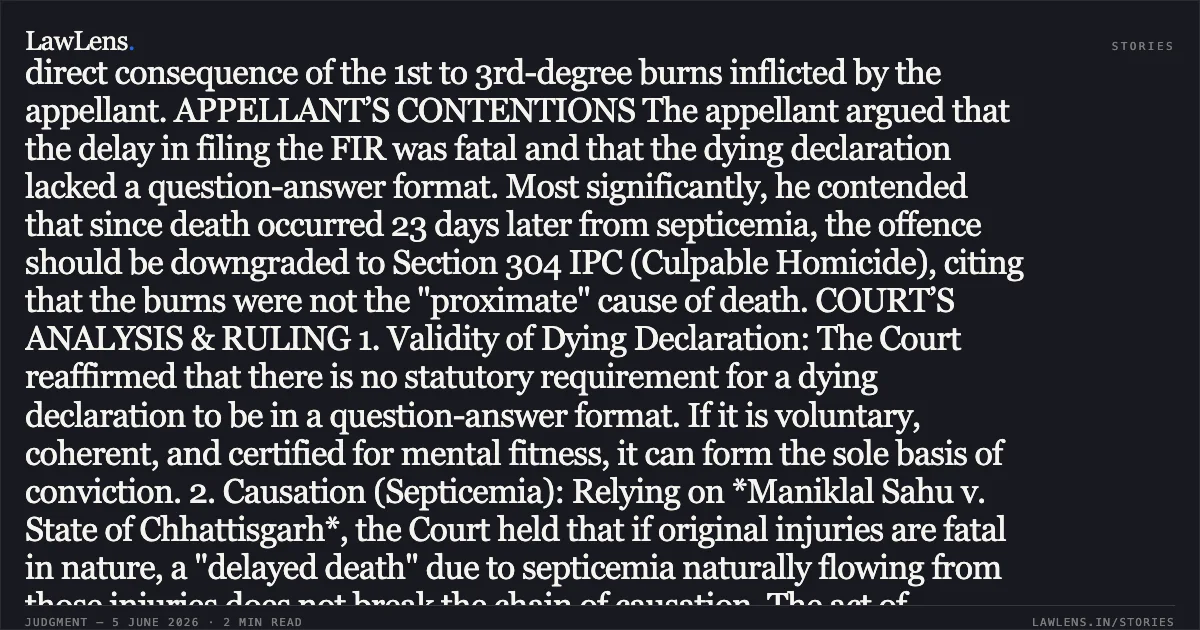
Dying Declaration and Intentional Burning of Pregnant Wife Establish Murder Despite Delayed Death from Septicemia FACTUAL MATRIX The appellant was convicted under Section 302 IPC for the murder of his eight-month pregnant wife, Ruchi. On November 28, 2010, the appellant took the deceased into a room, poured kerosene on her, set her ablaze, and bolted the door from the outside. The victim succumbed to her injuries 23 days later in the hospital. The Trial Court acquitted the appellant of dowry-related charges (Sections 304-B, 498-A IPC) but sentenced him to life imprisonment for murder. PROSECUTION CASE The prosecution relied primarily on a dying declaration recorded by an Executive Magistrate and certified by a medical officer. The declaration detailed the brutal nature of the assault. The medical evidence through PW-5 and PW-6 confirmed that while the immediate cause of death was septicemic shock, it was a direct consequence of the 1st to 3rd-degree burns inflicted by the appellant. APPELLANT’S CONTENTIONS The appellant argued that the delay in filing the FIR was fatal and that the dying declaration lacked a question-answer format. Most significantly, he contended that since death occurred 23 days later from septicemia, the offence should be downgraded to Section 304 IPC (Culpable Homicide), citing that the burns were not the "proximate" cause of death. COURT’S ANALYSIS & RULING 1. Validity of Dying Declaration: The Court reaffirmed that there is no statutory requirement for a dying declaration to be in a question-answer format. If it is voluntary, coherent, and certified for mental fitness, it can form the sole basis of conviction. 2. Causation (Septicemia): Relying on *Maniklal Sahu v. State of Chhattisgarh*, the Court held that if original injuries are fatal in nature, a "delayed death" due to septicemia naturally flowing from those injuries does not break the chain of causation. The act of pouring kerosene and bolting the door demonstrated a clear intention to cause death under Section 300 "Firstly" and "Fourthly" IPC. 3. Refusal of Exceptions: The Court rejected the plea for Exception 4 (Sudden Fight), noting that bolting the door from the outside negated any claim of acting without cruelty or in the heat of passion. 4. Proportionality of Sentence: While upholding the conviction, the Court exercised its constitutional power to modify the life sentence. Considering the appellant’s young age (21 at the time of the crime), his 15 years already served, and "good conduct" reports from jail, the Court commuted the life sentence to a fixed term of 20 years rigorous imprisonment without remission to balance deterrence with the possibility of reformation. CONCLUSION The conviction under Section 302 IPC was affirmed; however, the sentence was modified to a fixed 20-year term.. Manish vs State Of U.P.. Allahabad High Court. LawLens

Allahabad High Court·

Dying Declaration and Intentional Burning of Pregnant Wife Establish Murder Despite Delayed Death from Septicemia FACTUAL MATRIX The appellant was convicted under Section 302 IPC for the murder of his eight-month pregnant wife, Ruchi. On November 28, 2010, the appellant took the deceased into a room, poured kerosene on her, set her ablaze, and bolted the door from the outside. The victim succumbed to her injuries 23 days later in the hospital. The Trial Court acquitted the appellant of dowry-related charges (Sections 304-B, 498-A IPC) but sentenced him to life imprisonment for murder. PROSECUTION CASE The prosecution relied primarily on a dying declaration recorded by an Executive Magistrate and certified by a medical officer. The declaration detailed the brutal nature of the assault. The medical evidence through PW-5 and PW-6 confirmed that while the immediate cause of death was septicemic shock, it was a direct consequence of the 1st to 3rd-degree burns inflicted by the appellant. APPELLANT’S CONTENTIONS The appellant argued that the delay in filing the FIR was fatal and that the dying declaration lacked a question-answer format. Most significantly, he contended that since death occurred 23 days later from septicemia, the offence should be downgraded to Section 304 IPC (Culpable Homicide), citing that the burns were not the "proximate" cause of death. COURT’S ANALYSIS & RULING 1. Validity of Dying Declaration: The Court reaffirmed that there is no statutory requirement for a dying declaration to be in a question-answer format. If it is voluntary, coherent, and certified for mental fitness, it can form the sole basis of conviction. 2. Causation (Septicemia): Relying on *Maniklal Sahu v. State of Chhattisgarh*, the Court held that if original injuries are fatal in nature, a "delayed death" due to septicemia naturally flowing from those injuries does not break the chain of causation. The act of pouring kerosene and bolting the door demonstrated a clear intention to cause death under Section 300 "Firstly" and "Fourthly" IPC. 3. Refusal of Exceptions: The Court rejected the plea for Exception 4 (Sudden Fight), noting that bolting the door from the outside negated any claim of acting without cruelty or in the heat of passion. 4. Proportionality of Sentence: While upholding the conviction, the Court exercised its constitutional power to modify the life sentence. Considering the appellant’s young age (21 at the time of the crime), his 15 years already served, and "good conduct" reports from jail, the Court commuted the life sentence to a fixed term of 20 years rigorous imprisonment without remission to balance deterrence with the possibility of reformation. CONCLUSION The conviction under Section 302 IPC was affirmed; however, the sentence was modified to a fixed 20-year term.

The appellant, Manish, married the deceased, Ruchi, in 2007.

2 MIN READ

### Lieutenant Governor’s Authority to Frame Service Rules and Create Group 'A' Posts Under Article 309 SUMMARY OF THE JUDGMENT I. Core Legal Issue Whether the Lieutenant Governor (LG) of Delhi is competent to frame recruitment rules for the DASS cadre and create Group ‘A’ posts therein following the 19.05.2023 amendment to the GNCTD Act. II. Background and Facts * Conflict: DANICS officers (Petitioners) challenged the restructuring of the Delhi Administrative Subordinate Secretariat Service (DASS/GNCTDSS), which abolished approximately 217 ex-cadre posts to create a new "Senior Scale" (Level-11) within the DASS cadre. * Petitioner’s Argument: Following the GNCTD (Amendment) Act, 2023 (Section 45C), only the Central Government retains the power to make rules. They claimed the LG lacked competence and that the new posts encroached upon the DANICS promotional quota. * Respondents' Argument: The DASS cadre suffered from extreme stagnation (17 years without review). The posts created were "non-DANICS/non-IAS" ex-cadre posts. The LG acted as a delegate of the President under Article 309. III. Court’s Analysis and Observations * Constitutional Authority: Under the proviso to Article 309, the President or his authorized representative (the LG) is empowered to frame rules in the absence of specific legislation. Rules framed by the LG occupy the field until displaced by an enactment of a competent legislature. * Administrative Prerogative: Matters concerning the creation or abolition of posts and cadre restructuring fall within the exclusive domain of the executive. Judicial interference is warranted only in cases of clear arbitrariness or mala fides, which were not evidenced here. * MHA Non-Objection: The Ministry of Home Affairs (MHA) had expressly conveyed a "No Objection" for the creation of these posts, effectively providing the sanction of the Central Government. * Impact on DANICS: The Court noted that the posts being encadred into DASS were never formally part of the DANICS cadre; thus, no vested rights of the petitioners were violated. IV. Conclusion and Ruling The Court declined to stay the ongoing Departmental Promotion Committee (DPC) proceedings. It held that the LG is legally competent to frame recruitment rules and that the restructuring was a valid exercise of policy reached after administrative necessity. V. Interim Direction The DPC scheduled for June 12, 2026, was allowed to proceed. However, any consequential promotion orders are subject to the final outcome of the writ petitions, and promoted officers must provide an undertaking that they will not claim equity if the petitions succeed.. Dr Atul Pandey & Ors. vs Union Of India & Ors.. Delhi High Court. LawLens

Delhi High Court·

### Lieutenant Governor’s Authority to Frame Service Rules and Create Group 'A' Posts Under Article 309 SUMMARY OF THE JUDGMENT I. Core Legal Issue Whether the Lieutenant Governor (LG) of Delhi is competent to frame recruitment rules for the DASS cadre and create Group ‘A’ posts therein following the 19.05.2023 amendment to the GNCTD Act. II. Background and Facts * Conflict: DANICS officers (Petitioners) challenged the restructuring of the Delhi Administrative Subordinate Secretariat Service (DASS/GNCTDSS), which abolished approximately 217 ex-cadre posts to create a new "Senior Scale" (Level-11) within the DASS cadre. * Petitioner’s Argument: Following the GNCTD (Amendment) Act, 2023 (Section 45C), only the Central Government retains the power to make rules. They claimed the LG lacked competence and that the new posts encroached upon the DANICS promotional quota. * Respondents' Argument: The DASS cadre suffered from extreme stagnation (17 years without review). The posts created were "non-DANICS/non-IAS" ex-cadre posts. The LG acted as a delegate of the President under Article 309. III. Court’s Analysis and Observations * Constitutional Authority: Under the proviso to Article 309, the President or his authorized representative (the LG) is empowered to frame rules in the absence of specific legislation. Rules framed by the LG occupy the field until displaced by an enactment of a competent legislature. * Administrative Prerogative: Matters concerning the creation or abolition of posts and cadre restructuring fall within the exclusive domain of the executive. Judicial interference is warranted only in cases of clear arbitrariness or mala fides, which were not evidenced here. * MHA Non-Objection: The Ministry of Home Affairs (MHA) had expressly conveyed a "No Objection" for the creation of these posts, effectively providing the sanction of the Central Government. * Impact on DANICS: The Court noted that the posts being encadred into DASS were never formally part of the DANICS cadre; thus, no vested rights of the petitioners were violated. IV. Conclusion and Ruling The Court declined to stay the ongoing Departmental Promotion Committee (DPC) proceedings. It held that the LG is legally competent to frame recruitment rules and that the restructuring was a valid exercise of policy reached after administrative necessity. V. Interim Direction The DPC scheduled for June 12, 2026, was allowed to proceed. However, any consequential promotion orders are subject to the final outcome of the writ petitions, and promoted officers must provide an undertaking that they will not claim equity if the petitions succeed.

The Petitioners, direct recruits of the DANICS cadre (2020-22), challenged an order dated 16.02.2026 passed by the Central Administrative Tribunal (CAT).

2 MIN READ