Employment and Labour LawAdministrative and Public Law
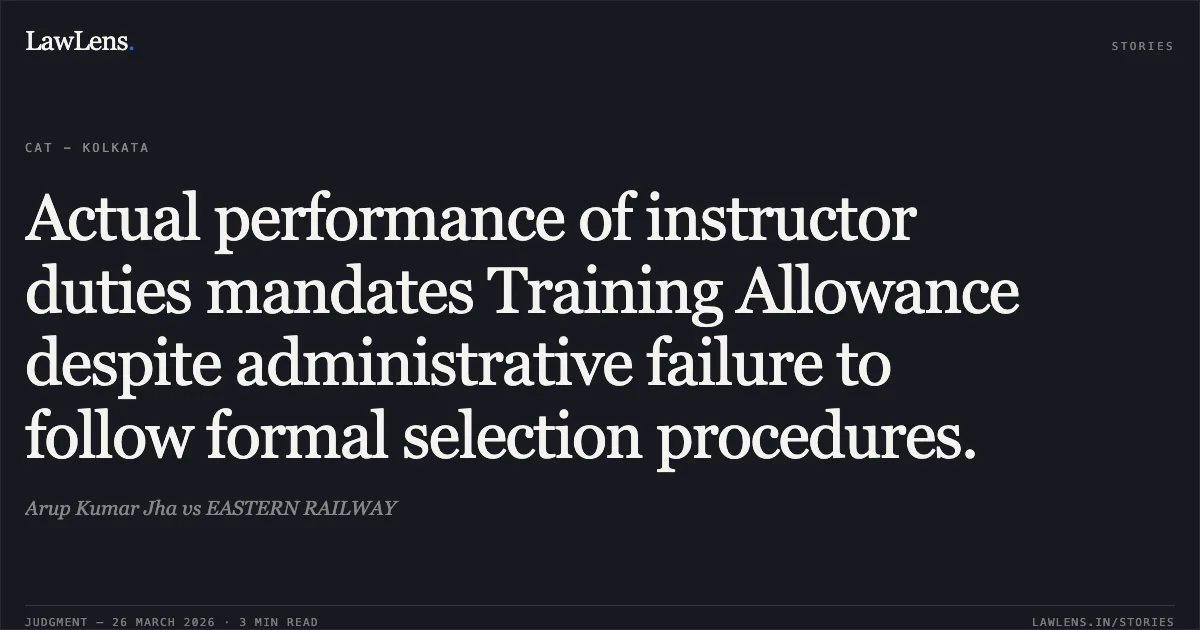
Performance of instructor duties mandates Training Allowance despite administrative lapses in formal selection procedures.
The applicant, a retired Senior Section Engineer of the Eastern Railway, was transferred and posted as an Instructor/Engg. at the Signal & Telecom Training School, Liluah, via an order dated 26.07.2018
3 MIN READ→
![Disciplinary authority must issue disagreement note and seek response before reversing inquiry officer's 'not proved' finding.. Maksudan Singh v. Union of India [OA/050/00264/2017]. Central Administrative Tribunal. LawLens](/stories/thumbnails/disciplinary-authority-must-issue-disagreement-note-and-seek-response-before-reversing-inq-c804cd137b1c41a9954b404423cf238b.webp)
![Anomaly due to higher advance increments to juniors warrants pay stepping-up for seniors.. Samrat Guha & Ors. v. Union of India & Ors. [O.A.No.350/710/2024 with M.A.No.350/562/2024]. Central Administrative Tribunal. LawLens](/stories/thumbnails/anomaly-due-to-higher-advance-increments-to-juniors-warrants-pay-stepping-up-for-seniors-1de1d1c73e14484b9b2c71e80f3ce2cc.webp)
![Contempt petition dropped where compliance aligns with subsequent Supreme Court clarifications.. Satya Narain v. Sri Upendra Chandra Joshi, General Manager, North Central Railway, Subedarganj, Allahabad, and Ors. [Civil Misc. Contempt Petition No.165 of 2024 IN Original Application No.06 of 2023]. Central Administrative Tribunal. LawLens](/stories/thumbnails/contempt-petition-dropped-where-compliance-aligns-with-subsequent-supreme-court-clarificat-c8fe2637ee2b4acdb4639beb8cf1d1df.webp)
![Unauthorized absence from a disciplined force is a grave misconduct warranting removal from service.. Harvinder Singh v. State of J&K [T.A. No. 61/844/2020]. Central Administrative Tribunal. LawLens](/stories/thumbnails/unauthorized-absence-from-a-disciplined-force-is-a-grave-misconduct-warranting-removal-fro-abd944f6af614e029a2319d380a804b3.webp)
![Disciplinary Authority's discretion in holding inquiry for minor penalties is upheld.. S. Prakasan v. Union of India [Original Application No. 180/00481/2016]. Central Administrative Tribunal. LawLens](/stories/thumbnails/disciplinary-authority-s-discretion-in-holding-inquiry-for-minor-penalties-is-upheld-aa0b7f1cc5824f2d888eb58a43fc450b.webp)
![Denial of promotion post-retirement due to expunged adverse remark is illegal.. P .N. Muralidharanachary v. Bharath Sanchar Nigam Limited (BSNL) [Original Application No. 180/00184/2020]. Central Administrative Tribunal. LawLens](/stories/thumbnails/denial-of-promotion-post-retirement-due-to-expunged-adverse-remark-is-illegal-d9ef7880954f4c01b3ccafe01d614e1c.webp)
![Voluntary retirement cannot be denied solely due to pending internal administrative verification or past financial irregularity already made good.. Shri Romesh B. Patel v. Union of India [O.A. No. 365/2025]. Central Administrative Tribunal. LawLens](/stories/thumbnails/voluntary-retirement-cannot-be-denied-solely-due-to-pending-internal-administrative-verifi-08c58770c0234f9482a7ec3506edb746.webp)
![Family pension to unmarried daughters beyond 25 subject to strict eligibility conditions.. Aarti Kumari & Ors. v. The Union of India & Ors. [OAN0.00029/2024]. Central Administrative Tribunal. LawLens](/stories/thumbnails/family-pension-to-unmarried-daughters-beyond-25-subject-to-strict-eligibility-conditions-7230ac8d3438461498e171d1034853d5.webp)
![DELAYED DPC: SENIORITY GRANTED FROM VACANCY YEAR, BUT PROMOTION ELIGIBILITY FROM ACTUAL JOINING DATE.. RAMENDRA KUMAR & ORS. v. NEW DELHI MUNICIPAL COUNCIL & ORS. [O.A. No. 2623/2025]. Central Administrative Tribunal. LawLens](/stories/thumbnails/delayed-dpc-seniority-granted-from-vacancy-year-but-promotion-eligibility-from-actual-join-13f337629403401ab577e0eaa2efe0c2.webp)
![Disciplinary proceedings vitiated by prolonged and unexplained delay, disentitling further punishment.. Subhash Chander Luthra vs. Union of India [OA No. 2734/2021]. Central Administrative Tribunal. LawLens](/stories/thumbnails/disciplinary-proceedings-vitiated-by-prolonged-and-unexplained-delay-disentitling-further--da4db73f27b6411e8b9fd146edb7c06a.webp)
![Delayed retiral benefits accrue interest at GPF rate, subject to High Court's final decision.. Manmohan Gulati v. The Commissioner, Municipal Corporation Delhi & Ors. [no citation]. Central Administrative Tribunal. LawLens](/stories/thumbnails/delayed-retiral-benefits-accrue-interest-at-gpf-rate-subject-to-high-court-s-final-decisio-d082ecb9bb5d426aa13a0b4885809940.webp)
![Departmental inquiry vitiated if mandatory procedural rules and natural justice principles are violated.. Vishnu Shankar Prasad v. Ministry of Road Transport & Highways and Ors. and Vishnu Shankar Prasad v. Ministry of Road Transport & Highways and Ors. (OA No. 2536/2022 with OA No. 2459/2022) [p.1]. Central Administrative Tribunal. LawLens](/stories/thumbnails/departmental-inquiry-vitiated-if-mandatory-procedural-rules-and-natural-justice-principles-03eb5397425e4da4af14cbaa81d50dff.webp)
![Inquiry lacking evidence and cross-examination vitiates dismissal despite unauthorized absence.. Vishnu Shankar Prasad, Ex-Chief Engineer, Ministry of Road Transport & Highways v. Ministry of Road Transport & Highways & Ors. (OA No. 2536/2022 and OA No. 2459/2022) [p.1]. Central Administrative Tribunal. LawLens](/stories/thumbnails/inquiry-lacking-evidence-and-cross-examination-vitiates-dismissal-despite-unauthorized-abs-535bdd94d41f486f8f29d46a558dded9.webp)
![Respondents directed to reconsider transfer request post-financial year, considering DOPT OMs and Apex Court judgment.. Shamba Das v. Union of India [O.A./350/379/2026]. Central Administrative Tribunal. LawLens](/stories/thumbnails/respondents-directed-to-reconsider-transfer-request-post-financial-year-considering-dopt-o-fdf090923bd54bbab796dee70b825afc.webp)
![LAW OF LIMITATION DOES NOT BAR REGULARIZATION CLAIMS IN VIOLATION OF ARTICLE 14 & 16.. Gauri Shankar Das & Ors. v. Union of India & Ors. [O.A.No. 260/00122 of 2020]. Central Administrative Tribunal. LawLens](/stories/thumbnails/law-of-limitation-does-not-bar-regularization-claims-in-violation-of-article-14-16-0ab99f34fd744af48892738f15e1febe.webp)
![Selection process for contract appointments not vitiated by transparency claims if advertised and fairly conducted.. O.A.No.181/00464/2025 Petitioner vs Union Territory of Lakshadweep [O.A.No.181/00464/2025]. Central Administrative Tribunal. LawLens](/stories/thumbnails/selection-process-for-contract-appointments-not-vitiated-by-transparency-claims-if-adverti-176bbe0bcfc442828721b7eab4a8b754.webp)
![Interim relief granted; stay on headquarters change pending appeal against suspension order.. Ravi Kumar Khatkar v. Director General, Employees’ State Insurance Corporation [O. A. No. 826/2026]. Central Administrative Tribunal. LawLens](/stories/thumbnails/interim-relief-granted-stay-on-headquarters-change-pending-appeal-against-suspension-order-6b5d1fbb01524c7fa02ba906cf459b3b.webp)
![Application disposed of due to compliance with all prayers by respondents.. Rajesh Kumar & Ors. vs Union of India & Ors. [OA No. 942/2025]. Central Administrative Tribunal. LawLens](/stories/thumbnails/application-disposed-of-due-to-compliance-with-all-prayers-by-respondents-1ac8671d404945f696ef9e34475c61d3.webp)
![DIRECTIONS: Disability exemption from typing test cannot be denied based on re-submission of documents.. Mohammad Saqib vs. Union of India & Ors. [O.A. No. 2627/2024]. Central Administrative Tribunal. LawLens](/stories/thumbnails/directions-disability-exemption-from-typing-test-cannot-be-denied-based-on-re-submission-o-b5d04a44fa8c4f6786680deed718d3cb.webp)
![Long-serving irregular employees performing continuous work are entitled to regularization and minimum wages.. Sanjay Kumar v. Secretary School Education Department JGK & Ors. [TA 187/2024 & 237/2024 & OA/404/2025 & CP/207/2025]. Central Administrative Tribunal. LawLens](/stories/thumbnails/long-serving-irregular-employees-performing-continuous-work-are-entitled-to-regularization-2101ffd2b9a343438babbdf4d9b9250c.webp)
![Engagement prior to cut-off date and continuous service entitles regularization, even posthumously with benefits to legal heirs.. Smt. Kamla Devi & Anr. v. State of Jammu and Kashmir & Ors. [TA 211/2023]. Central Administrative Tribunal. LawLens](/stories/thumbnails/engagement-prior-to-cut-off-date-and-continuous-service-entitles-regularization-even-posth-dd424db0a8564c71b1af7f8b5762f1bf.webp)
![Pension calculation based on last pay drawn; no recovery of excess payment without employee fault.. Tallo Ram & Ors. v. Union Territory of Jammu & Kashmir & Ors. [O.A. No. 1419/2024]. Central Administrative Tribunal. LawLens](/stories/thumbnails/pension-calculation-based-on-last-pay-drawn-no-recovery-of-excess-payment-without-employee-febb06688ad04222a8ad8115c6d441f6.webp)
![Pension is a statutory right, payable only when relevant service rules provide.. Rajan Sharma & Ors. v. U.T. of J&K & Ors. & Nazir Ahmed & Anr. v. U.T. of J&K & Ors. [Original Application No. 1257/2024 & 243/2025]. Central Administrative Tribunal. LawLens](/stories/thumbnails/pension-is-a-statutory-right-payable-only-when-relevant-service-rules-provide-bbfe114c7b09427c9ac2b44f26bc783e.webp)
![Pension is a statutory right, payable only when relevant rules provide for it.. RAJAN SHARMA & ORS. vs U.T. OF J&K & ORS. [O.A. No. 1257/2024 and 243/2025]. Central Administrative Tribunal. LawLens](/stories/thumbnails/pension-is-a-statutory-right-payable-only-when-relevant-rules-provide-for-it-d341789a89674b3196c79b129d33d6c3.webp)
![Promotion with reservation roster by superseding seniors and ad-hoc appointments of juniors unsustainable.. Dr. Kewal Krishan Bhardwaj & Ors. v. State of Jammu and Kashmir & Ors. [TA 5279/2020]. Central Administrative Tribunal. LawLens](/stories/thumbnails/promotion-with-reservation-roster-by-superseding-seniors-and-ad-hoc-appointments-of-junior-ddb827b9b6414b4ca0e74408e433bbba.webp)
![Migrant candidates eligible under rehabilitation schemes cannot be denied appointment due to procedural irregularities.. Dilip Pandita and Ors. vs. State of Jammu & Kashmir and Ors. [Transfer Application No. 331/2020 & OA 1359/2025]. Central Administrative Tribunal. LawLens](/stories/thumbnails/migrant-candidates-eligible-under-rehabilitation-schemes-cannot-be-denied-appointment-due--15028af5590d452d966795416cb33d79.webp)
![Discretionary minor penalty upheld; Courts do not interfere with quantum of punishment unless arbitrary.. Pawan Kumar Suman vs. The Union of India through the Secretary, Ministry of Railway, Railway Board, Rail Bhawan, New Delhi- 110001 & Ors. [OA 050/00320/2017]. Central Administrative Tribunal. LawLens](/stories/thumbnails/discretionary-minor-penalty-upheld-courts-do-not-interfere-with-quantum-of-punishment-unle-6a870dbe6d554cf2b6cf162093b47b31.webp)
![Review cannot be invoked to re-argue concluded issues or re-appreciate facts already adjudicated.. Comptroller & Auditor General of India & Anr. v. Ayan Paul & Ors. (RA No.17/2026 in OA No.2951/2022) [p.1]. Central Administrative Tribunal. LawLens](/stories/thumbnails/review-cannot-be-invoked-to-re-argue-concluded-issues-or-re-appreciate-facts-already-adjud-1d9f3e74be324e0e88178a79db1fb46e.webp)
![Family Pension Clarification: Remand for Identity and Bonafides Verification. Smt Firoza Begum v. Union of India [O.A./350/0091/2025]. Central Administrative Tribunal. LawLens](/stories/thumbnails/family-pension-clarification-remand-for-identity-and-bonafides-verification-052d6e91de284ae3b0df711fad50916a.webp)
![Termination of temporary, honorarium-based appointments not regularized under Uma Devi principles upheld.. Thalhath P.S. & Ors. v. Union of India & Ors. [O.A No. 181/00057/2016]. Central Administrative Tribunal. LawLens](/stories/thumbnails/termination-of-temporary-honorarium-based-appointments-not-regularized-under-uma-devi-prin-9df3d1f6065245e48dfb5cce9f6f3045.webp)
![Transfer policy guidelines for surplus employees from disbanded units not applicable.. Pardeep Kumar & Ors. v. Union of India & Ors. [OA No. 2400/2023]. Central Administrative Tribunal. LawLens](/stories/thumbnails/transfer-policy-guidelines-for-surplus-employees-from-disbanded-units-not-applicable-edcf4da964ba4ed3aed94248ebd279a2.webp)
![Disciplinary Proceedings Against Retired Persons Must Be Concluded Within Four Months.. Meitangkeishangbam Tomba Singh v. The Union of India & Ors. [O.A. Nos.58/2026]. Central Administrative Tribunal. LawLens](/stories/thumbnails/disciplinary-proceedings-against-retired-persons-must-be-concluded-within-four-months-b503af081e5746b58a054fda21c9a9fd.webp)
![COURT DIRECTS RAILWAYS TO DECIDE FAMILY PENSION APPEAL FOR MISSING EMPLOYEE'S MOTHER WITHIN TWO MONTHS.. Smt. Chenimai Devi v. The Union of India [O.A. No. 040/00188/2024]. Central Administrative Tribunal. LawLens](/stories/thumbnails/court-directs-railways-to-decide-family-pension-appeal-for-missing-employee-s-mother-withi-57c697084f5846fb83f9fafdc28b9d2a.webp)
![Appellate Authority must pass a reasoned, detailed order considering all issues raised in appeal.. Priya Ranjan Bharati v. UOI and Ors. [O.A. 350/12/2026]. Central Administrative Tribunal. LawLens](/stories/thumbnails/appellate-authority-must-pass-a-reasoned-detailed-order-considering-all-issues-raised-in-a-d84ec8c2bcc540af9c80c5401542a0c8.webp)
![Recovery of excess payment from retired employees or after five years is impermissible.. Gayatri Trivedi v. U.O.I. & Ors. [OA No. 332/00768/2024]. Central Administrative Tribunal. LawLens](/stories/thumbnails/recovery-of-excess-payment-from-retired-employees-or-after-five-years-is-impermissible-56003186e8ed45f89016cf8ec2b24e3c.webp)
![Recovery of penal rent for unauthorized accommodation accrues from the first official eviction notice.. Rambachan Ram vs Union of India and Others [O.A./444/2022]. Central Administrative Tribunal. LawLens](/stories/thumbnails/recovery-of-penal-rent-for-unauthorized-accommodation-accrues-from-the-first-official-evic-11c4837dd5e948fa9f8965db8465026f.webp)
![Enhanced pay scale from 01.01.1996 to be extended notionally to similarly situated employees.. Mukesh Kumar Khandelwal v. Union of India [OA No. 96/2026, MA No. 107/2026]. Central Administrative Tribunal. LawLens](/stories/thumbnails/enhanced-pay-scale-from-01-01-1996-to-be-extended-notionally-to-similarly-situated-employe-3ff41392f0e445339fb4c4f43c978a0a.webp)
![Enhanced Pay Scale: Identical Treatment required for similarly placed officers.. Handore Nilesh Shankerrao vs. Union of India [O.A. No. 95/2026 with M.A. No. 106/2026]. Central Administrative Tribunal. LawLens](/stories/thumbnails/enhanced-pay-scale-identical-treatment-required-for-similarly-placed-officers-30a220c4c4a246438f1cc89496b6738c.webp)
![Government employees entitled to equal benefits of enhanced pay scale with retrospective notional effect.. Tapankumar N. Bhandyopadhyay v. Union of India [OA No. 94/2026 with M.A. No. 105/2026]. Central Administrative Tribunal. LawLens](/stories/thumbnails/government-employees-entitled-to-equal-benefits-of-enhanced-pay-scale-with-retrospective-n-9aaec744e03944fe9c80517522b8faeb.webp)
![Forest Department directed to release pending wages under CAMPA Scheme.. Rinku Kumar & Ors. v. U.T. of J&K & Ors. [O.A. No. 61/244,245,246,247&248/2024]. Central Administrative Tribunal. LawLens](/stories/thumbnails/forest-department-directed-to-release-pending-wages-under-campa-scheme-c28de4eb964c4c0dba2bb9606d6a5955.webp)
![Respondents directed to release pending wages under CAMPA Scheme within eight weeks.. Rinku Kumar & Ors. v. U.T. of J&K & Ors. [O.A. No. 61/244, 245, 246, 247 & 248/2024]. Central Administrative Tribunal. LawLens](/stories/thumbnails/respondents-directed-to-release-pending-wages-under-campa-scheme-within-eight-weeks-320dd62661f4494ba5fc31141ce0b38c.webp)
![Pending Wages Under CAMPA Scheme Must Be Released Within Eight Weeks.. Rinku Kumar & Ors. v. U.T. of J&K & Ors. [O.A. No. 61 /244/2024 c/w O.A. No. 61 /245 /2024, O.A. No. 61 /246 /2024, O.A. No. 61 /247 /2024, O.A. No. 61 /248 /2024]. Central Administrative Tribunal. LawLens](/stories/thumbnails/pending-wages-under-campa-scheme-must-be-released-within-eight-weeks-2351910c040144b5ba5cd9ac234222dd.webp)
![Suspension Extension Requires Reconsideration Post-Discharge from Criminal Proceedings.. Narinder Singh v. Government of NCT of Delhi & Ors. [O.A. No. 589/2026]. Central Administrative Tribunal. LawLens](/stories/thumbnails/suspension-extension-requires-reconsideration-post-discharge-from-criminal-proceedings-4e024c050a3e4fa5a1ff4b84dfbd8ab9.webp)
![Pay Scale Upgradation: Similarly situated employees are entitled to equal benefit of enhanced pay scale.. Sujit Pushpshil Gaekwad v. Union of India [O.A. No. 83/2026]. Central Administrative Tribunal. LawLens](/stories/thumbnails/pay-scale-upgradation-similarly-situated-employees-are-entitled-to-equal-benefit-of-enhanc-70f9d0b5423845dabc9e2320dafc6388.webp)
![EWS certificate validity determined by crucial date, not subsequent issuance for financial year.. Jatin Kumar v. Staff Selection Commission & Ors. [O.A. No. 525/2024 with O.A. No. 526/2024]. Central Administrative Tribunal. LawLens](/stories/thumbnails/ews-certificate-validity-determined-by-crucial-date-not-subsequent-issuance-for-financial--1a3c9a714d854e6281436ac5abfae926.webp)
![Original Application treated as representation; respondents to pass reasoned speaking order.. Neeraj Sharma and Ors. v. Union Territory of Jammu and Kashmir and Ors. [O.A. No. 61/292/2026]. Central Administrative Tribunal. LawLens](/stories/thumbnails/original-application-treated-as-representation-respondents-to-pass-reasoned-speaking-order-f251efa5eab44c72afde0682a8fea0f2.webp)
![Retiring Employee's Transfer: Tribunal Directs Consideration of Transfer Policy and Service Regulations.. Farooq Ahmed Butt v. U.T of J&K and Others [O.A. No. 61 /300/2026]. Central Administrative Tribunal. LawLens](/stories/thumbnails/retiring-employee-s-transfer-tribunal-directs-consideration-of-transfer-policy-and-service-ca5d747934e7473982ddc1022530dc93.webp)
![Employee unlawfully denied duty can claim full salary, nullifying "no work, no pay".. Sant Ram v. Union of India [O.A. No. 702/2022]. Central Administrative Tribunal. LawLens](/stories/thumbnails/employee-unlawfully-denied-duty-can-claim-full-salary-nullifying-no-work-no-pay-ff5ef647c1a247e99c9db51d5dee6e55.webp)
![Headline: Courts generally do not interfere with charge memos or disciplinary proceedings prematurely.. Shri James Mathai vs The State of West Bengal [O.A. No. 82/2026]. Central Administrative Tribunal. LawLens](/stories/thumbnails/headline-courts-generally-do-not-interfere-with-charge-memos-or-disciplinary-proceedings-p-747e032efaac4614a4171f7e5f27b8a4.webp)
![Respondents directed to decide representations on prior service benefits within six weeks.. Dr. Daya Shankar Kumar & Ors. v. Govt. of NCT of Delhi & Anr. [O.A. No. 833/2026, M.A. No. 1091/2026, M.A. No. 1092/2026]. Central Administrative Tribunal. LawLens](/stories/thumbnails/respondents-directed-to-decide-representations-on-prior-service-benefits-within-six-weeks-94fe1b544b8144debcd9782ddf70abba.webp)
![OBC candidates are entitled to one repeat chance for training, totaling two attempts.. Satyendra Kumar v. Union of India and Ors. [Original Application No. 247 of 2026]. Central Administrative Tribunal. LawLens](/stories/thumbnails/obc-candidates-are-entitled-to-one-repeat-chance-for-training-totaling-two-attempts-a4e74bf4a40a4553ade10320560f3078.webp)
![Application Dismissed as Withdrawn for one applicant with liberty to file fresh application.. Azad Amhed Chiloo & Ors. v. Union of India & Ors. [T.A. No. 4665 of 2020]. Central Administrative Tribunal. LawLens](/stories/thumbnails/application-dismissed-as-withdrawn-for-one-applicant-with-liberty-to-file-fresh-applicatio-bf789393e95141b6a8b84fbb03bcf1fa.webp)
![Application Dismissed for Non-Prosecution Due to Repeated Absence.. Rajender Singh Chauhan & Ors. v. South Delhi Municipal Corporation & Ors. [Item No. 79 (C-V) 1 OA No. 5/2019]. Central Administrative Tribunal. LawLens](/stories/thumbnails/application-dismissed-for-non-prosecution-due-to-repeated-absence-faf2bdaf4c4f4d52b9b9c1d1b3bf56d6.webp)
![Disciplinary proceedings upheld when findings based on evidence and no natural justice violation.. Bhagirathi Sahoo v. Union of India [O.A. No. 260/000522 of 2020]. Central Administrative Tribunal. LawLens](/stories/thumbnails/disciplinary-proceedings-upheld-when-findings-based-on-evidence-and-no-natural-justice-vio-519cfe9b983446f588b8d6d51465e2a0.webp)
![Railway employee's quarter retention valid without change in controlling authority; damage rent quashed.. Chittaranjan Nayak v. Union of India and Ors. [O.A. No. 260/00515 of 2023]. Central Administrative Tribunal. LawLens](/stories/thumbnails/railway-employee-s-quarter-retention-valid-without-change-in-controlling-authority-damage--da4dfd4fc3f64078bace30bd57944b24.webp)
![Unauthorised absence justifies termination without formal inquiry if natural justice is afforded.. Ravi Kumar Sharma v. Union Territory of Jammu and Kashmir and others [O.A. No. 61/731/2022]. Central Administrative Tribunal. LawLens](/stories/thumbnails/unauthorised-absence-justifies-termination-without-formal-inquiry-if-natural-justice-is-af-de8c742db9c745caaf50750f947ff69f.webp)
![Original Application Disposed of as Infructuous Due to Satisfied Reliefs.. Rohitashw Chaudhary & Ors. v. Union of India & Ors. [O.A. No. 3579/2025]. Central Administrative Tribunal. LawLens](/stories/thumbnails/original-application-disposed-of-as-infructuous-due-to-satisfied-reliefs-98806e8cd896401492b03fd2fd560b20.webp)
![Review jurisdiction not exercisable to re-argue a case or introduce new points.. Shri Manik Mandal vs Union of India [R.A No. 22/2026 in OA No. 1522/2024]. Central Administrative Tribunal. LawLens](/stories/thumbnails/review-jurisdiction-not-exercisable-to-re-argue-a-case-or-introduce-new-points-7b48f6c8771148ebb6ded1f16bbcc06a.webp)
![Recovery from gratuity after superannuation requires reasoned decision based on representation.. Surender Kumar Jain v. Delhi Development Authority & Ors. [O.A. No. 872/2026]. Central Administrative Tribunal. LawLens](/stories/thumbnails/recovery-from-gratuity-after-superannuation-requires-reasoned-decision-based-on-representa-2238e0c7dde04e24bc4233af74bee9bd.webp)
![Interest on Delayed Retiral Benefits: Tribunal Directs Consideration of Representations.. SMT VIBHA SINGH & ORS. vs. MUNICIPAL CORPORATION OF DELHI & ANR. [O.A. No. 875/2026, M.A. No.1164/2026]. Central Administrative Tribunal. LawLens](/stories/thumbnails/interest-on-delayed-retiral-benefits-tribunal-directs-consideration-of-representations-448664cbff9c4074bc696cb994c40bdf.webp)
![Recruitment process not vitiated by amended eligibility criteria if extended application period allows equal opportunity.. Parvesh Kumar and Ors. v. Union of India and Ors. [O.A. No. 1446/2016]. Central Administrative Tribunal. LawLens](/stories/thumbnails/recruitment-process-not-vitiated-by-amended-eligibility-criteria-if-extended-application-p-064f650704f84b50b7fd77cb9a5aab28.webp)
![Skill tests in recruitment are qualifying; written exam merit does not guarantee qualification.. Reenu Rani, Group ‘C’ vs. Union of India and Another [O.A. No.1234/2019]. Central Administrative Tribunal. LawLens](/stories/thumbnails/skill-tests-in-recruitment-are-qualifying-written-exam-merit-does-not-guarantee-qualificat-75e12f985354401193abd7656f504c02.webp)
![Regularization of long-term casual workers is mandatory, even requiring supernumerary posts.. Jagabandhu Mohapatra & Ors. v. Union of India & Ors. [O.A.No. 260/00497 of 2025]. Central Administrative Tribunal. LawLens](/stories/thumbnails/regularization-of-long-term-casual-workers-is-mandatory-even-requiring-supernumerary-posts-a5a340535141407d8ff2fba0cf53a771.webp)
![COURT DIRECTS CONSIDERATION OF PORTERS' REPRESENTATION FOR CLASS IV APPOINTMENT UNDER RAILWAY BOARD CIRCULAR.. O.A../1 153/2016 vs [No Respondent Information]. Central Administrative Tribunal. LawLens](/stories/thumbnails/court-directs-consideration-of-porters-representation-for-class-iv-appointment-under-railw-392dc3af57324f3ab988629b036bbab9.webp)
![Medical condition mandates consideration for posting retention, subject to legal impediments.. Rubeena Akhter v. Union Territory of Jammu & Kashmir & Ors. [O.A. NO: 195 OF 2026]. Central Administrative Tribunal. LawLens](/stories/thumbnails/medical-condition-mandates-consideration-for-posting-retention-subject-to-legal-impediment-f5675ddb6b1c4ad6920e7aeb1fb3a88d.webp)
![Withheld examination results after quashed malpractice charges require reconsideration by authorities.. Anand Kumar vs. Union of India and Others [O.A./41/2023]. Central Administrative Tribunal. LawLens](/stories/thumbnails/withheld-examination-results-after-quashed-malpractice-charges-require-reconsideration-by--1fd7d07b0ed54ed3b50bfd52125994df.webp)
![Granting temporary status for pension calculation necessitates individualized assessment; no automatic benefits.. C.V. Santhosh v. Union of India [O.A. No. 180/00497/2023]. Central Administrative Tribunal. LawLens](/stories/thumbnails/granting-temporary-status-for-pension-calculation-necessitates-individualized-assessment-n-e426169cb2934358839dbcd4cbb4d0c6.webp)
![Original Application Rendered Infructuous by Partial Cancellation of Transfer Order.. Anwer Hussain K.K. v. Union of India [Original Application No. 181/00492/2025]. Central Administrative Tribunal. LawLens](/stories/thumbnails/original-application-rendered-infructuous-by-partial-cancellation-of-transfer-order-3ba72bd093714c17ab5d7ff31ae2ac4e.webp)
![Promotion with retrospective effect and consequential benefits mandated despite administrative delays.. P.M. Unnikrishnan Unnithan & Ors. v. Union of India & Ors. [Original Application No. 180/00479/2021]. Central Administrative Tribunal. LawLens](/stories/thumbnails/promotion-with-retrospective-effect-and-consequential-benefits-mandated-despite-administra-8ea77a947f2244dc9a8f52727a33c5f5.webp)
![Expert handwriting opinion alone, without corroboration, cannot sustain disciplinary charges.. Vikas Kumar v. Union of India and Others [O.A. No. 164/2024]. Central Administrative Tribunal. LawLens](/stories/thumbnails/expert-handwriting-opinion-alone-without-corroboration-cannot-sustain-disciplinary-charges-a357da8e7b59439ab31f30f16ef584ce.webp)
![Disciplinary proceedings not vitiated by delay sans demonstrable prejudice or final order.. Rakesh Bahadur v. Union of India & Anr. [O.A. No.31/2015]. Central Administrative Tribunal. LawLens](/stories/thumbnails/disciplinary-proceedings-not-vitiated-by-delay-sans-demonstrable-prejudice-or-final-order-c9646907849943c3abc2734870207ed1.webp)
![No legal right to notional promotion or revision of pension for unheld higher post.. Dilip Kumar Goswami v. The Union of India & Ors. [O.A. No. 350/201/2019]. Central Administrative Tribunal. LawLens](/stories/thumbnails/no-legal-right-to-notional-promotion-or-revision-of-pension-for-unheld-higher-post-e4cf0b8fb3234e13a04fcfc723d84536.webp)
![Contempt proceedings closed: Apex Court's clarification on pension increment affects compliance.. Naresh Kumar Sharma v. Shri Ajay Srivastava Chief Workshop Manager, Railway Workshop, North Central Railway, Jhansi, Contempt Petition No. 150 of 2024 arising out of O.A. No. 1028 of 2023 [no citation].. Central Administrative Tribunal. LawLens](/stories/thumbnails/contempt-proceedings-closed-apex-court-s-clarification-on-pension-increment-affects-compli-551aba4223344e2292450dd2db2e7801.webp)
![Disciplinary recovery for perpetuated error, without loss to exchequer, is illegal.. Sri Antaryami Behera v. Union of India and Anr. [O.A. No. 454 of 2021]. Central Administrative Tribunal. LawLens](/stories/thumbnails/disciplinary-recovery-for-perpetuated-error-without-loss-to-exchequer-is-illegal-428b5f5275a4414fa06233e4071a4633.webp)
![Inadvertent clerical error in application form does not justify cancellation of candidature.. Pawan Kumar Yadav S/o Sh. Phool Chand v. Union Territory, Chandigarh Administration, Chandigarh & Ors. [Original Application No. 1261/2021]. Central Administrative Tribunal. LawLens](/stories/thumbnails/inadvertent-clerical-error-in-application-form-does-not-justify-cancellation-of-candidatur-79a86110d5ea408cb246994577de6c6d.webp)
![Ad-Hoc Service with Breaks Not Counted for Increment Purposes.. Ram Briksha Singh S/o - Sri Late Ram Karan Singh v. Kendriya Vidyalaya Sangthan through its Commissioner, 18, Institutional Area, Shaheed Jeet Singh Marg, New Delhi & Ors. [Original Application No. 1766 of 2015]. Central Administrative Tribunal. LawLens](/stories/thumbnails/ad-hoc-service-with-breaks-not-counted-for-increment-purposes-56c79ac5a2e248daa471628057e49039.webp)
![Seniors' pay must be stepped up to match juniors, even if anomalous pay started through court order.. O.A.No.180/00984/2016 [no citation]. Central Administrative Tribunal. LawLens](/stories/thumbnails/seniors-pay-must-be-stepped-up-to-match-juniors-even-if-anomalous-pay-started-through-cour-78eb53868b54469c87dc956fe7b8c22a.webp)
![Denial of promotion due to insufficient service and expired eligibility relaxation upheld.. Pankaj Kumar Thakur v. Union of India and Others [Original Application No. 485 of 2025]. Central Administrative Tribunal. LawLens](/stories/thumbnails/denial-of-promotion-due-to-insufficient-service-and-expired-eligibility-relaxation-upheld-2ee4465ff47249a29b2a44a14cfcecd8.webp)
![Termination based on concealed trivial criminal case from minority requires re-examination and reasoned order.. Brijesh Yadav v. Union of India [Original Application No. 1310 of 2024]. Central Administrative Tribunal. LawLens](/stories/thumbnails/termination-based-on-concealed-trivial-criminal-case-from-minority-requires-re-examination-cafa8158a1784bca9d89f91ec30b5818.webp)
![Concealment of material facts in attestation form renders candidate ineligible for employment.. Ajesh U v. HLL Life Care Limited and Anr. [O.A No. 180/00088/2026]. Central Administrative Tribunal. LawLens](/stories/thumbnails/concealment-of-material-facts-in-attestation-form-renders-candidate-ineligible-for-employm-aa35d47d91df4612a03dbb5c3a04be08.webp)
![Recovery of excess pension from family pensioners is inequitable and impermissible.. Omana Amma v. The Commandant in Chief & Anr. [O.A. No. 180/00520/2025]. Central Administrative Tribunal. LawLens](/stories/thumbnails/recovery-of-excess-pension-from-family-pensioners-is-inequitable-and-impermissible-38e296f45ff340d5b6da73568877b2b3.webp)
![Court directs consideration of inter-district transfer request on security and humanitarian grounds.. Mudasar Parveen vs. Union Territory of Jammu and Kashmir and Ors. [O.A. 1331/2025]. Central Administrative Tribunal. LawLens](/stories/thumbnails/court-directs-consideration-of-inter-district-transfer-request-on-security-and-humanitaria-e7722fe30be046e28ad7c3bf2c0b7c3a.webp)
![Long-term co-terminus appointment mandates fair consideration for regularisation, not automatic absorption.. Shri Har Kishan v. Union of India & Anr. [OA No.3201/2018]. Central Administrative Tribunal. LawLens](/stories/thumbnails/long-term-co-terminus-appointment-mandates-fair-consideration-for-regularisation-not-autom-04f4ec9734aa44af8dc5a64f01ab7cee.webp)
![Central Government must decide on proforma promotion after High Court's explicit directions.. Shri Sheo Prasad Ram v. The Union of India [Original Application No. 040/00158/2020]. Central Administrative Tribunal. LawLens](/stories/thumbnails/central-government-must-decide-on-proforma-promotion-after-high-court-s-explicit-direction-58efd6d054654fd49e225a362c77195f.webp)
![Termination for failing proficiency tests valid; no right to alternate employment after clerical error in offer.. Sushanta Choudhury v. The Union of India & Ors. [Original Application No. 040/00082/2021]. Central Administrative Tribunal. LawLens](/stories/thumbnails/termination-for-failing-proficiency-tests-valid-no-right-to-alternate-employment-after-cle-f4f0dacec5fe4e5a8e025b69eabef80b.webp)
![Applicant entitled to regularization as casual labour due to similar circumstances and prior service.. Ram Swaroop vs UOI & Ors. [O.A. No. 332/000133 of 2015]. Central Administrative Tribunal. LawLens](/stories/thumbnails/applicant-entitled-to-regularization-as-casual-labour-due-to-similar-circumstances-and-pri-b576cb6e33af4d32967f247bebfa3c58.webp)
![DENIAL OF ARREARS AND FULL TEMPORARY SERVICE BENEFITS UPHELD; NO NEGATIVE EQUALITY.. Anilkumar N.S. & Ors. v. Flag Officer, Commanding-in-Chief & Ors. [Original Application No. 180/00048/2023]. Central Administrative Tribunal. LawLens](/stories/thumbnails/denial-of-arrears-and-full-temporary-service-benefits-upheld-no-negative-equality-baf3f8971f064788872713534ac2b5b0.webp)
![Deployment cancellation stayed pending medical evaluation and representation consideration.. Mudasir Wahab Lone v. Union Territory of Jammu & Kashmir and Others [O.A NO: 182 OF 2026]. Central Administrative Tribunal. LawLens](/stories/thumbnails/deployment-cancellation-stayed-pending-medical-evaluation-and-representation-consideration-529616e6ff38424ea58d9b18cced2a3b.webp)
![Transfer Requests: Employee Right to Transfer Not Fundamental, but Hardship Merits Sympathetic Consideration.. Pranav Sharma v. Union of India [Original Application No. 1328/2024]. Central Administrative Tribunal. LawLens](/stories/thumbnails/transfer-requests-employee-right-to-transfer-not-fundamental-but-hardship-merits-sympathet-70293939598d46cba34c872b5c58903c.webp)
![PAY SCALES: Upgraded pay scales for Superintendents and Inspectors to be effective notionally from 01.01.1996 and actually from 21.04.2004.. Karun Kumar Kataria v. Union of India and Others [O.A. No. 248/2026]. Central Administrative Tribunal. LawLens](/stories/thumbnails/pay-scales-upgraded-pay-scales-for-superintendents-and-inspectors-to-be-effective-notional-59589dff4e2249b183f46ba08ad99a33.webp)
![CASUAL EMPLOYEES: Regularization scheme does not apply if applicants fall outside its scope.. Original Application No. 180/00573/2016, Original Application No. 180/00921/2015, Original Application No. 180/00178/2017 & Original Application No. 180/00610/2015 [no citation]. Central Administrative Tribunal. LawLens](/stories/thumbnails/casual-employees-regularization-scheme-does-not-apply-if-applicants-fall-outside-its-scope-ba02cfdfe751488fb592bf7454043bcc.webp)
![Retrospective promotions to fill pre-restructuring vacancies under old rules are upheld.. K K Kushwaha & Ors. Vs. UOI & Ors. [O.A. No. 332/00238 of 2013]. Central Administrative Tribunal. LawLens](/stories/thumbnails/retrospective-promotions-to-fill-pre-restructuring-vacancies-under-old-rules-are-upheld-1b9d18098b4a4c4cbb08ee0020ab868f.webp)
![Disciplinary authority must record tentative disagreement before seeking delinquent officer's representation.. Rajesh Kumar Singh v. UOI & Ors. [O.A. No. 332/00075 of 2021]. Central Administrative Tribunal. LawLens](/stories/thumbnails/disciplinary-authority-must-record-tentative-disagreement-before-seeking-delinquent-office-d7026aeb40254ec0974c7a2a54d8d9d9.webp)
![Retirement does not bar IPS selection if otherwise eligible for relevant vacancy year.. P .M Pradeep v. Union of India and Others [Original Application No. 180/00118/2026]. Central Administrative Tribunal. LawLens](/stories/thumbnails/retirement-does-not-bar-ips-selection-if-otherwise-eligible-for-relevant-vacancy-year-bb4e34b216d947169886d0ec1dacc21c.webp)
![Transfer rejection without reasons is arbitrary; authorities must reconsider with speaking order.. Shri Priyagopal Sarkar vs Union of India, et al. [O.A. 350/332/2026]. Central Administrative Tribunal. LawLens](/stories/thumbnails/transfer-rejection-without-reasons-is-arbitrary-authorities-must-reconsider-with-speaking--92a55b72bd484afd8830a162b5e72ef5.webp)
![EMPLOYMENT: Regularization of long-serving casual labourers performing perennial duties is mandatory, overriding *Umadevi*.. Babuli Rout v. Union of India [O.A.No. 260/00125 of 2020]. Central Administrative Tribunal. LawLens](/stories/thumbnails/employment-regularization-of-long-serving-casual-labourers-performing-perennial-duties-is--f883b773d1624c79a0c0763d0fcaebb1.webp)
![Promotion effective only from date of grant, not vacancy or eligibility.. Susanta Kumar Mangaraj v. Union of India [O.A.No. 260/00310 of 2020]. Central Administrative Tribunal. LawLens](/stories/thumbnails/promotion-effective-only-from-date-of-grant-not-vacancy-or-eligibility-b170c84402ae468c862a824d430d30df.webp)
![Tainted recruitment vitiates appointments; Article 311(2) and natural justice inapplicable where fraud is systemic.. O.A. No. 2051/2025, 2052/2025 & 643/2022 vs. (Central Administrative Tribunal, Jammu Bench, Jammu) [no citation]. Central Administrative Tribunal. LawLens](/stories/thumbnails/tainted-recruitment-vitiates-appointments-article-311-2-and-natural-justice-inapplicable-w-792cfd83d75e4af4b0e9105d7f550cc9.webp)
![Retired employee acquitted in judicial proceedings entitled to interest on delayed gratuity and pension.. Smt. Triptikana Ganguly v. Union of India and Others [O.A. 350/01335/2023]. Central Administrative Tribunal. LawLens](/stories/thumbnails/retired-employee-acquitted-in-judicial-proceedings-entitled-to-interest-on-delayed-gratuit-f15003f4bb234d989536d4429125f48e.webp)
![Pay fixation in ex-cadre posts: Officiating pay based on substantive pay and applicable rules was upheld.. Alex Thomas v. Union of India and Another [O.A No. 180/00760/2017]. Central Administrative Tribunal. LawLens](/stories/thumbnails/pay-fixation-in-ex-cadre-posts-officiating-pay-based-on-substantive-pay-and-applicable-rul-d5602b6419124538abbac3334d1b0991.webp)
![Selective implementation of judicial directions in public employment violates Articles 14 and 16.. Inderpal Singh v. State of J&K through Commissioner-cum-Secretary, Revenue Department & Ors. [Transfer Application No. 1087/2020]. Central Administrative Tribunal. LawLens](/stories/thumbnails/selective-implementation-of-judicial-directions-in-public-employment-violates-articles-14--ce11672baf694a39965540c835d69a41.webp)
![Termination solely based on pending FIR without conviction violates natural justice and is unsustainable.. Vikram Singh v. Union Territory of J&K [O.A. No. 326/2023 & 1618/2023]. Central Administrative Tribunal. LawLens](/stories/thumbnails/termination-solely-based-on-pending-fir-without-conviction-violates-natural-justice-and-is-33a54fa8d81e4b6c8bfc3cdf1926200c.webp)
![Delay in disciplinary proceedings affecting defense of a retired employee warrants quashing proceedings.. S.Kotteeswaran v. Union of India [OA No. 538/2020 & MA 117/2025]. Central Administrative Tribunal. LawLens](/stories/thumbnails/delay-in-disciplinary-proceedings-affecting-defense-of-a-retired-employee-warrants-quashin-82419246fd3d4e1daf291ad490e81c96.webp)
![Recovery of overpaid salary from retired employees based on executive instructions is impermissible.. N.Sundararajan vs. The General Manager, Integral Coach Factory and J.Sidhanandan vs. The Union of India [OA Nos. 271/2021 & 337/2021]. Central Administrative Tribunal. LawLens](/stories/thumbnails/recovery-of-overpaid-salary-from-retired-employees-based-on-executive-instructions-is-impe-3270145c8bc041929edcc6139d161f07.webp)
![Stale claims lacking diligence are dismissed; repeated representations do not revive cause of action.. Bijay Ketan Pattnaik & Ors. vs. Union Of India & Ors. [O.A.No. 260/00586 of 2020]. Central Administrative Tribunal. LawLens](/stories/thumbnails/stale-claims-lacking-diligence-are-dismissed-repeated-representations-do-not-revive-cause--3f9381f1bf6f4699a5409377e7a18616.webp)
![EWS certificate issued after crucial date invalid; eligibility determined by cut-off.. Jatin Kumar v. Staff Selection Commission & Ors. [O.A. No. 525/2024 with Ankit v. Staff Selection Commission & Ors., O.A. No. 526/2024]. Central Administrative Tribunal. LawLens](/stories/thumbnails/ews-certificate-issued-after-crucial-date-invalid-eligibility-determined-by-cut-off-f23d10d931bf45fb83c31bea078cc9a0.webp)
![Discretionary rejection of candidature based on minor charges and honorable acquittal is unsustainable.. Mohan Kumar v. Commissioner of Police & Anr. [O.A. No. 67/2025]. Central Administrative Tribunal. LawLens](/stories/thumbnails/discretionary-rejection-of-candidature-based-on-minor-charges-and-honorable-acquittal-is-u-389c191a4ad342ffa6e86b935ea29031.webp)
![Guest/contractual teaching experience does not count towards essential qualification for principal post.. Anju v. Union Public Service Commission (UPSC) & Ors. [O.A. No. 605/2023]. Central Administrative Tribunal. LawLens](/stories/thumbnails/guest-contractual-teaching-experience-does-not-count-towards-essential-qualification-for-p-9f49daa2906b46dea093cae80f584be8.webp)
![Retirement at 56 does not bar consideration for Indian Police Service promotion.. Surendran L. vs Union of India [Original Application No. 180/00117/2026]. Central Administrative Tribunal. LawLens](/stories/thumbnails/retirement-at-56-does-not-bar-consideration-for-indian-police-service-promotion-4cdf800d2bd24a4780b2fd4b75434bf0.webp)
![Retirement at 56 does not bar consideration for Indian Police Service selection if otherwise eligible.. Abdul Razack K.P. v. Union of India and Others [Original Application No. 180/00116/2026]. Central Administrative Tribunal. LawLens](/stories/thumbnails/retirement-at-56-does-not-bar-consideration-for-indian-police-service-selection-if-otherwi-0266e9859cb3400e9d4e91d3e00df743.webp)
![Dismissal of OA due to prior adjudication on identical issues.. Afroza Bano & Ors. v. Union Territory of J&K & Ors. [OA/062/1315/2025 & OA/062/0433/2025]. Central Administrative Tribunal. LawLens](/stories/thumbnails/dismissal-of-oa-due-to-prior-adjudication-on-identical-issues-9075e6721d5541bfab901877bd942986.webp)
![Court dismisses MA, imposes costs on counsel for misleading statements and professional misconduct.. Rajakumar B.L. v. Union of India [Miscellaneous Application No. 170/00091/2026 in Original Application No. 170/000613/2024]. Central Administrative Tribunal. LawLens](/stories/thumbnails/court-dismisses-ma-imposes-costs-on-counsel-for-misleading-statements-and-professional-mis-6e427ccb32d64d9cb9b0afdcfd8ba94c.webp)
![Claim for higher post benefits denied without formal appointment by competent authority.. MAN SINGH BISHT vs. UNION OF INDIA & ORS. [OA No.1062/2022]. Central Administrative Tribunal. LawLens](/stories/thumbnails/claim-for-higher-post-benefits-denied-without-formal-appointment-by-competent-authority-b18d22e0ab9a4e33a1aa90c1bf23d779.webp)
![Disciplinary appeal remedy must be exhausted before Tribunal intervenes in factual and legal disputes.. Smt. K. Sujatha v. Union of India [O.A.No.180/00798/2018]. Central Administrative Tribunal. LawLens](/stories/thumbnails/disciplinary-appeal-remedy-must-be-exhausted-before-tribunal-intervenes-in-factual-and-leg-72d814533acf488b9b59e012cc48ef16.webp)
![Authorities directed to decide representations concerning look-after charge as per recruitment rules.. Dhanish Kumar Kansal & Ors. v. Delhi Jal Board & Ors. [O.A. No. 762/2026, Item No. 75 (C-3)]. Central Administrative Tribunal. LawLens](/stories/thumbnails/authorities-directed-to-decide-representations-concerning-look-after-charge-as-per-recruit-aa50307dc5994787b584b019c890e7dc.webp)
![Compassionate appointment under SRO 43 requires legally recognized adoption under applicable personal law.. Nazir Ahmad Parray v. Union Territory of Jammu & Kashmir [T.A. 171/2024]. Central Administrative Tribunal. LawLens](/stories/thumbnails/compassionate-appointment-under-sro-43-requires-legally-recognized-adoption-under-applicab-629b1d8b16bd4c1a809439cce6289918.webp)
![Respondents directed to consider applicant's regularization date for pension benefits.. Nazir Ahmad Bhat v. Union Territory of Jammu & Kashmir & Ors. [O.A. No: 161 of 2026]. Central Administrative Tribunal. LawLens](/stories/thumbnails/respondents-directed-to-consider-applicant-s-regularization-date-for-pension-benefits-a42079a9aac24f47b2a123084d6383c4.webp)
![MACP: Promotional benefits due to merger of pay scales must be ignored.. Sunil Kumar Bhatnagar v. Union of India [OA No.4179/2023]. Central Administrative Tribunal. LawLens](/stories/thumbnails/macp-promotional-benefits-due-to-merger-of-pay-scales-must-be-ignored-e2f7a3809c034790b40efa836b178058.webp)
![MACP: Promotions to merged grades before 6th CPC recommendations are not promotions for financial upgradation.. OA No. 2869/2015 vs Central Administrative Tribunal, Principal Bench, New Delhi [OA No. 2869/2015]. Central Administrative Tribunal. LawLens](/stories/thumbnails/macp-promotions-to-merged-grades-before-6th-cpc-recommendations-are-not-promotions-for-fin-a9df75519c7e47408f5c0b70e18820d8.webp)
![Judicial orders are binding; previous reasons cannot be reasserted for rejection.. Swatilekha Behera vs Rourkela Steel Plant (RSP) [O.A.No. 260/00237 of 2024]. Central Administrative Tribunal. LawLens](/stories/thumbnails/judicial-orders-are-binding-previous-reasons-cannot-be-reasserted-for-rejection-e90058b0d13b443f9f8d6d00039280aa.webp)
![APPLICATIONS FILED WITH SUBSTANTIAL AND UNEXPLAINED DELAY ARE DISMISSIBLE AS STALE CLAIMS.. Mrs. Smita Shah v. Union of India [Original Application No. 154 of 2025]. Central Administrative Tribunal. LawLens](/stories/thumbnails/applications-filed-with-substantial-and-unexplained-delay-are-dismissible-as-stale-claims-5a09c58decc1488cb8d407efffdf093d.webp)
![Railway employee not entitled to double running allowance; pay fixation must adhere to rules.. Karmendra Joshi v. Union of India and Others [Original Application No. 791 of 2014]. Central Administrative Tribunal. LawLens](/stories/thumbnails/railway-employee-not-entitled-to-double-running-allowance-pay-fixation-must-adhere-to-rule-e8ff893857ff4a78b393b15b07bcaa0e.webp)
![Contempt Petition Dismissed: High Court Set Aside Order and Found Compliance.. N.V. Krishnan vs The Registrar, Central Administrative Tribunal, Ernakulam Bench [Contempt Petition(C) No. 180/00019/2023 in O.A No. 180/668/2016]. Central Administrative Tribunal. LawLens](/stories/thumbnails/contempt-petition-dismissed-high-court-set-aside-order-and-found-compliance-eeb01eab99de4b38b91f15cc4497ac68.webp)
![Compassionate Appointment Not for Financial Stability, But for Destitution.. Vasuben Mavi and Hirabhai Mavi v. Union of India and The Divisional Railway Manager [O.A. No. 31 of 2023]. Central Administrative Tribunal. LawLens](/stories/thumbnails/compassionate-appointment-not-for-financial-stability-but-for-destitution-98b72697b1394daf8df983ebdbe36938.webp)
![NOC for external employment must be issued unless specific disciplinary or criminal proceedings are pending.. Dr. Oshin v. Union of India and Others [O.A. 350/389/2026]. Central Administrative Tribunal. LawLens](/stories/thumbnails/noc-for-external-employment-must-be-issued-unless-specific-disciplinary-or-criminal-procee-20dcf9550fd54fa68ad5a1c28a03d0d5.webp)
![Compassionate appointment cannot be claimed as a matter of right and must follow strict rules and merit-based criteria.. O.A.No. 260/00190 of 2025 vs. no respondent provided [no citation]. Central Administrative Tribunal. LawLens](/stories/thumbnails/compassionate-appointment-cannot-be-claimed-as-a-matter-of-right-and-must-follow-strict-ru-37464bb3dec74ffe8986f7777d0107dc.webp)
![Policy changes affecting land-loser appointments cannot apply retrospectively to pending cases.. Yaseen Ahmad Ganaie & Ors. v. State of Jammu and Kashmir & Ors. [OA/062/886/2023]. Central Administrative Tribunal. LawLens](/stories/thumbnails/policy-changes-affecting-land-loser-appointments-cannot-apply-retrospectively-to-pending-c-47bd27f68b734618a2e18c512e321c57.webp)
![MACP financial upgradation conditional on Apex Court's ruling on promotional vs. direct recruitment.. Sri Kabir Charan Mallik vs Union of India and Others [O.A. No. 260/00809 of 2011]. Central Administrative Tribunal. LawLens](/stories/thumbnails/macp-financial-upgradation-conditional-on-apex-court-s-ruling-on-promotional-vs-direct-rec-0c2efe392b7b45f6b608ed8519a1a087.webp)
![Error in recording an employee's deputation cannot prejudice their selection rights.. Sanjay Kumar vs. Union of India and Others [Original Application No. 122/2020]. Central Administrative Tribunal. LawLens](/stories/thumbnails/error-in-recording-an-employee-s-deputation-cannot-prejudice-their-selection-rights-96b95653e52642069bac788fac9f94f4.webp)
![Temporary Status Grant Backdated for Pension Eligibility Based on Precedent.. P. N. Balakrishnan v. Union of India, O.A. No. 180/00498/2023 [no citation given for official citation, assumed to be this format]. Central Administrative Tribunal. LawLens](/stories/thumbnails/temporary-status-grant-backdated-for-pension-eligibility-based-on-precedent-0cdca6ea2c994f55993b6b57ea652c39.webp)
![Applicants similarly situated are entitled to identical reliefs granted in prior cases.. Nikathil K Gopi & Ors. v. Union of India & Ors. [Original Application No. 180/00499/2023]. Central Administrative Tribunal. LawLens](/stories/thumbnails/applicants-similarly-situated-are-entitled-to-identical-reliefs-granted-in-prior-cases-3b1a7b678ebd4d2a90fd11c8df6aae20.webp)
![Claim for tuition fee reimbursement dismissed for lack of supporting documentation and self-certification.. M. Rasheed (Formerly Abdul Rasheed) v. Union of India, represented by the Secretary, Ministry of Railway and Others [Original Application No. 180/00456/2017]. Central Administrative Tribunal. LawLens](/stories/thumbnails/claim-for-tuition-fee-reimbursement-dismissed-for-lack-of-supporting-documentation-and-sel-67a886048aa1425bbd20d575cfc4f2b8.webp)
![PRAYER TO DECIDE LEGAL NOTICE ON MERITS WITHIN TIMEFRAME ALLOWED.. Sukhpal Singh & Ors. v. Union of India & Ors. [OA 60/212/2026]. Central Administrative Tribunal. LawLens](/stories/thumbnails/prayer-to-decide-legal-notice-on-merits-within-timeframe-allowed-b817a8b0f2924edf82524c743e5557a2.webp)
![Grant of temporary status confers entitlement to pensionary benefits for long-serving employees.. Banwari v. Union of India [Original Application No. 194/2026]. Central Administrative Tribunal. LawLens](/stories/thumbnails/grant-of-temporary-status-confers-entitlement-to-pensionary-benefits-for-long-serving-empl-a625ef48fc7a45eca2cef7941d4ae1ea.webp)
![Conviction justifies dismissal; appeal or suspended sentence does not negate disciplinary action.. Ram Deo Yadav & Anr. v. Union of India & Ors. [Original Application No. 639/2017]. Central Administrative Tribunal. LawLens](/stories/thumbnails/conviction-justifies-dismissal-appeal-or-suspended-sentence-does-not-negate-disciplinary-a-9fb96ee40f194fe081819ef4563e7bdb.webp)
![Dismissed employee not entitled to earned leave encashment under CCS (Leave) Rules, 1972.. Ramesh Prasad & Anr. v. Union of India & Ors. [Original Application No. 287/2021]. Central Administrative Tribunal. LawLens](/stories/thumbnails/dismissed-employee-not-entitled-to-earned-leave-encashment-under-ccs-leave-rules-1972-67316d4e3c994a09b83eeab8209d807d.webp)
![ACP Scheme: Re-examination of financial upgradation required for parity with similar employees.. Shamimullah v. Union of India [Original Application No. 1822 of 2012]. Central Administrative Tribunal. LawLens](/stories/thumbnails/acp-scheme-re-examination-of-financial-upgradation-required-for-parity-with-similar-employ-c2ffbd0b07124cadb7660da53f4b9386.webp)
![Transfer order: Tribunal directs consideration of employee's hardship and departmental vacancies.. Pradeep Kumar Sharma v. Union of India and Others [Original Application No. 231 of 2026]. Central Administrative Tribunal. LawLens](/stories/thumbnails/transfer-order-tribunal-directs-consideration-of-employee-s-hardship-and-departmental-vaca-591953668ec14bf1b1ff59bbcbff3601.webp)
![Transfer Order Challenge: Tribunal directs applicant to join, then submit representation.. Om Narayan Shukla v. Union of India through Ministry of Defence & Others [Original Application No. 209 of 2026]. Central Administrative Tribunal. LawLens](/stories/thumbnails/transfer-order-challenge-tribunal-directs-applicant-to-join-then-submit-representation-ead853f0689f49d5a483a6545d4b84e6.webp)
![Overtime Allowance Calculation: HRA, TA, SFA Inclusion Mandated by Supreme Court Affirmation.. Small Arms Factory Employees Union & Anr. v. Union of India & Ors. [Original Application No. 398 of 2025]. Central Administrative Tribunal. LawLens](/stories/thumbnails/overtime-allowance-calculation-hra-ta-sfa-inclusion-mandated-by-supreme-court-affirmation-c1eefe766bd3456db6544559a324b6a9.webp)
![IAS Officer Postings Mandate Civil Services Board Recommendation, Upholding Cadre Rules.. KERALA IAS ASSOCIATION & ORS. vs STATE OF KERALA & ORS. [Original Application No. 180/00367/2023, Contempt Petition No. 180/00009/2025 and Contempt Petition No. 180/00041/2025 in Original Application No. 180/00367/2023, Original Application No. 180/00418/2025]. Central Administrative Tribunal. LawLens](/stories/thumbnails/ias-officer-postings-mandate-civil-services-board-recommendation-upholding-cadre-rules-d22b06d5f2b247e4bd4245246cf46f57.webp)
![Civil Services Board's Recommendation Mandatory for All IAS Officer Appointments, Transfers, and Postings.. Kerala IAS Association & Ors. v. State of Kerala & Ors. [Original Application No. 180/00367/2023, Contempt Petition Nos. 180/00009/2025 and 180/00041/2025 in Original Application No. 180/00367/2023, Original Application No. 180/00418/2025]. Central Administrative Tribunal. LawLens](/stories/thumbnails/civil-services-board-s-recommendation-mandatory-for-all-ias-officer-appointments-transfers-6ef0cafad1cc4a9f930c8ea86ce28085.webp)
![Conditional Entitlement to MACP Benefits Based on Supreme Court's Final Decision. D. Gangadharappa v. The Union of India & Ors. [OA.No.170/00113/2020/CAT/BANGALORE]. Central Administrative Tribunal. LawLens](/stories/thumbnails/conditional-entitlement-to-macp-benefits-based-on-supreme-court-s-final-decision-6fbef766af874a29897f7ade0726e0c4.webp)
![Court-protected promotions attain finality and cannot be unsettled by retrospective administrative reinterpretations.. Aparna Sahu v. Union of India and Others [Original Application No. 664/2025]. Central Administrative Tribunal. LawLens](/stories/thumbnails/court-protected-promotions-attain-finality-and-cannot-be-unsettled-by-retrospective-admini-9553607f148d4133900af936d489e9f4.webp)
![Compassionate appointment not a right; rejection valid if based on comparative assessment and rules.. Hemant Kumar v. Union of India [Original Application No. 462/2015]. Central Administrative Tribunal. LawLens](/stories/thumbnails/compassionate-appointment-not-a-right-rejection-valid-if-based-on-comparative-assessment-a-fcc81873e2dc4a239d16952f1613ab28.webp)
![Notional promotion period counts as regular service for MACP/NFG benefits.. Ashish Kumar Awasthi & Ors. v. Union of India & Ors. [Original Application No. 1062/2025]. Central Administrative Tribunal. LawLens](/stories/thumbnails/notional-promotion-period-counts-as-regular-service-for-macp-nfg-benefits-94aa8afc0f644189899035e5dfee367c.webp)
![Failure to apply directed compassionate appointment scheme renders rejection unlawful.. Smt. Gulab Kali and Another v. Union of India and Others [Original Application No. 56/2020]. Central Administrative Tribunal. LawLens](/stories/thumbnails/failure-to-apply-directed-compassionate-appointment-scheme-renders-rejection-unlawful-8a0a4187da8b4fda9e80ad4c457b56d1.webp)
![Casual Employment: Regularization Not a Right; Requires Formal Status Conferment. Sanjeev Kumar v. Union of India and Others [Original Application No. 740/2014]. Central Administrative Tribunal. LawLens](/stories/thumbnails/casual-employment-regularization-not-a-right-requires-formal-status-conferment-5aa48e6d9ee24fc49e2e50e218b9b00f.webp)
![Delayed GPF payment mandates statutory interest, regardless of administrative fault.. Sanjay Anand v. Union of India [Original Application No.171/2025]. Central Administrative Tribunal. LawLens](/stories/thumbnails/delayed-gpf-payment-mandates-statutory-interest-regardless-of-administrative-fault-aaaecaa1ac0a4d7db4931c5e546e0061.webp)
![Compassionate appointment subject to scheme rules; delay and ineligibility preclude relief.. Balbeer Singh v. Union of India [Original Application No. 749/2022]. Central Administrative Tribunal. LawLens](/stories/thumbnails/compassionate-appointment-subject-to-scheme-rules-delay-and-ineligibility-preclude-relief-ca6d0f7b05dc4e719a25e32bd5f22b2a.webp)
![Notional promotion period counts as regular service for MACP/NFSG benefits.. Neeraj Saxena & Anr. v. Union of India & Ors. [Original Application No. 233/2026]. Central Administrative Tribunal. LawLens](/stories/thumbnails/notional-promotion-period-counts-as-regular-service-for-macp-nfsg-benefits-8e602469b922428dbf0e85c360f20bf7.webp)
![PENSION - Undue delay in verifying date of birth for additional family pension and failure to provide duplicate PPO is arbitrary.. Kaushilya Devi W/O Late Ram Tiwari v. Union of India [Original Application No. 306/2024]. Central Administrative Tribunal. LawLens](/stories/thumbnails/pension-undue-delay-in-verifying-date-of-birth-for-additional-family-pension-and-failure-t-7cd9ccd3468d49acbc5c18587ac900f7.webp)
![Disciplinary proceedings quashed; CVC advice is advisory, repeated inquiries after exoneration constitute harassment.. Ramesh Kumar Nigah, Aged 57 years, S/o Late Sh. Sarwan Dass v. Union of India through Secretary to Government of India, Ministry of Health and Family Welfare, and Others [Original Application No. 060/382/2019]. Central Administrative Tribunal. LawLens](/stories/thumbnails/disciplinary-proceedings-quashed-cvc-advice-is-advisory-repeated-inquiries-after-exonerati-13a823553195402da1fce2d02c044683.webp)
![Correction of erroneous pay scale: Recovery of excess payment impermissible.. Kanwal Deep Singh v. Union of India and Others [O.A. No. 889/2023]. Central Administrative Tribunal. LawLens](/stories/thumbnails/correction-of-erroneous-pay-scale-recovery-of-excess-payment-impermissible-5a8fb1862b704538b54c926b65117161.webp)
![Revised pay scale withdrawal upheld; recovery of excess payment impermissible.. Kanwal Deep Singh v. Union of India [O.A. No. 889/2023]. Central Administrative Tribunal. LawLens](/stories/thumbnails/revised-pay-scale-withdrawal-upheld-recovery-of-excess-payment-impermissible-778308a890904384b66b83ff86996897.webp)
![Contractual employees cannot be replaced by outsourced personnel for the same work.. Bandana Gill D/o Manohar Gill v. Sports Authority of India [O.A. No. 060/582/2019 & Misc. Application No. 2616/2025]. Central Administrative Tribunal. LawLens](/stories/thumbnails/contractual-employees-cannot-be-replaced-by-outsourced-personnel-for-the-same-work-909bf224c6104f59b0406d6a4c916706.webp)
![Retrospective confirmation mandates lien retention in parent department following technical resignation.. O.A. No. 060/876/2025 (Shivani v. Union of India) [p.1]. Central Administrative Tribunal. LawLens](/stories/thumbnails/retrospective-confirmation-mandates-lien-retention-in-parent-department-following-technica-f3f01aee5edc40b988365d5b65565b58.webp)
![Ad hoc service prior to 2004, regularized without break, qualifies for Old Pension Scheme.. Manorama Sharma v. Union of India [O.A. No. 060/767/2021]. Central Administrative Tribunal. LawLens](/stories/thumbnails/ad-hoc-service-prior-to-2004-regularized-without-break-qualifies-for-old-pension-scheme-4f60663cc4594fa7aef7e7605fe21039.webp)
![Recruitment process initiated pre-corporatization dictates service conditions, not appointment date.. Tilak Raj Chauhan & Ors. v. Union of India & Ors. [O.A. No. 060/1022/2018]. Central Administrative Tribunal. LawLens](/stories/thumbnails/recruitment-process-initiated-pre-corporatization-dictates-service-conditions-not-appointm-2547cc1e2b5f4d50b2c2c8d41c73a4dd.webp)
![Disciplinary proceedings for contesting elections without permission are not vitiated by evasion of service.. Dharmi Meena v. The West Central Railway [OA No. 129/2017]. Central Administrative Tribunal. LawLens](/stories/thumbnails/disciplinary-proceedings-for-contesting-elections-without-permission-are-not-vitiated-by-e-6425e74a5eb6485aa7c290d7f473f6ac.webp)
![Casual Employees Entitled to Regularization if Similarly Situated Individuals Were Regularized.. O.A.No. 260/00225 of 2025 [p.1]. Central Administrative Tribunal. LawLens](/stories/thumbnails/casual-employees-entitled-to-regularization-if-similarly-situated-individuals-were-regular-16498a96d35f42faa6b8b8e63ffeef49.webp)
![CAT has jurisdiction over regularization claims of casual employees.. Hrusikesh Sahoo vs Union of India & Others [O.A.No. 260/00241 of 2025]. Central Administrative Tribunal. LawLens](/stories/thumbnails/cat-has-jurisdiction-over-regularization-claims-of-casual-employees-a17ec54658e14bfab5f28ec23192fb2e.webp)
![Pay disparity between CSS and lower formation Assistants is discriminatory.. T.R.Mohanakrishnan & Ors. v. Union of India & Ors. [Original Application No.180/00108/2023]. Central Administrative Tribunal. LawLens](/stories/thumbnails/pay-disparity-between-css-and-lower-formation-assistants-is-discriminatory-92671b4033f940dcab68f90625b2928d.webp)
![Review: Tribunal cannot re-examine merits or sit in appeal over its own judgment.. Vidhya Ravindran vs The State of West Bengal and others [R.A No. 180/41/2025 in OA No.180/99/2024]. Central Administrative Tribunal. LawLens](/stories/thumbnails/review-tribunal-cannot-re-examine-merits-or-sit-in-appeal-over-its-own-judgment-6f8c68049c6448fca3d004b0ff59b2e7.webp)
![Seniority of compassionate appointees must be fixed based on the calendar year, not the recruitment year.. Ajish Sebastian v. Union of India and Others [O.A.No.180/00148/2020]. Central Administrative Tribunal. LawLens](/stories/thumbnails/seniority-of-compassionate-appointees-must-be-fixed-based-on-the-calendar-year-not-the-rec-0234f85377ff452cb12ea3d04105fce9.webp)
![Recovery of excess payment from retired employee is permissible where voluntary undertaking exists.. Smt. Rani. P & Anr. v. Union of India & Ors. [O.A.No.170/138/2025/CAT/BANGALORE]. Central Administrative Tribunal. LawLens](/stories/thumbnails/recovery-of-excess-payment-from-retired-employee-is-permissible-where-voluntary-undertakin-bfc9579a44984d038b06434fe3f6a2f0.webp)
![DISPROPORTIONATE PENALTY: Dismissal for financial irregularity warrants reconsideration of lesser punishment.. Sube Ram v. Union of India [Original Application No. 864/2018]. Central Administrative Tribunal. LawLens](/stories/thumbnails/disproportionate-penalty-dismissal-for-financial-irregularity-warrants-reconsideration-of--4d099d075f9346849238767cf039907d.webp)
![Teacher's Termination for Moral Turpitude Upheld; Summary Inquiry Valid.. Shri Umesh Babu M. vs. Union of India and Ors. [OA.No.170/00228/2023/CAT/BANGALORE]. Central Administrative Tribunal. LawLens](/stories/thumbnails/teacher-s-termination-for-moral-turpitude-upheld-summary-inquiry-valid-977bd14353ba426ab698f1872a9e697b.webp)
![CASUAL LABORERS ENTITLED TO RETROSPECTIVE REGULARIZATION DESPITE UMA DEVI PRECEDENT.. Sri Chitrasen Mohanty v. Union of India and Others [O.A. No. 260/00510 of 2020]. Central Administrative Tribunal. LawLens](/stories/thumbnails/casual-laborers-entitled-to-retrospective-regularization-despite-uma-devi-precedent-99c59bcf15414d4b924b12bae9074630.webp)
![Res judicata bars fresh litigation on claims already settled by Apex Court orders.. Bharat Kumar Dalei v. Union of India and Others [O.A.No. 260/00678 of 2023]. Central Administrative Tribunal. LawLens](/stories/thumbnails/res-judicata-bars-fresh-litigation-on-claims-already-settled-by-apex-court-orders-b6852f339e354b45abe0ec56effe7606.webp)
![Recovery of excess payment from retired Group 'C' employees, without misrepresentation, is impermissible.. Smt. Sunita Ex COS/Store v. Union of India [OA 4130/2024]. Central Administrative Tribunal. LawLens](/stories/thumbnails/recovery-of-excess-payment-from-retired-group-c-employees-without-misrepresentation-is-imp-5849b9ca3d1f416f93ae74324547525b.webp)
![Promotion to Master Craftsman with retrospective benefits directed for artisan staff.. R. Prakash Rao v. Union of India [OA 310/00080/2017]. Central Administrative Tribunal. LawLens](/stories/thumbnails/promotion-to-master-craftsman-with-retrospective-benefits-directed-for-artisan-staff-10e98169f21641ba8df20182928548fe.webp)
![GDS service not countable for pension in regular postal department posts.. M. Suseela v. Union of India and Others [OA 310/01440/2025]. Central Administrative Tribunal. LawLens](/stories/thumbnails/gds-service-not-countable-for-pension-in-regular-postal-department-posts-134bc6510bea43bfb1a98e4c1b87deca.webp)
![Recovery of excess payments from retired employees or those nearing retirement is impermissible.. K.S. Gopal & Ors. v. Union of India & Ors. [OA/310/01537, 1539, 1583 AND 1012/2016]. Central Administrative Tribunal. LawLens](/stories/thumbnails/recovery-of-excess-payments-from-retired-employees-or-those-nearing-retirement-is-impermis-d20923b55aec4e33923cac1ecd21b087.webp)
![Recovery from retired employees or those retiring within one year is impermissible.. K. S. Gopal & Ors. v. Union of India & Ors. [OA/310/01537, 1539, 1583 AND 1012/2016]. Central Administrative Tribunal. LawLens](/stories/thumbnails/recovery-from-retired-employees-or-those-retiring-within-one-year-is-impermissible-afd56369c4974448939d67082716e816.webp)
![Recovery of excess MACP payments from retired employees is impermissible in law.. K. S. Gopal & Ors. v. Union of India & Ors. [OA/310/01537, 1539, 1583 AND 1012/2016]. Central Administrative Tribunal. LawLens](/stories/thumbnails/recovery-of-excess-macp-payments-from-retired-employees-is-impermissible-in-law-0a655aa531cb485a9bec70b997c6ecd8.webp)
![Recovery of excess payments from retired employees is impermissible.. K. S. Gopal & Ors. v. Union of India & Ors. [OA/310/01537, 1539, 1583 AND 1012/2016]. Central Administrative Tribunal. LawLens](/stories/thumbnails/recovery-of-excess-payments-from-retired-employees-is-impermissible-22ac70fe75f14ccbbe221b1bf500350c.webp)
![DISMISSAL FROM SERVICE FOR MISAPPROPRIATION: LOSS OF CONFIDENCE TRUMPS AMOUNT MISAPPROPRIATED.. A. Rojapoo v. Union of India [OA/310/01845/2016]. Central Administrative Tribunal. LawLens](/stories/thumbnails/dismissal-from-service-for-misappropriation-loss-of-confidence-trumps-amount-misappropriat-740d0ed9937945fd8148e0b9ce81ae96.webp)
![Ex-serviceman status for re-employment ceases upon availing benefits for a government civil post.. N. Kathiravan v. Union of India and Others [OA/310/01420/2016]. Central Administrative Tribunal. LawLens](/stories/thumbnails/ex-serviceman-status-for-re-employment-ceases-upon-availing-benefits-for-a-government-civi-0e47e479121242e89ad0489692be0c9e.webp)
![Back wages are not automatic upon quashing of punishment on procedural grounds, requiring exoneration or reinstatement.. R.Rajaselvasekaran Vs. Union of India rep by, Director, National Institute for Research in Tuberculosis, Indian Council of Medical Research [OA/310/01527/2018; Dated: 11th February 2026]. Central Administrative Tribunal. LawLens](/stories/thumbnails/back-wages-are-not-automatic-upon-quashing-of-punishment-on-procedural-grounds-requiring-e-028865b0668d4ddaa459f08e8e131033.webp)
![CASUAL LABOR SERVICE COUNTS FOR MACP ELIGIBILITY IF RECKONED FOR FIRST TWO UPGRADATIONS.. P.Mohanadu v. Union of India [OA/310/00688/2019]. Central Administrative Tribunal. LawLens](/stories/thumbnails/casual-labor-service-counts-for-macp-eligibility-if-reckoned-for-first-two-upgradations-eac555915d8c4f45a4d763108226f45a.webp)
![Ad-hoc service does not count for seniority or promotion to higher grades.. P.Ramakrishnan v. Union of India [OA/310/00388/2022]. Central Administrative Tribunal. LawLens](/stories/thumbnails/ad-hoc-service-does-not-count-for-seniority-or-promotion-to-higher-grades-6baf2f5a0dee436f93905cdca279549f.webp)
![Employee qualified for promotion despite retirement if delay due to administrative reasons.. M.Anbalagan v. The Union of India [OA/310/00721/2016]. Central Administrative Tribunal. LawLens](/stories/thumbnails/employee-qualified-for-promotion-despite-retirement-if-delay-due-to-administrative-reasons-21cea941143e4279966fc81b54aa4e45.webp)
![Application for regularization dismissed as applicant not a government-funded casual labourer.. M. Jabastian v. Union of India and Ors. [OA/310/00 447/2020]. Central Administrative Tribunal. LawLens](/stories/thumbnails/application-for-regularization-dismissed-as-applicant-not-a-government-funded-casual-labou-f4cfc3401387414fbd83b6f14758b5b7.webp)
![LARSGESS scheme not applicable to medically decategorized staff absorbed into substantive, non-safety posts.. P. Sangili vs. Union of India and Another [OA No. 127/2020]. Central Administrative Tribunal. LawLens](/stories/thumbnails/larsgess-scheme-not-applicable-to-medically-decategorized-staff-absorbed-into-substantive--e974303a946e434a8b8dd56083b574d7.webp)
![Compulsory Retirement for Doubtful Integrity Unjustified After Consistent "Beyond Doubt" APARs.. S. Thiruppathi vs Sunil Paliwal, IAS [O.A No. 180/00605/2024]. Central Administrative Tribunal. LawLens](/stories/thumbnails/compulsory-retirement-for-doubtful-integrity-unjustified-after-consistent-beyond-doubt-apa-43ee3903ca744761b33e8e274194dba3.webp)
![Inclusion in select list does not confer indefeasible right to appointment.. Suriya Prakash M v. Union of India and Others [OA 310/0 0110/2026]. Central Administrative Tribunal. LawLens](/stories/thumbnails/inclusion-in-select-list-does-not-confer-indefeasible-right-to-appointment-ce2c8929ab34426f80fdbb3ba5ec35f6.webp)
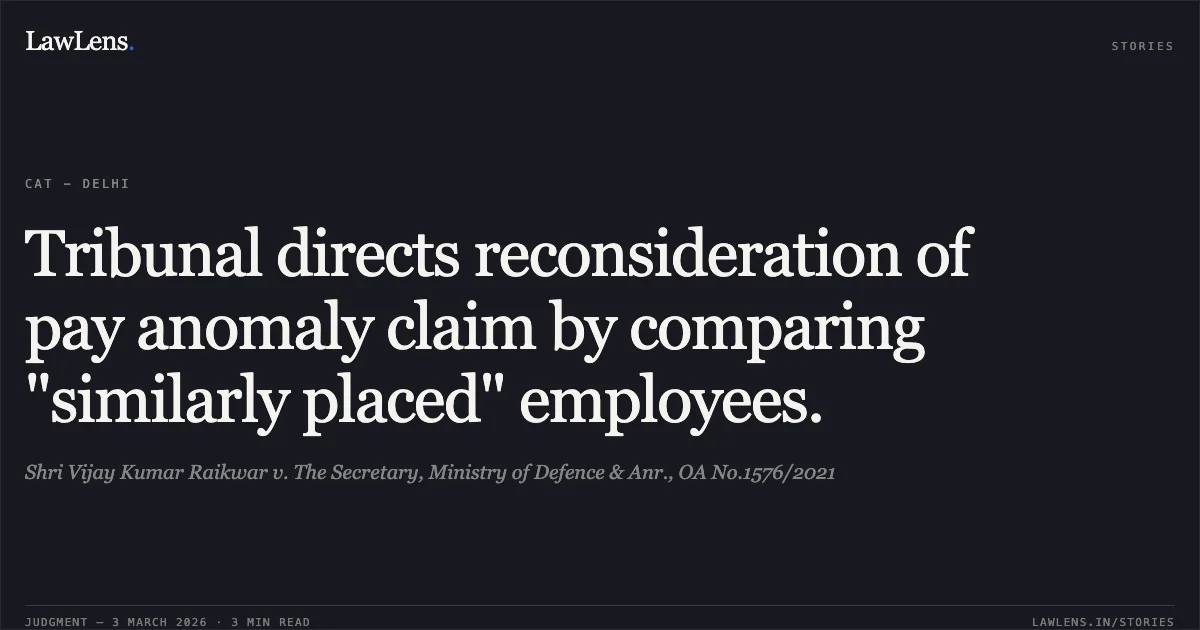
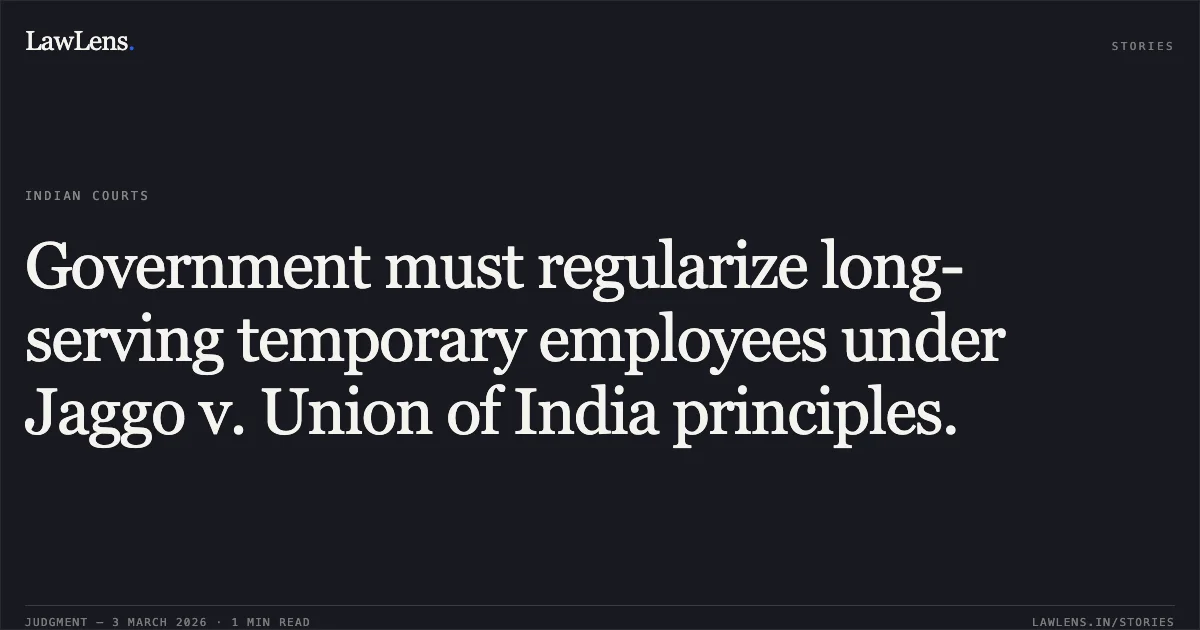
![Employer justified in deferring appointment when serious criminal charges, involving moral turpitude, are pending.. Ankeet v. The Commissioner, Navodaya Vidyalaya Samiti & Ors. [O.A. No. 2535 /2024]. Central Administrative Tribunal. LawLens](/stories/thumbnails/employer-justified-in-deferring-appointment-when-serious-criminal-charges-involving-moral--4c2027eb7a0f4650a5ffc8e6e65ee806.webp)
![DIRECTIONS ISSUED TO CONSIDER OUT-OF-TURN PROMOTION FOR OUTSTANDING PERFORMANCE IN APPREHENDING PROCLAIMED OFFENDERS.. HC (Exe.) Rampal Samota v. Union of India and Others [O.A. No. 2968/2025]. Central Administrative Tribunal. LawLens](/stories/thumbnails/directions-issued-to-consider-out-of-turn-promotion-for-outstanding-performance-in-apprehe-2089a3a4892343dab2d9797bd039e664.webp)
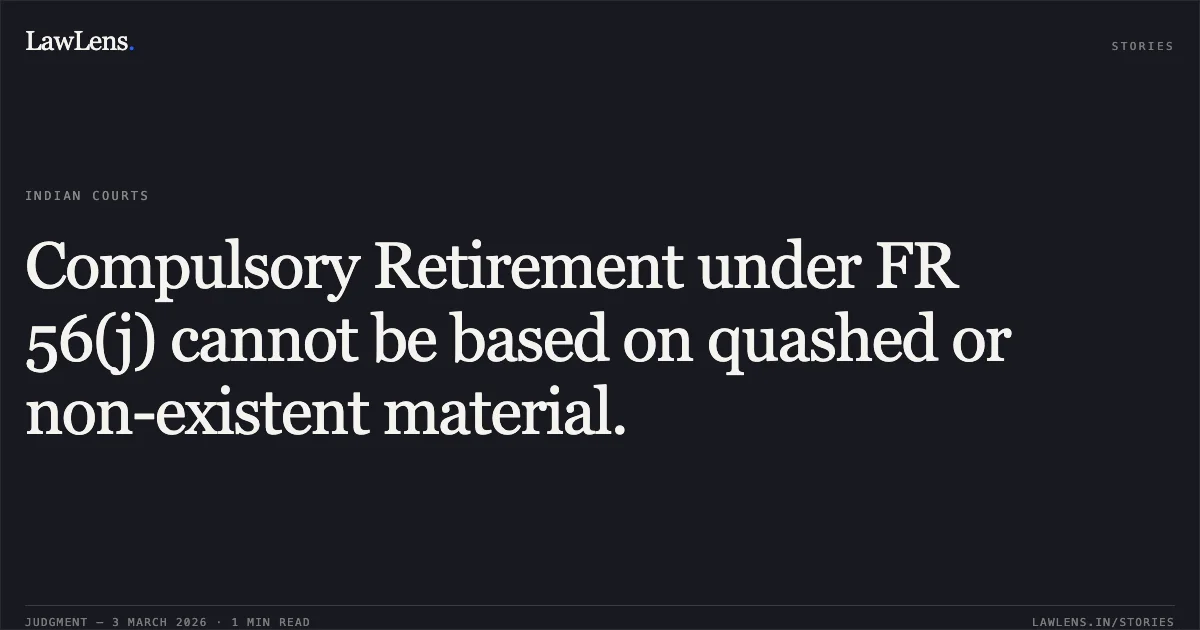
![Application Dismissed as Withdrawn; Pending Motions Also Disposed.. OA. No. 3050/2024, M.A. No. 4524/2025, M.A. No. 2803/2024, Central Administrative Tribunal, Principal Bench, New Delhi [p.1]. Central Administrative Tribunal. LawLens](/stories/thumbnails/application-dismissed-as-withdrawn-pending-motions-also-disposed-f88115778f0149fe9a205b65d928c9ca.webp)
![Promotion relief becomes infructuous upon retirement if duties not assumed in higher post.. Ajit Kumar Rajak v. Union of India [O.A. No. 208/2026]. Central Administrative Tribunal. LawLens](/stories/thumbnails/promotion-relief-becomes-infructuous-upon-retirement-if-duties-not-assumed-in-higher-post-91df9f5063004693bd1bc1fbf05155ed.webp)
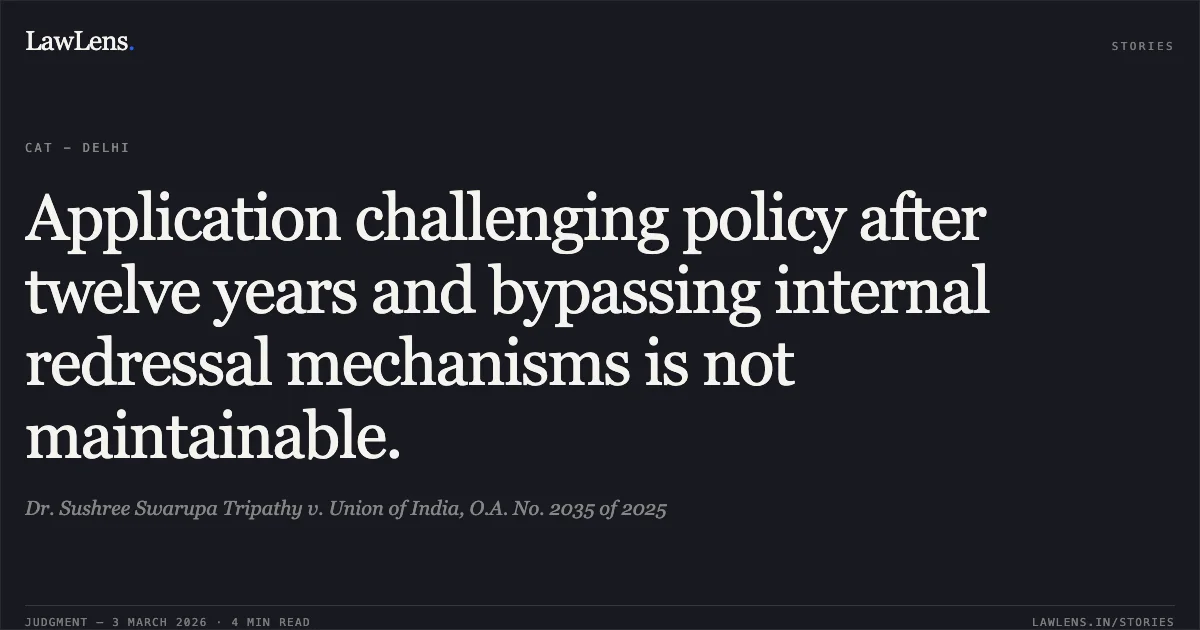
![Regularization of ad-hoc/daily wage employees not appointed under statutory rules is illegal.. Shri Anil Kumar & Anr. v. Union of India & Ors. [O.A. No. 3909 of 2015]. Central Administrative Tribunal. LawLens](/stories/thumbnails/regularization-of-ad-hoc-daily-wage-employees-not-appointed-under-statutory-rules-is-illeg-291ba5911cc1497196dd836acef87627.webp)
![Stale claims for promotion after superannuation and gross delay not maintainable.. Devaki Nandan & Ors. v. Bharat Sanchar Nigam Limited (BSNL) & Ors. [O.A. No. 750/2026, M.A. No. 956/2026]. Central Administrative Tribunal. LawLens](/stories/thumbnails/stale-claims-for-promotion-after-superannuation-and-gross-delay-not-maintainable-87a81d7dd9c9475d992a4a5b539e56c8.webp)
![Contempt not attracted by compliance with subsequent Supreme Court law on notional increment.. Raj Kishore Pandey & Ors. v. Shri Shobhan Choudhury & Ors. [Civil Misc. Contempt Petition No.185 of 2024 IN Original Application No.488 of 2024]. Central Administrative Tribunal. LawLens](/stories/thumbnails/contempt-not-attracted-by-compliance-with-subsequent-supreme-court-law-on-notional-increme-59076657420d488b80b415b692fc3a83.webp)
![Period between removal and reinstatement, without pay, can be treated as dies non.. Pyare Lal v. Union of India [Original Application No. 1602 of 2011]. Central Administrative Tribunal. LawLens](/stories/thumbnails/period-between-removal-and-reinstatement-without-pay-can-be-treated-as-dies-non-231bd89f7e8b4c28b438299e7c4fcf69.webp)
![Panel modification valid if based on procedural irregularities and sanctioned by higher authority.. Subodh Kumar Gupta v. The Union of India & Ors. [Original Application No. 1563 of 2014]. Central Administrative Tribunal. LawLens](/stories/thumbnails/panel-modification-valid-if-based-on-procedural-irregularities-and-sanctioned-by-higher-au-dbc6dc1ade6c486c93dc6af2df827e9b.webp)
![DEPARTMENTAL INQUIRIES MUST CONTAIN REASONED FINDINGS AND ADHERENCE TO NATURAL JUSTICE.. Jitendra Kumar S/o Sri Awadhesh Rai vs. Union of India and Others [Original Application No. 1108 of 2016]. Central Administrative Tribunal. LawLens](/stories/thumbnails/departmental-inquiries-must-contain-reasoned-findings-and-adherence-to-natural-justice-de8a7aa4eb834a9c9de3998e0c2291b9.webp)
![False declaration of pending criminal cases justifies cancellation of appointment, regardless of subsequent conviction nature.. Chirag Goyal vs. Union of India and Others [O.A. No. 278/2016]. Central Administrative Tribunal. LawLens](/stories/thumbnails/false-declaration-of-pending-criminal-cases-justifies-cancellation-of-appointment-regardle-42198299f432434ba5f38f9631c5dd89.webp)
![Disciplinary proceedings cannot be re-initiated if original charge-sheet withdrawal lacked intent for fresh action.. Gopi Sahai Meena vs. Union of India and Others [O.A. No. 074/2020]. Central Administrative Tribunal. LawLens](/stories/thumbnails/disciplinary-proceedings-cannot-be-re-initiated-if-original-charge-sheet-withdrawal-lacked-647bd2d057f54e029dc6f12a9538d111.webp)
![Compassionate Appointment: Eligibility Assessed on Date of Consideration, Not Death; Financial Status of Entire Family Relevant.. Suriya Shaheen v. Union Territory of Jammu & Kashmir [O.A. 556/2020]. Central Administrative Tribunal. LawLens](/stories/thumbnails/compassionate-appointment-eligibility-assessed-on-date-of-consideration-not-death-financia-9e50d417f0214cd4985b76b59346b6d3.webp)
![Administrative Tribunal directs consideration of pay scale upgrade representations in light of precedents.. Jai Prakash et al. v. Union of India et al. [O.A. No. 759/2026]. Central Administrative Tribunal. LawLens](/stories/thumbnails/administrative-tribunal-directs-consideration-of-pay-scale-upgrade-representations-in-ligh-6e0c4ec84c45478b88dfd1680a173ea3.webp)
![Discriminatory denial of service benefits to similarly situated employees is arbitrary and unsustainable.. Mrs. Sebika Neog v. Union of India and Another [Original Application No. 040/00086/2023]. Central Administrative Tribunal. LawLens](/stories/thumbnails/discriminatory-denial-of-service-benefits-to-similarly-situated-employees-is-arbitrary-and-3a593980eb7e4cb6a1c2938ddae75dbb.webp)
![Employer must reconsider transfer exemption for caregiver of disabled dependent based on DOPT O.M.. Md. Nazrul Islam v. The Union of India & Ors. [O.A. No. 040/000142/2025]. Central Administrative Tribunal. LawLens](/stories/thumbnails/employer-must-reconsider-transfer-exemption-for-caregiver-of-disabled-dependent-based-on-d-3b9bb31ca02947108ca605a2545975b0.webp)
![Benefit denial to similarly situated employees is arbitrary and discriminatory, demanding equal treatment.. Dr. Bhupendra Goswami v. Union of India and The Chairman, All India Council for Technical Education [Original Application No. 040/00037/2023]. Central Administrative Tribunal. LawLens](/stories/thumbnails/benefit-denial-to-similarly-situated-employees-is-arbitrary-and-discriminatory-demanding-e-30f96439553a439fac7db8bd908b186a.webp)
![Right to interest on delayed retiral dues affirmed despite financial constraints.. Rakesh Kumar Aggarwal v. The Commissioner, Municipal Corporation of Delhi [O.A. No. 602/2026]. Central Administrative Tribunal. LawLens](/stories/thumbnails/right-to-interest-on-delayed-retiral-dues-affirmed-despite-financial-constraints-e442118b91544e738d172e2dcdadfc39.webp)
![Quota (percentage) for promotions to be worked out on roster points, not post-based vacancies.. Sri. Manjunatha Hubballi v. Union of India & Anr. [O.A. No. 170/00483/2021/CAT/Bangalore]. Central Administrative Tribunal. LawLens](/stories/thumbnails/quota-percentage-for-promotions-to-be-worked-out-on-roster-points-not-post-based-vacancies-afaf7924b9724afebc2e9f50ea996de0.webp)
![LDCE quota vacancies cannot be curtailed by adjusting excess DPC quota from previous years.. Shri P.M.S Suryanarayana & Anr. v. Union of India & Ors. [Original Application No. 170/00373/2021]. Central Administrative Tribunal. LawLens](/stories/thumbnails/ldce-quota-vacancies-cannot-be-curtailed-by-adjusting-excess-dpc-quota-from-previous-years-be934a680d3547849ba921a35dcd5989.webp)
![Delayed gratuity interest denied for conditional exoneration, not "fully exonerated.". Sripathy Upadya vs. Union of India and Anr. [OA.No.170/00171/2025/CAT/BANGALORE]. Central Administrative Tribunal. LawLens](/stories/thumbnails/delayed-gratuity-interest-denied-for-conditional-exoneration-not-fully-exonerated-21e9c63dbde040ad97211a61821710ba.webp)
![Disciplinary proceedings prevent granting financial upgradation despite prior quashed disciplinary orders.. Radhakrishna Mallya vs Smt. Vandita Kaul & Ors. [MA.No.170/00 517/202 5/CAT/BANGALORE]. Central Administrative Tribunal. LawLens](/stories/thumbnails/disciplinary-proceedings-prevent-granting-financial-upgradation-despite-prior-quashed-disc-b83642a6c11744bba5abebf4440f01fa.webp)
![ACP/MACP benefits not granted when prior promotions received before scheme commencement.. V.S. Tewari v. Union of India [Original Application No. 670 of 2012 (Connected with O.A. No. 671 of 2012, O.A. No. 672 of 2012, O.A. No. 673 of 2012)]. Central Administrative Tribunal. LawLens](/stories/thumbnails/acp-macp-benefits-not-granted-when-prior-promotions-received-before-scheme-commencement-0d70f9313dd24f33b415d628fbc90c67.webp)
![Pension calculation must be based on emoluments drawn during last ten months of service. Recovery from retired Class-III employees without notice is impermissible.. Ved Prakash v. Union of India, Original Application No. 612 of 2023 [no citation]. Central Administrative Tribunal. LawLens](/stories/thumbnails/pension-calculation-must-be-based-on-emoluments-drawn-during-last-ten-months-of-service-re-dfd5bfd9ed9544eebf87746950af4bbc.webp)
![Application for Regularization: Respondents to Consider Grievance through Speaking Order.. All India Archaeological Survey Mazdoor Union & Ors. v. Union of India & Ors. [Original Application No. 1828 of 2012]. Central Administrative Tribunal. LawLens](/stories/thumbnails/application-for-regularization-respondents-to-consider-grievance-through-speaking-order-dd19d427736c4e1489c23306d1d7fd01.webp)
![Casual laborers eligible for re-engagement at minimum wage, but not regularization without policy.. All India Archaeological Survey Mazdoor Union, Agra & Ors. v. Union of India & Ors. [Original Application No. 1828 of 2012]. Central Administrative Tribunal. LawLens](/stories/thumbnails/casual-laborers-eligible-for-re-engagement-at-minimum-wage-but-not-regularization-without--85fcb687b8864344a128710379aa985a.webp)
![TERMINATION FOR CRIMINAL ANTECEDENTS REQUIRES RECONSIDERATION POST ACQUITTAL AND UPHOLDING EMPLOYMENT PRINCIPLES.. Vipin Yadav v. Union of India [Original Application No. 837 of 2024]. Central Administrative Tribunal. LawLens](/stories/thumbnails/termination-for-criminal-antecedents-requires-reconsideration-post-acquittal-and-upholding-dad17fb0c4d74593932a5dc33390b74f.webp)
![Failure to communicate "below benchmark" ACR/APAR renders them non-reckonable for ACP/MACP.. Asutosh Johari vs Union of India [O.A./805/2011]. Central Administrative Tribunal. LawLens](/stories/thumbnails/failure-to-communicate-below-benchmark-acr-apar-renders-them-non-reckonable-for-acp-macp-0f17216ee06e44d59d80f4171ef28530.webp)
![Dismissal for misconduct involving public funds upheld; judicial review limited.. Sachidananda Patanaik vs Union of India and Others [O.A.No. 260/0004 of 2021]. Central Administrative Tribunal. LawLens](/stories/thumbnails/dismissal-for-misconduct-involving-public-funds-upheld-judicial-review-limited-92475353de6841c28db0b1c9f1eff4bd.webp)
![Divorced daughter living separately before parent's death is eligible for family pension.. Smt. Binata Naik v. Union of India and Anr. [O.A.No. 260/00424 of 2022]. Central Administrative Tribunal. LawLens](/stories/thumbnails/divorced-daughter-living-separately-before-parent-s-death-is-eligible-for-family-pension-32508c87af924d7e8d13df64d7fff902.webp)
![Deemed appointment and benefits for waiting list candidates appointed against same selection vacancies.. Anil Kumar & Ors. v. Chandigarh Administration & Ors. [O.A.No.060/99/2024]. Central Administrative Tribunal. LawLens](/stories/thumbnails/deemed-appointment-and-benefits-for-waiting-list-candidates-appointed-against-same-selecti-9c2c6607e9134478a7ef0941e5906529.webp)
![Prior service cannot be ignored for promotion eligibility merely due to mutual transfer.. Akash Baliyan S/o Jitendra Kumar v. Comptroller and Auditor General of India & Ors. [O.A.No.060/377/2025]. Central Administrative Tribunal. LawLens](/stories/thumbnails/prior-service-cannot-be-ignored-for-promotion-eligibility-merely-due-to-mutual-transfer-6c43d61659c245a7b62b819a3e25d296.webp)
![TRIBUNAL CANNOT INTERFERE WITH CHARGE SHEET AT NASCENT STAGE OF DISCIPLINARY PROCEEDINGS.. Prem Shankar Dubey v. Union of India [no citation]. Central Administrative Tribunal. LawLens](/stories/thumbnails/tribunal-cannot-interfere-with-charge-sheet-at-nascent-stage-of-disciplinary-proceedings-03b63eba6fda4ecfb9edfaacf44b7b83.webp)
![Authorities mandated to release DCRG and leave salary where legal proceedings are dismissed.. Syed Dilshad Hussain v. Union of India and Others [O.A. 350/147/2026]. Central Administrative Tribunal. LawLens](/stories/thumbnails/authorities-mandated-to-release-dcrg-and-leave-salary-where-legal-proceedings-are-dismisse-0d6991c46cc54ee5ba3e30c08e76b858.webp)
![Tribunal directs Administrator to decide regularization claim considering continuous service and precedents.. M.K. Mohammed Rafi v. The Administrator, Lakshadweep Administration & Anr. [O.A. No. 181/00289/2021]. Central Administrative Tribunal. LawLens](/stories/thumbnails/tribunal-directs-administrator-to-decide-regularization-claim-considering-continuous-servi-8be3df26989545fe9438ad20549f8570.webp)
![Compassionate transfer cannot reduce employee's previously acquired Grade Pay or pay scale.. Sanalkumar S Kandhaswamy v. Union of India & Ors. [Original Application No. 180/00149/2024]. Central Administrative Tribunal. LawLens](/stories/thumbnails/compassionate-transfer-cannot-reduce-employee-s-previously-acquired-grade-pay-or-pay-scale-ac4bbd51e012400bbafba424f28f8e7f.webp)
![Review Application Allowed to Re-Examine OA on Merits Due to Factual Distinctions.. Chief Postmaster General, Kerala Circle & Anr. v. Nirmala.S & Anr. [R.A No.180/0011/2014 in O.A No.180/00631/2012]. Central Administrative Tribunal. LawLens](/stories/thumbnails/review-application-allowed-to-re-examine-oa-on-merits-due-to-factual-distinctions-865b21cb9d6d483baadcb48d1f7e7d68.webp)
![Compassionate appointment denied if employee not in service at death or family not in immediate destitution.. Nayanthaara Menon v. The Principal Chief Commissioner of Income Tax, Kerala & Ors. [O.A No. 180/00400/2024]. Central Administrative Tribunal. LawLens](/stories/thumbnails/compassionate-appointment-denied-if-employee-not-in-service-at-death-or-family-not-in-imme-a500145eb3a947fea6f433354e578e4c.webp)
![Original Application dismissed as benefits received, rendering it infructuous.. Vijayakumaran Pillai vs Union of India [O.A. No. 180/00364/2019]. Central Administrative Tribunal. LawLens](/stories/thumbnails/original-application-dismissed-as-benefits-received-rendering-it-infructuous-85ec9c606c864914a828ec81c8644a99.webp)
![Review jurisdiction is limited to self-evident errors, not re-adjudicating merits or converting to appeal.. Virender Singh Chauhan & Ors. v. Raj Kumar & Anr. (R.A. No.92 of 2020 in C.P. No.14 of 2016 in OA 2151/2014) [p.1]. Central Administrative Tribunal. LawLens](/stories/thumbnails/review-jurisdiction-is-limited-to-self-evident-errors-not-re-adjudicating-merits-or-conver-912792e981ed42a395049eb7538dbe7c.webp)
![Public servant's resignation to contest elections not a 'compelling reason' for withdrawal post-loss.. Neeraj Bishnoi v. Comptroller and Auditor General of India [OA No. 121/2024]. Central Administrative Tribunal. LawLens](/stories/thumbnails/public-servant-s-resignation-to-contest-elections-not-a-compelling-reason-for-withdrawal-p-3dea8df1cad34073876754c2a8a6bf50.webp)
![Tribunal directs authorities to consider and decide child care leave application in two weeks.. Nazira Shaban v. Union Territory of Jammu and Kashmir [O.A. No. 154 of 2026]. Central Administrative Tribunal. LawLens](/stories/thumbnails/tribunal-directs-authorities-to-consider-and-decide-child-care-leave-application-in-two-we-6afd945dc4644a138c90c3dac932526a.webp)
![Respondents directed to consider applicant's representation for In-Situ Promotion within eight weeks.. Gh. Ahmad Bhat v. Union Territory of Jammu & Kashmir and Ors. [O.A. NO: 137 OF 2026]. Central Administrative Tribunal. LawLens](/stories/thumbnails/respondents-directed-to-consider-applicant-s-representation-for-in-situ-promotion-within-e-b73c94560e0e4a91834413afe2005a78.webp)
![Recruitment into a new cadre is not promotion, obviating M. Nagaraj reservation requirements.. OA No.1526/2021 with OA Nos. 1559/2021 & 1560/2021 [Central Administrative Tribunal, Principal Bench, New Delhi]. Central Administrative Tribunal. LawLens](/stories/thumbnails/recruitment-into-a-new-cadre-is-not-promotion-obviating-m-nagaraj-reservation-requirements-d5b495c566f549638970f86ddaeb0a96.webp)
![Departmental inquiry findings supported by evidence and not perverse are not subject to reappreciation in judicial review.. Vijay Shankar v. Union of India [Original Application No. 1663 of 2013]. Central Administrative Tribunal. LawLens](/stories/thumbnails/departmental-inquiry-findings-supported-by-evidence-and-not-perverse-are-not-subject-to-re-f5aeda46781246a2ba33e94e0d499d38.webp)