HCMONTHLY CASE LAW ARCHIVE

Gujarat High Court Judgments in July 2026: Case Law Digest

Read 828 LawLens analyses of Gujarat High Court judgments published in July 2026, covering key rulings, legal principles and case law.

← BACK TO GUJARAT COURT REPORT

PERMANENT MONTHLY EDITIONS

Browse by month

AUTOMATICALLY UPDATED

July 2026 Judgments

828 ARTICLES · NEWEST FIRST
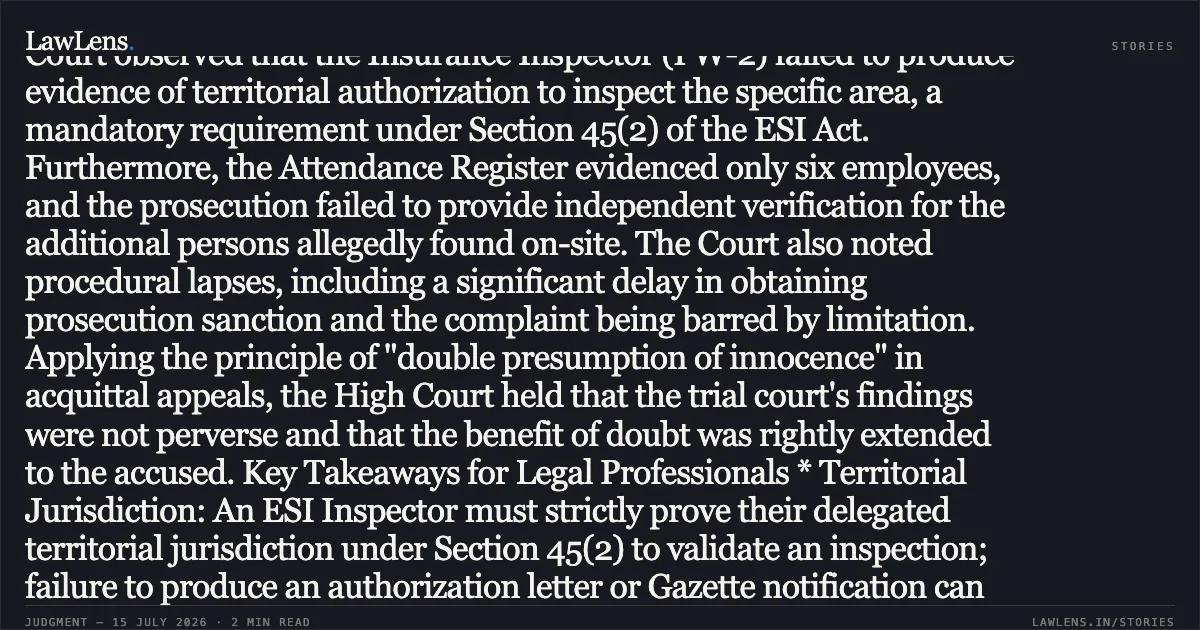
### Acquittal Upheld as Inspector’s Lack of Territorial Jurisdiction and Failure to Prove Minimum Employee Count Vitiate Prosecution Summary of Judgment The High Court of Gujarat dismissed an appeal by the Employees’ State Insurance Corporation (ESIC) against a trial court order acquitting M/s. Hotel Navjivan and its partner. The respondents were charged under Sections 85(e) and 85(g) of the ESI Act for failing to submit statutory returns (Form-6) and contribution challans. The prosecution’s case rested on an inspection report alleging the hotel employed more than 10 persons. However, the High Court observed that the Insurance Inspector (PW-2) failed to produce evidence of territorial authorization to inspect the specific area, a mandatory requirement under Section 45(2) of the ESI Act. Furthermore, the Attendance Register evidenced only six employees, and the prosecution failed to provide independent verification for the additional persons allegedly found on-site. The Court also noted procedural lapses, including a significant delay in obtaining prosecution sanction and the complaint being barred by limitation. Applying the principle of "double presumption of innocence" in acquittal appeals, the High Court held that the trial court's findings were not perverse and that the benefit of doubt was rightly extended to the accused. Key Takeaways for Legal Professionals * Territorial Jurisdiction: An ESI Inspector must strictly prove their delegated territorial jurisdiction under Section 45(2) to validate an inspection; failure to produce an authorization letter or Gazette notification can prove fatal to the prosecution. * Applicability Threshold: Mere oral testimony of an inspector regarding the number of persons found working is insufficient to override official Attendance Registers unless corroborated by recorded statements of such persons. * Appellate Restraint: In appeals against acquittal, if two reasonable views are possible, the High Court will not disturb the trial court's conclusion unless it is marred by manifest illegality or perversity. * Limitation and Sanction: Unexplained delays in obtaining sanction and filing complaints under Section 85 of the ESI Act weaken the prosecution’s standing.. THE REGIONAL DIRECTOR EMPLOYEES STATE INSURANCE vs STATE OF GUJARAT. Gujarat High Court. LawLens

Gujarat High Court·

Social Security and PensionsCriminal Procedure and Evidence

### Acquittal Upheld as Inspector’s Lack of Territorial Jurisdiction and Failure to Prove Minimum Employee Count Vitiate Prosecution Summary of Judgment The High Court of Gujarat dismissed an appeal by the Employees’ State Insurance Corporation (ESIC) against a trial court order acquitting M/s. Hotel Navjivan and its partner. The respondents were charged under Sections 85(e) and 85(g) of the ESI Act for failing to submit statutory returns (Form-6) and contribution challans. The prosecution’s case rested on an inspection report alleging the hotel employed more than 10 persons. However, the High Court observed that the Insurance Inspector (PW-2) failed to produce evidence of territorial authorization to inspect the specific area, a mandatory requirement under Section 45(2) of the ESI Act. Furthermore, the Attendance Register evidenced only six employees, and the prosecution failed to provide independent verification for the additional persons allegedly found on-site. The Court also noted procedural lapses, including a significant delay in obtaining prosecution sanction and the complaint being barred by limitation. Applying the principle of "double presumption of innocence" in acquittal appeals, the High Court held that the trial court's findings were not perverse and that the benefit of doubt was rightly extended to the accused. Key Takeaways for Legal Professionals * Territorial Jurisdiction: An ESI Inspector must strictly prove their delegated territorial jurisdiction under Section 45(2) to validate an inspection; failure to produce an authorization letter or Gazette notification can prove fatal to the prosecution. * Applicability Threshold: Mere oral testimony of an inspector regarding the number of persons found working is insufficient to override official Attendance Registers unless corroborated by recorded statements of such persons. * Appellate Restraint: In appeals against acquittal, if two reasonable views are possible, the High Court will not disturb the trial court's conclusion unless it is marred by manifest illegality or perversity. * Limitation and Sanction: Unexplained delays in obtaining sanction and filing complaints under Section 85 of the ESI Act weaken the prosecution’s standing.

The Appellant (ESIC) filed a complaint against M/s. Hotel Navjivan and its partner (Respondents) under Sections 85(e) and 85(g) of the ESI Act, 1948. The allegation was the non-submission of statutory returns (Form-6)...

2 MIN READ

### ADOPTION OF A FEMALE CHILD IS NOT LEGALLY RECOGNIZED UNDER ANCIENT HINDU LAW PRIOR TO 1956. SYNOPSIS * Core Question: Whether the adoption of a female child (specifically an *Angaliyat* child) was legally valid and conferred inheritance rights under Shastric Hindu Law prior to the enactment of the Hindu Adoptions and Maintenance Act, 1956. * Factum of Adoption: The Plaintiff claimed she was adopted in 1949 by her mother’s second husband, Bhovanbhai, under a pre-condition of marriage. She asserted status as a Class-I heir to inherit his agricultural lands. * Legal Standing of Female Adoption: The High Court observed that according to ancient Hindu texts (Manu, Vasishta, and Saunaka), adoption was strictly restricted to male children for the religious purposes of performing *pinda-dan* and providing spiritual benefit. * Status of *Angaliyat*: The Court found that while the Plaintiff was absorbed into the stepfather’s household as an *Angaliyat* (foster child), this social arrangement did not transform her into a legally adopted daughter with rights of succession under ancient Hindu law. * Preservation of Biological Ties: The Plaintiff admitted to inheriting property from her biological father. Under Hindu law, a valid adoption requires the total severance of ties with the biological family and renunciation of inheritance therein, which was absent here. * Outcome: The High Court upheld the Trial Court’s dismissal of the suit, ruling that in the absence of a valid legal adoption, the Plaintiff could not claim ownership of the deceased’s properties through inheritance.. HIRUBEN PPARBATBHAI SATASIYA vs BHAGWANJIBHAI POPATBHAI RANPARIA. Gujarat High Court. LawLens

Gujarat High Court·

Wills, Inheritance, and TrustsReligious and Personal Law

### ADOPTION OF A FEMALE CHILD IS NOT LEGALLY RECOGNIZED UNDER ANCIENT HINDU LAW PRIOR TO 1956. SYNOPSIS * Core Question: Whether the adoption of a female child (specifically an *Angaliyat* child) was legally valid and conferred inheritance rights under Shastric Hindu Law prior to the enactment of the Hindu Adoptions and Maintenance Act, 1956. * Factum of Adoption: The Plaintiff claimed she was adopted in 1949 by her mother’s second husband, Bhovanbhai, under a pre-condition of marriage. She asserted status as a Class-I heir to inherit his agricultural lands. * Legal Standing of Female Adoption: The High Court observed that according to ancient Hindu texts (Manu, Vasishta, and Saunaka), adoption was strictly restricted to male children for the religious purposes of performing *pinda-dan* and providing spiritual benefit. * Status of *Angaliyat*: The Court found that while the Plaintiff was absorbed into the stepfather’s household as an *Angaliyat* (foster child), this social arrangement did not transform her into a legally adopted daughter with rights of succession under ancient Hindu law. * Preservation of Biological Ties: The Plaintiff admitted to inheriting property from her biological father. Under Hindu law, a valid adoption requires the total severance of ties with the biological family and renunciation of inheritance therein, which was absent here. * Outcome: The High Court upheld the Trial Court’s dismissal of the suit, ruling that in the absence of a valid legal adoption, the Plaintiff could not claim ownership of the deceased’s properties through inheritance.

The Appellant (Plaintiff) filed a suit for declaration and possession of immovable properties belonging to the deceased, Bhovanbhai.

2 MIN READ